

Dario Amodei thinks AI will eliminate 50% of entry-level white-collar jobs within five years.
Brookings analyzed 33 months of employment data after ChatGPT launched and found... basically nothing changed.
Matt Shumer told an AI to build him an app on Monday. Walked away. Came back four hours later to a finished product — tens of thousands of lines of code, tested, iterated, ready to ship.
Forrester says only 6% of U.S. jobs will be automated by 2030.
These aren’t fringe voices disagreeing with each other on a panel somewhere. These are the most credentialed, most informed people working on this problem — and they can’t agree on what’s happening right now, let alone what’s coming next.
I’ve spent the last several months sitting in the middle of this tension. Running AI systems at scale. Hosting conversations with GTM executives through Pavilion’s AI roundtables. Talking to founders, operators, and investors on the AI Business Network podcast every week. And what I keep hearing is that really smart people are looking at the same data and reaching wildly different conclusions.
That used to bother me. Now I think the disagreement is the insight.
Four Groups, Four Realities
I wrote recently about why AI is coming for your Tuesday, not your job — how the real shift is happening at the task level, not the role level. But since publishing that piece, I’ve gone deeper into the data and the perspectives shaping this conversation. And what I’ve found is that the debate isn’t just noisy. It’s structurally fractured. There are four distinct groups looking at AI and work right now, and they’re each seeing something real — but incomplete.
The Frontier Builders: “You Have No Idea What’s Coming”
The CEOs building the most advanced AI systems are the most direct about disruption. They have to be — they can see the capability curve from the inside.
Dario Amodei (CEO, Anthropic) predicts AI models “substantially smarter than almost all humans at almost all tasks” are on track for 2026 or 2027. Not a decade. Not “someday.” Next year. He says AI is already writing “much of the code” at Anthropic and estimates we’re one to two years from AI autonomously building the next generation of itself.
He’s described a scenario — 50 million AI “citizens,” each smarter than any Nobel laureate, thinking 10-100x faster than any human, never sleeping — and called it possibly the most serious national security threat in a century. That’s not a competitor talking. That’s the guy who built it.
OpenAI disclosed in technical documentation that GPT-5.3 Codex “was instrumental in creating itself” — debugging its own training, managing its own deployment, diagnosing its own evaluations. That sentence isn’t a prediction about self-improving AI. It’s a disclosure that it’s already here.
Google DeepMind’s Demis Hassabis frames AGI as a near-term milestone, not a distant aspiration.
These people are simultaneously more excited and more frightened than anyone else on the planet. And what they’re telling us, consistently, is that the acceleration has already started.
The Economists: “Show Me the Data”
Then there’s the counterbalance. And it’s substantial.
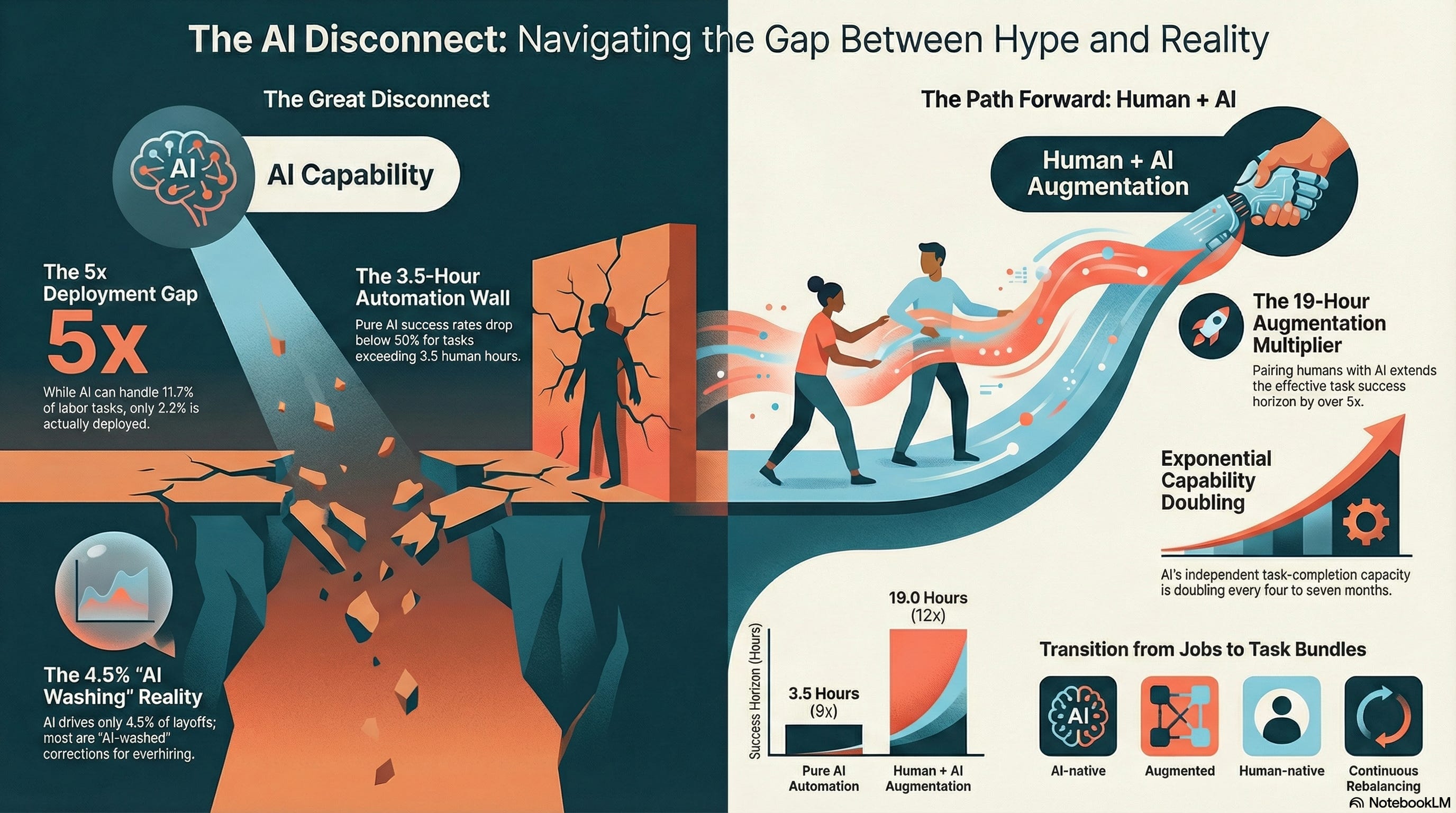
MIT’s Project Iceberg found that current AI can handle tasks worth 11.7% of U.S. labor market wages. But here’s the buried number: only 2.2% is actually deployed. Five times more capability sitting on the shelf than in production. If AI were truly eating jobs, you’d expect deployment to be chasing capability. It’s not. Not even close.
Yale’s Budget Lab and Brookings analyzed 33 months of post-ChatGPT employment data. Jobs most “exposed” to AI haven’t budged in employment share since January 2023. Martha Gimbel, senior fellow at Brookings, put it plainly: “We’re not in an economy-wide jobs apocalypse right now.”
Forrester projects only 6% of U.S. jobs automated by 2030. Their analyst JP Gownder warns that CEOs who aren’t deep in the weeds are cutting 20-30% of headcount hoping to backfill with AI — but without mature, deployed applications, it takes 18 to 24 months to replace a person. If it works at all.
The economists aren’t AI skeptics. They’re deployment realists. And their data says there’s an enormous gap between what the technology can do and what organizations are actually doing with it.
The Practitioners: “It Already Happened to Us”
Then there’s the ground-level view — and it’s the one that keeps me up at night.
Matt Shumer — six-year AI startup founder and investor — published a piece this week comparing this moment to February 2020. We’re in the “this seems overblown” phase of something much bigger than COVID.
His experience isn’t theoretical. He told AI to build an application — specified what it should do, roughly how it should look — and walked away for four hours. Came back to a finished product. Not a prototype. Not a draft. Tens of thousands of lines of code. The AI opened the app, tested features, iterated on design, and only returned when it met its own standards. That was Monday.
What shook him most wasn’t the output. It was the judgment. The newest models show something that feels like taste — the intuitive sense of the right call, not just the technically correct one. The thing everyone said AI would never have.
His warning is blunt: nothing that can be done on a computer is safe in the medium term. If your job happens on a screen — reading, writing, analyzing, deciding — AI is coming for significant parts of it. The timeline isn’t “someday.” It’s already started.
His rule of thumb: if a model shows even a hint of a capability today, the next generation will be genuinely good at it. Not linearly better. Exponentially.
And the gap between perception and reality is dangerous. Most people evaluating AI are basing their assessment on free-tier ChatGPT from 2023. That’s like judging smartphones by using a flip phone.
The Business Reframers: “You’re Asking the Wrong Question”
Marc Andreessen argues the entire debate is built on a flawed model. The conversation about jobs and AI is “reductive” and “overly simplistic” because it confuses jobs with tasks. Jobs persist far longer than the specific tasks that define them. Both executives and secretaries survived the computer revolution. Every task within both roles changed completely.
He describes a “Mexican standoff” emerging in knowledge work — PMs, engineers, and designers can each now use AI to perform the others’ tasks. A coder designs. A designer codes. A PM prototypes without either. The result isn’t fewer workers. It’s superpowered workers who swap tasks fluidly across domains.
And he raises the demographic argument nobody talks about: global population growth is declining. Productivity has been anemic for years. Many sectors face chronic labor shortages. We might need AI to substitute for workers we don’t have, not to replace the ones we do.
The Tension Is the Insight
So who’s right?
All of them. And none of them — because they’re each looking at different time horizons and different layers of the same problem.
The frontier builders see what the technology can do and extrapolate. The economists see what organizations are doing and measure. The practitioners are living in the gap between capability and deployment — and they’re watching that gap close faster than anyone expected. The business reframers are saying the question itself is wrong.
Here’s how I’d synthesize it after 21 years of scaling organizations through technology transitions, from T-Mobile to Verizon to OYO to REEF to where I sit now:
The capability is accelerating faster than even the optimists predicted. The deployment lags significantly behind capability. And the gap between the two is closing in a way that will reward the prepared and punish the complacent.
The economists are right that the apocalypse hasn’t arrived. The builders are right that something unprecedented is coming. The practitioners are right that it’s already here for anyone paying attention. And the reframers are right that “which jobs disappear” is the wrong question entirely.
The useful question — the one that actually changes what you do on Monday morning — is about tasks, not titles.
The Data That Changes the Conversation
This is where I want to go deeper than the first piece I wrote, because there’s a layer of data that most leaders haven’t seen — and it fundamentally changes the calculus on how to deploy AI.
Anthropic’s Economic Index doesn’t just show that augmentation is beating automation (52% to 45%, as of November 2025 — with augmentation growing as models get more capable). It reveals something about the structure of AI’s effectiveness that has massive implications for organizational design.
AI success rates decline as tasks get longer and more complex. That’s intuitive. What’s not intuitive is how dramatically the deployment model changes the equation.
Pure automation — AI working without human involvement — hits a 50% success rate at tasks that would take a human roughly 3.5 hours. Under an hour? About 60% success. Over five hours? Drops to 45%. The cliff is steep and it falls fast.
Human + AI augmentation — where humans iterate, correct, redirect, and break problems into steps — pushes that 50% success threshold to approximately 19 hours of equivalent human work.
Same AI. Five times the effective task horizon. The human isn’t overhead. The human is a force multiplier.
And complexity tells the same story with a twist. Simpler tasks succeed about 70% of the time. College-level complexity drops to around 66%. But when complex tasks succeed, they deliver higher value — a 12x speedup versus 9x for simpler tasks.
The highest-value tasks are exactly the ones where AI struggles most alone but delivers the biggest payoff when paired with a human.
This resolves a huge piece of the tension between the perspectives. The frontier builders are right about capability — it’s enormous and growing. The economists are right about deployment — most organizations aren’t set up to capture it. The practitioners are right that it’s transformative — if you know how to pair human judgment with AI execution. And the reframers are right that the unit of analysis is tasks, not jobs.
The mistake most organizations make is defaulting to full automation on easy tasks (modest gains, high reliability) and avoiding AI entirely on hard tasks (where the real value lives). The winning move is Human + AI on the complex, high-value work. You accept lower success rates per attempt in exchange for dramatically higher returns when it works.
And it explains why “cut headcount and replace with AI” keeps failing. Remove the humans and you collapse your effective task horizon from 19 hours to 3.5. You lose five-sixths of your AI’s useful range. The humans aren’t the cost. They’re the capability multiplier.
The Acceleration That Makes This Urgent
I could leave it there — a useful framework for thinking about deployment. But the acceleration data makes the urgency real.
METR measures the length of real-world tasks AI can complete end-to-end without human help. Not benchmarks. Not test scores. Actual tasks, measured by how long they’d take a human expert.
About a year ago, the answer was roughly ten minutes. Then an hour. Then several hours. The most recent measurement — Claude Opus 4.5, November 2025 — showed AI completing tasks equivalent to nearly five hours of expert human work.
That capability is doubling approximately every seven months. Recent data suggests it may be accelerating to every four months. And those measurements don’t include the models released this week.
Extend the trend: AI working independently for days within the next year. Weeks within two. Month-long projects within three.
And there’s a compounding factor most people outside the industry don’t grasp. OpenAI’s disclosure that GPT-5.3 Codex was “instrumental in creating itself” isn’t just a flex. It’s the beginning of a feedback loop. Each generation helps build the next, which is smarter, which builds the next faster. Amodei estimates we’re one to two years from current AI autonomously building the next generation.
The researchers call this an intelligence explosion. The people building it say it’s already underway.
This doesn’t invalidate the economists’ data. Deployment still lags capability. Most organizations are still fumbling with basic implementations. But it means the window for building the right organizational architecture — calmly, deliberately, while you still have breathing room — is shorter than the deployment data suggests.
The capability curve doesn’t wait for your change management process.
The AI Washing Trap
And right in the middle of all this tension, a significant portion of what’s being attributed to AI in layoff headlines is narrative convenience, not technological reality.
Look at the actual 2025 layoff data across 1.2 million announced job cuts. Government efficiency and DOGE cuts: 24.3% — the single largest driver. Market and economic conditions: 21%. Store and department closings: 15.9%. Corporate restructuring: 11.1%.
AI? 4.5%. Roughly 54,800 jobs out of 1.2 million.
Government cuts alone are five times larger. Market conditions are nearly five times larger. Yet AI dominates the headlines. Economists are calling it “AI washing” — companies citing AI when the real drivers are tariffs, overhiring corrections, and profit maximization.
The incentives are obvious. “We’re cutting because AI made us more efficient” makes you look like a tech-forward innovator. “We overhired during COVID” or “tariffs are crushing our margins” doesn’t play as well. And in the current political climate, blaming tariffs invites backlash. As Gimbel put it: companies are hesitant to say anything negative about the economic impacts of the current administration. AI becomes the consequence-free explanation.
Even the poster-child examples collapse under scrutiny. Duolingo announced “AI first” — then told the New York Times they’d never laid off full-time employees. Amazon’s VP linked layoffs to AI — then CEO Jassy walked it back: “not really AI-driven. It really is culture.” A laid-off Amazon employee who built AI tools for her team said the real move was replacing her with someone junior at lower pay.
AI washing is dangerous from both directions. It creates fear among the people you need embracing AI tools — “AI is replacing people at Amazon” doesn’t inspire experimentation, it inspires hiding. And it gives leaders false confidence that AI can fill gaps it can’t actually fill yet, leading to headcount cuts based on capability that doesn’t exist.
This is where the tension between the four perspectives becomes operationally critical. If you believe only the frontier builders, you cut too fast and create capacity gaps. If you believe only the economists, you move too slow and get leapfrogged. If you listen to the practitioners without the economists’ grounding, you overhype internal pilots. If you only hear the reframers, you understand the theory but miss the urgency.
You need all four.
What to Actually Do: The Task Architecture
So here’s the resolution — the framework that accounts for all four perspectives and gives you something to act on.
Stop designing your organization around jobs. Start designing it around tasks.
This isn’t an abstraction. It’s a four-step process I’ve seen work across healthcare, telecom, logistics, hospitality, and clean energy over 21 years of scaling organizations. The companies that get it right don’t shrink their org charts. They raise the altitude of every role on them.
Step 1: Decompose every role into its task bundle.
Map the actual work — not the job description. For every task: Is it repetitive or novel? Data-rich or judgment-heavy? Short-horizon or complex? Does it require consistency at volume or creativity in the moment?
This is where most organizations stop before they start. They look at roles and say “too complex to decompose.” It’s not. Every role, no matter how senior, is a bundle of discrete tasks. Map them.
Step 2: Assign each task to the right owner — using the right deployment model.
Three categories, informed by the task horizon data:
AI-native (full automation). Short-horizon, repetitive, data-rich, consistency-critical, always-on. Scheduling, verification, triage, first-response, data synthesis, monitoring. Sub-3.5-hour tasks where AI succeeds reliably. And this ceiling is rising every few months.
Human + AI (augmentation). Complex, high-value work where human iteration extends the effective horizon to 19 hours and delivers 12x returns. Analysis where AI surfaces patterns and humans decide. Content where AI drafts and humans refine. Customer interactions where AI handles intake and humans handle escalation. This is where the biggest ROI lives — and where most organizations are chronically underinvesting because it’s harder to measure than pure automation.
Human-native. Emotional judgment. Novel strategy. Relationship building. Ethical decisions. Accountability that requires a person. The irreducible human layer — though the boundary is shifting faster than expected.
Step 3: Build for continuous rebalancing.
The METR data shows the AI-native ceiling rising every few months. The AI is helping build the next AI. Your task architecture can’t be a one-time exercise. It has to be a living system that shifts tasks between categories as capability grows — elevating humans continuously rather than cutting them periodically.
This is the difference between organizations that absorb each capability leap smoothly and organizations where every new model release triggers a panicked reorg.
Step 4: Hire for task fluidity.
The most valuable people aren’t going to be the ones who do one thing well. They’re the ones who orchestrate across all three categories — knowing when to delegate to AI, when to collaborate with it, and when to own the task entirely.
Andreessen’s “Mexican standoff” is already real. I see it everywhere. Ops people building their own dashboards. Product teams prototyping without engineering. Sellers creating their own enablement content. The task boundaries between roles are dissolving — but the roles themselves are still there. Just operating at a higher altitude.
The superpowered generalist is the new specialist. Hire accordingly.
Sitting With the Tension
I’m not going to pretend I’ve resolved the fundamental disagreement between these four perspectives. I don’t think anyone can — not yet. The honest truth is that we’re in a period where the capability curve and the deployment curve are dramatically out of sync, and nobody knows exactly when or how they converge.
But I’ve been through enough technology transitions to know this: the organizations that design for uncertainty beat the organizations that bet on a single prediction. Task architectures give you that optionality. They let you absorb acceleration without crisis. They let you capture value from augmentation while the full automation crowd is still debugging their implementations. And they keep your best people doing their best work instead of drowning in tasks that should have been handed to a machine two years ago.
The frontier builders might be right that massive disruption is 18 months away. The economists might be right that it takes a decade. The practitioners are definitely right that it’s already here for anyone who’s actually using the best tools available.
The question for you isn’t which prediction to believe. It’s whether you’re building an organization that’s ready regardless of which one turns out to be right.
I know which bet I’m making.
Where does your organization sit in this tension? Are you closer to the economists’ reality (lots of capability, very little deployed) or the practitioners’ reality (already transforming daily work)? I’d love to hear what you’re seeing. This is the conversation that matters right now.