

I get it. The headlines are terrifying. “AI will eliminate half of all entry-level white-collar jobs.” “92 million jobs displaced by 2030.” “The robots are coming.”
And every time a new study drops, the takes follow the same script: panic, prediction, and some vague advice about “upskilling.” Rinse, repeat. Nobody seems to stop and ask a more interesting question — what’s actually happening right now, today, in real companies with real workers?
I spend my days running AI systems. So I’m not theorizing about AI replacing work. I’m watching it happen in real time, at massive scale. And what I see is nothing like the apocalypse narrative.
Here’s what I see: AI isn’t replacing jobs. It’s replacing Tuesdays.
Let me explain.
We’re Measuring the Wrong Thing
Marc Andreessen made an observation recently that crystallized something I’ve been thinking about for a while. He argued that the entire AI job loss debate is built on a “reductive” and “overly simplistic” model — because it confuses jobs with tasks.
A job isn’t a single thing. It’s a bundle of tasks. And that bundle changes constantly. We should be talking about task evolution, not job elimination. Because jobs tend to persist far longer than the specific tasks that define them at any given moment.
He used a perfect example. Think about executives and secretaries fifty years ago. Executives never typed. They dictated. Secretaries handled the physical act of putting words on paper and getting them into envelopes. Then email showed up. Computers showed up. And something interesting happened — the executive started doing their own typing (a task they previously considered beneath them), while the secretary evolved into an administrative role focused on orchestration, planning, and coordination.
Both jobs survived. Every single task within them changed.
That’s not a historical curiosity. That’s a blueprint for what’s happening right now with AI.
The Gap Between What Could Happen and What Is Happening
MIT just dropped a study — Project Iceberg — that should be getting way more attention than it is. They found that current AI systems could take over tasks representing 11.7% of the U.S. labor market. That’s roughly $1.2 trillion in wages. Not theoretical future AI. Current systems. Today.
But here’s the number buried in the research that changes the whole conversation: only 2.2% of that capability is actually being deployed. The visible part of the iceberg — what companies are actually doing with AI right now — is about one-fifth of what the technology can already do.
Think about that gap for a second. We have roughly five times more AI capability sitting on the shelf than we’re using. And yet the discourse is about mass unemployment?
Yale’s Budget Lab and the Brookings Institution went looking for the AI jobs apocalypse. They analyzed federal employment data through 33 months after ChatGPT’s launch. What they found was... basically normal. The occupational mix is shifting slightly faster than during the early internet era — about one percentage point. Workers in the jobs most theoretically “exposed” to AI? Their employment share hasn’t budged since January 2023.
As Molly Kinder, senior fellow at Brookings, put it: we’re not in an economy-wide jobs apocalypse right now. It’s mostly stable.
So where’s the disconnect? Why does it feel like everything is changing when the macro data says it isn’t?
Because the change isn’t happening at the job level. It’s happening at the task level. And that distinction matters enormously.
Tasks, Not Titles
Anthropic published their Economic Index — one of the most granular studies we have on how people actually use AI in the wild. They analyzed over a million real conversations between users and Claude, then mapped those tasks to more than 700 distinct occupations.
What they found flips the script on the replacement narrative.
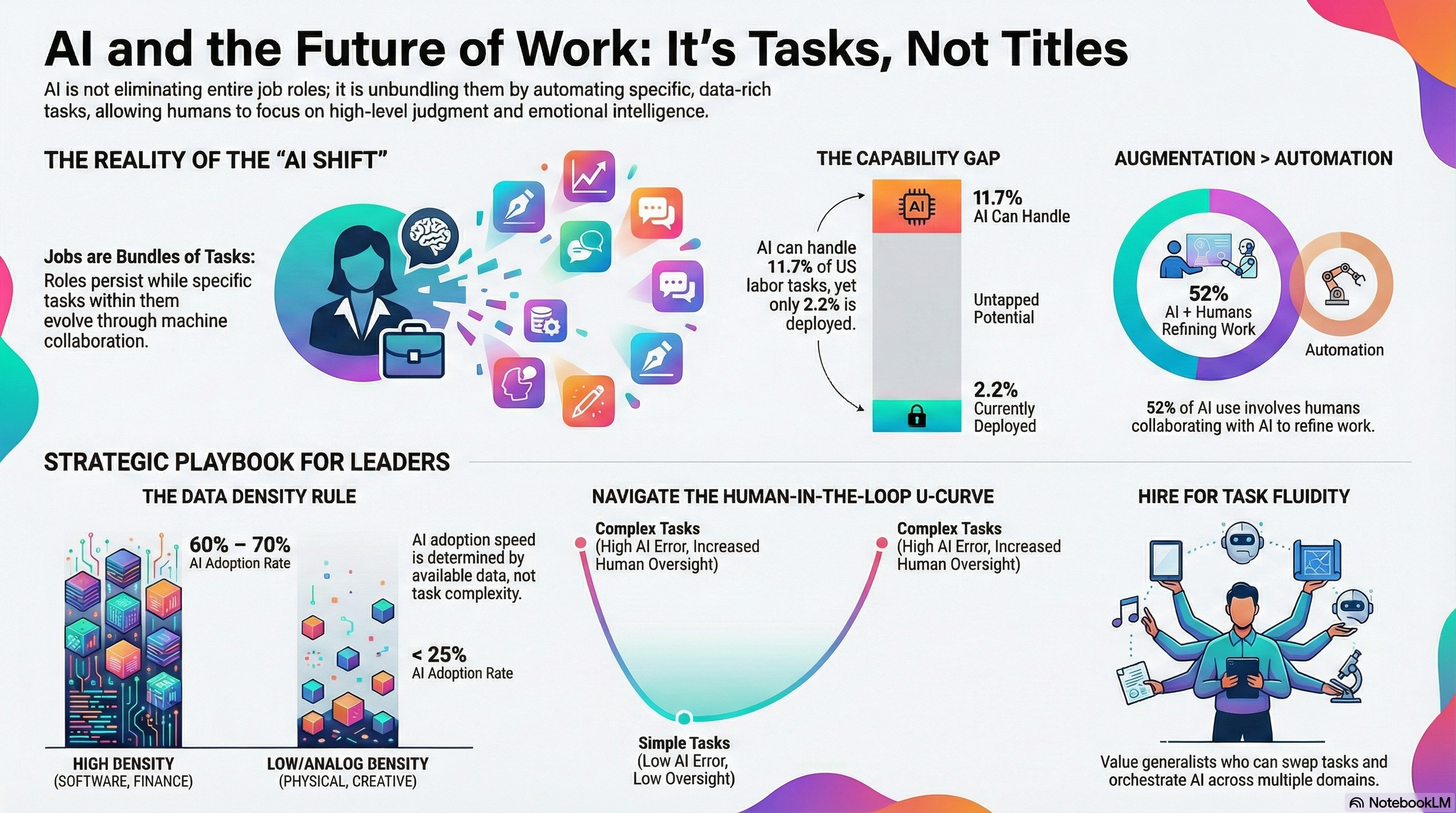
52% of work-related AI conversations involved augmentation — humans collaborating with AI to iterate, refine, and improve their work. Only 45% involved full automation, where AI completed a task independently. And that augmentation number is actually growing, not shrinking. Earlier in 2025, automation briefly surpassed augmentation. But by November, the trend reversed. Human-machine collaboration overtook human-machine substitution as the dominant pattern.
Read that again. As AI gets more capable, people are using it more for collaboration, not less.
The other number that jumped out at me: only 4% of occupations use AI for 75% or more of their tasks. Meanwhile, 49% of jobs now use AI for at least a quarter of their tasks. The pattern isn’t “some jobs disappear” — it’s “most jobs change.”
This tracks perfectly with what I’ve seen building Care Agent at Experity. We didn’t replace patient service representatives. We changed what they spend their time doing. The AI handles the repetitive scheduling, insurance verification, and FAQ responses. The humans handle the complex cases, the emotional moments, the judgment calls that actually require a person. Same headcount. Radically different workday.
That’s what I mean by “AI is coming for your Tuesday.” It’s not eliminating the job. It’s eliminating the parts of the job that were draining people in the first place.
The Next Layer of Abstraction
Andreessen frames what’s happening in software engineering in a way I think applies to almost every knowledge work role. He describes coding as shifting from writing code by hand to orchestrating AI — arguing with AI bots, managing multiple agent instances to generate, debug, and fix code. Programmers aren’t disappearing. Their task bundle is being completely rewritten.
And this isn’t new. It’s a pattern as old as computing itself. We went from manual calculation to punch cards. Assembly language to scripting languages. Each generation abstracted away the lower-level tasks — memory management, syntax, compilation — so humans could focus on higher-order problems. AI is just the next layer.
What makes this round different is the scope. It’s not just engineers. It’s everybody.
Andreessen describes what he calls a “Mexican standoff” between product managers, engineers, and designers. Each role can now use AI to perform the tasks of the other two. A coder can use AI to design. A designer can use AI to write code. A product manager can prototype without either one.
The result isn’t fewer workers. It’s superpowered workers — individuals who can swap tasks fluidly and function as relevant specialists across multiple domains simultaneously.
I’m seeing this at Experity. Our operations people are building their own dashboards. Our clinical team is prototyping workflow changes without waiting for engineering. The task boundaries between roles are dissolving, but the roles themselves? Still there. Just operating at a higher altitude.
A designer who used to spend 40% of their time creating icons and assets can now hand that to AI and focus on what Andreessen calls “capital D design” — how a product functions in the real world and how it makes humans feel. That’s not job loss. That’s job elevation.
Why Data Density Is the Real Predictor
Most analysis focuses on which jobs are “at risk.” But the World Economic Forum made an observation that I think is far more useful: the speed of AI adoption isn’t determined by task complexity. It’s determined by data density.
AI learns from data the way we learn from experience. Industries drowning in structured, digital data — software, finance, customer support — are seeing adoption rates around 60-70%. Industries with sparse or analog data? Under 25%.
This is why GitHub Copilot took off before autonomous vehicles, even though driving a car seems “simpler” than writing code. GitHub has 420 million repositories of training data. Driving data for rare accident scenarios? Almost nonexistent.
Think about what this means for your industry, your team, your role. The question isn’t “is my job complex enough to survive?” The question is “how much of my work generates data that AI can learn from?”
Finance? Massive amounts of digital transaction data. Customer support? Years of call logs, tickets, and email threads. Healthcare administration? Mountains of claims, scheduling, and billing records.
Physical work, creative judgment, relationship-driven roles? Still mostly analog. Still mostly human. Not because AI “can’t” do them — but because the training data doesn’t exist yet.
The Backwards Human-in-the-Loop Curve
Here’s something nobody’s talking about that I think is critically important.
When organizations first deploy AI, they assume they’ll need heavy human oversight — and that the need for oversight will decrease over time as the AI “gets better.” The curve looks like a straight line going down.
That’s not what actually happens.
What actually happens is more like a U-curve. At first, the AI handles simple tasks well and you need minimal oversight. Then you give it harder tasks, and the error rate spikes. Anthropic’s own data shows this: as task complexity increases, the AI’s success rate drops significantly, which reduces the actual time humans save.
Earlier estimates of AI productivity assumed tasks were successful whenever AI was used. When you account for errors, correction cycles, and the need for human checking, the real productivity gains are much more modest than the projections suggest.
This is why the “AI will replace everyone” crowd keeps being wrong on timing. They model capability. They don’t model integration. And integration is where everything gets messy, political, and very, very human.
The Macro Nobody Mentions
There’s another dimension to this that gets almost zero airtime in the AI-and-jobs debate: demographics.
Andreessen points out something that should be obvious but somehow isn’t part of the conversation. Population growth is declining globally. Productivity growth has been anemic for years. We don’t actually have a surplus of human workers. In many sectors and geographies, we have the opposite — chronic labor shortages that are only getting worse.
We might actually need AI to substitute for the workers we don’t have, not to replace the ones we do. Without it, economies don’t grow. They shrink.
That reframes the entire debate. AI isn’t competing with an abundance of human labor. It’s arriving precisely when we need more productive capacity and have fewer people to provide it.
So What Do You Actually Do With This?
If you’re a leader reading this, here’s the shift I’d challenge you to make.
Stop asking: “Which roles can we automate?” Start asking: “Which tasks within every role are preventing our best people from doing their best work?”
That reframe changes everything. Instead of a cost-cutting exercise, you’re running a capability expansion. Instead of people fearing AI, they start requesting it — because it eliminates the parts of their job they hate.
A few practical moves:
Audit at the task level, not the role level. Map every role to its component tasks. Identify which ones are repetitive, data-rich, and low-judgment. Those are your AI candidates — not the humans doing them.
Measure augmentation, not just automation. If your AI metrics only track “tasks eliminated,” you’re missing the bigger picture. Track time reallocated to higher-value work. Track quality improvements. Track employee satisfaction. The ROI of augmentation is harder to measure but usually larger than pure automation.
Follow the data density. Start AI adoption where your data is richest and most structured. Don’t try to AI your way through data-poor processes — you’ll burn budget and credibility. Build wins in data-rich areas, then expand.
Design for the U-curve. Plan for the reality that AI accuracy drops on complex tasks. Build human checkpoints into your workflows for the hard stuff. The goal isn’t full autonomy — it’s an intelligent division of labor where humans and AI each do what they’re best at.
Hire for task fluidity. The most valuable people on your team aren’t going to be the ones who do one thing well. They’re going to be the ones who can swap tasks, operate across domains, and orchestrate AI to extend their reach. The superpowered generalist is the new specialist.
The Real Transformation Is Already Here
I’ll be honest — the “AI replacing all jobs” narrative frustrates me because it distracts from the transformation that’s actually happening, right now, in companies that are paying attention.
The shift isn’t from employed to unemployed. It’s from doing to thinking. From processing to deciding. From repetitive to creative. From reactive to proactive.
Jobs aren’t disappearing. Task bundles are being rewritten. And the people and companies who understand that distinction — who invest in redesigning work at the task level instead of panicking about headcount — are going to have an enormous competitive advantage.
The question isn’t whether AI will change your job. It will. The question is whether you’re going to let the headlines define that change, or whether you’re going to design it yourself.
I know which one I’m betting on.
What tasks in your role would you love to hand off to AI tomorrow? What parts of your job require you — the human — more than ever? I’d love to hear what you’re seeing in the comments.