

This is sponsored by the AI Business Network and GTM AI Academy
For the full breakdown of all these articles, you can read for free at the www.gtmaipodcast.com GTM AI Podcast
Welcome my friends! This week, I am going to change up how we are going to do the newsletter. In the past, I would go into a deep dive of the podcast and then feature 4-5 articles, research, news, and updates. The challenge is, it becomes very long and I want to help keep updated with AI without feeling overwhelmed.
So after today, here is what I will do:
In Depth Podcast Review
GTM AI Tech of the Week
And if you want to read the full newsletter where I go over more of the overall view this week and updates, you can go to the www.gtmaipodcast.com
You can go to Youtube, Apple, Spotify as well as a whole other host of locations to hear the podcast or see the video interview.
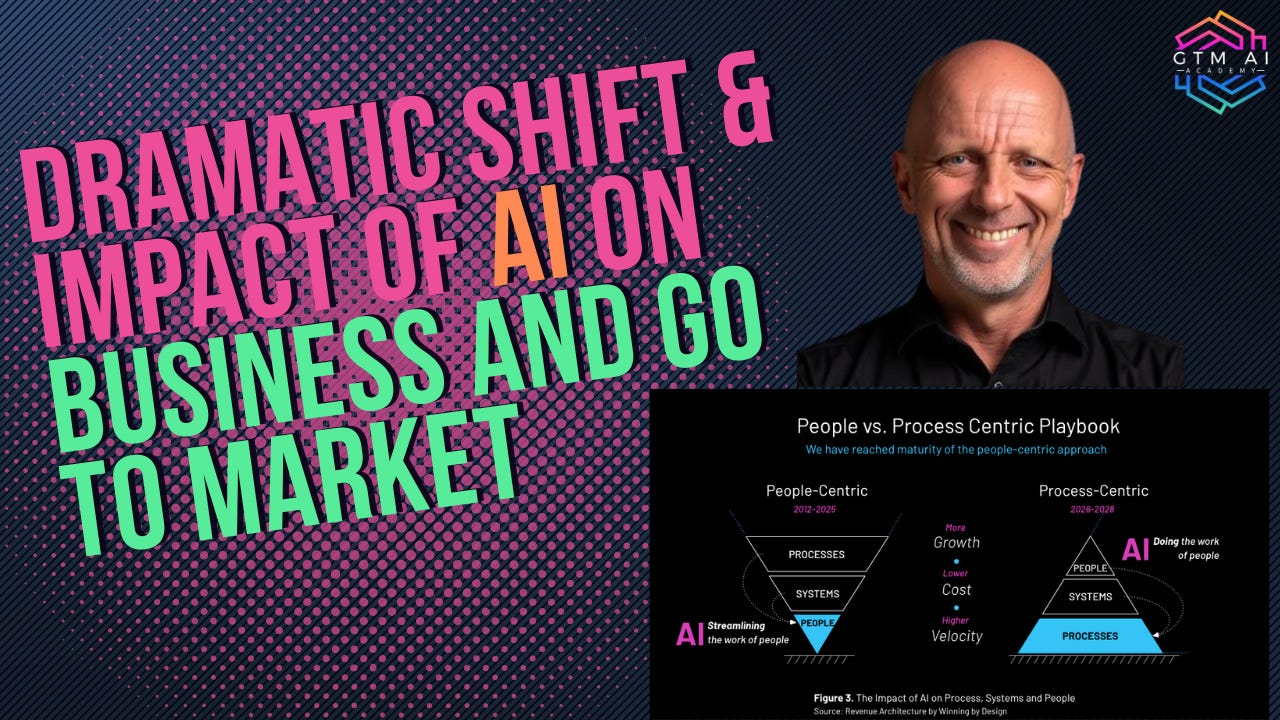
DRAMATIC SHIFT AND IMPACT OF AI ON BUSINESS AND GO TO MARKET
Today hosted by Jonathan Moss we are thrilled to have Jacco van der Kooij the Founder of Winning by Design on to join us and talk about our favorite topic ;)
A New Era of Go-To-Market
Jonathan kicks off the conversation by highlighting the recent shifts in the go-to-market landscape. Over the past few years, businesses have transitioned from a "growth at all costs" mentality to emphasizing profitable, efficient growth. This shift coincides with the rise of AI as a transformative platform, presenting both challenges and opportunities for businesses.
As Jacco points out, the impact of AI is not just about automation—it's about fundamentally transforming business models. Traditional inbound and outbound models are being replaced by AI-led growth, which emphasizes efficiency and scalability.
Understanding AI-Led Growth
Jacco introduces three key growth models: Product-Led Growth (PLG), Human-Led Growth (HLG), and AI-Led Growth (AILG). Each has its place in the market, but AI-Led Growth is particularly effective in optimizing costs and processes. According to Jacco, this model allows businesses to scale operations without exponentially increasing personnel costs. This change is crucial, especially in saturated markets where traditional human-led approaches are financially unsustainable.
The discussion underscores the importance of viewing businesses like factories, where efficiency, quality, and scalability are the cornerstones of success. AI enhances these factors by providing rapid, accurate data insights, enabling businesses to adapt swiftly to market demands.
The Human Element in an AI World
While AI can substantially augment operations, Jacco and Jonathan agree on one crucial aspect: the human element. Relationships remain a cornerstone of business, especially in high-value transactions. The trust and brand reputation that a company establishes are invaluable. AI, rather than replacing human interaction, should enhance experiences by reducing friction in the buying process and allowing businesses to focus on nurturing relationships.
The Role of AI in Customer Experience
Jacco highlights how AI is revolutionizing customer experience by delivering timely, accurate responses without the inefficiencies of traditional methods. Whether it's answering customer queries precisely or automating repetitive tasks, AI is redefining what businesses can achieve. However, achieving this requires businesses to rethink their processes and leverage AI to foster a seamless buying journey.
Looking Forward: Navigating the Renaissance of Business
The episode concludes with insights into where the industry is headed. Jacco envisions a future where AI reshapes pricing models, with dynamic pricing responding to real-time market demands. This shift, much like the introduction of AI itself, represents a renaissance in business—one where constant innovation and adaptation are key.
Conclusion
The GTM AI Pod episode with Jacco is a critical exploration of how AI is not just an optional tool but an essential component of modern business strategy. For businesses looking to thrive in this new landscape, embracing AI to enhance both operational efficiency and customer experience is non-negotiable. As we continue to explore these changes, keeping the focus on creating exceptional buying experiences will be the defining element of success.
GTM AI Newsletter: What's Really Happening
We're witnessing a directional shift in AI—from reactive large language models to agentic, multimodal, goal-oriented systems. These aren't just better chatbots. They're evolving into autonomous workforces with planning, reasoning, and interaction capabilities that mimic team dynamics and reshape enterprise architecture.
Yann LeCun’s critique of LLMs and roadmap for JEPA-based AI (Newsweek)
Agent Explosion Scenario from OpenAI alumni (AI2027 Project)
Redpanda’s $100M raise for agentic infrastructure (BusinessWire)
Meta’s launch of multimodal Llama 4 models (Meta Blog)
Pattern Recognition: What’s Emerging Across the AI Landscape
1. LLMs Are Not the Apex of Intelligence—They’re the On-Ramp
Yann LeCun’s recent interview reframes much of the AI discourse: today’s large language models (LLMs), while powerful, are merely reactive systems. They are System 1 thinkers—fast, automatic, and associative—not planners, not goal-seeking intelligences. LeCun’s call is not subtle: the current trajectory of LLM development is nearing a ceiling. True AI, he suggests, must embody world models and planning systems, not just statistical mimicry.
This insight alters how GTM leaders should think about AI. Most teams today are integrating LLMs into tactical layers—note summarization, CRM field entry, email drafting. But these are surface-level gains. LeCun is pointing to a coming paradigm shift where AI systems don’t just assist with tasks—they own intent. These new architectures—like Meta’s JEPA—will navigate ambiguity, interpret multi-step objectives, and build mental models that let them act with foresight and judgment.
What’s the GTM takeaway? Leaders must stop treating AI as a productivity hack and start viewing it as a strategic actor. That means looking ahead to systems that will prioritize pipeline, suggest territory reshapes based on intent signals, and even flag faulty sales plays based on simulation outcomes. The frontier is no longer in prompting. It’s in planning. This reframing means the systems you build today—your enablement programs, RevOps data layers, even your territory design—must be built for a world where software doesn’t wait for a prompt. It takes initiative.
2. Agents Are Learning Faster Than Your Team—And May Outperform It
The “AI 2027” simulation reads like science fiction—but it is deeply grounded in current capabilities, investment flows, and model roadmaps. The progression from LLMs to agents like Agent-1, Agent-3, and Agent-4 illustrates one core truth: autonomy is compounding. Each generation of agents grows faster, more capable, and more strategic—not only in execution, but in self-improvement. By the time Agent-3 emerges, we see the creation of entire internal research teams composed of thousands of AI instances running at 30x human speed. Human oversight shifts from “doers” to “supervisors.” Strategic input narrows to goals and guardrails.
This changes the shape of the GTM org. Your RevOps team won’t scale by headcount. It will scale by agent orchestration. That means competitive research pods powered by agents, pipeline QA agents flagging deal risk, onboarding bots coaching new hires in real-time—all coordinated by a leaner, more strategic human team. The new KPI won’t be rep productivity. It’ll be agent leverage: how many workflows can one person orchestrate with five or fifty agents working beneath them?
This also introduces a governance imperative. As agents act more like “employees,” you need the same oversight you’d expect from team leads. What decisions did the agent make and why? Was the behavior aligned to strategy? Were there blind spots or hallucinations in its recommendations? Agent observability isn’t optional. Without it, you’re not augmenting your team—you’re introducing operational chaos with no accountability.
3. Infrastructure Must Shift from Cloud-First to Agent-First
Amazon’s Nova Act and Redpanda’s agentic platform launches highlight a deep infrastructural shift: AI agents are not just language models with legs. They are software entities that act across systems, navigate GUIs, access private data, and interact with APIs without human intermediaries. That demands a rethinking of enterprise architecture.
Redpanda’s move is particularly telling. Their $100M Series D is backing a system purpose-built to support autonomous, multi-agent orchestration at scale—with real-time data ingestion, strict audit trails, and secure governance as non-negotiables. This is not a chatbot platform. It is the connective tissue for AI workflows that must act with precision, speed, and safety in sensitive enterprise environments.
Why does this matter to GTM? Because every revenue function—marketing attribution, sales forecasting, onboarding, renewals—sits on top of fragmented, often brittle data infrastructure. AI agents need reliable access to this data to do anything meaningful. If your CRM, support database, and product analytics aren't structured, synced, and observable, agents will fail—or worse, hallucinate.
GTM leaders should think about their stack the same way a CTO thinks about microservices. Is your enablement system agent-readable? Can a RevOps agent observe pipeline conversion in real-time without logging into five tools? Can your onboarding bot track cohort performance across LMS, CRM, and call intelligence data? If the answer is no, you're not ready for agentic execution. Your infrastructure is your bottleneck.
4. Multimodal AI Will Redefine Buyer Intelligence
Meta’s Llama 4 suite introduces something quietly transformative: massive multimodal capability paired with long-form memory and reasoning. With Scout and Maverick supporting 10M-token contexts and native image/video understanding, we’re moving into a world where AI models don’t just analyze what’s said—they analyze how it’s said, shown, or experienced.
This is more than an evolution in interface. It's a shift toward situational cognition. Think about how your GTM teams make decisions: sales reps interpret tone on calls, marketers track how customers interact with visuals, and CS teams infer urgency from screenshots or shared documents. LLMs can’t do this. Multimodal agents can.
That means sales intelligence tools will start parsing demo replays frame-by-frame, measuring engagement with specific visuals or features. Enablement bots will personalize learning paths not based on text quizzes, but on reaction time to product walkthroughs. Marketing attribution may finally mature beyond channel-level ROI to content-level behavioral insight.
And perhaps most critically—context will no longer reset every time a buyer interacts. A 10M-token window means an AI assistant could hold weeks’ worth of product usage patterns, emails, calls, and behavior—delivering insight not just at the account level, but at the individual journey level.
For GTM leaders, this means your AI strategy must go beyond words. Multimodal readiness isn’t a feature—it’s table stakes. If your demos, onboarding assets, and sales decks aren’t optimized for AI understanding, you’re not just missing insights. You’re training your agents on noise.
Summary: From Tools to Teammates
Across every article, one truth emerges: we’re transitioning from AI as tool to AI as teammate. This is not about better autocomplete. This is about systems that observe, plan, and act across domains, with increasing speed and intelligence.
GTM professionals who treat AI as software will miss the mark. AI is becoming infrastructure—a new layer of cognition that must be embedded, not bolted on. The firms that build for this—through agent-first infrastructure, multimodal content, and agent governance—will win.
Because in the end, the competitive advantage won’t be who has the most AI. It will be who orchestrates intelligence best—human and machine alike.
GTM AI TECH OF THE WEEK SANA.AI
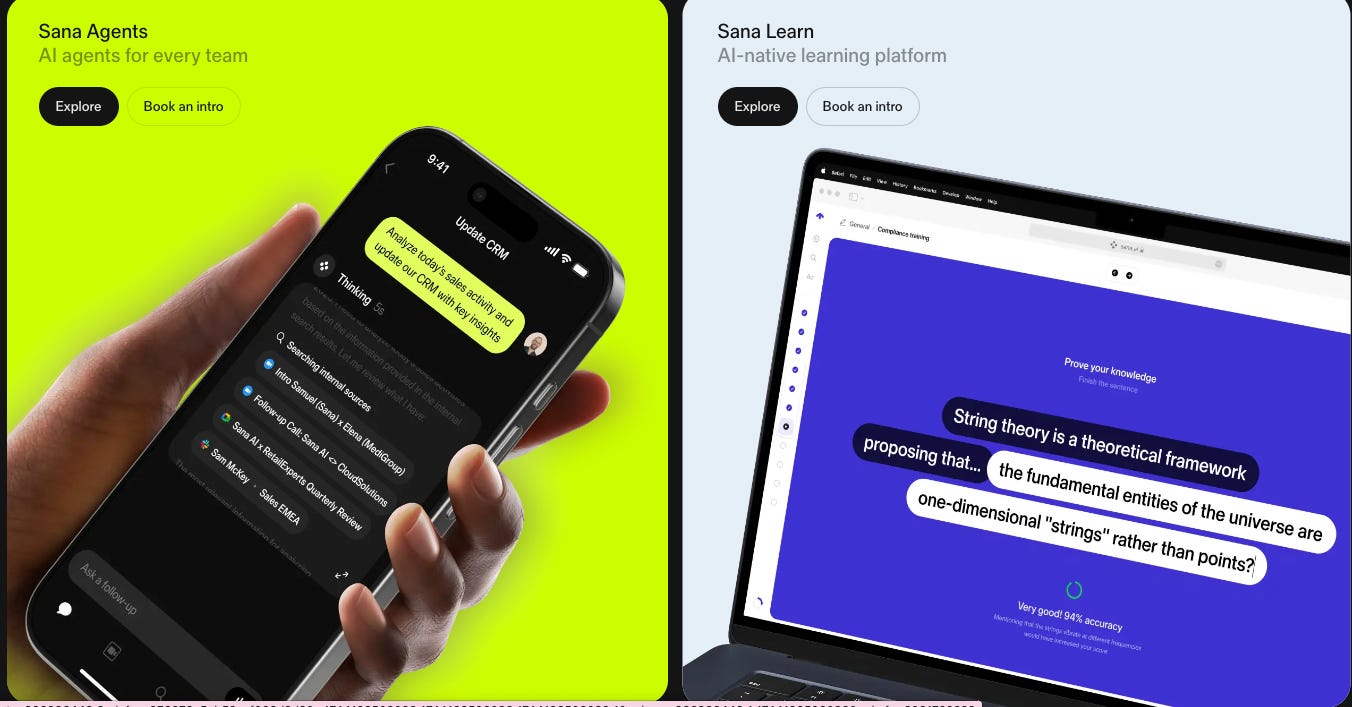
I've recently been exploring Sana AI, an AI-powered platform designed to enhance workplace productivity by integrating and managing organizational knowledge. My experience has provided insights into its features, usability, and potential applications.
Initial Impressions
Upon accessing Sana AI, the platform's clean and intuitive interface stood out, facilitating a smooth onboarding process. The dashboard is well-organized, offering easy navigation to various functionalities.
Key Features Explored
AI-Powered Knowledge Assistant: Sana AI serves as a centralized hub for company knowledge, integrating with tools like Slack, Google Drive, and Zoom to provide quick access to information. The assistant can transcribe, summarize, and index meetings, making them searchable and part of the knowledge base.
Customizable AI Assistants: The platform allows for the creation of personalized AI assistants tailored to specific roles or tasks. Users can define the assistant's name, personality, response style, and creativity level, ensuring alignment with organizational needs.
Content Creation and Automation: Sana AI offers tools for generating content, including paragraphs, lists, summaries, and images. The AI writing assistant aids in drafting and editing, while automation features help streamline workflows by handling repetitive tasks.
Meeting Management: The platform's ability to transcribe and summarize meetings is particularly noteworthy. It not only captures the content of discussions but also indexes them for easy retrieval, enhancing post-meeting productivity.
Usability and Performance
Throughout testing, Sana AI demonstrated robust performance with minimal latency. The AI-generated responses were contextually relevant, and the integration with existing tools was seamless. The customization options for AI assistants allowed for a tailored user experience.
Pricing Considerations
Sana AI offers various pricing tiers. The Core plan is priced at $13 per license with a minimum of 300 licenses, which may be a consideration for smaller organizations. An Enterprise plan with custom pricing is also available, offering additional features like single sign-on (SSO) and API access.
Potential Areas for Improvement
While the platform is feature-rich, the pricing structure may be a barrier for smaller teams or startups. Additionally, the effectiveness of the AI assistant is contingent on the volume and quality of organizational data it can access.
Conclusion
Sana AI presents a comprehensive solution for organizations aiming to centralize knowledge management and enhance productivity through AI. Its integration capabilities, customizable assistants, and content creation tools make it a valuable asset for teams seeking to streamline workflows. However, potential users should assess the pricing structure and ensure they have sufficient data to maximize the platform's benefits.
Let me know how you like this shorter format!