

Hey y'all! Before we get started, if you are reading this thank you for investing in yourself and coming here.
We have made some updates to our content and structure, you can always find them here to ensure you get the most value.
Back to the program…..
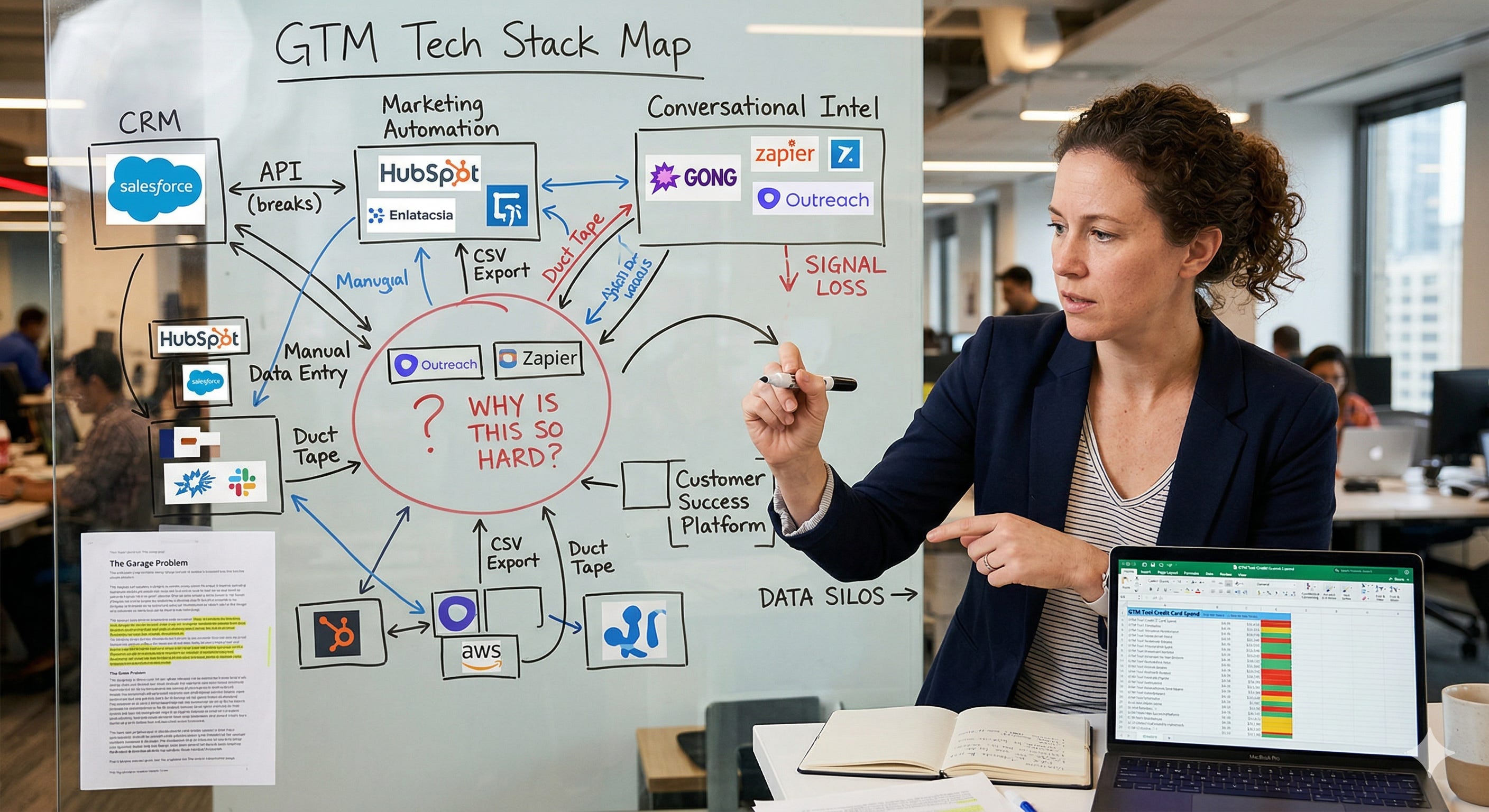
Go count the SaaS tools your GTM team pays for. Not the ones in the deck. The ones actually running. The ones someone signed up for eighteen months ago that still bill the credit card even though the champion left. Now count how many of them share data without someone manually exporting a CSV.
That gap between “tools we pay for” and “tools that actually talk to each other” is the most expensive line item nobody tracks.
The Garage Problem
Every GTM team I have worked with over the past 21 years has the same issue. It looks different at every company, but the shape is identical.
It starts with a problem. Pipeline visibility is bad. Someone buys a tool. Content production is slow. Someone buys a tool. Competitive intel is stale. Someone buys a tool. Customer health scores are unreliable. Someone buys a tool.
Each purchase made sense at the time. Each vendor demo was convincing. Each implementation had a champion who cared. And now you have 14 tools across marketing, sales, CS, and RevOps that were never designed to work together, connected by integrations that break quarterly, managed by people who spend half their time maintaining the plumbing instead of doing the work the tools were supposed to make easier.
This is not a technology problem. It is an architecture problem. And the entire GTM industry has been pretending it is normal.
I can say this with confidence because I was one of the people pretending. I signed the contracts. I championed the tools. I sat in the QBRs and told my team the new platform would fix the data problem. Three of those tools are still billing my old company’s credit card right now, and I am not sure anyone knows the login.
The Market Map Illusion
You have seen the market maps. The ones with 150 logos arranged in neat categories. CRM. Marketing Automation. Sales Engagement. Revenue Intelligence. Conversational Intelligence. Customer Success Platform. ABM. Content. SEO. Competitive Intel.
They look organized on a slide. They feel chaotic in practice.
Here is what actually happens when you run a GTM operation across those categories:
Data lives in silos. Your CRM knows about deals. Your marketing automation knows about engagement. Your CS platform knows about health scores. Your content tools know about performance. None of them know about each other. The competitive intelligence your analyst gathered last Tuesday lives in a Google Doc that three people have read.
Integrations are duct tape. Zapier, native connectors, custom API work. They move data from point A to point B, but they do not carry context. A lead score in your MAP tells your CRM a number. It does not tell your sales team why that number is high, what content the prospect engaged with, or what competitive alternative they were evaluating.
Signal loss is the default. Every handoff between tools loses information. Marketing qualified a lead and passed it to sales. What was the qualification signal? It is in the MAP, but the AE is in the CRM. The customer told your CSM something important on a call. It is in the conversational intelligence tool. Your product team will never see it.
Nobody owns the whole picture. Each tool has an admin. Nobody administrates the system. Because there is no system. There is a collection of tools.
What This Actually Costs
The direct costs are obvious. License fees stack. A mid-market GTM team easily spends $200K-$400K annually on SaaS subscriptions across these categories. Enterprise teams spend millions.
But the indirect costs are worse:
Time tax. Your ops team spends 30-50% of their time on integration maintenance, data hygiene, and tool administration. That is your most strategic team doing janitorial work.
Decision latency. When a signal has to travel through three tools and two manual handoffs before it reaches the person who can act on it, you are making decisions on stale information. Every time.
Context collapse. The thing that makes your business distinctive -- your market knowledge, your customer relationships, your competitive position -- gets flattened into whatever fields the tool allows. Your institutional intelligence lives in people’s heads instead of in the system.
Training drag. Every new hire learns 8-12 tools. Every tool update resets muscle memory. Every tool switch requires migration. The switching costs are so high that teams stay on bad tools because moving is worse than suffering.
The Question Nobody Asks
Here is what I kept asking myself across two decades of GTM work: why do we accept this?
Why do we accept that marketing, sales, and CS should operate in different software environments? Why do we accept that “integration” means a fragile API connector instead of shared context? Why do we accept that every department has its own version of the truth?
The answer is that we did not have an alternative. The SaaS model was the best we had. Best-of-breed tools in each category, connected by integrations, managed by ops teams. That was the architecture. It was the only architecture available.
It is not the only architecture available anymore.
What is behind the paywall: The five-step Tech Stack Audit framework I use to diagnose exactly where signal dies in a GTM stack, the thesis that ties this entire series together, and a paid subscriber resource -- a complete Tech Stack Audit Interactive Guide you can run with your ops team this week.
The diagnosis above is free. The prescription is for subscribers.
