

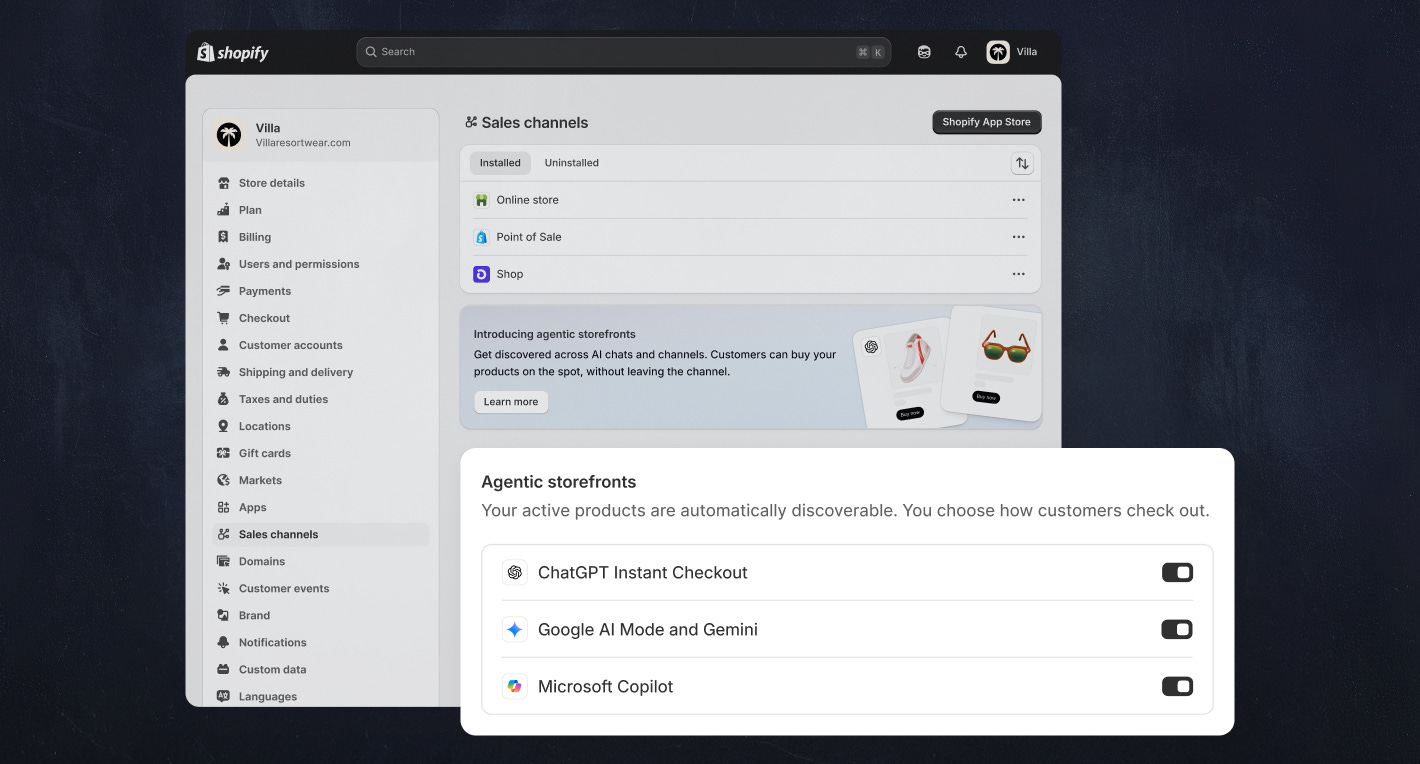
Yesterday, Shopify dropped a bomb that should have every B2B leader paying attention.
They announced the Universal Commerce Protocol—an open standard they co-developed with Google that lets AI agents complete purchases on behalf of consumers. Native shopping in Google’s AI Mode. Embedded checkout in Microsoft Copilot. A new “Agentic plan” that opens their commerce infrastructure to brands everywhere.
Shopify called it “agentic commerce” and declared “AI is the next great platform shift in commerce.”
I’m sitting here thinking: they’re not wrong. But they’re also underselling what’s about to happen to B2B.
Here’s what most people miss: consumer buying experiences always lead. B2B buying always follows. Sometimes it takes five years. Sometimes ten. But the gap is shrinking fast.
And this time? B2B can’t afford to wait.
The Consumer Playbook Is Writing Itself
Let me paint you a picture of what Shopify just enabled.
Brands like Monos, Gymshark, and Everlane will soon sell directly inside AI conversations. No clicking through to a website. No filling out forms. No checkout pages.
You ask Gemini for a recommendation. It shows you options. You pick one. The agent handles the rest—applying your loyalty credentials, selecting shipping preferences, processing payment.
The protocol is designed so customers can submit discount codes, input loyalty credentials, select subscription billing cadences, or confirm selling terms like final sale timing right in the chat.
Think about that for a second.
The entire shopping funnel—discovery, consideration, negotiation, purchase—collapsed into a conversation. No landing pages. No nurture sequences. No abandoned cart emails. Just... resolution.
As Victor Tam, CEO of Monos put it: “It’s a new way for our story and product details to show up at the exact moment someone is asking real questions with real intent, in a format that feels helpful, not intrusive.”
Intent captured. Friction eliminated. Transaction completed.
And here’s the kicker: this isn’t vaporware. The protocol already has endorsement from 20+ retailers and platforms.
Why B2B Leaders Should Be Nervous
Every time consumer technology shifts, there’s a cohort of B2B executives who say “that’s cute, but enterprise buying is different.”
They’re not entirely wrong. B2B deals involve multiple stakeholders, longer cycles, complex pricing, and legal reviews that make consumer purchases look like impulse buys.
But they’re missing the pattern.
Think about what happened with:
Self-service research. Consumers started Googling products before walking into stores. A few years later, B2B buyers were doing 60-70% of their research before ever talking to sales.
Mobile-first experiences. Consumer apps became intuitive, fast, frictionless. Now B2B buyers expect the same from vendor portals and procurement systems. (And they’re mostly disappointed.)
Chat-based support. Consumers demanded instant answers via messaging. Now B2B buyers wonder why they still need to schedule calls for simple questions.
Product-led growth. Consumers got hooked on free trials and self-service onboarding. Then Slack, Dropbox, and Zoom brought the same model to enterprise.
The pattern is always the same: what consumers experience, buyers expect.
So when a procurement manager spends their personal time asking Claude to research vacation destinations, compare options, and book the trip—all in a single conversation—how long before they wonder why evaluating enterprise software feels like filing a tax return?
The Agentic Commerce Stack
Here’s where it gets interesting for those of us thinking about B2B GTM.
Shopify built what they call “Agentic Storefronts”—central management of AI channel distribution from their admin panel. Merchants set up their data once, and it surfaces across ChatGPT, Microsoft Copilot, Google AI Mode, and Gemini.
Read that again.
One source of truth. Multiple AI channels. Automatic distribution. Zero incremental effort to reach buyers wherever they’re having conversations.
Now imagine this for B2B.
Your product data, pricing logic, implementation requirements, and case studies—all structured in a way that agents can access and act on. A procurement agent asks about solutions in your category. Your information surfaces. The agent negotiates basic terms. Routes to the right human when needed. Handles routine transactions autonomously.
This isn’t science fiction. The infrastructure is being built right now, just on the consumer side first.
Shopify’s “Agentic plan” opens their commerce infrastructure to brands not even using Shopify for their online store. Non-Shopify merchants can list products in the Shopify Catalog and sell through AI channels.
They’re building the rails. And whoever builds the rails for B2B agentic commerce will define the next decade.
What Actually Changes
When buying moves to agents, three things shift fundamentally:
1. Discovery moves upstream.
Right now, buyers discover your product through content, ads, referrals, or outbound. They land on your website. They fill out forms. They enter your funnel.
With agentic commerce, discovery happens inside a conversation they’re already having. The agent brings your product into their context—not the other way around. You don’t control the top of funnel anymore. You’re either in the agent’s index, or you don’t exist.
2. Friction becomes fatal.
Consumer checkout friction is measured in basis points of conversion. Every extra step costs revenue.
B2B has gotten away with friction because buying committees tolerate it. Multiple stakeholders mean someone will push through the procurement gauntlet.
But when an agent can surface five alternatives that all solve the problem, the one with the simplest path to purchase wins. Complex pricing models, custom quote requests, mandatory demo calls—they become competitive disadvantages, not just annoyances.
3. Data becomes the product.
Shopify’s catalog uses “specialized LLMs to categorize, enrich, and standardize product data to surface exactly what customers want in seconds.”
If your product data isn’t structured for agent consumption, you’re invisible.
In B2B, this gets harder. Pricing varies by deal size, contract length, feature bundle, and competitive situation. Implementation complexity depends on existing tech stack. ROI calculations require context about the buyer’s industry and use case.
The companies that figure out how to encode this complexity in agent-readable formats will have a massive advantage. The ones that don’t? They’ll keep wondering why their pipeline is shrinking.
The B2B Buying Agent Is Coming
I’ve been talking to founders building in this space. The pattern is clear.
Someone’s going to build the “Shopify for B2B agentic commerce.” A protocol that lets enterprise AI assistants handle procurement. A catalog that structures complex B2B products for agent discovery. A transaction layer that handles enterprise-grade requirements—security reviews, legal terms, integration specifications.
And when that happens, the companies that prepared will capture outsized value. The ones that didn’t will spend the next five years playing catch-up.
What preparation looks like:
Structure your product data obsessively. Every feature, use case, integration, and outcome—documented in ways that machines can parse and reason about.
Simplify your buying process. If an agent can’t complete a transaction or understand why a human is needed, you’ve already lost deals you’ll never know about.
Build for programmatic access. APIs, documentation, self-service tools. The companies making it easy for agents to transact will win.
Rethink your sales motion. Agents handle routine. Humans handle complex. The middle? It’s disappearing.
The Real Question
Everyone’s asking: will AI replace salespeople?
Wrong question.
The right question: which buying scenarios require a human, and which can an agent handle?
Simple transactions? Agents. Complex negotiations? Humans. Routine renewals? Agents. Strategic partnerships? Humans. Standard product purchases? Agents. Custom implementations? Humans.
The line between these will shift over time. But it’s not going away.
As Microsoft’s Nayna Sheth put it: “Today’s shoppers expect to go from search to purchase in a single conversation.”
Today’s shoppers. Tomorrow’s buyers.
What I’m watching: How fast B2B infrastructure providers start building their own versions of the Universal Commerce Protocol. The first mover here has a real shot at becoming a category-defining platform.
What I’m curious about: Has anyone in your org started thinking about how you’d structure product data for agent consumption? How you’d automate the low-complexity parts of your sales motion? I’d love to hear what you’re seeing.
Sharp take on the agentic commerce shift - especially the point about B2B following consumer patterns, just slower. When procurement moves into AI conversations, the financial layer (payment terms, credit checks, settlement timing) gets compressed too. TCLM often explores that intersection: how transaction automation reshapes trade credit, liquidity risk, and AR workflows. A forward-looking read for finance teams.
(It’s free)- https://tradecredit.substack.com/