

I’ve been staring at a number all week and I can’t shake it.
According to 6sense’s 2025 Buyer Experience Report, 94% of B2B buyers are now using LLMs during their buying process. Not “experimenting with.” Not “curious about.” Using. Actively. Right now. While your reps are still manually updating Salesforce fields and searching for that one case study they swear exists somewhere in Google Drive.
Here’s what keeps me up: we’re not just witnessing a shift in how people buy. We’re watching the entire architecture of commerce get rewritten in real-time. And most revenue teams? They’re bringing a clipboard to a data fight.
I spent the last few months building out a research framework I’m calling The Four Phases of AI-Transformed Buying. It maps the evolution from humans selling to humans, all the way to machines negotiating with machines. But the framework itself isn’t the insight. The insight is what it reveals about your infrastructure—and why the companies that win in every phase will be the ones who built their Revenue Nervous System before they needed it.
Let me walk you through it.
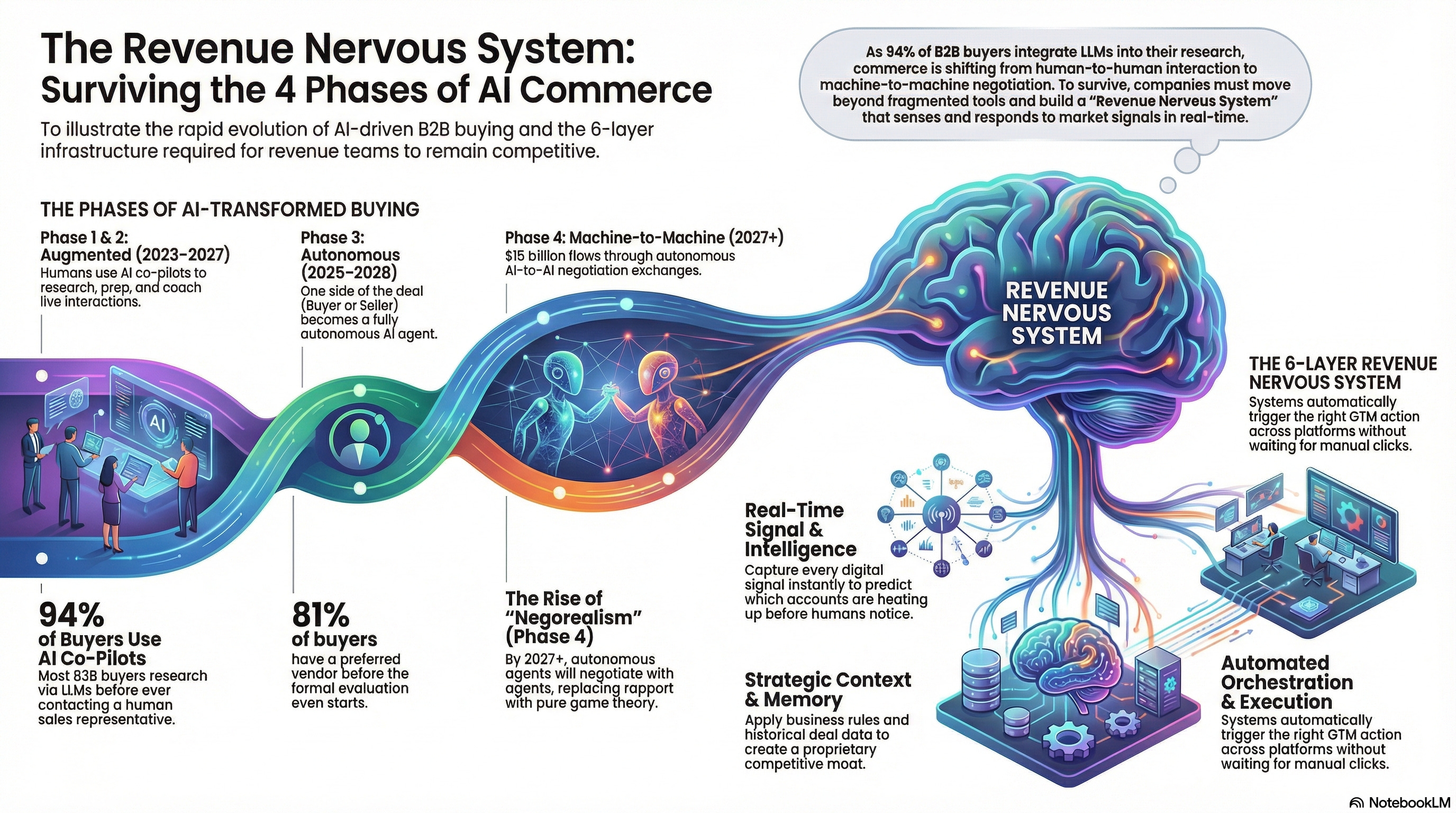
The Four Phases (and Why Most Teams Are Stuck in Phase 1)
The buying experience is evolving through four distinct stages. They’re not sequential replacements—they coexist, layer on top of each other, and create compounding complexity.
Phase 1: Human → Human, AI Behind the Scenes (2023–2025)
This is where most companies think they are—and honestly, where most actually are. The rep gets on a Zoom. The buyer asks questions. Emails go back and forth. Classic.
But backstage? Both sides are using AI to prepare. Buyers research products through ChatGPT before they ever talk to a human. Sellers use AI to generate outreach, summarize accounts, and draft proposals. The interaction itself is still human. The preparation is increasingly not.
The problem? 6sense found that 81% of buyers already have a preferred vendor before formal evaluation even starts. If your product isn’t showing up in AI-generated consideration sets—if you’re not optimized for how LLMs surface and recommend solutions—you’re invisible before the conversation begins.
That’s the Day One Shortlist problem. And it’s already here.
Phase 2: Human+AI ↔ Human+AI (2024–2027)
This is where things get genuinely weird. Both buyer and seller bring AI co-pilots into the live interaction itself. Think two chess players, each with a grandmaster whispering in their ear.
The buyer’s AI analyzes the seller’s claims in real-time. Generates counter-questions. Flags inconsistencies. Scores value propositions against competitor data. Meanwhile, the seller’s AI surfaces battle cards the moment a competitor is mentioned. Suggests talk-track pivots based on sentiment analysis. Calculates optimal discount thresholds on the fly.
Outreach reports 33 million weekly AI-assisted sales interactions. The AI sales coaching market hit $62B in 2025, growing at 28.3% CAGR. This isn’t coming. It’s here.
And here’s the paradox nobody’s talking about: when both sides are AI-augmented, the quality of the interaction rises—but the human becomes the differentiator again. The rep who can transcend their AI coaching to create a genuine moment of connection? That’s the one closing deals. Not the one with the best prompts.
Phase 3: Human → AI (2025–2028)
One side of the transaction goes fully autonomous. A buyer chats with an AI sales agent to get product information, negotiate pricing, and complete a purchase. Or a seller’s human rep negotiates with the buyer’s AI procurement agent—one that’s been delegated authority to evaluate, negotiate, and approve purchases within defined parameters.
Forrester’s 2026 B2B Predictions report says at least 20% of B2B sellers will be compelled to respond to AI-powered buyer agents. Not “might need to consider.” Compelled.
The trust dynamics here are fascinating. Gartner found only 34% of Americans trust AI to make purchases on their behalf. But Morgan Stanley predicts nearly half of online shoppers will use AI agents by 2030. The gap between trust and adoption is going to close fast—and it’ll close from the adoption side, not the trust side.
Phase 4: AI → AI Commerce (2027+)
This is the one that breaks people’s brains a little. AI agents negotiating with AI agents. Both buyer and seller delegate authority to autonomous systems. Commerce becomes machine-readable, machine-negotiable, and machine-executable.
Gartner’s Strategic Predictions 2026 says by 2028, 90% of B2B buying will be AI agent-intermediated. That’s $15 trillion flowing through AI agent exchanges. Google launched its Universal Commerce Protocol in January 2026 with Walmart, Target, Visa, Mastercard, and 20+ partners. OpenAI countered with its own Agentic Commerce Protocol built with Stripe. The plumbing is being laid right now.
When machines negotiate with machines, traditional sales psychology—rapport, emotional intelligence, objection handling—becomes irrelevant. Your product must be machine-parseable. Your pricing must be dynamically optimizable. Your value proposition must be structured data an agent can evaluate in milliseconds.
I’m calling this shift “Negorealism.” Game theory replaces gut feel. And if your systems can’t speak that language, you’re out.
Here’s What Nobody’s Connecting: The Revenue Nervous System
So you’ve read through the four phases and you’re probably thinking some version of: “Cool framework, Jonathan. But what do I actually do about this?”
This is the part I care about most. Because the framework reveals something uncomfortable: the bottleneck isn’t technology. It’s infrastructure.
Every single phase—from AI-assisted research in Phase 1 to autonomous agent commerce in Phase 4—depends on the same foundational capability: your ability to sense market signals, process them intelligently, and respond in coordinated real-time. I’ve been calling this the Revenue Nervous System, and I think it’s the single most important concept in GTM right now.
Think about your actual nervous system for a second. You touch a hot stove. Your hand pulls back before your brain even consciously registers the pain. Signals travel through nerves. Your body coordinates a response instantly. No committee meeting. No quarterly review. No “let’s sync on this next Tuesday.”
Now think about your revenue organization. A buyer visits your pricing page three times in 48 hours, downloads a case study, and their CFO connects with your CEO on LinkedIn. How long does it take for your system to sense that signal, interpret it, and act on it? Hours? Days? Never, because those data points live in four different tools that don’t talk to each other?
That’s the problem. And it gets exponentially worse as buying moves through the four phases.
The Six Layers That Make It Work
The Revenue Nervous System isn’t a single tool. It’s an architecture. Six layers, each building on the one below:
1. The Data Layer (Foundation) Every signal captured in real-time across your entire go-to-market surface. Website behavior, email engagement, product usage, intent data, conversation intelligence—all of it flowing into one unified stream. Not batch-processed overnight. Real-time.
2. The Intelligence Layer Machine learning models that process patterns and predict outcomes. Not dashboards you stare at hoping for insight. Predictive systems that identify which accounts are heating up, which deals are at risk, and which segments are emerging—before a human could spot the pattern.
3. The Context Layer This is where most AI implementations fail. Raw intelligence without business context is just noise. The Context Layer applies your specific business rules, domain knowledge, and strategic priorities to translate intelligence into relevant action. It’s why a signal that matters for a $50K deal looks completely different from the same signal on a $500K deal.
4. The Memory Layer Learning systems that compound over time. Every customer interaction, every campaign result, every won and lost deal teaches the system something your competitors can’t replicate. This is how you build a data moat. Not through volume—through accumulated intelligence that gets sharper with every cycle.
5. The Orchestration Layer This is the neural network of the whole thing. It coordinates disparate signals, insights, and actions into coherent, coordinated revenue generation. Instead of humans manually triaging what to do next, the system automatically triggers the right action at the right moment for the right account. Marketing nurture shifts based on real-time sales conversation data. CS proactively reaches out when usage patterns predict churn. Pricing adjusts based on competitive signals.
6. The Execution Layer Action systems that implement decisions in the real world. Agents that send the right message, adjust the campaign, update the forecast, route the lead—without waiting for a human to click seven buttons across four platforms.
Why This Architecture Wins in Every Phase
Here’s what makes the Revenue Nervous System so powerful: it’s not optimized for one phase of AI-transformed buying. It’s the foundation that lets you compete in all four simultaneously.
In Phase 1, the Revenue Nervous System ensures your content is structured for AI discovery. Your Data Layer captures which LLMs are surfacing your brand. Your Intelligence Layer identifies the specific queries driving consideration. You’re not guessing at SEO vs. GEO strategy—you’re measuring it.
In Phase 2, when both sides bring AI co-pilots to the table, the Orchestration Layer becomes your unfair advantage. Your rep’s AI coaching isn’t pulling from a static battle card database—it’s drawing on real-time competitive intelligence, deal-specific context, and institutional memory. The buyer’s AI can fact-check your claims, but your system ensures those claims are defensible, specific, and tailored to their exact use case.
In Phase 3, when buyers interact directly with AI sellers (or your reps negotiate with AI procurement agents), the Context Layer is critical. Your AI seller needs to understand not just product features but deal dynamics, stakeholder politics, and strategic pricing—all in real-time. That doesn’t come from a prompt. It comes from infrastructure.
In Phase 4, AI-to-AI commerce, the Revenue Nervous System is how you compete. Machine customers evaluate products in milliseconds. They need machine-readable value propositions, dynamic pricing APIs, and structured product data. Your six-layer architecture becomes the literal interface through which commerce happens.
The Uncomfortable Truth
Most companies are doing exactly the wrong thing right now. They’re layering AI tools on top of broken processes and fragmented data. They’re buying point solutions for each phase instead of building the connective tissue that makes any AI effective.
IDC reports that the average B2B company uses 76 different software applications. Salesforce’s State of Sales found reps spend 68% of their time on administrative tasks. And we wonder why AI adoption isn’t delivering the promised results?
It’s like buying a Tesla and trying to run it on a dirt road. The car isn’t the problem. The infrastructure is.
The companies I’m watching win right now—the ones seeing what McKinsey and Bain research consistently shows as 25-40% higher win rates, 30-50% reduction in acquisition costs, and 40-60% improvement in sales productivity—they all share one characteristic. They invested in the nervous system before they invested in the tools. Clean CRM data. Connected systems. Real-time pipelines. Unified customer records.
Boring? Maybe. But boring infrastructure is how you build an intelligent system that compounds its advantage every single day.
What This Means for You
If I had to boil this entire article down to three things you should do this quarter, it would be:
Audit your signal capture. How many buying signals are you currently missing because they live in tools that don’t talk to each other? The answer is probably “most of them.” Start there.
Build for machine readability alongside human persuasion. Your website, your pricing, your product documentation—all of it needs to work for both human buyers and AI agents. This isn’t a 2028 problem. This is a now problem. Look into llms.txt, structured data, and digital twin representations of your product.
Invest in orchestration, not more point solutions. The next tool you buy shouldn’t add a new capability. It should connect the capabilities you already have. The Revenue Nervous System isn’t built by adding layers. It’s built by connecting them.
The buying experience is transforming whether we’re ready or not. 94% of your buyers are already using AI (6sense). The question isn’t whether this matters. The question is whether your revenue system can sense it, understand it, and respond to it—in real-time, at every phase.
Build the nervous system. The rest follows.