

I’ve sat through dozens of board meetings where executives proudly presented their AI initiatives. The slide decks all look similar: logos of enterprise AI vendors, pilot program metrics, vague promises about “transformation.”
Then I ask one question and the room gets quiet.
“Is the AI actually doing the work? Or is it just writing instructions for your existing software to do the work?”
Most can’t answer. The ones who can often don’t like what they realize.
Here’s what I’ve learned after watching this pattern repeat across companies of every size: the gap between AI investments that deliver 5x returns and those that deliver 1.2x almost never comes down to the model. It comes down to something most vendors won’t talk about—architecture.
And there’s a case study hiding in plain sight that makes this crystal clear.
The $30 Billion Experiment
Microsoft has spent roughly $30 billion positioning Copilot as the enterprise AI solution. They’ve integrated it across Office 365, embedded it in workflows millions of people use daily, and marketed it as the future of productivity.
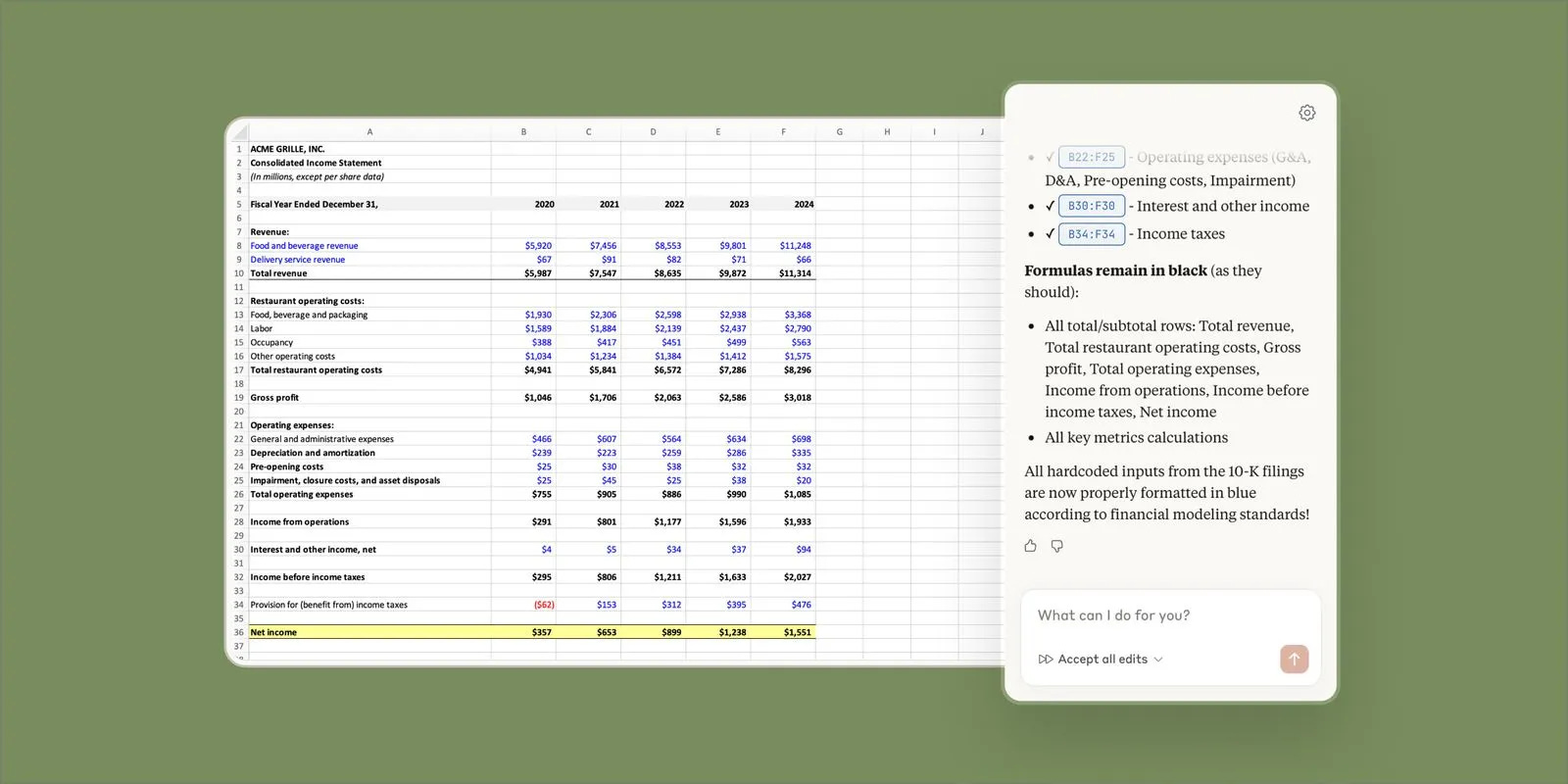
Anthropic just launched Claude in Excel. Same underlying model—Claude 4.5 powers both products.
The results aren’t even close.
Source: Anthropic
AIG deployed Claude and compressed their business review timelines by 5x. Data accuracy jumped from 75% to over 90%.
Norway’s $1.6 trillion sovereign wealth fund reported saving 213,000 hours of analyst time.
Meanwhile, I’ve talked to dozens of companies running Copilot. The feedback is consistent: “It’s nice. Saves some time. We’re not sure it’s worth the extra $30 per seat.”
Same intelligence. Same underlying capability. Completely different business outcomes.
Why?
The Architecture Question Nobody’s Asking
Microsoft built Claude as a formula writer. You ask a question, and the AI generates a VLOOKUP or a SUMIF or some combination of Excel functions. Then Excel executes those functions and returns the result.
Sounds reasonable. It’s how most enterprise AI works. The AI becomes a translation layer between natural language and the software’s existing capabilities.
The problem? The AI is now capped at what Excel formulas can express.
Think about that for a second. You’re paying for access to one of the most advanced AI systems ever built—capable of reasoning, pattern recognition, multi-step analysis. And you’ve constrained it to writing VLOOKUP statements.
Anthropic took a different approach. Claude performs the analysis directly. The AI reasons through the problem, does the actual analytical work, and uses Excel as a display layer for results.
The ceiling isn’t Excel’s capability. It’s the model’s capability.
This is the difference between AI as a tool assistant and AI as a thinking partner.
Why This Matters for Every AI Decision You Make
I’ve spent years watching technology transformations—some that delivered on the hype, most that didn’t. The pattern is always the same.
Companies that bolt new technology onto existing processes get incremental improvements. Maybe 10-20% better. Nice, but not game-changing.
Companies that rebuild processes around new capabilities get exponential improvements. 5x. 10x. Sometimes more.
The first group treats new technology as an accelerator for how they already work. The second group treats it as permission to work fundamentally differently.
Most enterprise AI deployments right now are firmly in the first camp.
Your vendors are selling you “AI-powered” versions of tools you already use. Behind the scenes, they’re routing your requests to an LLM, then constraining the output to fit what their legacy architecture can handle.
You’re paying for the model’s full intelligence. You’re receiving a fraction of it.
The Three Questions Every Executive Should Ask
I’ve started asking these questions in every conversation about AI investments. The answers tell you immediately whether you’re looking at a 5x opportunity or a 1.2x optimization.
Question 1: Does the AI perform the analysis, or does it write code for existing tools to execute?
This is the fundamental architecture question. If the AI is generating SQL queries, Excel formulas, or code snippets for other software to run—you’ve constrained it to that software’s ceiling.
If the AI performs the analysis directly and outputs results—you’re accessing the model’s actual capability.
Question 2: What’s the ceiling—the AI’s capability or the legacy system’s capability?
Every system has a ceiling. The question is which one limits you. A model writing Excel formulas can never exceed what Excel formulas can do. A model doing analysis directly can exceed what any spreadsheet was designed for.
Question 3: Can you show me results from customers who rebuilt workflows versus customers who automated existing ones?
This is where vendor marketing falls apart. Ask for case studies specifically from companies that redesigned their processes around AI capabilities. Compare those results to companies that just added AI to existing workflows.
The delta will tell you everything about whether the product is architected for transformation or optimization.
What the Production Deployments Tell Us
The companies getting real results aren’t using AI to do their old jobs faster. They’re using AI to do entirely different jobs.
AIG didn’t just automate their business reviews. They redesigned what a business review could be when an AI system can analyze thousands of data points in seconds instead of having analysts manually aggregate spreadsheets.
Norway’s sovereign wealth fund didn’t just speed up their existing analyst workflows. They rebuilt those workflows around what becomes possible when AI handles the pattern recognition and humans focus on judgment and decision-making.
The financial services industry is actually ahead of most sectors here. Firms like Citadel and Point72 have been building AI-native workflows for years. They understood early that the competitive advantage isn’t having AI—everyone will have AI. The advantage is rebuilding processes around AI capabilities.
The companies figuring this out now are creating gaps their competitors can’t close by optimizing harder.
The Vendor Problem
Here’s the uncomfortable truth about enterprise AI: most vendors have a structural incentive to constrain AI capabilities.
If Microsoft built an AI that could do actual analysis—not just write formulas—it would compete with Excel itself. Why would you need a spreadsheet if the AI could analyze data directly?
So they constrain the AI to be a better Excel assistant. The product improves incrementally. The existing business model stays intact.
This isn’t nefarious. It’s rational behavior given their position. But it means their incentives aren’t aligned with your transformation goals.
When you’re evaluating AI vendors, ask yourself: Does this company benefit from AI replacing their existing products, or from AI making their existing products stickier?
The answer shapes everything about how they’ve architected the solution.
What Changes From Here
I’m not suggesting you rip out every AI tool you’ve deployed. But I am suggesting you look at your AI portfolio through a different lens.
For each investment, ask: Is this tool using AI to reach a higher ceiling? Or using AI to get to the same ceiling faster?
Both have value. But only one delivers transformation.
The companies that get this right over the next two years will build advantages that compound. The ones that don’t will keep wondering why their AI investments feel underwhelming.
Same models. Same underlying intelligence. Architecture and workflow design determine whether you get 5x or 1.2x.
The model isn’t your moat. How you rebuild around it is.
What AI investments have you made that delivered less than expected? I’m curious if the architecture explains why. Hit reply—I read everything.