

Yesterday, OpenAI launched Frontier—an enterprise platform for building, deploying, and managing AI agents across your entire business.
The tech press called it “an agent management platform.” Fortune called it OpenAI’s bid to become “the operating system of the enterprise.” Gartner called agent management platforms “the most valuable real estate in AI.”
They’re all underselling it.
What OpenAI actually announced is just more validation of the research I put together early last year of where we are heading and why Founders, Business Executives and GTM operators need to pay attention that the future of enterprise revenue operations isn’t about better tools. It’s about building a nervous system—one that senses, processes, learns, coordinates, and acts across every system your business runs.
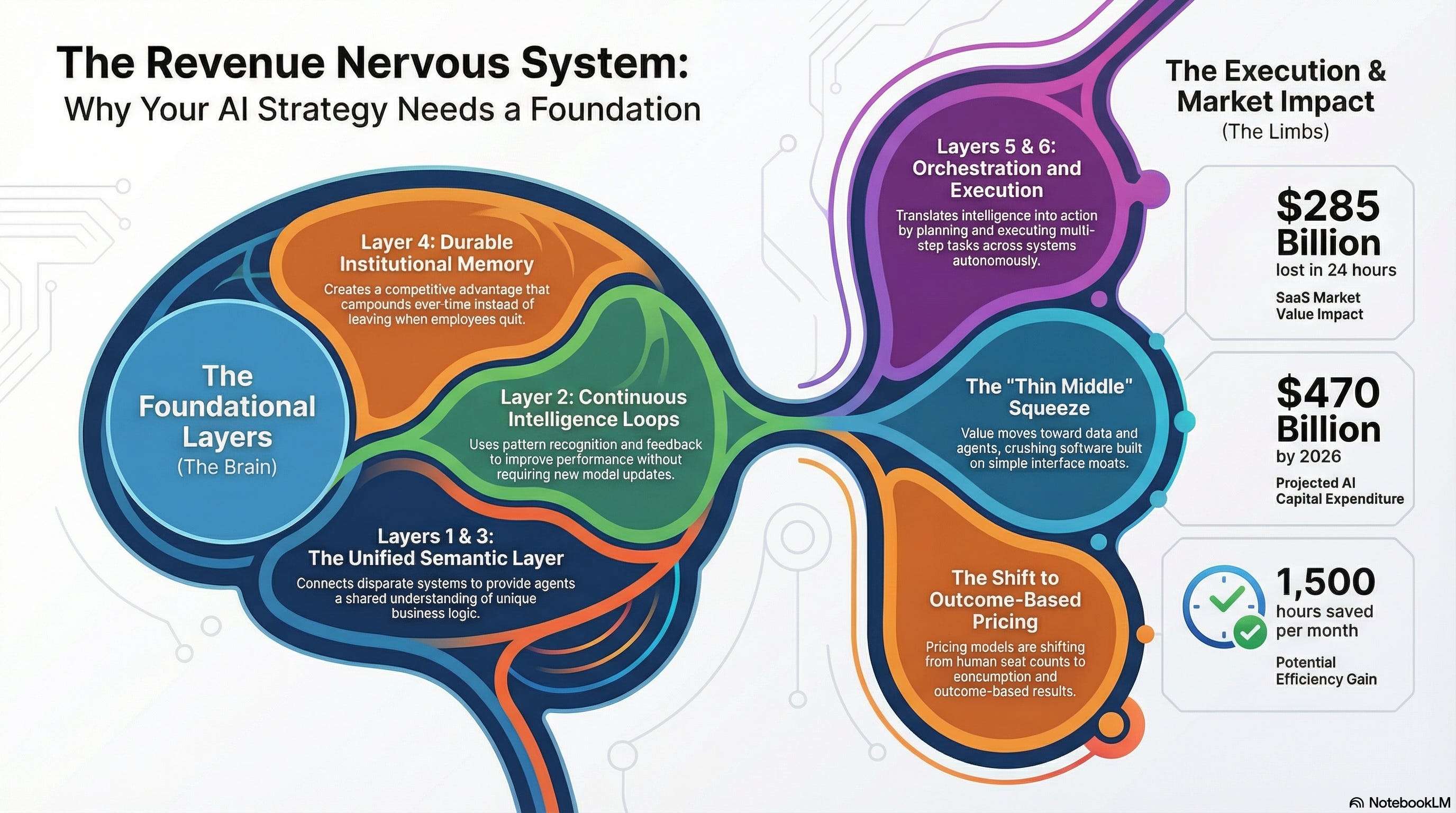
I’ve been writing about this exact architecture for over a year. I call it the Revenue Nervous System. And watching Frontier’s feature set unfold felt less like reading a product announcement and more like reading my own blueprint back to me—translated into OpenAI’s language.
The Architecture OpenAI Is Describing (Whether They Know It or Not)
Let me walk through what Frontier actually does, layer by layer. Because the parallels aren’t subtle.
Frontier creates a “semantic layer for the enterprise”—a shared context engine that connects data warehouses, CRMs, ticketing tools, and internal applications so agents can operate with a unified understanding of how your business actually works.
That’s the Data Layer and the Context Layer of the Revenue Nervous System. Layers 1 and 3. The sensory system that captures every signal, combined with the business logic engine that makes those signals meaningful.
Frontier gives agents “onboarding” and “institutional knowledge.” It builds what OpenAI calls “durable institutional memory” so agents understand not just what to do, but why—based on how your specific organization operates.
That’s the Memory Layer. Layer 4. The one I’ve been arguing is the most underrated competitive advantage in enterprise AI. The layer that compounds over time instead of walking out the door every time someone quits.
Frontier includes “built-in evaluation and optimization loops” that show what’s working and what isn’t, so agents improve with experience. Performance gets better over time, not just when someone ships a new model.
That’s the Intelligence Layer. Layer 2. Pattern recognition that gets smarter through continuous feedback, not periodic model updates.
Frontier provides an “orchestration” capability where agents can coordinate across systems, plan multi-step actions, run code, use tools, and work together in parallel to complete complex tasks.
That’s the Orchestration Layer. Layer 5. The coordinator that translates intelligence into action across your entire operation.
And Frontier enables autonomous execution across local environments, enterprise cloud infrastructure, and OpenAI-hosted runtimes—agents that actually do the work, not just recommend it.
That’s the Execution Layer. Layer 6. Where decisions become revenue.
Six layers. Six capabilities. The same architecture.
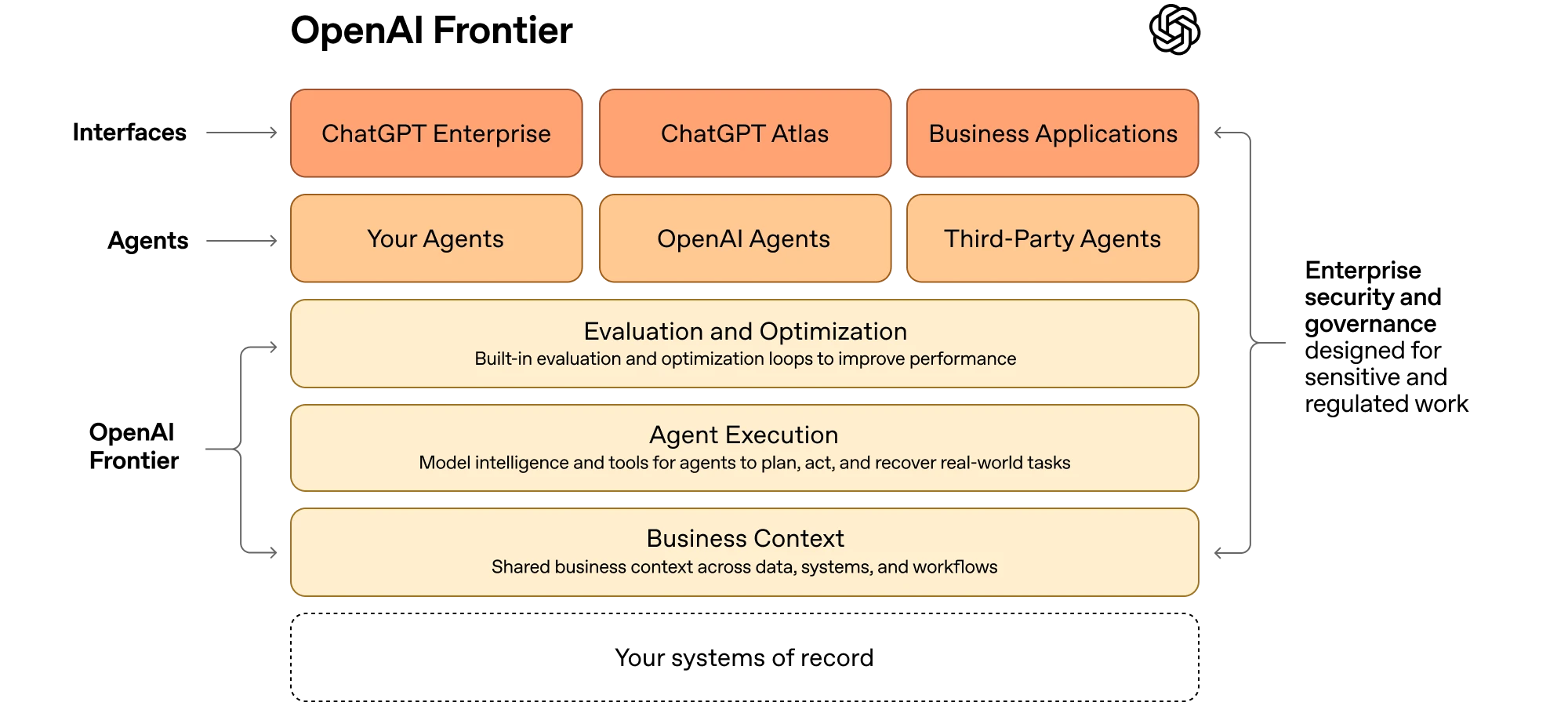
OpenAI didn’t cite the Revenue Nervous System when they built Frontier. They didn’t need to. The architecture is convergent because the problem is universal: enterprises need intelligence systems that sense, process, learn, coordinate, and act—continuously, autonomously, and at scale.
That’s not a product feature list. That’s a nervous system.
What Fidji Simo Accidentally Confirmed
Here’s the part that made me sit up in my chair.
Fidji Simo, OpenAI’s CEO of Applications, described her experience as CEO of Instacart—spending months integrating AI tools that each worked for one use case but “weren’t integrated or talking to one another.” Her exact words: “We were just reinforcing silos upon silos.”
This is the precise failure mode I’ve been warning about for the past year. Companies bolting AI agents onto existing workflows without building the underlying architecture. Efficiency theater. Linear improvements masquerading as transformation.
Simo said she “dreamed of one platform to create and manage all of an organization’s agents.” That dream isn’t just about convenience. It’s about the fundamental insight that AI agents without shared context, institutional memory, and coordinated orchestration are just faster versions of the same broken processes.
And here’s what makes this moment so critical: OpenAI is building the platform. But most companies still don’t have the architecture to use it.
The Layer Everyone Still Gets Wrong
Frontier is impressive. But it has the same blind spot that every major platform launch has had for the past two years.
It starts at Layer 5 and 6. Orchestration and Execution. The shiny stuff. The agents doing things.
And it works backward toward the foundational layers—data, context, memory, intelligence—as supporting infrastructure.
The Revenue Nervous System works the other way. Foundation first. Execution last.
Here’s why that matters.
A global financial services firm using Frontier reportedly got “90% more time back for their client-facing team.” A tech company saved “1,500 hours a month in product development.” Those numbers are real, and they’re meaningful.
But they’re linear improvements. Efficiency gains. Doing the same work faster.
Compound intelligence—the kind that creates insurmountable competitive advantages—requires something different. It requires the Memory Layer to accumulate institutional knowledge over time. It requires the Intelligence Layer to recognize patterns across millions of interactions. It requires the Context Layer to apply your unique business logic to every signal.
Without those foundational layers, Frontier gives you faster agents. With them, Frontier gives you agents that get exponentially smarter every single day.
That’s the difference between AI-enabled and AI-native.
And it’s a difference that most companies deploying Frontier won’t understand until their competitors—the ones who built the foundation first—start pulling away at a pace that can’t be matched.
The $285 Billion Wake-Up Call
Last week, Anthropic released a set of plugins for Claude Cowork. Not a new model. Not a chatbot upgrade. Plugins. Within 24 hours, software stocks lost $285 billion in market value. A plugin marketplace announcement erased more wealth in a single day than most industries generate in a year.
Look at the carnage: Salesforce (CRM) down 44%. ServiceNow (NOW) down 48%. Intuit down 47%. Oracle down 55%. HubSpot down 72%. Atlassian (TEAM) down 68%. Even Microsoft dropped 26%.
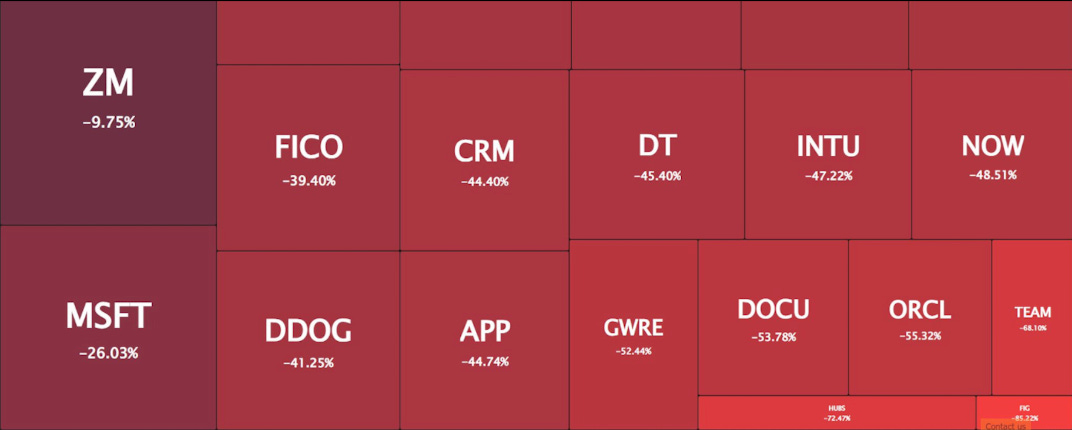
Wall Street isn’t scared of AI anymore. They’re scared of what AI replaces.
And now, 48 hours later, OpenAI launches Frontier—a platform that lets AI agents log into your existing tools and execute entire workflows autonomously across every system your business runs. If anyone thought the Cowork plugins were the wake-up call, Frontier is the alarm that won’t turn off.
Here’s what’s actually dying. It’s not software. Companies will spend more on software this year than ever—enterprise AI capital expenditure alone will exceed $470 billion in 2026. What’s dying is a very specific type of software business: the one built on a nice UI over someone else’s data, charged per seat, with switching costs as the moat.
I think of it as the Thin Middle Squeeze. Picture three layers in the enterprise stack:
The top layer is the AI agent—the thing that actually executes the work. The bottom layer is the system of record—the databases, CRMs, and ERPs that store the real data. And the middle layer is the SaaS UI—the dashboards, the workflows, the buttons humans click.
Value is getting sucked upward into the agent layer and downward into the data layer. Everything in the thin middle gets crushed.
That’s why Adobe’s forward P/E dropped from 30 to 12. Not because people don’t need what they do—but because investors realized the moat around “nice UI plus integrations” is paper-thin when an AI agent can bypass the UI entirely. The interface used to be the product. Now it’s just a shell.
If 10 AI agents can do the work of 100 employees, you don’t need 100 Salesforce seats anymore. AI doesn’t kill the software directly. It kills the headcount that justifies the per-seat pricing. Which kills the revenue model. Which kills the business.
This is precisely what the Revenue Nervous System framework predicted. When your intelligence architecture sits above individual applications—when the Data Layer, Context Layer, Memory Layer, and Intelligence Layer operate as a unified system—the execution tools become interchangeable commodities. Salesforce, HubSpot, Outreach, whatever—they become endpoints in a nervous system, not the system itself.
Frontier accelerates this by being model-agnostic and platform-agnostic. It works with OpenAI agents, your custom agents, and third-party agents from Google, Microsoft, and Anthropic. It doesn’t care where the system of record lives. It just orchestrates work across all of them.
The money isn’t disappearing. It’s moving. Moving into AI platform subscriptions priced on consumption, not seats. Moving into systems of record that agents need as authoritative data sources. Moving into security, governance, and compliance infrastructure. Moving into outcome-based pricing—”$5 per contract reviewed” instead of “$99/seat/month.” And moving into services, because making AI actually work inside a real business is a different story than deploying a demo.
Here’s the irony nobody is talking about: Frontier itself is a SaaS product. Sold via subscription. To organizations. On the internet. SaaS as a delivery model is fine. It was always fine. SaaS as a business strategy built on shallow moats and per-seat pricing for commodity workflows—that’s what’s over.
Companies that understand where value is moving will restructure their entire tech stack around intelligence architecture. Companies that don’t will keep paying for seats nobody sits in while the thin middle collapses beneath them.
The 18-Month Window Just Got Shorter
I’ve been writing about an 18-24 month competitive window for AI-native transformation. The math is straightforward: compound intelligence systems exhibit S-curve adoption patterns where early advantages are modest, but once critical mass is achieved, performance improves exponentially. Companies that start after competitors reach this inflection point find themselves competing against exponentially improving opponents with only linear improvement capabilities.
Frontier just compressed that timeline.
Not because the platform itself is revolutionary—it’s the natural evolution of what we’ve been watching for two years. But because it makes the Execution Layer accessible to every Fortune 500 company. OpenAI is removing the biggest friction point that was slowing enterprise adoption: the complexity of getting agents into production.
That means the companies who already have their foundational layers in place—the Data Layer, the Context Layer, the Memory Layer, the Intelligence Layer—can now plug Frontier in and immediately start compounding. While companies still debating their “AI strategy” will watch the gap widen in real time.
The window didn’t shrink because the technology changed. It shrank because the barrier to execution just dropped to nearly zero.
What To Do About It (Starting Monday Morning)
If you’re a revenue leader reading this, here’s what matters right now.
Stop evaluating Frontier as a product. Start evaluating your readiness for the architecture it requires. Ask yourself: Do we have a unified data foundation that captures every revenue signal? Do we have a context engine that applies our specific business logic? Do we have institutional memory that compounds over time? Do we have intelligence capabilities that recognize patterns and predict outcomes?
If the answer to any of those is no, Frontier will give you faster agents doing dumb things. That’s expensive automation, not transformation.
Build your Memory Layer before anything else. This is still the most underinvested capability in enterprise AI. Every interaction, every campaign result, every sales conversation, every customer success intervention should be feeding a learning system that gets smarter over time. This is the layer that creates compound advantages. And it’s the layer that Frontier is explicitly designed to leverage through what OpenAI calls “durable institutional memory.”
Map your Revenue Nervous System architecture. Every layer. Every connection. Every feedback loop. Understand where your signals flow, where your intelligence lives, where your context is applied, where your memory accumulates, how your decisions get coordinated, and where your actions execute. Then—and only then—decide which platforms fill which gaps.
Treat this as an architectural decision, not a vendor decision. Frontier, Agentforce, Copilot, Claude Cowork—they’re all execution surfaces. The competitive advantage isn’t in which platform you choose. It’s in the intelligence architecture underneath.
The Real Headline
The real story of OpenAI Frontier isn’t that OpenAI launched another enterprise product. It isn’t that SaaS stocks dropped. It isn’t even that agents can now manage other agents.
The real story is this: the largest AI company in the world just validated that enterprise AI isn’t about better tools. It’s about building a system that senses, processes, learns, coordinates, and acts—continuously, autonomously, and at scale.
A nervous system.
The companies that already understand this architecture have a head start that’s about to become permanent.
The companies that don’t—even the ones who sign up for Frontier tomorrow—will discover that the most sophisticated execution platform in the world can’t compensate for missing intelligence architecture.
The foundation always comes first. The agents come second.
OpenAI just made the agents easy. The question is whether you’ve built the nervous system they need to be smart.
If you’re building your Revenue Nervous System and want to go deeper on the six-layer architecture, subscribe to this newsletter. I break down the framework, the implementation roadmap, and the competitive dynamics every week—with real data, not hype.
And if you want to talk about what this means for your specific organization, reach out. The window is closing faster than most people realize.