

The Stories
Anthropic Accidentally Leaked Its Most Dangerous Model
The noise: breathless coverage of “Mythos,” the secret model tier above Opus that Anthropic says is too dangerous to release. Cybersecurity exploitation capabilities. Pentagon contracts. $380B valuation. The mystery box is doing its job.
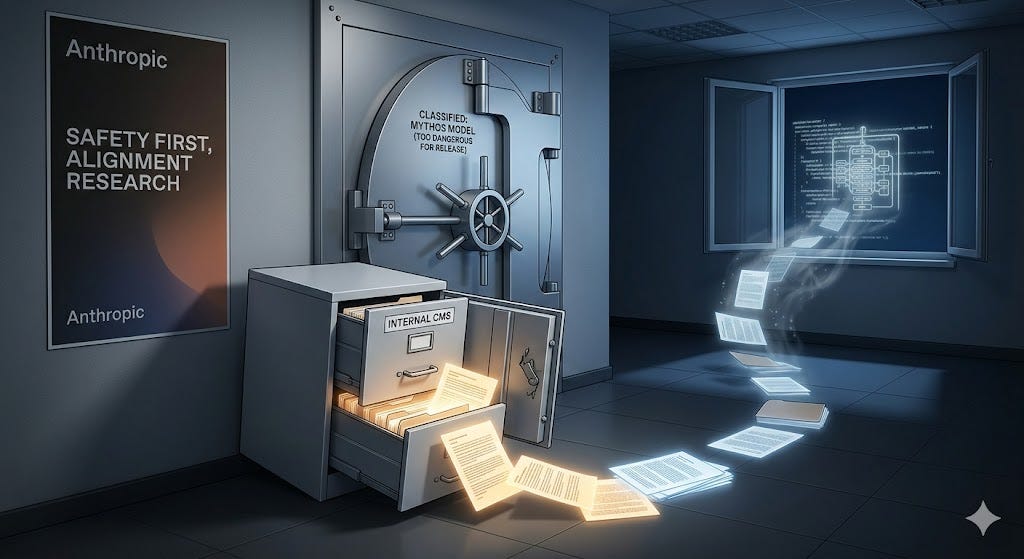
The signal: A safety-focused company exposed 3,000 internal files through a CMS misconfiguration. Forget the model for a second. The company whose entire brand is “we’re the responsible ones” just demonstrated that operational security is harder than alignment research. The model itself might be genuinely dangerous. The leak proving Anthropic can’t secure its own CMS? That’s a different kind of dangerous. Consumer subs doubling and an $18B revenue target tell you the business is working. The question is whether “too dangerous to release” becomes a moat or a liability.
OpenAI Killed Sora. Nobody Should Be Surprised.
The noise: AI’s first major product death. The end of an era. Video generation dreams dashed.
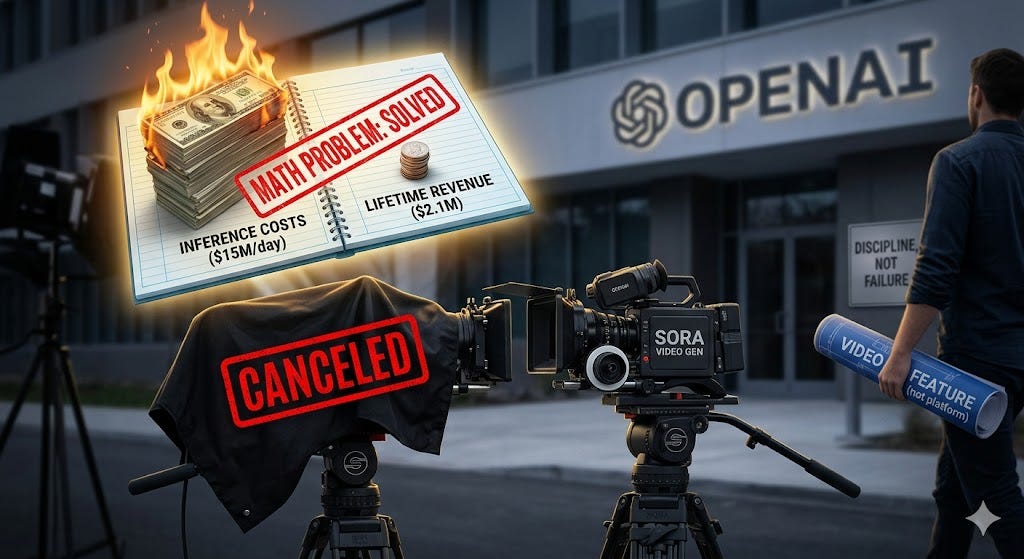
The signal: $15M per day in inference costs against $2.1M in total lifetime revenue. That’s not a product death. That’s a math problem that finally got solved. Sora was always a demo dressed up as a product. The real story: OpenAI at $850B valuation and $20B+ ARR can afford to kill things that don’t work. That’s a sign of discipline, not failure. Video generation stays in ChatGPT for subscribers, which is exactly where it belongs: a feature, not a platform.
The White House Wants to Preempt Every State AI Law
The noise: the National AI Policy Framework is either “pro-innovation” or “regulatory capture,” depending on which side of the aisle you read.
The signal: this framework has already failed legislatively twice. It’s sector-specific, creates no new regulatory body, and preempts state laws. Translation: the federal government wants to prevent a patchwork of 50 state regulations without actually regulating anything itself. Industry loves it because the alternative is California writing the rules for everyone. Whether you think that’s good or bad depends on whether you trust sectors to regulate themselves. (History says no.)
Claude Code’s Auto Mode Changes the Developer UX Game
The noise: incremental product update. Classifier-based permissions. Less clicking.
The signal: the approval loop was the single biggest friction point in AI-assisted coding. Every time a developer had to click “yes, proceed” for an obvious action, the tool lost momentum. Auto mode is Anthropic betting that the classifier can distinguish between “rename this variable” and “delete the production database” well enough to remove the human from routine decisions. If it works, this is the kind of UX shift that changes daily adoption numbers, not quarterly strategy decks.
OpenAI Bought Six Companies in 2026. That’s Not a Model Company.
The noise: OpenAI acquired Astral (uv, Ruff) and Promptfoo. Smart picks. Developer tooling. Evaluation infrastructure.
The signal: six acquisitions in a single year. Add the $50B Amazon partnership for stateful agent runtime on Bedrock. This is a platform company building distribution, not a research lab building models. Sam Altman is running the Microsoft playbook: own the developer toolchain, own the cloud runtime, own the ecosystem. The model becomes the kernel nobody thinks about. Whether that’s good for the industry depends on how tightly they lock the stack.
MCP Hit 97 Million Monthly SDK Downloads
The noise: protocol adoption numbers go up. Good for Anthropic.
The signal: 4,750% growth in 16 months. That’s not adoption. That’s infrastructure. When a protocol layer hits this kind of trajectory, it stops being a feature and starts being a standard. MCP is becoming the USB-C of AI agent connectivity. The companies not building MCP integrations today will be retrofitting them in six months.
Atlassian Cut 1,600 People and Blamed AI
The noise: another round of tech layoffs dressed up as strategic transformation.
The signal: “AI pivot” is becoming the “blockchain strategy” of 2026. When a company lays off 10% of its workforce and leads the press release with AI, the community calls it correctly: cost-cutting with better PR. The real AI pivots are happening at companies that are hiring into new roles, not cutting existing ones. Watch what companies build, not what they say during layoff announcements.
Google Went From 5.4% to 18.2% Chatbot Market Share in a Year
The noise: Gemini is catching up. Google is back in the AI race.
The signal: the fastest growth trajectory in the market, driven by the most aggressive pricing anyone has seen. Gemini 3 at $2/$12 per million tokens is a price that forces everyone else to respond. Google is doing what Google always does: subsidize adoption with infrastructure advantages nobody else can match. DeepMind’s research pipeline feeding directly into products that run on Google’s own chips and cloud. The 114 model price changes across the industry in March alone tell you this pricing war is unsustainable for everyone except the company that owns the data centers.
Meta Shipped Open-Weight MoE Multimodal Models
The noise: Llama 4 Scout and Maverick are here. Open source wins again.
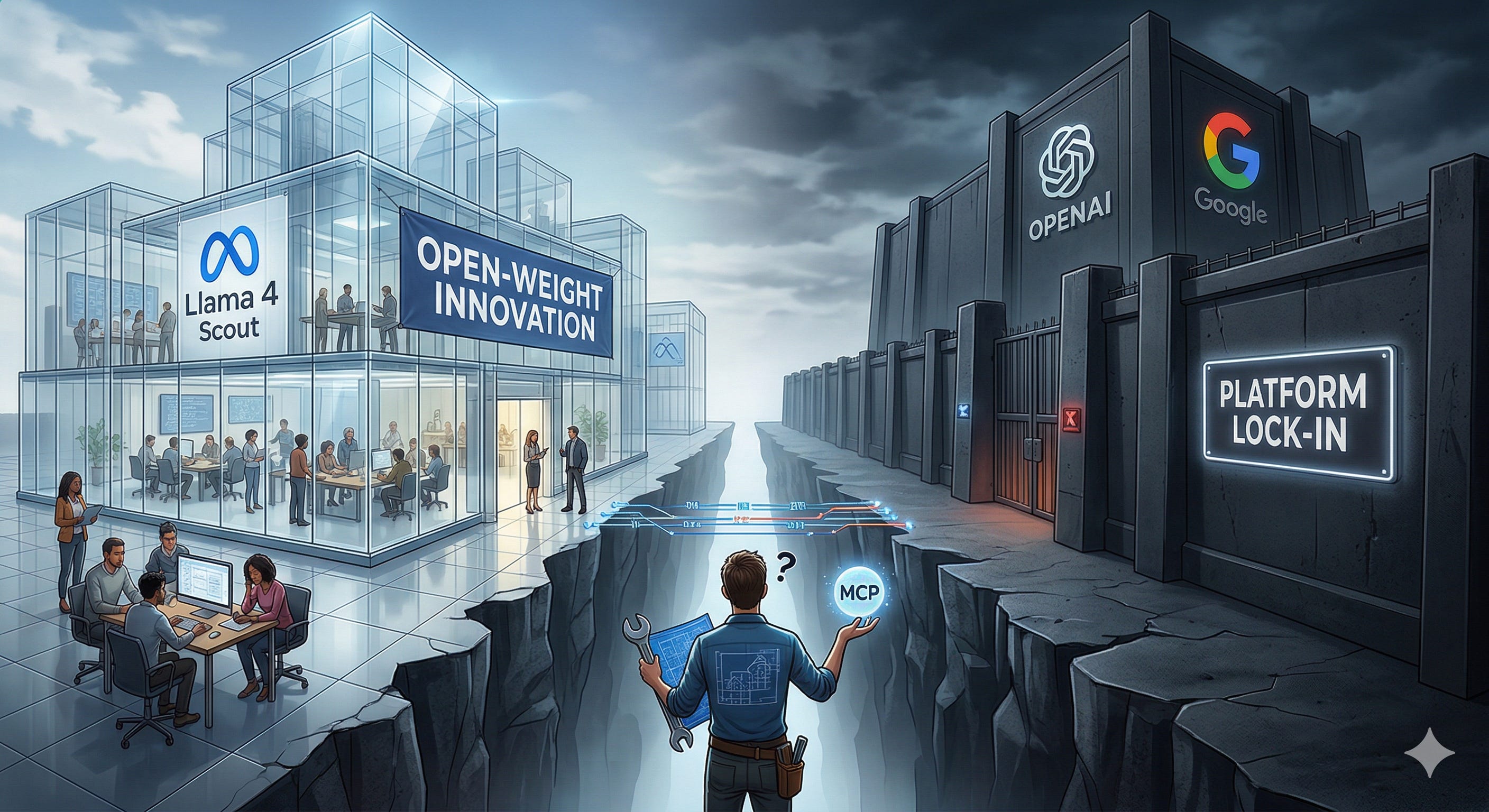
The signal: Meta keeps commoditizing the model layer, and every release makes the gap between open-weight and proprietary models smaller. Mixture-of-experts architecture in open weights means smaller companies can run competitive models on reasonable hardware. LlamaCon on April 29 will likely accelerate this. The strategic play is clear: if models are commoditized, the value moves to applications, data, and distribution. Meta has all three.
Robotics Got $1.2 Billion in March Alone
The noise: LeCun’s AMI Labs raised $1.03B. Physical AI is the next frontier.
The signal: JEPA architecture (Joint Embedding Predictive Architecture) is LeCun’s bet that the path to general intelligence runs through world models, not language models. A billion dollars says he’s not alone in that belief. The robotics funding surge is the market saying that software-only AI is approaching diminishing returns for certain problem classes. Moving atoms, not just bits, is where the next decade of value creation lives. And unlike software agents, physical robots need real-world training data that can’t be synthesized from the internet. That data moat is why the money is moving now, before the window closes.
Perplexity Launched a “Personal Computer.” Yes, Hardware.
The noise: a search company is selling an always-on Mac mini AI agent. Quirky pivot.
The signal: Perplexity is testing a thesis that matters. The browser is a bad form factor for AI agents that need persistent context, local file access, and always-on availability. An always-on device that runs your AI agent locally solves the context window problem by never closing the session. It’s early, probably too early. But the insight underneath is correct: cloud-based chat interfaces are a transitional form factor. The companies thinking about what comes after the chat window will define the next generation of AI UX.
OpenAI Foundation Pledged $1B for 2026
The noise: OpenAI is serious about safety. Zaremba is leading. Big number. Good optics.
The signal: context matters. This is the same organization that made six acquisitions, partnered with Amazon for $50B, and killed Sora when the economics didn’t work, all in the same quarter. A billion dollars in safety funding against that backdrop is either genuine commitment or the cost of maintaining a narrative while you scale as fast as possible. The proof will be in what the foundation actually funds, who has independence to publish findings that embarrass the parent company, and whether any of it slows down the commercial roadmap. I’ll believe it when I see a safety finding delay a product launch.
The Pattern
Two forces defined this week. The first: the split between “too dangerous” and “too expensive.” Anthropic won’t ship Mythos because of safety concerns. OpenAI killed Sora because the economics didn’t work. These are fundamentally different reasons for products not reaching users, and the industry needs to stop conflating them. Safety decisions and business decisions require different frameworks, different oversight, and different public accountability.
The second: the platform war is over before most people realized it started. OpenAI’s six acquisitions, Amazon’s $50B partnership, MCP’s infrastructure trajectory, Google’s pricing aggression. These aren’t companies competing on model quality anymore. They’re competing on ecosystem lock-in, developer toolchains, and distribution. The model layer is being commoditized from above (proprietary platforms) and below (open-weight releases from Meta). The winners will be decided by who owns the integration points, not who has the best benchmark score.
If you’re building on AI right now, the question isn’t which model to use. It’s which platform you’re willing to be locked into for the next five years.