

The average company runs 106 SaaS applications. Let that number sit for a second.
Not 106 features. Not 106 integrations. 106 separate tools, each with its own data model, its own vendor, its own update cycle, and its own team of people who decided to adopt it without asking the person three desks over if it would play nicely with what they already had.
Now here’s where it gets uncomfortable. In a stack that size, the number of possible integration points doesn’t grow linearly. It grows quadratically. Add one tool and you don’t add one unit of complexity -- you add 106 potential new interconnections. Your management infrastructure is still linear. Your calendar still has 24 hours in it. Your RevOps team still has a headcount it can fill.
That gap -- between quadratic complexity and linear management -- is where GTM systems break. Not at the tool level. At the interaction layer between them.
And AI is not closing that gap. In most companies, it’s widening it.
GTM Is Not a People-and-Process Problem Anymore
I’ve spent 21 years building GTM systems at companies across health tech, real estate, clean energy, education, logistics. At every stage of that career, the dominant assumption was the same: if you hire the right people, define the right process, and hold people accountable to the right metrics, revenue follows.
That assumption worked -- until it didn’t.
Go-to-market today requires real-time signal detection across hundreds of accounts simultaneously. It requires dynamic lead scoring that adapts to behavioral patterns in hours, not quarters. It requires cross-functional handoffs that happen in hours, not weeks. It requires customer health models that synthesize product usage, support tickets, NPS scores, and billing data into one score, routed to the right person at the right moment.
No team of humans can run that by hand. Not because they aren’t talented -- because the problem has outgrown the operating model.
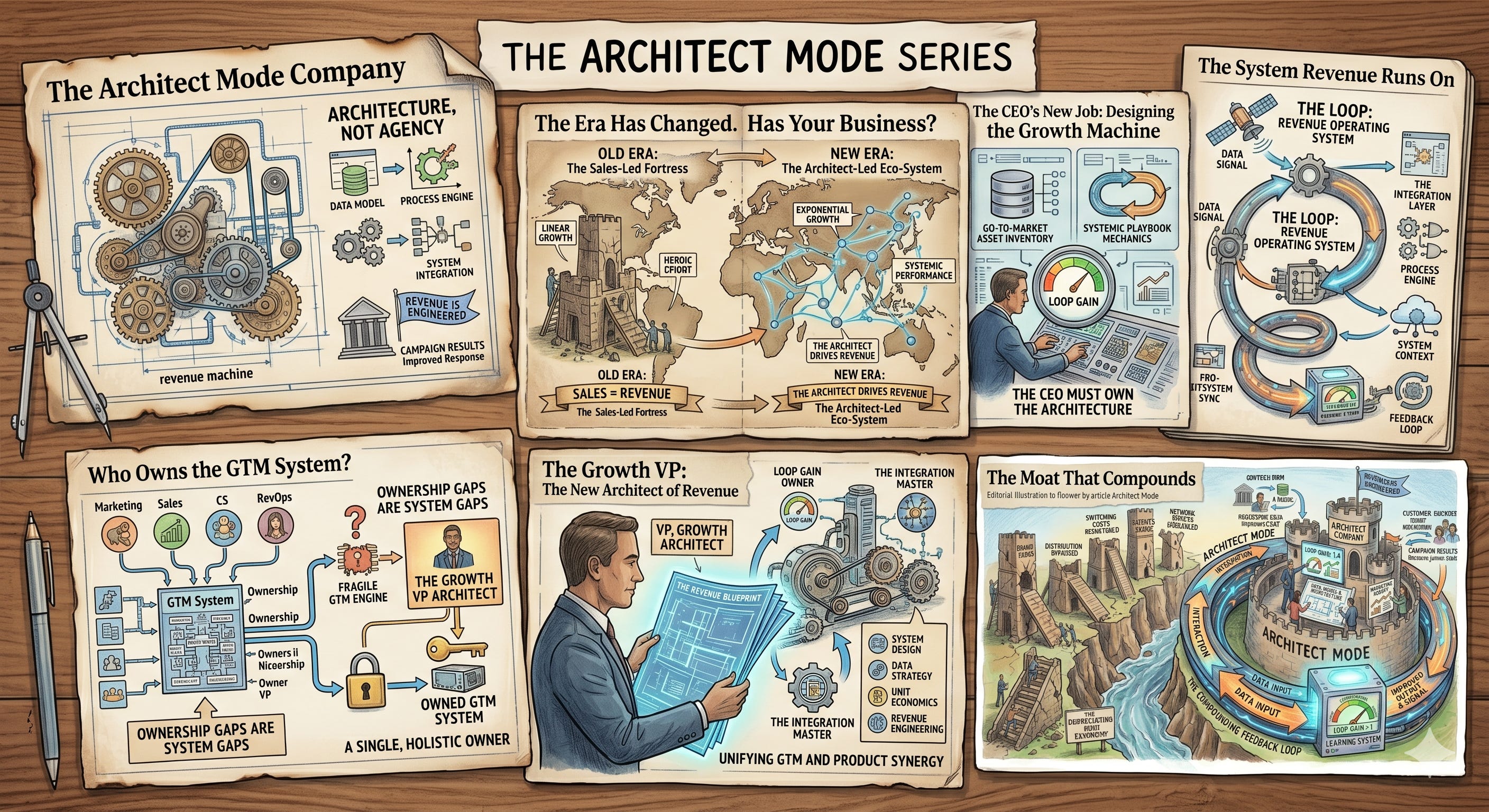
GTM is a system. Not a collection of people with aligned OKRs. Not a set of functions with shared reporting. A system -- with inputs, processes, feedback loops, and compounding outputs. And the companies treating it like a people-and-process operation are going to fall behind companies that treat it like an engineering problem. Not eventually. Already.
The harder part: most companies don’t have a system. They have a collection of functions that happen to share a CRM.
What AI Is Actually Doing to This Problem
Here’s where the complexity problem gets a second layer. While RevOps teams are consolidating tooling and trying to get governance in place, another department just adopted eight new AI tools without telling anyone. Marketing is running three different AI content workflows. Sales is using AI for prospecting, for call summarization, for follow-up sequencing. CS adopted something for churn prediction. Product has its own data pipeline.
None of it connects. No one reviewed it. No one has visibility into the interaction layer between any of it.
Agent sprawl is the new SaaS tool sprawl, at 10x the speed. A 200-person company with 3 employees each building two AI agents is suddenly running 600 disconnected systems. No procurement. No governance. No one who owns how the outputs from one agent become the inputs to another.
This is not a hypothetical scenario. It’s what’s happening inside GTM organizations right now.
And here is the thing about AI that everyone needs to understand before they deploy another one of these tools: AI is a multiplier, not a corrector. It amplifies whatever it touches. Clean processes plus AI delivers dramatically faster, dramatically more effective output. Broken processes plus AI delivers dramatically worse output, at scale.
An AI layer dropped onto a broken foundation produces outputs that look authoritative and say nothing accurate. The AI isn’t malfunctioning -- it’s doing exactly what it was designed to do: synthesizing the inputs it receives. When those inputs are garbage, the outputs are confident garbage.
Jacco van der Kooij at Winning by Design put it precisely: “A wrong answer you can catch. A hallucinated strategy looks right.”
That’s the failure mode no one is talking about clearly enough. A wrong forecast gets caught in the next pipeline review. A hallucinated growth strategy -- one that looks rigorous, cites internal data, passes the sniff test of a board presentation -- runs for quarters before anyone traces the problem to its source.
The Right Sequence (Most Companies Are Doing It Backward)
There is a right order for deploying AI in GTM. Four stages have to be in place for AI to deliver its best work:
Data -- Process -- System -- Application
Most companies start at Application. There’s a compelling demo. There’s a visible ROI story. The vendor makes it look easy. So they skip to the end and patch backward when it fails.
Here’s what patching backward costs you: a disconnected system cannot learn. Every AI initiative that lives on disconnected data stays local. It doesn’t compound. The learning from this quarter’s outbound motion doesn’t feed into next quarter’s customer success motion. The signal that close-won deals generate doesn’t improve the prospecting model upstream.
You end up with AI-assisted points of productivity -- individual efficiency gains scattered across the org -- instead of a system that gets smarter with every interaction.
Playing the long game means building in the right order. Not perfectly -- you don’t perfect each stage before connecting to the next. But you do get each stage functional enough that the system can start teaching you what to improve. The sequence is the discipline.
