

Microsoft saw the cloud coming and rebuilt. IBM saw it and flinched. Both had the same data. Both had the resources. The difference was a decision made in a room, by people who either had the stomach for architectural reinvention or didn’t.
Redpoint’s 2026 deck says every software company is standing at that same fork right now. I agree. I’ve spent the last year inside a 20-year-old healthcare software company with thousands of customers trying to force exactly this kind of reinvention. And I can tell you the hardest part isn’t the strategy. It’s not even the technology. It’s the moment someone in the room says “but our margins are fine” and everyone exhales, because that sentence is the most comfortable way to avoid the uncomfortable conversation.
“Have a re-founding moment” is investor language. Operators need a playbook.
The Incumbents Are Telling On Themselves
Before we get to the how, let’s sit with the why. Redpoint surveyed executives at Fortune 500 companies and the quotes are devastating -- not because they’re surprising, but because they’re specific.
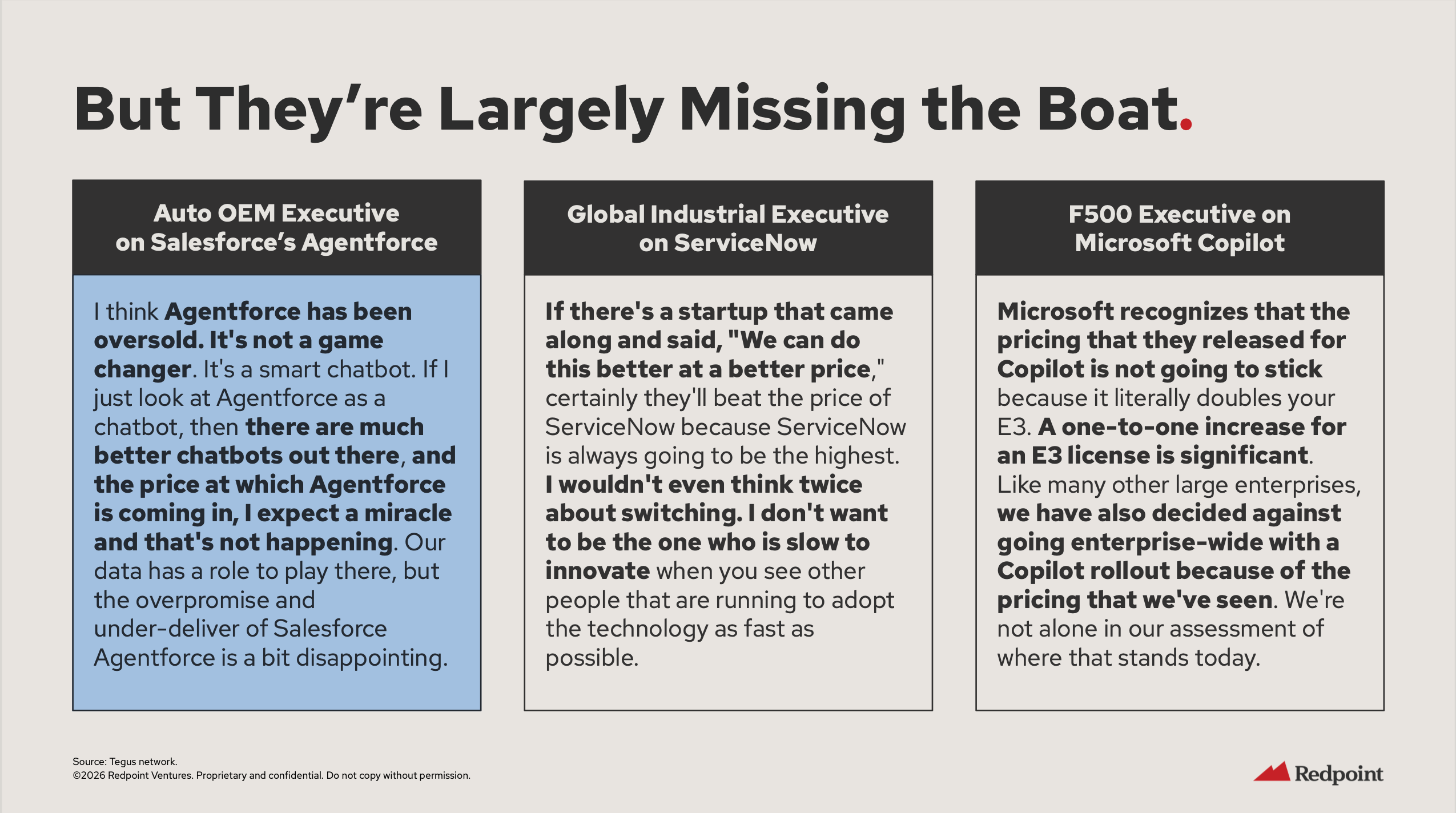
An auto OEM exec on Salesforce’s Agentforce: “I think Agentforce has been oversold. It’s not a game changer. It’s a smart chatbot. If I just look at Agentforce as a chatbot, then there are much better chatbots out there, and the price at which Agentforce is coming in, I expect a miracle and that’s not happening.”
A Fortune 500 exec on ServiceNow: “If there’s a startup that came along and said, ‘We can do this better at a better price,’ certainly they’ll beat the price of ServiceNow because ServiceNow is always going to be the highest. I wouldn’t even think twice about switching.”
Another Fortune 500 exec on Microsoft Copilot: “Microsoft recognizes that the pricing that they released for Copilot is not going to stick because it literally doubles your E3.”
These aren’t analysts speculating. These are buyers -- the people writing checks -- saying out loud that the emperor’s AI clothes don’t fit. When your biggest customers describe your flagship AI product as “a smart chatbot” and your pricing as “expecting a miracle,” you don’t have a product problem. You have a credibility problem.
And credibility, unlike software, can’t be patched in a sprint.
The Rosetta Stone
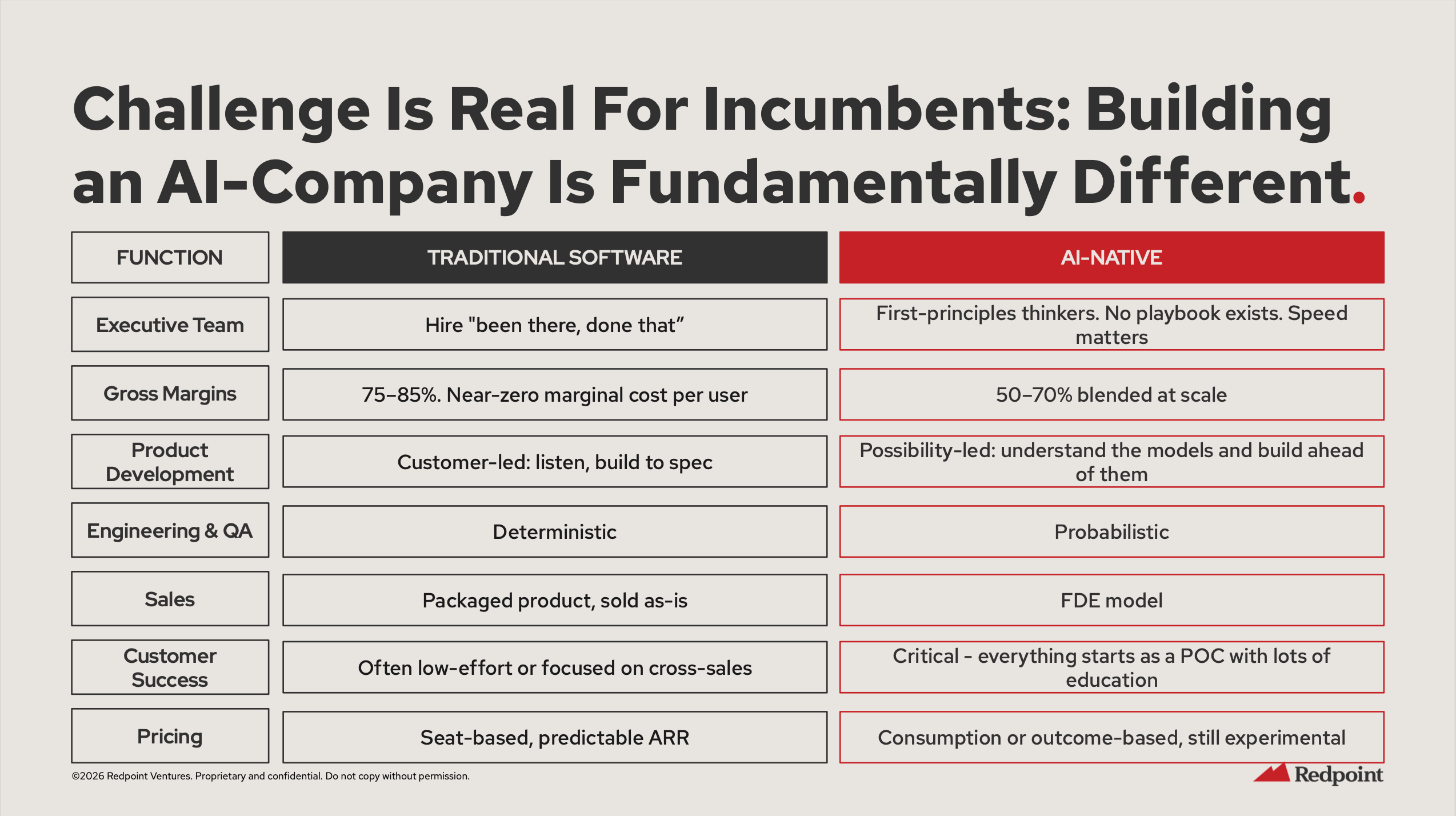
The most useful slide in Redpoint’s entire 60-page deck is page 43. It’s a simple two-column comparison: Traditional SaaS vs. AI-Native. I’ve stared at it for weeks now, and every time I look, I see a different failure mode in my own organization.
Let me walk through what this actually means when you’re sitting in the chair.
Executive Team. Traditional: “been there done that.” AI-Native: “First-principles thinkers. No playbook exists. Speed matters.” I’ve been in rooms where the most senior person’s primary qualification is having scaled a SaaS company in 2014. That experience is now a liability dressed up as a resume line. The playbook they ran -- PLG motion, land-and-expand, seat-based pricing -- was built for a world where software was deterministic and customers needed training. That world is gone.
Product Development. Traditional: customer-led (listen, build to spec). AI-Native: possibility-led (understand models, build ahead). This one cuts deep. I spent years building the muscle of “talk to customers, build what they ask for.” It’s good practice. It’s also a guaranteed way to build yesterday’s product. When your customer asks for a better dashboard, they’re not asking for the agent that could eliminate the need for the dashboard entirely. Customer-led development in an AI world means your roadmap is always one paradigm behind.
Engineering. Traditional: deterministic. AI-Native: probabilistic. This isn’t just a technical distinction -- it’s a hiring filter, a QA philosophy, and a product liability question all wrapped into one word. I watched a team spend three months trying to make an LLM-powered feature pass the same regression test suite they use for their REST APIs. The tests kept “failing” because the outputs varied. The outputs were supposed to vary. That’s the whole point.
Sales. Traditional: packaged product sold as-is. AI-Native: Forward-Deployed Engineer model. You know what FDE means in practice? It means your first 50 customers each get a slightly different product. It means your sales team needs to understand what the technology can do, not just what the current SKU does. I watched a sales rep demo our traditional product for 45 minutes and then spend 5 minutes on the AI features because -- his words -- “I don’t want to promise something that might work differently next week.” He’s not wrong. But that instinct will kill you.
Pricing. Traditional: seat-based, predictable ARR. AI-Native: consumption or outcome-based, experimental. This is the one that makes CFOs break out in hives. Seat-based pricing is beautiful. It’s predictable. It makes forecasting easy. It also has nothing to do with value delivery in an AI world. When one agent can do the work of ten seats, you’re either charging for outcomes or you’re watching your TAM collapse. We tried floating outcome-based pricing internally. Finance asked how to model it. I said, “You can’t, not yet.” That meeting ended early.
The Re-Founding Moment
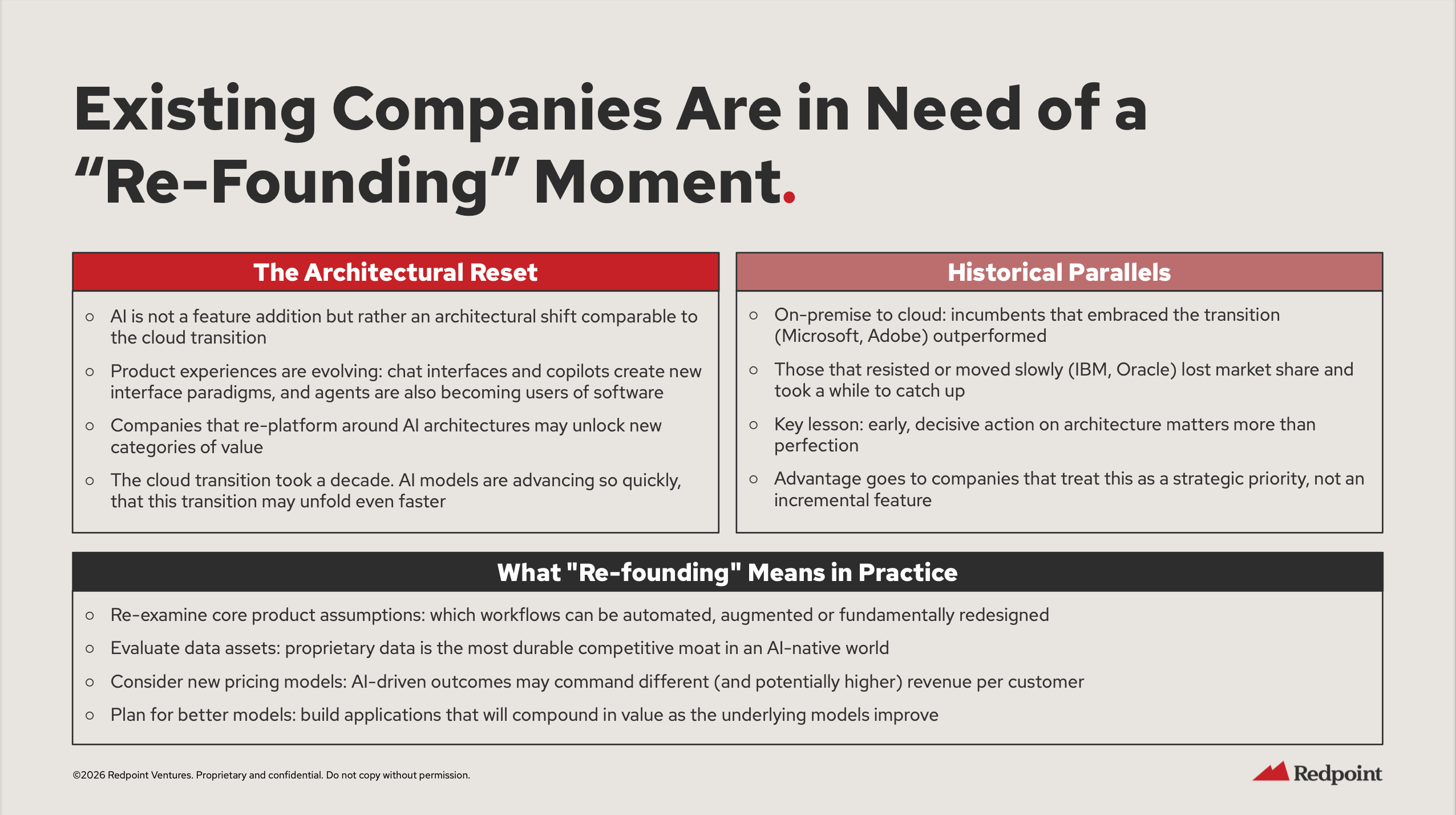
Redpoint frames this as an architectural shift comparable to the cloud transition. They point to historical parallels: Microsoft and Adobe embraced cloud and outperformed. IBM and Oracle resisted and lost share.
That framing is correct and completely unhelpful.
Here’s why: when Microsoft went to cloud, Satya Nadella had a $400 billion balance sheet and could afford to cannibalize Office for a decade. When Adobe moved to subscriptions, they had a near-monopoly in creative tools and could weather the transition dip. The lesson isn’t “be brave like Satya.” The lesson is “you probably don’t have Satya’s margin of error, so you need a different plan.”
