

There’s a photo going around that stopped me mid-scroll.
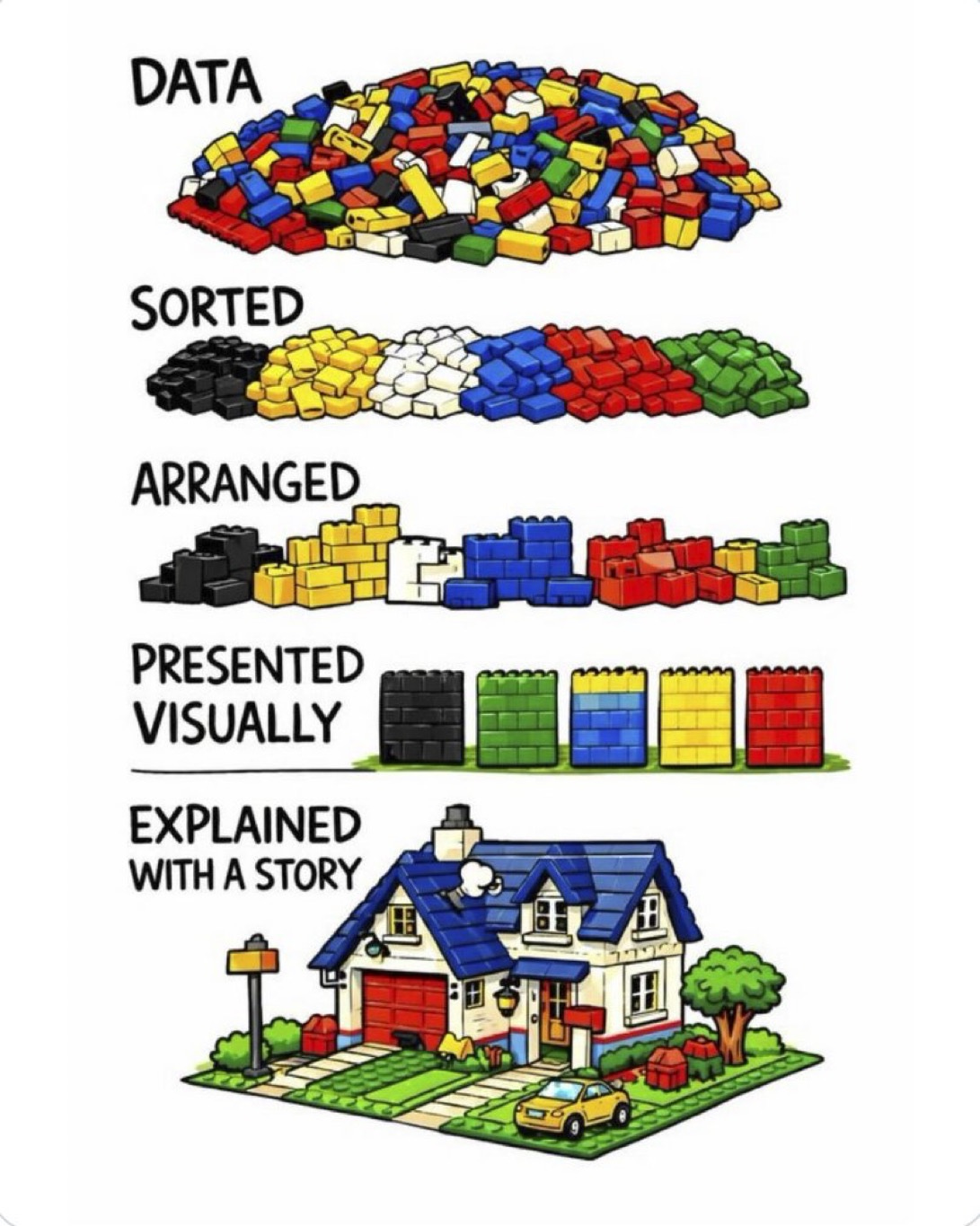
It’s a series of LEGO images. First, a pile of loose bricks in every color — total chaos, no structure. Then sorted by color. Then arranged in neat rows. Then stacked into clean columns as a bar chart. Then, finally, built into a house.
Five stages. Same bricks. Radically different outcomes.
The label at the top reads: DATA.
The label at the bottom reads: EXPLAINED WITH A STORY.
I’ve been thinking about it for three days. Because that image isn’t just about data visualization. It’s about where AI is about to fundamentally break the enterprise open — and why most companies are still living in stage two or three wondering why nothing works.
We’re All Sitting on a Pile of Bricks
Here’s what I’ve seen at every company I’ve worked with — from Verizon’s $260M P&L to REEF’s physical network to what we’re building right now at Experity: organizations have more data than they’ve ever had, and fewer answers than they’ve ever needed.
The data exists. Usually a lot of it. CRM records, EHR transactions, customer interactions, pipeline metrics, operational logs. Thousands of bricks in a pile.
And for years, the solution everyone sold was: sort the bricks.
Build a data warehouse. Implement a BI tool. Create dashboards. Clean the data. Tag it. Organize it into neat little color-coded piles. That’s the “sorted” phase. And look — that’s real progress. I’m not dismissing it. But sorted bricks are still just bricks. They don’t tell you what to build.
Then came the “arranged” phase: analytics. Slicing and dicing. Segmentation. Cohort analysis. More sophisticated sorting with pattern recognition layered on top. A huge improvement. Still not a house.
Then “presented visually”: BI dashboards. Tableau. PowerBI. Data storytelling became a profession. This is where a lot of companies are right now, and they feel pretty good about themselves — because the chart looks clean and the executive presentation has color-coded bars.
But here’s the thing. A bar chart of sorted LEGO bricks isn’t a house. It’s a picture of organized potential.
The Gap
There’s a massive valley between “we have insights” and “we have answers.”
Most organizations I’ve encountered have become very, very good at generating data, organizing data, and presenting data. What they haven’t cracked is explaining data in a way that drives immediate, contextual action.
That last image — the house — that’s not just a better visualization. It’s a completely different product. The same bricks, assembled by someone (or something) that understood what needed to be built, not just what bricks existed.
This is the central promise of AI agents. And most conversations about it are still stuck in the “sorted” and “arranged” stages.
I talk to operators every week who are deploying AI in their businesses. And when I ask what it’s actually doing, the answer is usually some version of: it’s making our existing processes faster. Faster sorting. Faster arranging. Better dashboards. Summaries of reports that used to take hours.
That’s real value. But it’s optimizing the first four images, not building the house.
What Agents Actually Change
The reason the fifth image — the house — is different isn’t because someone worked harder. It’s because someone shifted from organizing information to applying judgment.
Judgment about what to build. Judgment about what matters. Judgment about which bricks belong together to create something useful.
That’s what AI agents are designed to do — and it’s why the agentic AI movement is categorically different from “AI tools that help you work faster.”
An agent doesn’t just retrieve data. It reasons across data. It identifies what’s missing. It takes action based on what it finds. It communicates outcomes in context — not just as another row in a dashboard, but as a decision-ready story.
Think about what that actually means at ground level. At Experity, we’re working on this with Care Agent in urgent care. The data exists — patient visit patterns, operational bottlenecks, billing outcomes, scheduling gaps. For years, that data has been available. Sorted. Arranged. Presented visually.
But a patient who leaves without being seen isn’t prevented by a better dashboard. An agent that detects the early signals of walkout risk and communicates them to the right person in the right moment — that’s a house. That’s data doing actual work.
Same bricks. Entirely different outcome.
The Hierarchy Is a Roadmap
What I love about that LEGO image — beyond how elegantly simple it is — is that it maps almost perfectly to where different organizations are right now in their AI maturity.
Most enterprises are solidly in stages two and three. They’ve made real investments in data infrastructure and business intelligence. They’re proud of their dashboards. They’re not wrong to be.
The leading edge — the early movers in AI-native operations — are beginning to crack stage four. Their AI tools can generate reasonably good narratives from data. They’re surfacing insights. They’re reducing the time between data collection and human comprehension.
But almost nobody is consistently living in stage five at enterprise scale. The companies that figure that out first — agents that don’t just analyze data but build the house, automatically, in context, and communicate it as a story that drives action — those companies are going to have an operating advantage that compounds fast.
The Question You Should Actually Be Asking
Most of the AI conversations I’m in right now are still about stage two and three efficiency: how do we process more data, faster?
Those aren’t bad questions. But they’re the wrong questions if you’re trying to build durable competitive advantage.
The better question is: where in our business are we sitting on sorted bricks when we need a house?
Where do we have data, dashboards, even solid analytics — but the output is still a human staring at charts trying to figure out what to do next? Where is the gap between insight and action still filled by heroic individuals rather than systematic processes?
Because that gap? That’s where agents live.
That’s the space that’s about to get rebuilt from scratch over the next 18-36 months. Not the analytics. Not the dashboards. The actual decision-making layer — the moment between “here’s what the data says” and “here’s what we’re doing about it.”
A Note on What This Isn’t
I want to be clear about something: stage five isn’t magic. The house still requires good bricks.
If your data is dirty — if your CRM is a mess, if your customer records are incomplete, if your operational data is siloed across 11 different systems with no coherent structure — an AI agent won’t fix that. Agents built on bad data don’t build houses. They build unstable structures that look impressive until something breaks.
This is why I push back when people talk about AI as a shortcut around the messy data infrastructure work. It’s not. Stages two, three, and four still matter. You can’t skip to the house without getting the bricks right first.
But — and this is the part most organizations are missing — you can be doing stages two, three, and four with the explicit goal of enabling stage five. The question you’re building toward matters. “How do we get better dashboards?” is a stage three goal. “How do we enable agents to act on this data in real time?” is a stage five goal. They produce different infrastructure decisions, different integration priorities, different data quality investments.
Most companies are optimizing for what they have now instead of what they’re trying to build next.
Build the House
That LEGO image is going to keep showing up in my presentations because it does something unusually well: it makes the abstract concrete.
We’ve been talking about “data-driven decisions” for 20 years. We’ve built enormous infrastructure around making data available, organized, and visible. And we’ve gotten good at it.
But visible data isn’t the same as activated intelligence. A sorted pile of LEGOs is better than a chaotic pile. A bar chart of sorted LEGOs is better still. None of it is a house.
The companies winning the next decade aren’t going to win because they have better dashboards. They’re going to win because they figured out how to put the bricks together in ways that build something real — faster, more accurately, with less heroic human effort filling the gaps.
That’s the game. Stop reorganizing the pile.
Build the house.