

The fundamentals of go-to-market haven’t changed.
You still need to find the right customers. Communicate value. Build relationships. Close deals. Deliver outcomes. Expand accounts.
None of that is different.
What’s changing—rapidly—is how we solve for those fundamentals.
For decades, we’ve thrown people and process at every GTM problem. Pipeline weak? Hire more SDRs. Conversion low? Add more enablement. Churn high? Expand the CS team. Forecasting broken? Implement a new methodology.
People and process. Process and people. That was the playbook.
It worked. Mostly. But it was also papering over broken systems with human effort. And we all knew it.
Now that’s changing. Fast.
The Shift Nobody’s Talking About
We’re not just adding AI to GTM. We’re fundamentally reimagining what was broken and building it right this time—with systems and data at the foundation, not people and process bolted on top.
Kyle Norton from Owner put it directly: “If your RevOps team hasn’t evolved in the last 24 months, those probably aren’t the right leaders.”
That sounds harsh. But here’s what he’s really saying: the job has changed. Not the goals. Not the fundamentals. The approach.
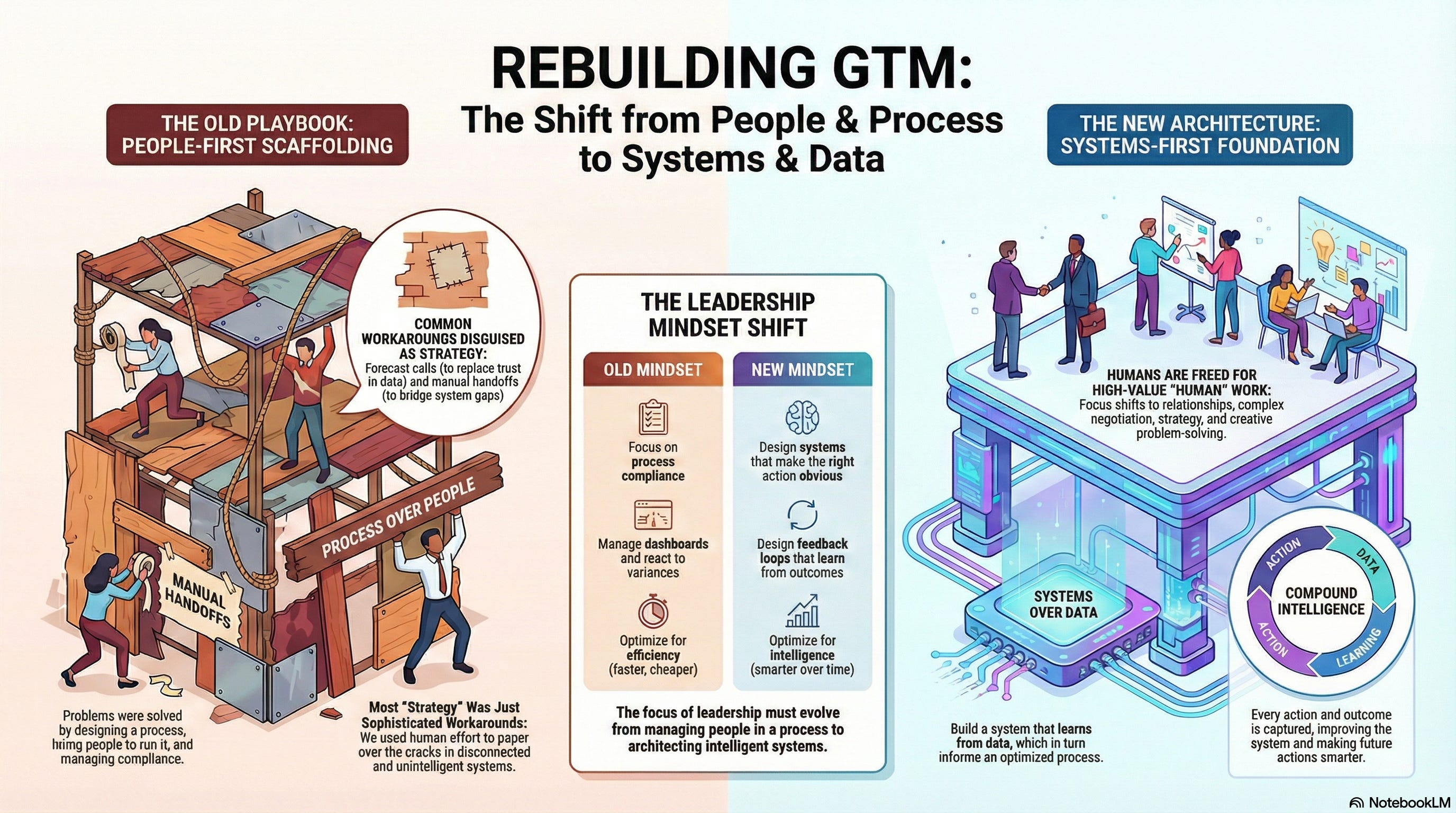
The old approach: identify a problem → design a process → hire people to run it → manage performance.
The new approach: identify a problem → build a system that learns → let data inform the process → free people to do what only humans can do.
Same destination. Completely different vehicle.
What We Were Really Doing All Along
Let me be honest about something.
Most of what we called “GTM strategy” was actually sophisticated workarounds for systems that didn’t exist.
Think about it:
Lead scoring was humans trying to pattern-match because we couldn’t process enough signals to actually predict outcomes.
Sales stages were artificial constructs because we couldn’t track real buyer behavior across touchpoints.
QBRs existed because our systems couldn’t surface account health in real-time.
Enablement programs scaled because we couldn’t embed intelligence directly into workflows.
Forecast calls happened because we didn’t trust the data—so we trusted gut instinct filtered through layers of management.
None of this was wrong. It was the best we could do with what we had.
But look at what we were actually solving for: pattern recognition, signal processing, institutional memory, coordinated action. These aren’t people problems. They’re systems problems.
We just didn’t have the systems to solve them. So we used people instead.
The Foundation vs. The Scaffolding
Here’s the mental model that’s been helping me think through this shift:
The fundamentals of GTM—finding customers, communicating value, building relationships, delivering outcomes—those are the foundation. They don’t change. They’re why companies exist.
Everything else? The org structures, the processes, the methodologies, the tech stack configurations? That’s scaffolding. It’s how we’ve historically built on top of the foundation.
For decades, the scaffolding was made of people and process. And we got really good at constructing elaborate scaffolding. Complex handoff procedures. Multi-stage approval workflows. Layered management structures. Detailed playbooks.
But scaffolding isn’t the building. It’s what you use to build the building.
And now we have access to different materials. Systems that learn. Data that flows in real-time. Intelligence that compounds. Memory that doesn’t walk out the door.
The foundation stays the same. The scaffolding gets rebuilt entirely.
What’s Actually Broken (And Always Was)
When I look at what AI is transforming in GTM, it’s not the fundamentals. It’s all the stuff that was never quite right:
Alignment was broken. Marketing and sales weren’t aligned because they operated on different data, different timelines, different definitions. We solved it with meetings. Lots of meetings. Now it can be solved with unified systems where alignment is a property of the architecture, not a calendar invite.
Handoffs were broken. Leads got lost between stages because humans had to manually transfer context. We solved it with SLAs and CRM fields. Now it can be solved with systems that maintain continuous context across every touchpoint.
Forecasting was broken. We couldn’t predict outcomes because we didn’t capture enough signals or process them fast enough. We solved it with “commit” calls and weighted pipelines. Now it can be solved with systems that recognize patterns across thousands of deals.
Coaching was broken. Managers couldn’t observe every call or review every email. We solved it with ride-alongs and call reviews. Now it can be solved with systems that surface coachable moments in real-time.
Institutional knowledge was broken. Everything we learned walked out the door when people left. We solved it with documentation and tribal knowledge. Now it can be solved with systems that capture, synthesize, and apply learning continuously.
The problems were always there. We just normalized the workarounds.
The Revenue Nervous System
This is why I’ve been developing the Revenue Nervous System framework—because the new approach isn’t just “add AI to GTM.” It’s architecturally different.
Think about how your actual nervous system works. You don’t consciously decide to pull your hand away from a hot stove. Your system senses the heat, processes the signal, remembers that heat hurts, decides to move, and executes the action—all in milliseconds, all automatically, all while learning.
That’s what AI-native GTM looks like when it’s designed right:
Data Layer — Captures every signal from every touchpoint. Not just what’s in your CRM. Everything.
Intelligence Layer — Processes signals and recognizes patterns. What behaviors predict outcomes? What sequences accelerate deals?
Context Layer — Applies your specific business logic. Your ICP. Your positioning. Your competitive dynamics.
Memory Layer — Stores what works, what doesn’t, and why. Nothing gets lost. Everything compounds.
Orchestration Layer — Coordinates action across systems and teams. Turns insight into execution.
Execution Layer — Takes action while learning from every outcome.
The magic isn’t any single layer. It’s the feedback loops between them. Every action generates data that improves future actions.
That’s compound intelligence. And it changes everything about how we think about GTM.
People Don’t Go Away. Their Role Changes.
I want to be clear about something: this isn’t a “replace humans with AI” argument.
It’s the opposite.
When you move from people-and-process-first to systems-and-data-first, you actually unlock what humans do best.
Right now, most GTM professionals spend the majority of their time on tasks that systems should handle: data entry, research, admin, coordination, reporting. The Vasco report calls out that 78% of operations professionals’ time gets wasted on manual tasks.
That’s not a people problem. That’s a systems problem.
When systems handle the pattern recognition, the data processing, the coordination, the memory—humans get to focus on what only humans can do:
Building genuine relationships. Navigating complex negotiations. Exercising judgment in ambiguous situations. Creating strategy. Providing empathy when customers struggle.
The irony is that people-and-process-first approaches often dehumanized work. We turned sellers into data entry clerks. We turned CS managers into QBR robots. We turned marketers into campaign button-pushers.
Systems-and-data-first actually makes room for human work to be more human.
The Roles That Don’t Exist Yet
Here’s something that’s been on my mind: we don’t have the right people to build this new scaffolding. Or more precisely—we don’t have the right roles.
a16z just published a piece on “title arbitrage”—the idea that new job titles can meme change into existence. They point to Palantir’s invention of the “Forward-Deployed Engineer” in 2011. Palantir took solutions engineers and integration engineers—typically low-status roles—and recast them as FDEs. Even called them “Deltas,” like Delta Force.
It sounds ridiculous. And it worked brilliantly.
The insight was that these people were critical to customer success but treated as replaceable help. By elevating the title, Palantir attracted high-agency, high-EQ engineers who might otherwise have seen client-facing work as beneath them. The title gave the work prestige—and Palantir got a hiring moat.
Now look at what’s happening in AI. Clay coined “GTM Engineer.” Harvey coined “Legal Engineer.” These aren’t marketing gimmicks. They describe work that genuinely didn’t exist five years ago.
And here’s what I think GTM is missing: we need Forward-Deployed Engineers for revenue systems.
Think about it. Who’s building the AI agents that run your outbound? Who’s designing the data flows that feed your intelligence layer? Who’s architecting the memory systems that capture institutional knowledge?
Right now, it’s either nobody (most companies), or it’s a fragmented mess of RevOps people learning to code, engineers who don’t understand GTM, and consultants who leave when the project ends.
What we actually need are pods—small, cross-functional teams that combine:
GTM Engineers who understand revenue operations deeply and can translate business logic into system design
AI/ML specialists who can build and tune the models
Data engineers who can architect the flows
Product-minded operators who can test, iterate, and optimize
This is how product teams work. This is how engineering teams work. But GTM? We’re still organized around functions (marketing, sales, CS) rather than around the systems we’re trying to build.
The companies that figure out this organizational design—the pod structure for building revenue systems—are going to move dramatically faster than those trying to retrofit AI onto traditional GTM org charts.
The Mindset Shift
Here’s what I see separating leaders who are navigating this transition from those who are struggling:
They stopped asking “how do we get people to follow the process?” and started asking “how do we design systems that make the right action obvious?”
Old mindset: the process is right, we need better compliance. New mindset: if people aren’t following the process, the system isn’t serving them.
They stopped managing dashboards and started designing feedback loops.
Old mindset: monitor metrics, react to variances. New mindset: build systems where every outcome improves future outcomes.
They stopped thinking about efficiency and started thinking about intelligence.
Old mindset: how do we do this faster with fewer resources? New mindset: how do we design systems that get smarter over time?
They stopped optimizing individual stages and started designing end-to-end systems.
Old mindset: improve each conversion point. New mindset: understand how signals flow through the entire system.
They started building pods, not departments.
Old mindset: organize around functions with handoffs between them. New mindset: organize around the systems you’re building with cross-functional ownership.
Jen Igartua from Go Nimbly framed it well: “We can no longer do random acts of AI. We need to think about it like a fully orchestrated workflow.”
Random acts of AI is just adding tools to broken processes. That’s people-and-process thinking with a shiny new layer.
Systems thinking means redesigning from the foundation—including how we organize the people who build the systems.
The Window Is Closing
Here’s where I have to be direct.
The gap between companies building systems-first GTM and those still optimizing people-first approaches is compounding. Not linearly. Exponentially.
Why? Because systems-first creates compound intelligence. Every interaction makes the next one better. Every outcome improves the model. Every data point strengthens pattern recognition.
People-first creates linear improvement at best. You train someone, they get 10% better. You hire more people, you get more capacity. But nothing compounds.
The Vasco report talks about a “flight to quality” where winners in each category pull away so fast that we’ll see massive consolidation. The best talent flocks to them. The ecosystem wants to partner with them. Investment follows.
This isn’t because they have better people. It’s because they have better systems—and their systems get better every day while traditional approaches stay flat.
Stuart Watson from Resolve AI put it this way: “You don’t need crippling anxiety to operate in AI-era GTM, but you do need a healthy level of paranoia.”
I’d frame it differently: you need clarity about what’s actually changing and what’s staying the same.
The fundamentals aren’t changing. The scaffolding is being completely rebuilt.
What This Means For You
If you’re a GTM leader wrestling with this transition, here’s what I’d focus on:
Audit your workarounds. Look at every process, every role, every meeting that exists to compensate for systems that don’t work. Those are your opportunities.
Stop adding AI to broken processes. If your lead routing is broken, adding AI to route leads faster just creates broken results faster. Fix the system design first.
Think about data flows, not just workflows. Where does data originate? Where does it need to go? What gets lost in translation? What patterns are you not capturing?
Build memory into everything. The biggest advantage of systems-first is institutional learning that compounds. Ask: where does knowledge currently die? How do we capture and apply it continuously?
Free your people for human work. Every hour a human spends on something a system should handle is an hour not spent on relationship-building, strategic thinking, or creative problem-solving.
The Uncomfortable Truth
The fundamentals of GTM haven’t changed.
But everything we built on top of those fundamentals? The elaborate scaffolding of people and process we constructed to compensate for systems that didn’t exist?
That’s being reimagined. Rapidly.
The leaders who thrive won’t be the ones who add AI to their existing playbooks. They’ll be the ones who recognize that the playbooks were always workarounds—and now they can build what should have existed all along.
Systems that learn. Data that flows. Intelligence that compounds. Memory that persists.
That’s not replacing people. That’s finally building the foundation that lets people do what they were always supposed to do.
The question is whether you’re rebuilding your scaffolding—or just adding more duct tape.
What’s one broken process in your GTM motion that’s really a systems problem in disguise? I’d love to hear what you’re rethinking.