

Anthropic released Cowork. I called it transformative. I was wrong.
I was thinking too small.
On Friday, they dropped plugins for Cowork. And suddenly the roadmap clicked.
If you’re a founder, executive, or GTM operator who’s been dabbling with AI but never quite figured out how to scale it beyond individual productivity hacks—this is the moment everything shifts.
Here’s why this matters more than the headlines suggest.
The Problem Nobody Talks About
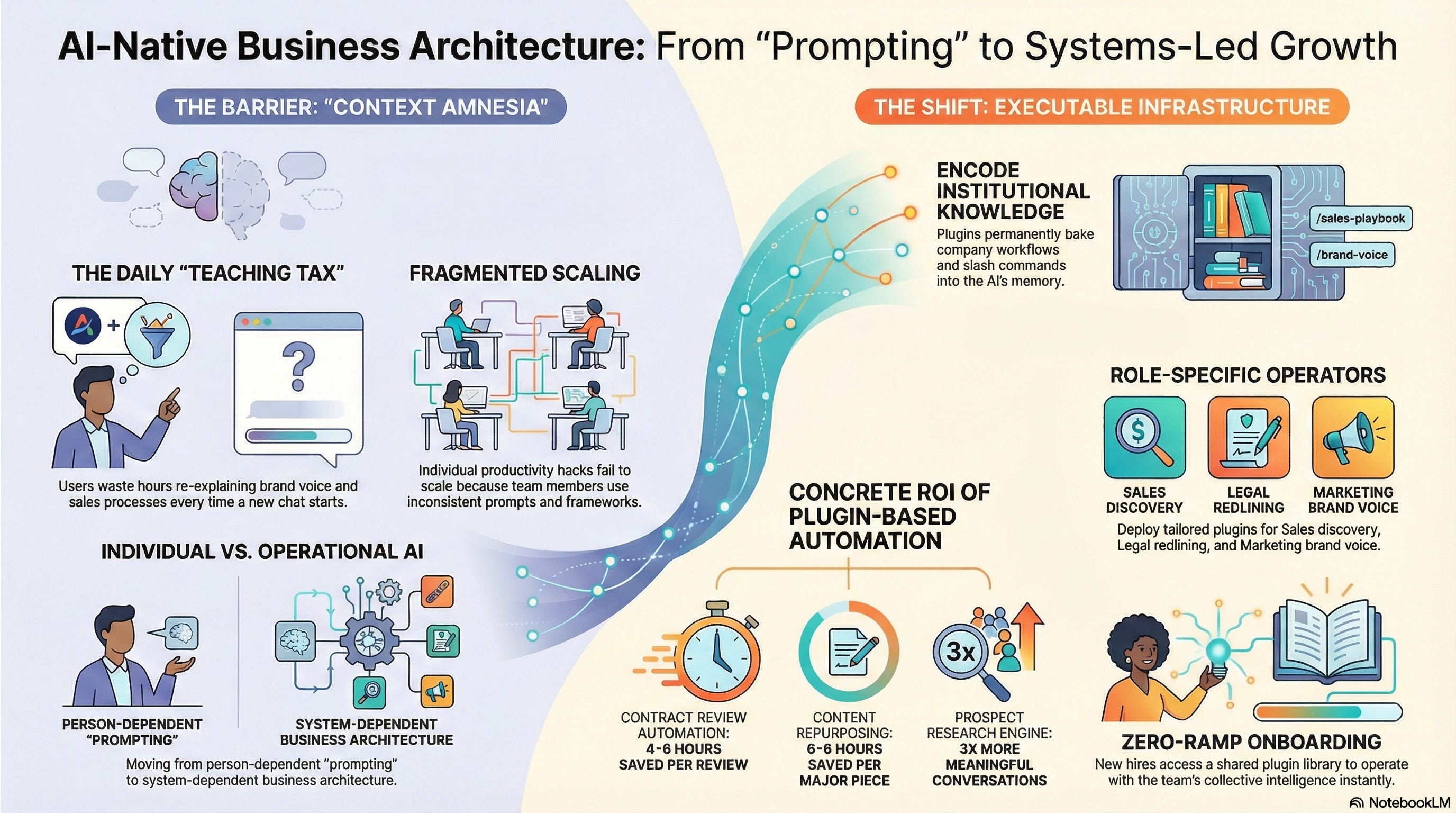
Every AI tool I’ve used for the past two years has had the same fundamental limitation: context amnesia.
You teach Claude your sales process. Monday morning you open a new chat. Gone.
You explain how your legal team reviews contracts. Thursday afternoon you start fresh. Vanished.
You build a custom prompt that nails your company’s writing voice. Three days later you’re re-explaining the same nuances for the fourth time.
We’ve all been doing the AI equivalent of training a new employee who forgets everything overnight. Every. Single. Day.
Matt Piccolella from Anthropic’s product team told TechCrunch something that caught my attention: “Really, what we’re doing with this launch is just bringing [plugins] to Cowork and giving them that kind of user-friendly, UI-centric flavor that will allow the maximum number of people to use them.”
Read that again. Maximum number of people.
This isn’t a developer tool being grudgingly extended to civilians. This is Anthropic explicitly democratizing agentic AI.
What Plugins Actually Are (Skip the Marketing Speak)
Strip away the jargon and here’s what plugins do:
They encode your institutional knowledge. Once. Permanently. You tell Claude how your company handles things—which systems to pull from, which workflows to follow, which slash commands to expose—and it remembers.
They create role-specific operators. A sales plugin connects to your CRM and knowledge base while embedding your actual sales process. A legal plugin reviews contract risk patterns your team has defined. A marketing plugin drafts content in your brand voice with your positioning framework baked in.
They eliminate the teaching tax. That daily re-education we’ve all been doing? Gone. Plugins let you front-load the training and then deploy Claude as if it already works there.
The 11 open-sourced plugins Anthropic released cover sales, finance, legal, product, marketing, customer support, data work, and biology research. But that’s just the starter kit.
The real play is building your own.
Why This Matters for GTM Teams Specifically
I’ve spent 21 years scaling companies from pre-revenue to $15B. The pattern I see most often is this: companies adopt AI as an individual productivity tool but never operationalize it as business infrastructure.
Person A has great prompts. Person B reinvents the wheel. Person C gives up because it’s too inconsistent.
Plugins solve this at the system level.
Think about what this means for a GTM organization:
Sales: Your entire discovery framework—the questions, the qualification criteria, the competitive positioning—lives inside a plugin. Every rep, every call prep, every follow-up operates from the same intelligence. Not because of training docs nobody reads, but because Claude executes from that playbook automatically.
Marketing: Brand voice isn’t a style guide that sits in a Google Doc. It’s encoded in how Claude drafts every piece of content. Your positioning framework, your messaging hierarchy, your tone—it’s operational.
RevOps: Pipeline hygiene, data validation, report generation—these become slash commands that any team member can execute without understanding the underlying logic.
Customer Success: Renewal playbooks, escalation protocols, health score interpretation—standardized across the team through plugins, not tribal knowledge.
Anthropic’s internal data shows exactly this pattern. Piccolella mentioned that “sales has been a really big one, both for our direct sales people, but then also just getting anybody who’s kind of sales adjacent, better connected to the customer and customer feedback.”
They’re eating their own cooking. And they’re reporting results.
The Organizational Sharing Piece (Coming Soon)
Right now, plugins save locally to your machine. Useful for individuals. Limited for teams.
But Anthropic already announced that organization-wide sharing is coming “in the weeks ahead.”
This is where it gets interesting.
Imagine a company-wide plugin library. IT-approved. Security-reviewed. Version-controlled.
New marketing hire on day one? They install the marketing plugin and immediately operate with the accumulated intelligence of the entire team. No three-month ramp. No “ask Sarah how we do it here.”
The institutional knowledge that usually lives in people’s heads—and walks out the door when they leave—becomes encoded in your AI infrastructure.
This is what I mean when I talk about AI-native architecture. It’s not about using AI. It’s about building your business processes on top of AI as a foundational layer.
Practical Use Cases (The Stuff You Can Actually Do)
Let me give you some concrete applications I’m already thinking through:
Contract Review Automation Build a legal plugin that embeds your specific risk tolerance, your standard redline positions, your escalation triggers. Claude reviews every incoming contract against your framework. Flags what matters. Suggests language you’ve pre-approved.
Time savings: 4-6 hours per contract review, at scale.
Prospect Research Engine Sales plugin connects to your CRM, LinkedIn data, company intel sources. Define what “good” looks like—your ICP markers, buying signals, disqualification criteria. Every rep has instant access to research that used to take an hour per prospect.
Impact: 3x more meaningful conversations per rep per week.
Customer Intelligence Dashboard Customer success plugin aggregates feedback, support tickets, usage patterns, NPS comments. Surfaces patterns your team would never see manually. Identifies churn risk based on signals you’ve defined, not generic algorithms.
Real value: Saving one enterprise customer pays for a year of this infrastructure.
Content Repurposing Machine Marketing plugin understands your full content library, positioning hierarchy, and platform-specific requirements. Long-form article goes in. LinkedIn posts, email sequences, social threads, and slide summaries come out—all in your voice, with your framework.
Time recovered: 6-8 hours per major content piece.
The Catch (Because There’s Always a Catch)
Three things to keep in mind:
First, Cowork is still in research preview. No firm date for general availability. Plugins are accessible to all paying Claude customers, but the full vision isn’t production-ready yet.
Second, there’s a security conversation here. Agentic tools with file access and internet connectivity create risk surface. Anthropic explicitly warns against using Cowork for regulated workloads. If you’re in healthcare, financial services, or government—proceed thoughtfully.
Third, this requires work upfront. Building good plugins means encoding your processes clearly. If your sales methodology is a mess, the plugin will execute a mess. If your brand voice is undefined, Claude can’t define it for you.
AI amplifies. It doesn’t fix.
What I’m Doing About This
I’m going to build a custom plugin stack for GTM operations. I want to encode the frameworks I’ve developed over two decades—the IMPACT+ methodology, the Revenue Nervous System layers, the AI-native GTM principles—into operational tools that teams can deploy.
Not as training content. As executable infrastructure.
If you’re a founder or operator who’s been frustrated by the gap between AI’s promise and AI’s actual impact on your business, this is the moment to pay attention.
The companies that figure out AI-native architecture first don’t just move faster. They compound their advantages in ways that become nearly impossible to replicate.
Everyone else will spend the next three years watching their competitors pull away while wondering what they missed.
Anthropic just open-sourced plugins that turn Claude into a department-specific operator. This isn’t an incremental product update—it’s the beginning of AI-native business architecture.
The real issue is getting teams using the same instructions. We've been working with this concept for our teams but in librechat and n8n. Context is everything.