

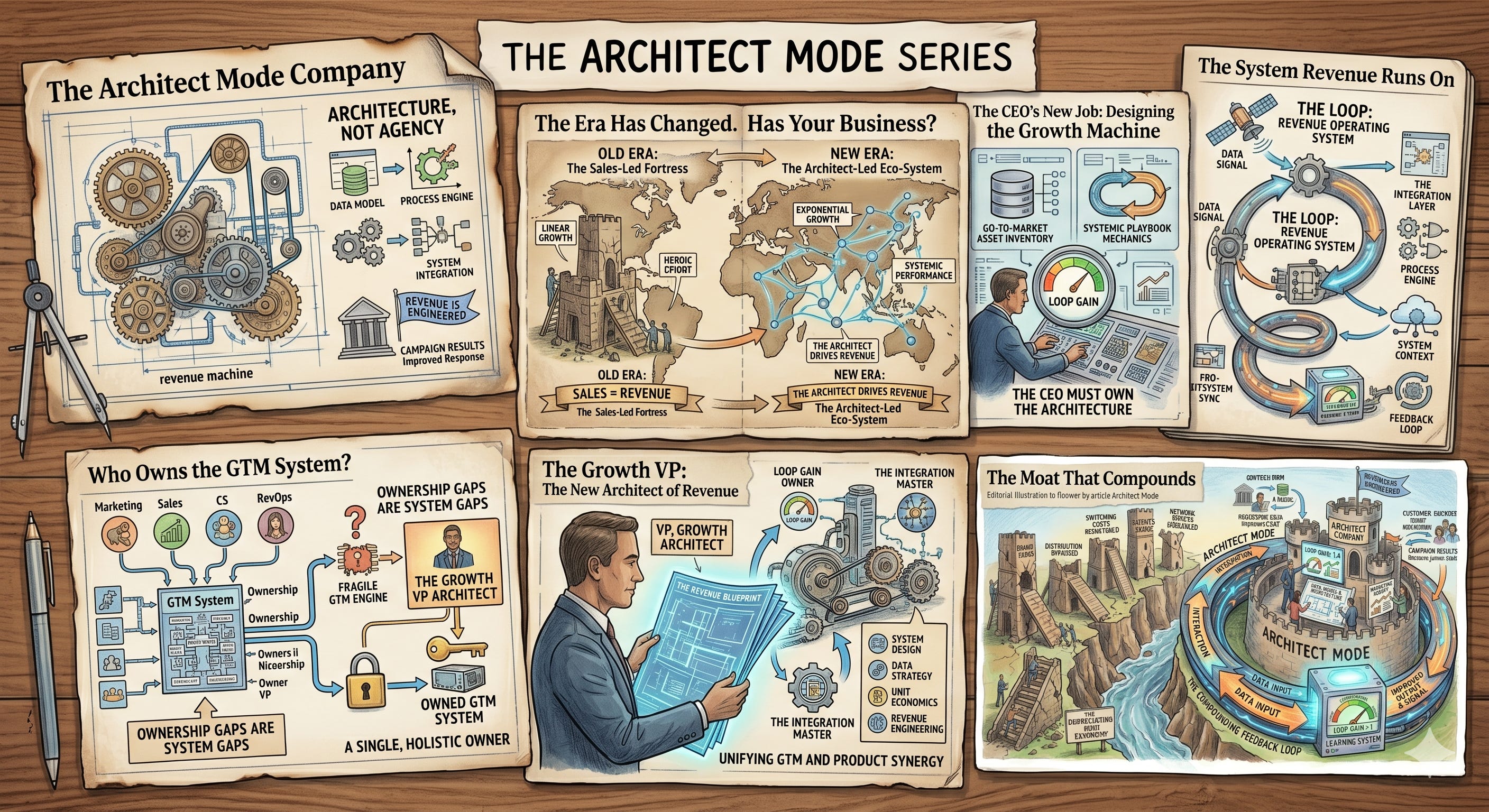
This is the piece the series has been building toward. Part 1 established that we are in a new era of business leadership. Part 2 clarified what that means for the CEO’s job. Part 3 described the system that revenue actually runs on. Part 4 asked who owns it. This piece answers that question -- specifically. The VP of Growth is not a rebrand. It is not a promotion. It is a new executive function that the market is pricing, filling, and in some cases getting wrong. Here is what it actually is.
The Bifurcation
RevOps has moved through three distinct eras.
From roughly 2015 to 2021, it was a service desk. CRM administration, report building, process documentation. Reactive by design. The function existed to support Sales and Marketing, not to operate alongside them. From 2021 to 2024, it became a strategic partner -- cross-functional by default, increasingly involved in tech stack decisions, revenue planning, and go-to-market design. That era produced a generation of RevOps leaders who genuinely understood the business, not just the tools.
Now it is becoming something else. The Growth Architect era. And the shift is not gradual.
AI is eliminating the service desk work. Reporting, hygiene, documentation, ticket management -- these are exactly the tasks AI handles well and handles fast. The middle of the RevOps function, where most of its headcount currently lives, is also where AI is most efficient. There is no safe version of the old job. The only path forward is the one that moves up the value chain fast enough to stay ahead of what AI absorbs below it.
There is no middle path. The middle is exactly what AI eliminates best.
The New Executive Seat
Every major platform shift creates a genuinely new executive role. Not an upgraded version of the previous one -- something new, with new scope, new authority, and new compensation to match.
The CTO emerged when technology became a competitive differentiator and needed someone who spoke both engineering and business at the executive table. The CMO emerged when marketing became too complex and too expensive to leave in the hands of a VP reporting to a generalist. The CRO emerged when go-to-market became multi-motion, multi-segment, and multi-year -- too complex for sales leadership alone. Each time, a function that had been operational became strategic. The market created a seat to reflect that.
The VP of Growth is that seat right now.
The data makes it concrete. LinkedIn showed approximately 6,000 open VP of Growth and VP of Revenue Operations roles in April 2026. Base compensation runs $250,000-$350,000, with total comp packages reaching $550,000. VP of RevOps titles grew 300% in 18 months. The GTM Engineer talent pool expanded 45% in three months. These are not coincidences. They are a market discovering, in real time, that a function it has been undervaluing has become structurally necessary at the executive level.
The Chief Customer Officer was supposed to solve this. It didn’t. The CCO unified reporting lines but not systems. Functional leaders reported up to the same person without changing how the underlying architecture worked. Handoffs still broke. Data still fragmented. The org chart changed; the system didn’t. The VP of Growth does what the CCO was supposed to do, but with actual system authority rather than organizational proximity.
A new executive has entered the room. The question is whether your company is putting someone in that seat or leaving it empty.
