

Before we dive in -- thank you to our paid subscribers! Make sure to take full advantage of all the value you get.
Check out our AI Education section, and this is where things get real. Step-by-step guides, how-to breakdowns, and hands-on training to help you build agents, build systems, and use tools like Claude Code, ChatGPT, and Perplexity at a level most people don’t even know exists. This isn’t surface-level stuff -- it’s the training that actually moves your AI capabilities forward.
Paid subscribers get access to interactive tools and guides that free subscribers don’t see.
Office hours and live events where you can bring your real questions, get them answered by people who’ve actually built this stuff, and get hands-on keyboard time with experts in the room.
Come build with us.
Most CEOs I talk to are running a 2022 company with a 2026 tool stack and calling it transformation. The AI line in the budget doubled. A ChatGPT subscription went out to the whole team. Copilot landed in the sales org last quarter. The board deck has a slide titled “AI-native.” And the underlying system that actually produces revenue is unchanged from three years ago.
That gap is not a technology gap. It is an architecture gap. And the growth-rate spread between companies that have closed it and companies that have not is already visible in the pipeline numbers, in retention, in the hiring curve. Not a projection for 2028. Current reality.
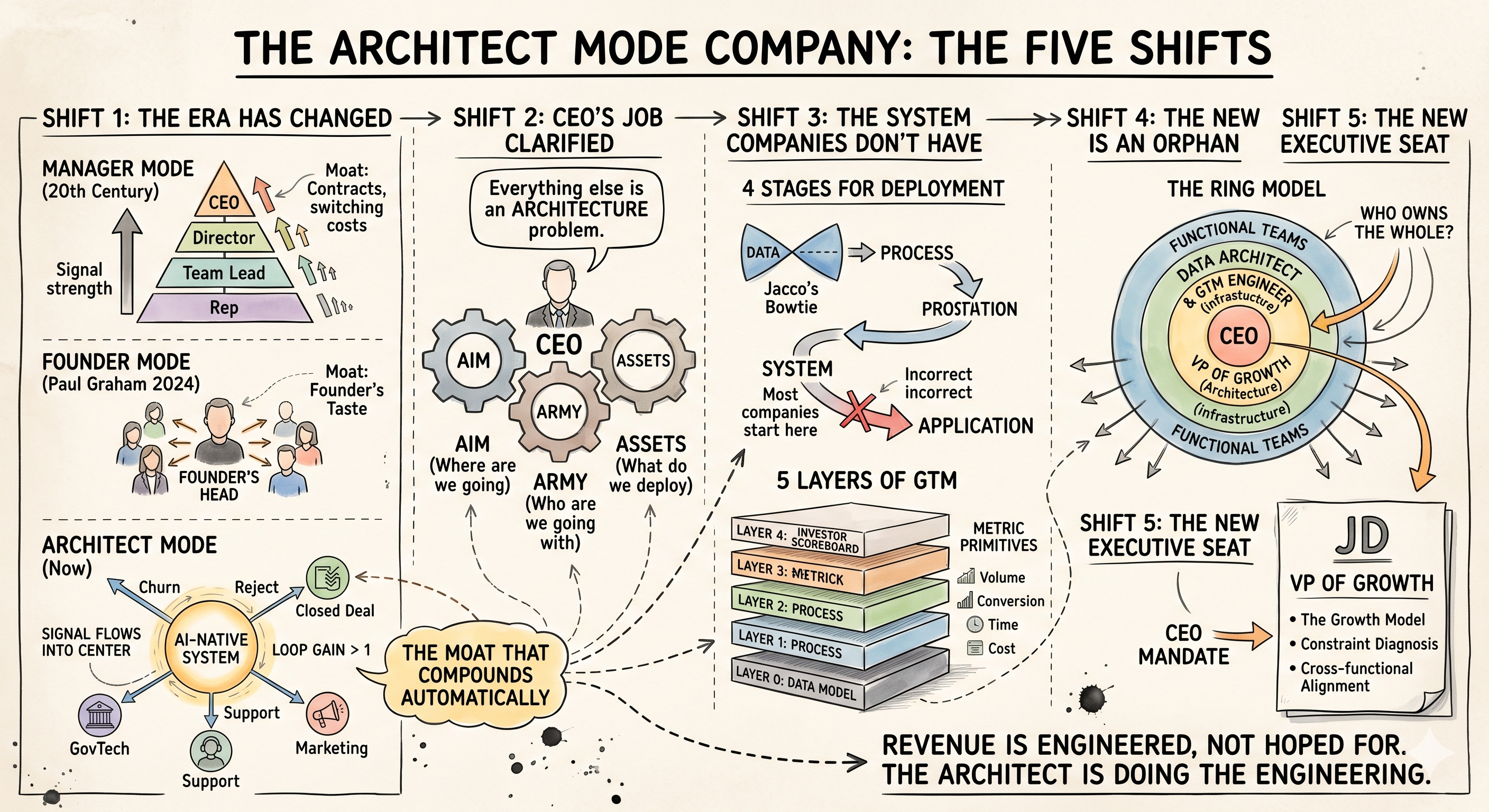
Five shifts explain the gap. Each one compounds into the next.
The era has changed. Three logics of running a company, three moats, only one that compounds automatically.
The CEO’s job got clarified, not simplified. Aim, Army, Assets. Everything else is an architecture problem.
The revenue system most companies run is hollow. 106 SaaS apps, quadratic complexity, a five-layer stack that was never built.
The system is an orphan. Everyone owns a piece, no one owns the whole.
A new executive seat is emerging to own it. Reports to the CEO. Different scope, different comp, different hire.
Shift 1. The Era Has Changed
Three logics have governed how companies get built in the last forty years. Two of them are closed. One is where business is won right now.
Manager Mode was the dominant logic of the 20th century. Information climbed a pyramid. A customer insight got caught by a rep, filtered by a team lead, reframed by a director, and arrived at the CEO as a sanitized slide with three bullets. Four relay nodes, four rounds of compression. The moat was contracts, switching costs, and org chart depth. It worked for decades. It built enormous companies. Its fatal flaw is latency. Every relay compresses signal. Every compression adds delay. When the feedback loop between customer behavior and company response has to run in hours, not quarters, Manager Mode’s architecture becomes its liability.
Founder Mode was a correction. Paul Graham named it in 2024 and it landed because it was true. The best founders are obsessed. They know things the org chart does not. The six-layer management hierarchy does compress signal into uselessness. Founder Mode was permission to break the glass and breathe. But it has a hard ceiling. It scales to roughly thirty people and then the bottleneck stops being bureaucracy and starts being the founder’s calendar. Every decision runs through one person. Every creative call requires one brain. The moat is the founder’s taste, network, and velocity, which means the moat retires when the founder does.
Architect Mode is where we are now. It keeps the speed and conviction of Founder Mode. It keeps the closeness to the customer. And it adds the piece neither prior era had: an AI-native system at the center of the operating model. In Manager Mode, intelligence lived in the relay nodes. In Founder Mode, it concentrated in the founder’s head. In Architect Mode, intelligence lives in a system that sits at the center, and every function connects to it directly. A churn event, a rejected submission, a support ticket, a closed deal, signal flows into the center and reflects back to whoever needs to act on it.
Every interaction makes the system smarter.
The moat column is where this gets real. Manager Mode’s moat erodes the moment something meaningfully better shows up. That used to take decades. It now takes months. Founder Mode’s moat is non-transferable and leaves with the founder. Architect Mode’s moat is different in kind: a proprietary feedback loop that compounds automatically. The competitor landing in your market tomorrow faces the learning curve you faced on day one while your system has been compounding for eighteen months.
Three examples of what that looks like right now, none of them demo slides.
A GovTech firm stopped treating regulatory rejections as bad news and started treating them as training data. Every rejection, the specific language that failed, the clause that triggered pushback, the reviewer who rejected and on what grounds, fed back into a model. Eighteen months in, approval rates climbing, cycle times compressed. The system now holds things about that regulatory environment no individual could hold in their head. A competitor walking in next quarter meets the bureaucracy this firm met eighteen months ago. This firm’s system has been compounding on that exact problem the whole time.
A customer support team stopped writing macros and built a response intelligence system. Every ticket, every resolution, every satisfaction score fed back. Volume is up, hiring curve is flat, CSAT is improving. The institutional knowledge that used to live in the heads of people who might quit on a Tuesday now lives in the system.
A marketing agency fed every campaign, every brief, every performance result into a central creative model. Junior account managers are producing work that used to require a senior strategist. The gap is not because the juniors got smarter. It is because the system got smarter and they are standing on it.
Most companies are tourists. They visit AI. They take the photos. They use a tool, learn something, share it at the next offsite. Tourists have a great time. They learn things. They come home with stories. But they go home. They do not build a life there. They do not put down the roots the compounding requires. The tourist trip is fun. The efficiency gains are real. The budget line looks good on the board slide. The transformation is not happening.
“Are we using AI?” is the wrong question. The right question is harder. Is your AI smarter today than it was yesterday, and does that gap widen automatically without your involvement? If not, you are in Founder Mode with a better toolkit. You are not in Architect Mode.
Shift 2. The CEO’s Job Got Clarified, Not Simplified
The most common mistake a CEO makes on entering Architect Mode is assuming it makes the job easier. It does not. It makes the job sharper and more uncomfortable, because the cover stories for what was broken go away.
The dashboards, the approval chains, the cross-functional status updates, the personal synthesis between a board meeting and a Tuesday ELT, none of that was the real work. It was the cost of a broken information architecture. The CEO was the synthesis layer because the org had no other way to pull signal from noise. Take the broken architecture away and what remains is three things.
I call them Aim, Army, and Assets.
Aim. Where are we going. AI maps markets, models scenarios, surfaces second-order effects, and runs strategy stress-tests faster than any internal team. Use it aggressively. Strategy is not the same as vision. A well-prompted model will give you a defensible answer to any strategic question, usually several of them. It will size the opportunity, rank the options, and flag the risks. What it will not do, and this is the permanent gap, is tell you which hill is worth bleeding for. That is yours. It will always be yours. As intelligence becomes more abundant, conviction becomes more scarce.
Army. Who are we going with. The talent calculus shifted in a way most hiring processes have not caught up with. One high-agency operator with genuine AI fluency, someone who builds systems, prompts well, automates their own process, and feeds signal back into the machine, now outperforms teams built around average performers. The output gap between your best system-thinker and your average contributor widened from 2x to something closer to 10x, and it is still widening. The honest CEO conversation that follows is not a comfortable one. Assess your current leadership team with clear eyes. Some of them are trending toward system-architect capability. Some are not. The people who got you here in Era 1 or Era 2 are not automatically the right people for Era 3. That is not a judgment on them. It is a judgment on fit.
Assets. What do we deploy. Capital, attention, focus, brand, trust. The scarce resource in Architect Mode is not information. AI gives every company more dashboards, more data, more machine-generated strategy documents than any team can act on. Most companies will drown in possibility. They will run twelve pilots simultaneously and get signal from none. They will spread the best people across eight initiatives and get compounding from none. The CEO’s job, the part that does not automate no matter how good the tools get, is to decide with conviction: what are we doing, and what are we not doing? The second question is the harder one. Saying no to a plausible opportunity is more cognitively difficult than saying yes to it. The analysis will always make three options look reasonable. Four will have credible champions. Your job is not to validate the analysis. Your job is to pick the asymmetric bets that deserve your best people and your best years, and be clear enough about the pick that the org does not have to guess.
The best CEOs in Architect Mode are allowed to be uncertain. They are not allowed to be unclear. Uncertain means: I have a hypothesis, I placed the bet, I am watching the signal, I will update when the data says to. Unclear means: I am not sure which of these five things we are actually prioritizing. Uncertainty is honest. Unclear is a cultural tax every team member pays every day in misaligned effort.
Aim, Army, Assets sounds clean on the whiteboard. The application of it requires something leadership training does not talk about enough: an identity shift. In Founder Mode, your value came from your involvement. You knew the answers because you were closest to the problem. Your fingerprints were on everything. Architect Mode asks for a different discipline. Build the thing that runs without your constant involvement while staying deeply accountable for what it produces. You optimize for system quality over personal heroics. That takes real work to sit with.
The question I would leave here is not “am I in Architect Mode?” Most CEOs will say yes and mean something closer to “I think about AI a lot.” The real question: if you were removed from your company for sixty days, which decisions would be better because your system kept learning, and which would be worse because the system does not exist yet? The length of the second list is the honest measure of how far you have to go.
