

Google just made a move that should terrify every GTM leader, startup founder, and enterprise executive.
And almost nobody noticed.
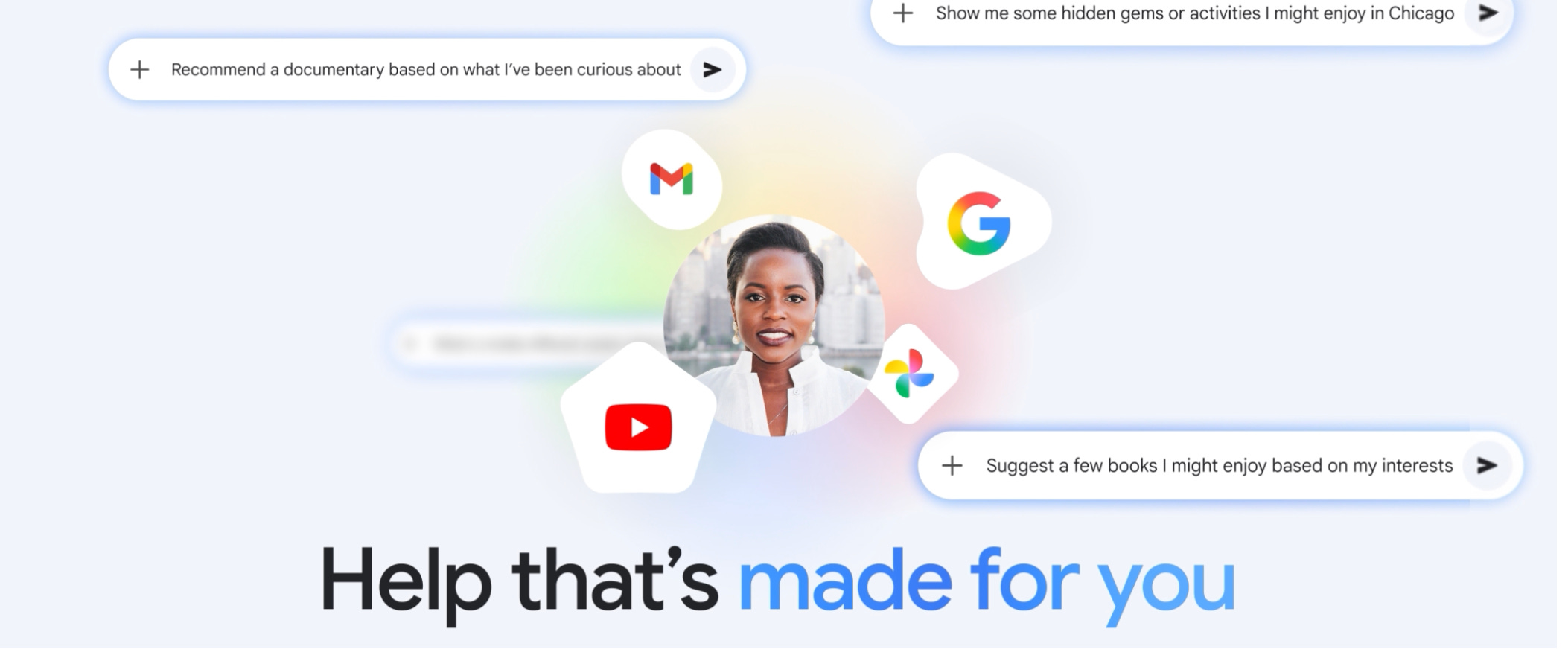
They announced “Personal Intelligence”—connecting Gemini to Gmail, Photos, YouTube, and Search with a single tap. The press coverage focused on a cute story about buying tires.
But here’s what actually happened: Google declared that the AI assistant war is now a personal data war. And they’re starting with a 20-year head start.
The Tire Shop Reveal
Google’s VP Josh Woodward shared an anecdote about standing in line at a tire shop. He asked Gemini for tire specs. Any chatbot can do that.
But Gemini went further. It suggested different options by referencing his family road trips found in Google Photos. It pulled a license plate number from an old picture. It identified his van’s specific trim by searching Gmail.
That’s not “AI that knows things.”
That’s AI that knows you.
And that distinction is about to reshape how business gets done.
Why This Is a Strategic Earthquake
Here’s why: Google already owns the data layer for billions of consumers. Now they’re making that data actively intelligent. The switching cost isn’t just retraining preferences anymore. It’s losing an AI that understands your life context—your travel patterns, your email history, your search behavior across years.
That’s not a switching cost. That’s escape velocity.
Think about what this means for the AI landscape. Claude, ChatGPT, Perplexity—they can all match reasoning capability. But they can’t match your Gmail plus Photos plus Search history without you actively porting it. And Google knows most people won’t.
Generic AI just became a commodity. Personalized AI is the new premium.
The GTM Implications Nobody’s Discussing
This announcement changes everything about how we need to think about go-to-market.
1. Personalization tech just got obsoleted
Current personalization is segments, cohorts, and behavioral signals. We spend millions on CDPs and personalization engines to approximate what someone might want.
Personal Intelligence represents real personalization—AI reasoning across your actual life context. Google can recommend based on your real preferences, not your inferred segment. Most martech becomes a weak approximation of what Google does natively.
2. AI-mediated buying becomes the norm
When consumers increasingly ask their AI assistant for recommendations, brand discovery shifts fundamentally. The question stops being “how do we rank in search?” or “how do we target the right segment?”
It becomes: How do we get the AI to recommend us?
This is the acceleration of the AI buyer paradigm I’ve been writing about. The AI does the research, filters options, and pre-qualifies decisions based on personal context. Your brand either shows up in that AI-curated consideration set, or it doesn’t exist.
3. Search transforms into AI Mode
Google explicitly stated Personal Intelligence is “coming to AI Mode in Search soon.”
Traditional SEO/SEM strategy must evolve. Ranking in results matters less when the AI synthesizes answers with personal context layered in. The optimization target shifts from keywords to AI recommendation criteria.
We don’t fully understand what those criteria are yet. But we’d better figure it out fast.
The Tech Stack Disruption
I’ve talked to dozens of revenue leaders about their tech stacks over the past year. Most are overbuilt, underleveraged, and increasingly disconnected from how buying actually happens.
This announcement makes that gap wider.
CDP and personalization stack disruption
If Google handles deep personalization at the AI layer—with full email, photo, and search context—what’s the role of Segment, mParticle, or any CDP? They become data inputs to AI rather than decision-making engines. The value capture shifts to the AI layer.
CRM evolution is non-optional
Current CRMs track interactions. Future CRMs must track AI-mediated interactions. When a prospect’s AI assistant researches your product, that’s an invisible touchpoint. The buying journey becomes partially unobservable unless you’re integrated with the AI layer.
How many deals are you losing to AI recommendations you never knew happened?
Marketing automation hits a ceiling
Rule-based and simple ML automation looks primitive compared to AI reasoning across personal context. The gap between “automated email based on website behavior” and “AI recommendation based on life context” is enormous.
The platforms that can bridge this gap will win. The ones that can’t will become infrastructure.
Integration becomes existential
Google’s privacy messaging emphasized that user data “already lives at Google securely, you don’t have to send sensitive data elsewhere to start personalizing your experience.”
Translation: If you want personal AI, you need to be in our ecosystem.
For tech vendors, the question becomes: Can you integrate with AI layers—MCP, function calling, tool use—or are you invisible to the AI intermediary?
The Platform Dependency Problem
I’ve written before about platform risk. Meta removing third-party AI from WhatsApp. The constant rule changes on every major platform. The risk of building on borrowed infrastructure.
This announcement crystallizes that risk.
Google is saying: the best AI experience happens inside our walled garden. Our data, our models, our interfaces. You want personal AI? Play by our rules.
For businesses, this creates a strategic dilemma. You can get better AI experiences by going deeper into Google’s ecosystem. But that dependency becomes a liability. What happens when Google decides to compete with you directly? When they change the rules? When they raise prices?
The companies that will navigate this best are the ones building their own context layers. First-party data that feeds their own AI systems. Customer relationships that aren’t mediated entirely by Google or any other platform.
It’s not about avoiding Google. It’s about not being completely dependent on Google.
What This Means for Care Agent
At Experity, we’re building Care Agent as a clinical intelligence platform. And Google’s announcement actually validates our strategic direction.
The insight Google is proving: personal context transforms AI from reactive to proactive. Generic smart loses to personally relevant.
For healthcare, the equivalent is knowing patient history, past interactions, insurance details, health preferences, communication patterns. It’s making the AI genuinely personal to each patient—not a generic healthcare chatbot that sounds the same for everyone.
The difference between “here’s general information about urgent care wait times” and “based on your past visits, I know you prefer the Maple Street location, and they currently have a 12-minute wait” is the difference between a tool and a trusted advisor.
That’s the bar Google just raised for everyone.
The Strategic Playbook
So what do you actually do with this information?
1. Audit your AI dependency
Where are you relying on generic AI capabilities that could be commoditized? Where are you building on top of platforms that could pull the rug? Where’s your personal context layer?
2. Accelerate first-party data strategy
First-party data was about feeding marketing systems. Now it’s about feeding AI systems. The structure, quality, and accessibility requirements change. Data needs to be AI-queryable, not just analytics-friendly.
3. Optimize for AI recommendation
If AI assistants increasingly mediate buying decisions, your GTM must include strategies for being the AI’s recommended answer. That means understanding how AI systems evaluate options, what signals they weight, and how to surface your value proposition in AI-mediated discovery.
4. Build AI-queryable systems
Every system needs to consider: can an AI access this information to make decisions? If your systems are siloed from AI layers, they’re invisible to AI-mediated workflows.
5. Watch the enterprise rollout
Google specifically noted Personal Intelligence isn’t available yet for Workspace business, enterprise, or education users. When that changes—and it will—the B2B implications multiply. Imagine procurement research done by an AI that knows your company’s past purchases, vendor history, and stated requirements.
That’s not a small update. That’s a new sales motion.
The Bottom Line
Google just declared that the future of AI isn’t about who has the smartest model.
It’s about who has the deepest personal context.
They’re betting their consumer AI strategy on the data moat they’ve built over two decades. And for everyone building GTM strategies, tech stacks, and AI systems—the AI intermediary layer just became the new battlefield.
This isn’t a product announcement. It’s a market structure announcement.
The companies that understand that distinction will be the ones still standing when the dust settles.
What’s your play?