I was on a call last week with a CEO I genuinely respect. Sharp operator. Running a real business. Thinking hard about AI.
He mentioned he’d been using Claude Cowork and was getting a lot out of it. Great. Then I asked if he’d tried Claude Code.
“No. That’s for engineers, right?”
I paused. Not because it’s a dumb question — honestly, it’s the reasonable assumption given how Anthropic positioned it. But because it’s the same thing I hear from revenue leaders, ops executives, and founders every single week. And it’s costing them the most powerful AI unlock that exists right now.
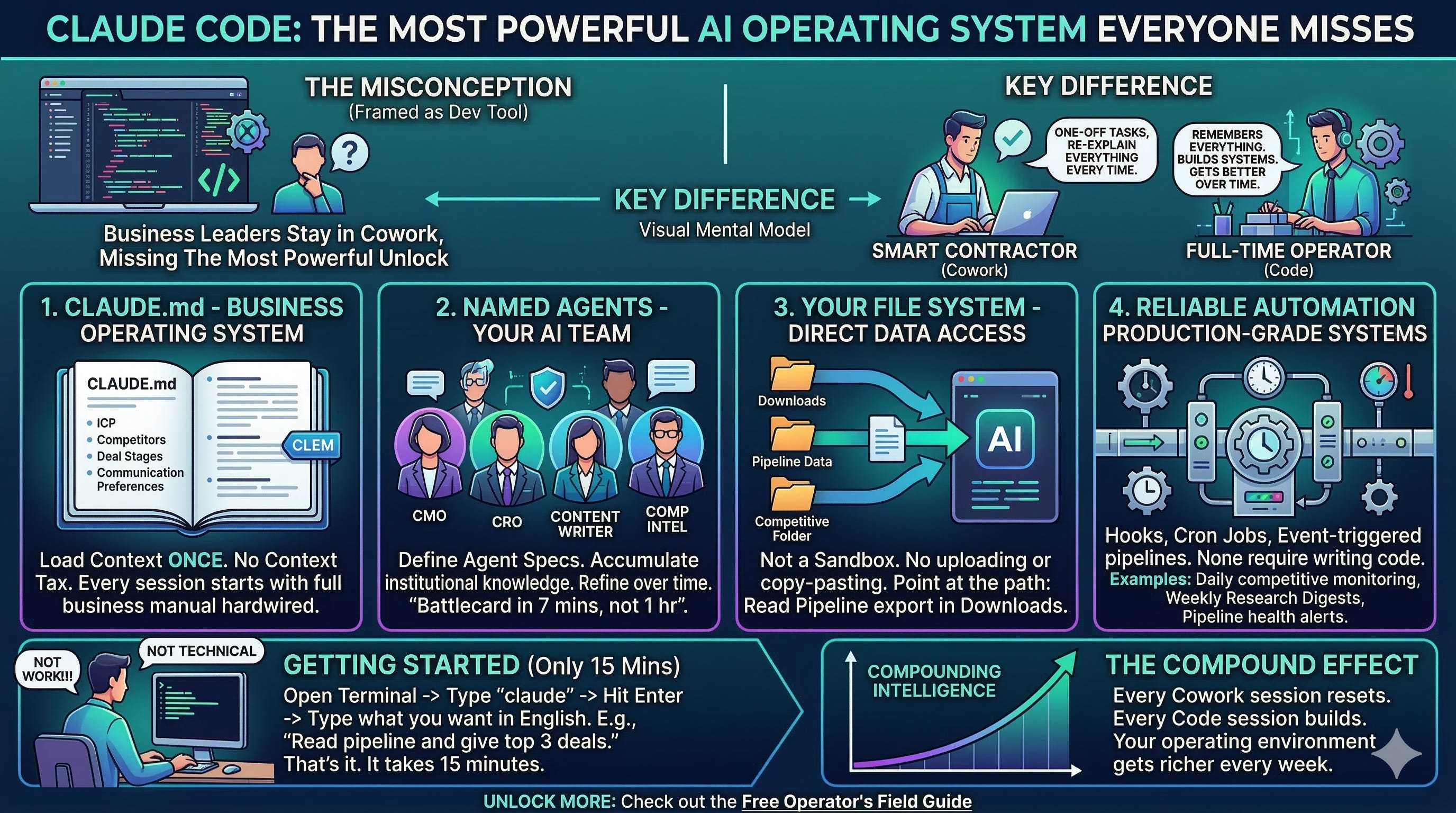
So let me just say this directly: Claude Code is not a code editor. It is an AI operating system.
The terminal is just where you type. That’s it.
Think about it like this:
You talk to people via text messages.
You talk to AI via a terminal.
The Misconception Anthropic Created (And Why It Matters)
When Anthropic released these tools, they framed Claude Code as a developer product and Cowork as the accessible business tool. That framing stuck. Hard.
Business leaders saw “Code” and heard “not for me.” They stayed in Cowork, did their one-off projects, and told themselves they were using AI. And they are — just not the most powerful version of it.
Here’s the mental model I use when I explain the difference:
Cowork is a smart contractor you hire for a day. They show up, do the task, leave. Great work. No memory of what they did before. Next time, you re-explain everything.
Code is a full-time operator who sits at your desk every day. They remember everything. They build systems. They get better over time. And when you need something done, they already know the context without you having to catch them up.
Same model underneath. Wildly different relationship.
The Four Things That Change Everything
I’ve put together a full operator’s guide (link below) that breaks down the complete comparison — feature by feature, use case by use case, including a step-by-step setup for your first 15 minutes. But let me walk you through the four capabilities that actually move the needle.
1. CLAUDE.md Is Your Business Operating System
This is the one that blew my mind first.
In Cowork, every session is fresh. You can build a memory workaround — write things to a file, hope it loads — but it’s manual and unreliable. You re-explain your ICP. You re-explain your deal stages. You re-explain your competitive landscape. Every. Single. Time.
In Code, there’s a file called CLAUDE.md that loads automatically at the start of every session. Write your business context there once — ICP, competitors, deal stages, naming conventions, team structure, communication preferences — and every future session starts with full context. No re-explaining. No uploading. No context tax.
It’s the difference between a sticky note on your monitor and an operating manual that’s hardwired into the system.
I now have over 400 lines in mine. First session of the day, Claude already knows everything. The compound effect over months is hard to overstate.
2. Named Agents Are Your AI Team
In Cowork, sub-agents are ephemeral. They exist for one task and disappear. Which is fine for quick work. But it means you’re starting over every time you need a competitive analysis, a piece of content, or a pipeline review.
In Code, you define agent specs. You build a CMO agent — here’s how it thinks about positioning, here are the competitors it tracks, here’s the writing style it uses. You build it once. You refine it over time. It accumulates institutional knowledge.
I’m running over 80 GTM agents now. CMO, CRO, Sales Engineers, Content Writers, Competitive Intel Analysts. When I need a battlecard, I don’t start from scratch. I invoke the Competitive Intel agent that already knows our positioning and our rivals and just ask for the update. The task that used to take an hour takes 7 minutes.
That’s not efficiency. That’s a different category of leverage.
3. Your File System Is Already There
Cowork works in a sandbox. Which means uploading, copy-pasting, and re-uploading your actual files into a contained environment every time you want to work with them.
Code works with what’s already on your machine.
“Read the pipeline export in Downloads and tell me which deals are at risk.”
You type that. It reads it. No prep work. No uploading. No explaining where things are. Your actual pipeline data. Your actual competitive folder. Your actual deal notes. All of it available by just pointing at the path.
This sounds like a minor convenience until you’ve done the upload dance three times in one week. Then it feels like a superpower.
4. Automation That Actually Runs
Cowork’s scheduled tasks are in beta as of right now, and honestly — they’re unreliable. They work sometimes. They silently fail other times. You cannot build a repeatable business process on “sometimes.”
Code supports hooks (event-triggered actions), cron jobs (scheduled tasks), and full automation pipelines. Things I have running in production today:
Daily competitive monitoring that flags pricing changes
Automated content pipeline: trend research → draft → review
Weekly research digests synthesized from multiple sources
Pipeline health alerts triggered by CRM events
None of those require writing code. They require describing what I want, once, and letting Claude build it.