

This week, Rox AI closed a round valuing the company at $1.2 billion. On approximately $8 million in ARR. That’s a 150x revenue multiple — breathtaking even by AI standards.
LinkedIn exploded. The AI SDR crowd started sharing the $1,200/month vs. $22,000/month comparison again. “See? The math works. AI SDRs are the future. The human SDR is dead.”
There’s just one problem with that narrative.
Rox AI isn’t an AI SDR.
What Rox AI Actually Is (And Why It Matters)
Rox was founded by Ishan Mukherjee, former Chief Growth Officer at New Relic and co-founder of Pixie (acquired by New Relic). His co-founders include Stanford professor Chris Re — one of the most cited researchers in machine learning.
Their product is an AI-native CRM replacement. A “Revenue Operating System” that sits across the entire deal lifecycle, not just top-of-funnel prospecting. Their customers include Ramp, OpenAI, MongoDB, NVIDIA, Databricks, and Confluent — companies that could buy any AI SDR tool on the market and chose something fundamentally different.
Here’s what makes Rox interesting: they explicitly rejected the AI SDR replacement thesis.
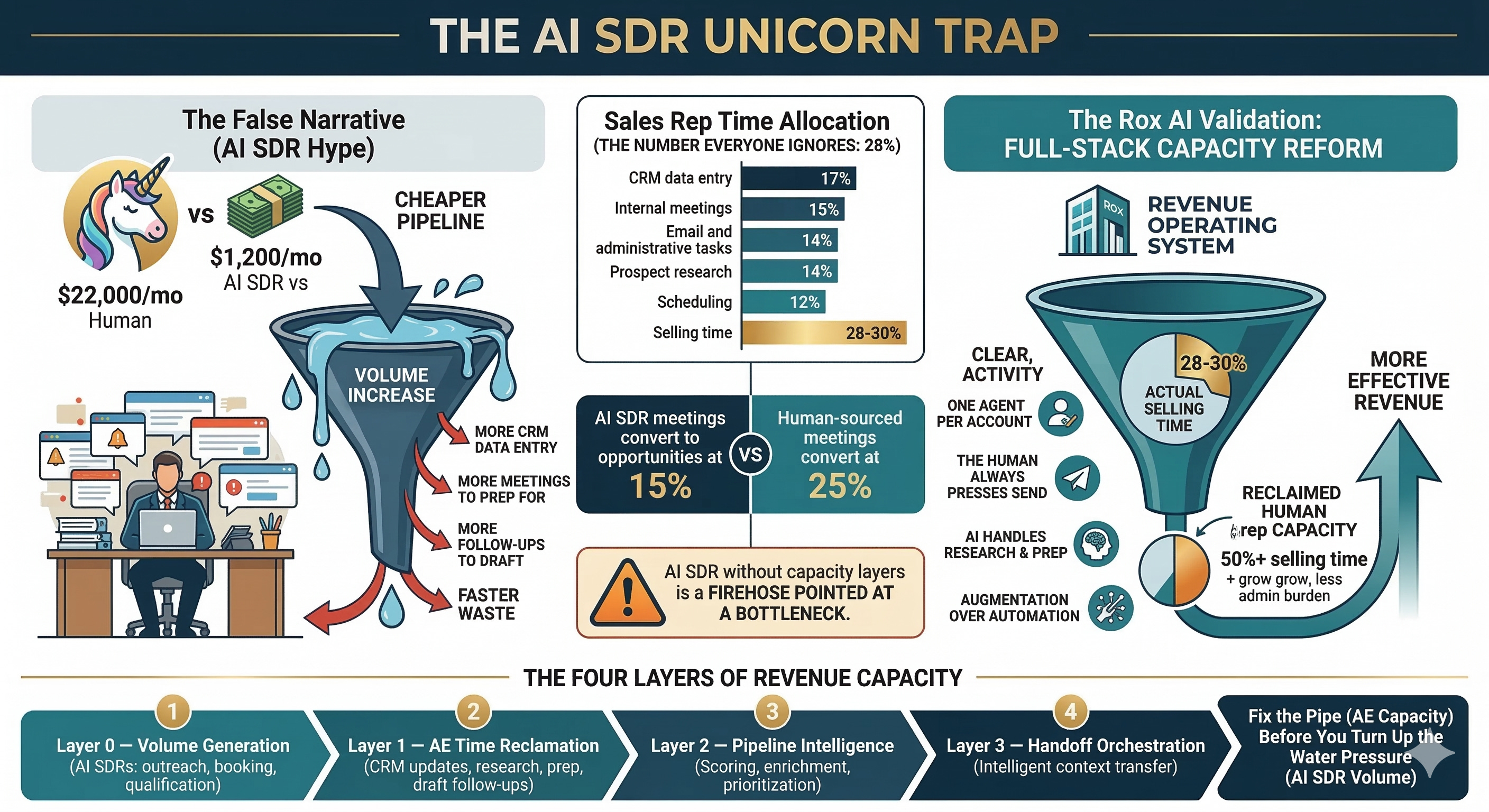
One agent per account. The human always presses send. Augmentation over automation. The AI handles research, context assembly, meeting prep, deal intelligence, and follow-up drafting. The human handles judgment, relationships, and the conversations that move revenue.
Sequoia led the seed. General Catalyst led the Series A and this latest round. These aren’t investors who got confused about what they were buying. They looked at the AI SDR landscape — 50-70% tool churn, the 11x scandal, conversion rates 40% lower than human reps — and bet $1.2 billion on the opposite thesis.
The smart money isn’t validating AI SDR replacement. It’s validating full-stack revenue capacity reform.
The Number Everyone Ignores: 28%
Here’s the stat that should be on every AI SDR vendor’s pitch deck but isn’t:
Sales reps spend only 28-30% of their time actually selling.
Salesforce’s State of Sales report has tracked this for years. The breakdown of what eats the other 70%:
CRM data entry: 17%
Internal meetings: 15%
Email and administrative tasks: 14%
Prospect research: 14%
Scheduling: 12%
Top performers manage to claw back a few points — getting to 35-40% selling time. That extra 5-10% translates to 5-8 additional selling weeks per year. It’s the single biggest differentiator between quota-crushers and everyone else.
Now think about what happens when an AI SDR floods that rep’s calendar with 3x more meetings.
The rep who was already spending 70% of their day on non-revenue work now has more meetings to prep for, more CRM records to update, more follow-ups to draft, more internal handoff notes to write. The AI solved the volume problem at the top of the funnel and made the capacity problem in the middle of the funnel actively worse.
Cheaper pipeline flowing into a constrained system doesn’t create revenue. It creates more expensive waste.
The MQL-to-SQL Graveyard
The biggest drop-off in every B2B funnel isn’t lead generation. It’s what happens next.
MQL-to-SQL conversion rates average 15-21% across industries. That means 80-85% of marketing-qualified leads never become sales-qualified opportunities. This is where pipeline goes to die — not because the leads were bad, but because the humans responsible for progressing them don’t have the time, context, or process support to do the work.
Now layer in AI SDR data:
AI SDR meetings convert to opportunities at 15% vs. 25% for human-sourced meetings
AI-only pipeline generates 2.6x less revenue than human pipeline in head-to-head tests
Meeting show rates drop from 70-85% (human-booked) to 40-60% (AI-booked)
The AI SDR conversation obsesses over the cost of generating meetings. Nobody talks about the cost of wasting them.
When your MQL-to-SQL conversion is 15% and your AEs have 28% selling time, adding more meetings to the top of the funnel is like turning up the water pressure on a pipe that’s already leaking from six joints. The water isn’t the problem. The pipe is.
I Run 93 AI Agents. Here’s What I’ve Learned.
I’ve been building what I call a Revenue Nervous System — a network of 93 AI agents spanning marketing, sales, customer success, revenue operations, product, and engineering. Not a hypothetical architecture. Production agents doing real work every day.
Here’s what became clear after the first 90 days: the agents that generate the most value aren’t the ones that replace humans. They’re the ones that reclaim human capacity for revenue-generating activities.
The SDR agent that books meetings? Useful. The agent that auto-enriches every account with competitive intelligence, recent news, tech stack data, and conversation history before the AE’s first call? That’s the one that moves the revenue needle.
The difference is where the agent sits in the workflow:
Layer 0 — Volume generation (AI SDRs sit here)
Automated outreach, meeting booking, initial qualification. This is where 90% of the market is building. It’s the easiest layer to automate and the lowest-value per unit of pipeline.
Layer 1 — AE time reclamation
AI handles CRM updates, research, meeting prep, follow-up drafts, internal reporting. The goal: move AEs from 28% selling time to 50%+. This is where Rox AI is building. This is where the $1.2B valuation lives.
Layer 2 — Pipeline intelligence
AI scores, enriches, and prioritizes pipeline so humans focus on the 20% of deals that drive 80% of revenue. Instead of working 50 meetings equally, the AE works 10 meetings deeply.
Layer 3 — Handoff orchestration
The meeting-to-opportunity conversion gap (15% AI vs. 25% human) exists largely because context gets lost between the AI that booked the meeting and the human who runs it. Intelligent handoff — full context transfer, next-best-action recommendations, conversation guides built from the prospect’s actual engagement history — closes that gap.
You need all four layers working together. An AI SDR without layers 1-3 is a firehose pointed at a bottleneck.
The Three Capacity Layers (Fix These Before You Buy an AI SDR)
If you’re evaluating AI SDR tools right now — or if you’ve already deployed one and the results are underwhelming — here’s the diagnostic framework I use:
1. Measure Revenue Per Hour of Selling Time
Before you add pipeline volume, know your baseline. If your AEs have 28% selling time (roughly 11 hours/week of actual selling in a 40-hour week) and generate $X in pipeline per quarter, your revenue efficiency per selling hour is:
Quarterly pipeline / (11 hours x 13 weeks) = revenue per selling hour
Now model what happens if you increase selling time to 40% (16 hours/week) without adding a single new lead:
Same pipeline / (16 hours x 13 weeks) = you just got 45% more capacity for free
That’s your AE time reclamation opportunity. It almost always has higher ROI than adding more top-of-funnel volume.
2. Audit Your Qualification-to-Close Ratio
If your MQL-to-SQL is below 20% or your meeting-to-opportunity is below 25%, you have a qualification problem, not a volume problem. Adding an AI SDR will make this worse, not better, because AI-generated meetings convert at a lower rate.
Fix qualification first:
Define explicit handoff criteria between AI-booked meetings and AE follow-up
Build meeting prep packages that give AEs full context before the first call
Score pipeline by engagement depth, not just demographic fit
3. Map Your Context Gaps
Where does information get lost in your sales process? Common context gaps:
SDR-to-AE handoff: The AI booked the meeting but the AE doesn’t know what the prospect engaged with, what questions they asked, or what their actual pain point is
Meeting-to-CRM: The conversation happened but the notes are thin, the next steps aren’t logged, and the follow-up email doesn’t reference anything specific
Cross-team: Marketing ran a campaign that influenced the deal but Sales doesn’t know about it. CS has renewal intel that could inform the expansion conversation but it lives in a separate system.
Every context gap is a conversion leak. AI agents that bridge these gaps — transferring context automatically, assembling deal intelligence, generating personalized follow-up — deliver more revenue impact than AI agents that send more cold emails.
What the $1,200 vs. $22,000 Comparison Actually Misses
The comparison is directionally correct. AI SDR platforms range from $500-$5,000/month. A fully loaded human SDR in a high-cost market runs $9,400-$15,400/month (the $22,000 figure likely includes HCOL base + benefits + management overhead + recruiting costs amortized over a 14-18 month average tenure).
But the comparison only measures cost per meeting generated. It doesn’t measure:
Revenue per meeting: Human-sourced meetings generate 2.6x more revenue
Downstream capacity cost: Each meeting consumes 2-3 hours of AE time (prep, call, follow-up, CRM update). Lower-quality meetings consume the same time for less return.
Opportunity cost: An AE spending an hour on a low-quality AI-booked meeting is an AE NOT spending that hour on a high-probability deal that needs attention.
Domain reputation risk: AI sending 1,000+ emails/day from your domain in an era where Gmail’s Gemini AI is specifically filtering AI-generated outreach isn’t free. Deliverability degradation affects your entire outbound motion, not just the AI channel.
The real comparison isn’t cost per meeting. It’s revenue generated per dollar of total sales cost. When you run that math, the pure AI SDR replacement model usually loses to the hybrid model by 2-3x.
What Happens Next
The AI SDR market is consolidating. The first wave (2023-2024) was about headcount replacement: “fire your SDRs, buy our bot.” That thesis is producing 50-70% churn.
The second wave (2025-2026) is about revenue infrastructure: AI-native CRMs, deal intelligence platforms, capacity reclamation tools. Rox AI, Monaco ($35M from Founders Fund), and the “anti-AI SDR” camp are building here.
The second wave is where the real money gets made. Not because top-of-funnel doesn’t matter — it does — but because top-of-funnel without mid-funnel capacity is a waste accelerator.
Gartner predicts that by 2028, AI agents will outnumber sellers 10:1. But they also predict fewer than 40% of sellers will report that AI agents improved their productivity. That gap — more AI, not more productivity — is exactly the capacity trap.
The companies that win will be the ones that fix the pipe before they turn up the water pressure.
The Bottom Line
Rox AI is worth $1.2B because they’re solving the hard problem: making human sellers more effective during the 28% of their day they actually spend selling.
The AI SDR vendors fighting over meeting volume are solving the easy problem.
If you’re a revenue leader evaluating AI for your sales org, start with one question:
What is my AEs’ revenue per hour of actual selling time, and how do I double it?
The answer to that question will determine whether AI SDRs create ROI or just create more meetings that nobody has time to convert.
The $1,200 AI SDR is real. The $22,000 human SDR is expensive. But the 70% of AE time spent on non-revenue work is the most expensive thing in your entire GTM motion.
Fix that first. Then add volume.