

The Churn Nobody Wants to Talk About
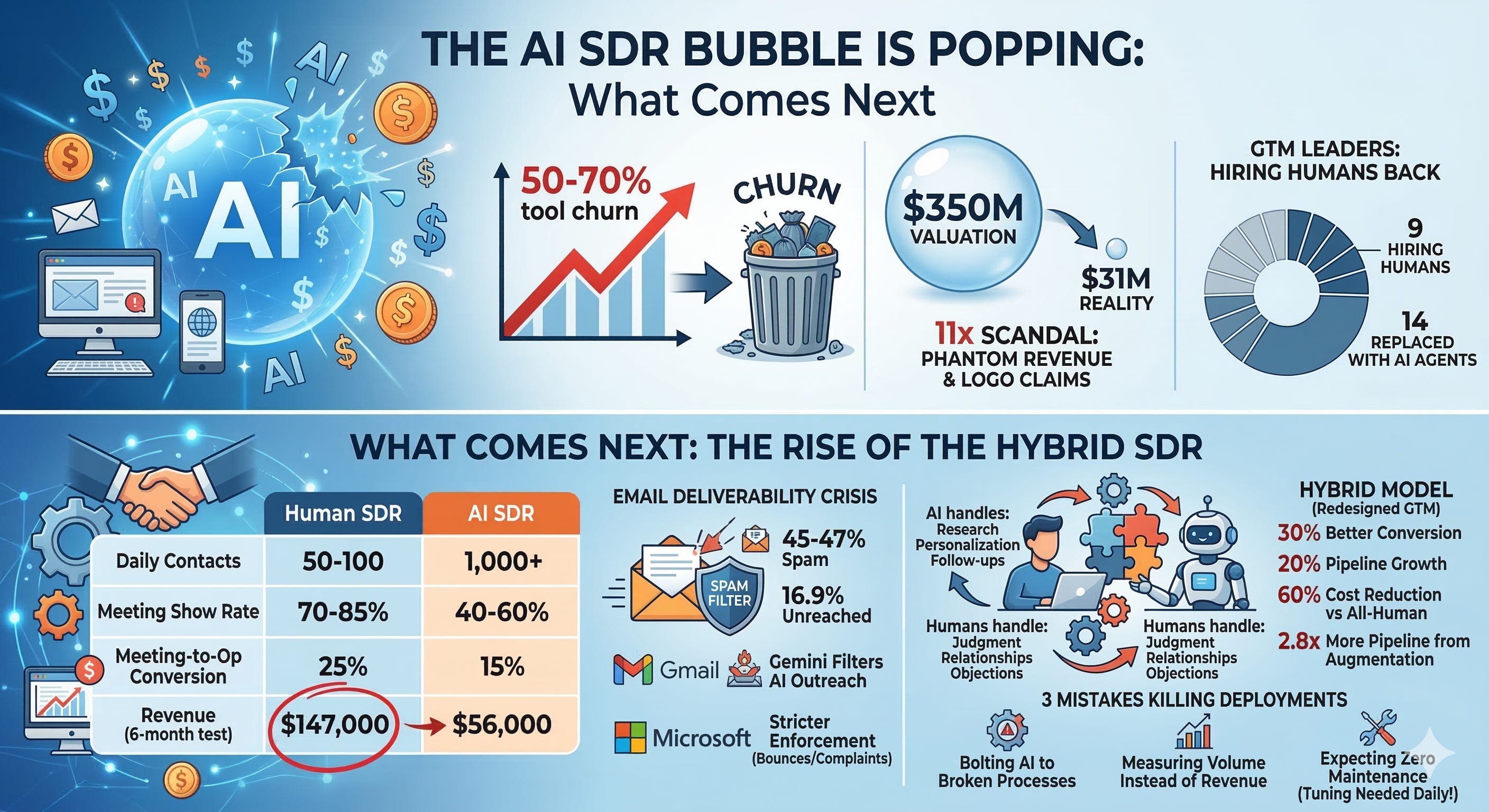
UserGems is reporting 50-70% annual tool churn rates on AI SDR platforms. That’s not normal SaaS churn. That’s roughly double the turnover rate of the human SDRs these tools are supposed to replace. Companies are buying, deploying, watching pipeline numbers wobble, and ripping the thing out before the first contract renewal.
Gartner predicts 40%+ of agentic AI projects will be abandoned by end of 2027. S&P Global’s 2025 survey found that 42% of companies abandoned most of their AI initiatives — up from 17% just a year earlier.
This isn’t a blip. It’s a pattern.
The 11x Scandal Should Have Been a Wake-Up Call
If you want to understand where this market really is, look at what happened with 11x.
This was the AI SDR darling. $50M Series B from Andreessen Horowitz at a $350M valuation. Harry Stebbings on the cap table claiming ~$25M ARR. TechCrunch cover stories.
Then it came apart. TechCrunch exposed that 11x was claiming customers it didn’t have — logos like ZoomInfo and Airtable used without consent. Former employees told reporters the company was losing 70-80% of customers that walked in the door. Inc. Magazine called it AI’s potential “Theranos moment.”
Independent analysis estimated the real valuation at ~$31M versus the $350M they raised at. That’s paying 116x actual revenue.
11x wasn’t just a bad company. It was the logical endpoint of a market where everyone was buying the hype faster than they were measuring the results.
I’ve Seen This Movie Four Times Before
I’ve been in go-to-market for 21 years. Every “automation replaces humans” cycle follows the exact same script:
Phase 1: Massive hype. Impressive demos. Cost savings on a slide deck. Venture money floods in.
Phase 2: Bolt-on deployment. Companies attach the tool to broken processes and expect magic. Nobody redesigns the workflow.
Phase 3: Volume goes up, quality craters. Pipeline looks full on the dashboard but conversion rates quietly drop. Closers start complaining about lead quality.
Phase 4: Correction. The best companies redesign the workflow. Everyone else churns and blames the tool.
Outsourced call centers in 2004. Marketing automation in 2012. Chatbots in 2018. AI SDRs in 2024-2026.
The pattern is identical every single time. We’re somewhere between Phase 2 and Phase 3 right now.
The Numbers Don’t Lie — But the Vendors Cherry-Pick
Here’s what the head-to-head data actually shows when you strip away the marketing:

The AI SDR booked more meetings. The human SDR generated 2.6x more revenue.
Every AI SDR vendor shows you the volume slide. Nobody shows you the revenue-per-meeting slide. Because the story it tells isn’t the one they’re selling.
One company I’m advising ran a 90-day controlled test:
AI-only pipeline: 847 meetings booked, 11% opportunity conversion
AI + human hybrid pipeline: 312 meetings booked, 38% opportunity conversion
The hybrid generated 2.3x more revenue from fewer meetings. Read that again. Fewer meetings, more money. Because meeting quality compounds and meeting volume doesn’t.
The Email Deliverability Crisis Is Making It Worse
Here’s something most AI SDR vendors won’t tell you: the email infrastructure they depend on is actively working against them.
45-47% of global email traffic is now classified as spam
16.9% of commercial emails never reach their destination
Gmail’s Gemini AI is specifically filtering AI-generated outreach
Microsoft rolled out stricter enforcement in May 2025 (bounces above 2%, complaints above 0.3% = domain reputation damage)
Average B2B cold email reply rates dropped from 6.8% in 2023 to 4-5% in 2025. The 10x volume advantage of AI SDRs is running headlong into inbox providers who are 10x better at flagging automated messages.
You’re not just fighting for attention anymore. You’re fighting for deliverability. And an AI sending 1,000 templated emails a day from a burned domain isn’t a growth strategy — it’s a self-inflicted wound.
The $75K vs. $25K Math Is Wrong on Both Sides
The cost comparison that launched a thousand pitch decks is misleading in both directions.
The human SDR actually costs more than $75K. Fully loaded — salary, benefits, management overhead, tools, office space, recruiting costs given 30-40% annual attrition — you’re looking at $110K-$139K per rep.
The AI SDR actually costs more than $25K. When you add implementation ($5K-$15K), data enrichment subscriptions, email infrastructure (domain warming, deliverability tools), CRM integration work, and the human time required for daily tuning and supervision, real TCO runs $35K-$65K.
The gap is real. But it’s not the 3:1 ratio the vendors show. It’s more like 2:1. And when the AI generates 2.6x less revenue, the math flips entirely.
What the Winners Are Actually Doing
The companies getting this right — and they exist — aren’t having the “replace vs. keep” debate. They’ve moved past it.
SaaStr’s case study is the most documented example. They deployed 20+ AI agents, went from 8-9 human salespeople to 1.2 humans plus AI. Results over 8 months: $5M additional pipeline, $2.4M closed, deal volume doubled, win rate doubled.
But the details matter more than the headline. Jason Lemkin — who’s arguably the biggest AI SDR bull in the market — said this: “If you hook up an AI SDR and go away and do nothing, you will get nothing. Zilch. Nada.”
Their inbound AI agent alone needed 47 iterations to stop being too aggressive on pricing. They have a dedicated AI operations person doing daily tuning. It works because they treat AI SDR as an operations challenge, not a plug-and-play product.
45% of sales teams have already moved to hybrid models. The data on hybrid is consistently strong:
30% improvement in conversion rates
20% pipeline growth
60% cost reduction versus all-human teams
2.8x more pipeline from augmentation versus replacement
The pattern: AI handles research, personalization, timing, initial touchpoints, and follow-up sequencing. Humans handle judgment, relationship-building, complex objections, and the conversations that actually move deals.
The Three Mistakes Killing AI SDR Deployments
After watching this play out across 14 companies, three failure modes account for the vast majority of the churn:
1. Bolting AI onto broken processes
If your ICP is undefined, your messaging is generic, and your handoff to AEs is broken — AI won’t fix any of that. It’ll scale the dysfunction at 10x speed. “Garbage in, garbage out” is not a metaphor here. It’s a daily pipeline review.
2. Measuring volume instead of revenue
The company that books 847 AI meetings and celebrates is the company that churns in 6 months. The company that measures meeting-to-opportunity conversion, opportunity-to-close rate, and revenue per meeting actually understands whether the tool is working.
3. Expecting zero maintenance
Every successful AI SDR deployment I’ve seen requires daily tuning. Not weekly. Not monthly. Daily. Prompt adjustment, domain monitoring, reply analysis, false positive filtering. The “set it and forget it” promise is the biggest lie in the market.
What Happens Next
Gartner predicts that by 2028, AI agents will outnumber sellers 10:1. McKinsey says 70% of routine sales tasks will be automated by 2030. This technology isn’t going away.
But the standalone AI SDR product — the one that promises to replace your BDR team for $25K/year with no workflow changes — is going to consolidate, rebrand, or die.
What survives will look more like this:
The $250K SDR. The hybrid rep who uses AI for 60-80% of operational tasks and applies human judgment to the 20-40% that actually closes revenue. They’ll earn 2-3x what today’s SDRs make, and they’ll be worth 10x.
AI-native outbound workflows. Not bolt-on tools, but redesigned processes where AI and humans each do what they’re best at. The workflow is the product, not the agent.
Revenue-measured, not volume-measured. The metric shift from “meetings booked” to “revenue generated per outbound dollar” will kill most current AI SDR vendors’ value propositions.
The Bottom Line
The AI SDR isn’t a strategy. It’s a tool inside a strategy. And if you can’t articulate the difference, you’re about to become a churn statistic.
The companies winning right now share one thing: they redesigned their top-of-funnel workflow before they added AI to it. They didn’t automate the existing process. They built a new one where AI makes human reps 3x more effective instead of trying to make AI do a human’s job at 40% quality.
If you’re evaluating AI SDR tools right now, ask the vendor one question: “What’s the meeting-to-opportunity conversion rate for your average customer?”
If they pivot to volume metrics, you have your answer.
What’s your experience been — AI SDRs delivering, or disappointing? Hit reply or drop a comment. I’m collecting real stories for a follow-up piece on the specific workflow designs that are actually working.
Sources & Further Reading: