

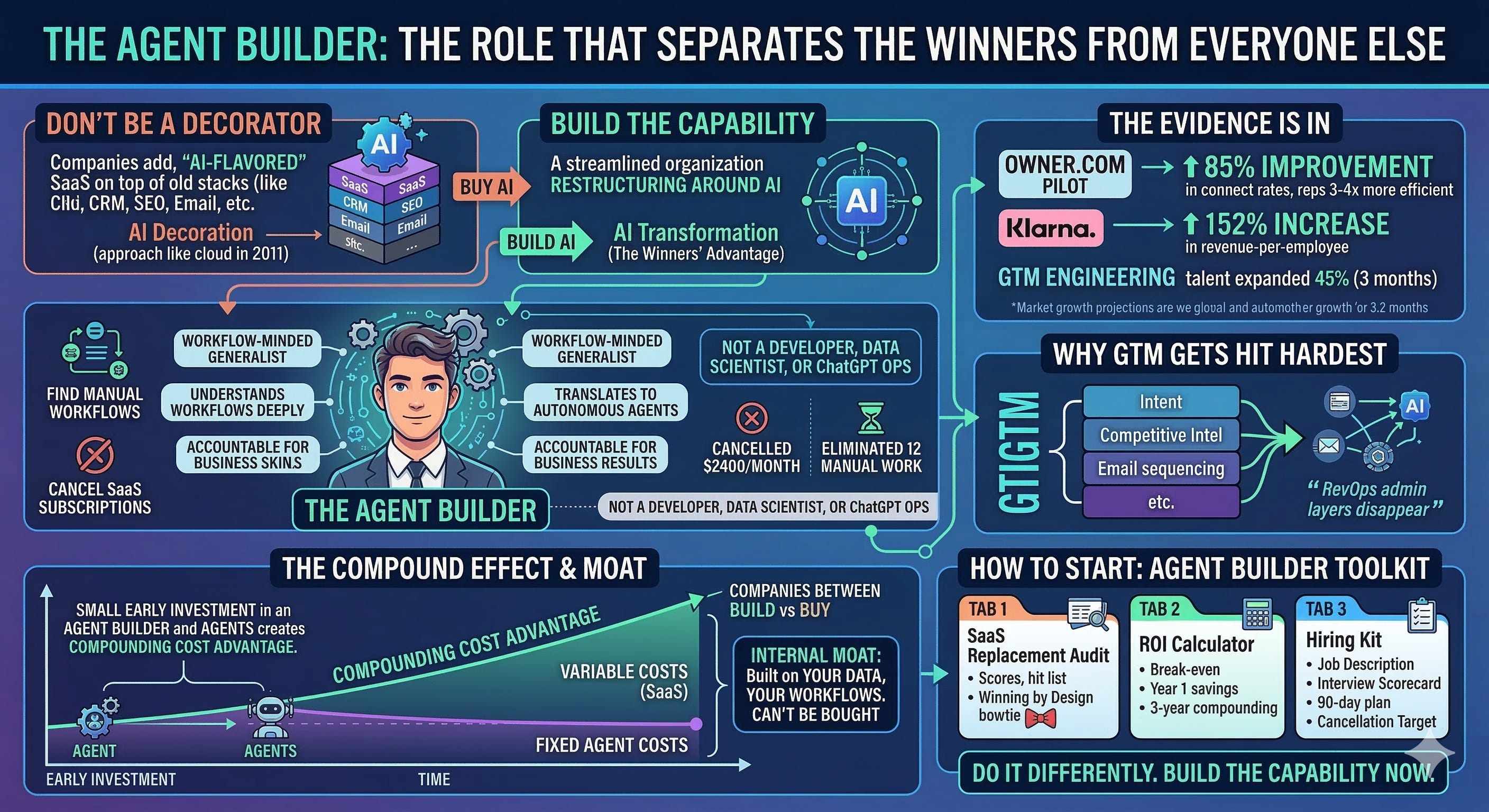
Most companies are approaching AI like they approached cloud in 2011. They’re adding it to what they already have. Layering it on top. Calling it transformation.
It’s not transformation. It’s decoration.
And the companies that figure this out—that actually restructure around AI instead of just buying AI-flavored SaaS—are going to have a competitive advantage that’s very hard to close.
The signal is always the same: the early movers don’t wait for the market to package the thing for them. They build the capability themselves, internally, before it becomes table stakes.
Right now, that capability is the Agent Builder.
The Math Changed and Nobody Updated Their Playbook
Buying AI-powered versions of the tools they already have.
New CRM? It has AI baked in. SEO tool? AI-powered. Social listening platform? AI-enhanced. Email sequencer? Copilot included.
The category names are new. The underlying model is identical: pay a vendor, get a tool, add it to your stack.
This made sense when AI was genuinely hard to implement. When you needed a team of engineers and weeks of fine-tuning just to automate a simple workflow. That era lasted maybe 18 months. It’s over.
What changed isn’t just that models got smarter. It’s that agent platforms got accessible enough that a sharp, workflow-minded generalist can build something genuinely useful in a day or two. Not a toy. Not a demo. Something that runs autonomously, handles edge cases, and generates actual output.
The AI agents market is projected to grow from $7.84 billion this year to $52.6 billion by 2030—a 46.3% CAGR. That’s not a trend. That’s a structural shift in how work gets done. And by end of 2026, 80% of B2B sales interactions are expected to be AI-powered.
The companies building this capability internally are going to capture the value. The companies buying it from vendors are going to pay a premium for someone else’s version of what they could have built themselves.
What the Agent Builder Actually Is
The Agent Builder isn’t a developer. They’re not a data scientist. They’re not an ops coordinator who learned to use ChatGPT.
The best Agent Builders live at a very specific intersection: they understand workflows deeply—what humans actually do, step by step, in a given function—and they can translate that into agents that do those same tasks autonomously.
The key word is autonomously. Not “with AI assistance.” Not “AI-augmented.” Autonomously.
Their mandate is simple: find manual workflows and SaaS subscriptions that can be replaced by agents, and build the replacements. Run discovery across teams. Understand inputs and outputs. Build, test, deploy.
But here’s what separates this from a tech project: they’re accountable for the business result. Not “the agent runs.” But “we cancelled that $2,400/month subscription” or “we eliminated 12 hours of manual data work per week from the growth team.”
This is a full-time role. It needs to be. Because the backlog of replaceable workflows and cancellable SaaS subs in your company is enormous—you just haven’t mapped it yet.
The Evidence Is Already In
This isn’t theory. The data is coming in fast and it’s unambiguous.
Owner.com ran a two-week pilot with AI agents in their BDR function. The result: 85% improvement in decision-maker connects. Their reps now operate 3-4x more efficiently than competitors. Two weeks.
Klarna achieved a 152% increase in revenue-per-employee without proportional headcount growth. They didn’t hire their way to efficiency. They built it.
The GTM Engineering talent pool—people who build at this intersection of revenue and automation—expanded 45% in just three months, with 1,570 new profiles entering the market. The role is real and the market is responding.
And here’s something I can speak to directly: I currently manage 93 specialized AI agents across 12 departments with 11 live integrations. One operator. Ninety-three agents. That’s not a future scenario. That’s my Tuesday.
Why GTM Gets Hit Hardest
Go-to-market is where this lands first and lands heaviest. And it’s where most leaders are the most behind.
Think about what your GTM stack actually looks like. Intent data. Social listening. Competitive intelligence. User feedback analysis. Email sequencing. Pipeline analytics. Content production. Prospect research.
How many of those are candidates for agents?
All of them. Every single one.
That doesn’t mean you flip a switch and cancel everything tomorrow. It means you have a strategic opportunity to systematically replace vendor dependencies with internal capabilities that are faster, cheaper, and tailored to your specific business context.
VP RevOps titles have grown 300% in the last 18 months. That’s the market telling you that companies are centralizing operational control. But the smart ones aren’t just hiring RevOps leaders to manage the existing stack—they’re hiring them to replace it.
Anthony Enrico from Leanscale said it plainly: “The Salesforce admin role is gonna die.” Nico Druelle at Revenue Architects went further: “RevOps staying at the surface—dashboards, reporting, CRM admin—AI will do most of that. That whole layer disappears.”
They’re not being dramatic. They’re describing what’s already happening.
The Compound Effect
Here’s what most people miss: it’s not one subscription or one workflow. It compounds.
Every agent you build is a fixed cost that replaces a variable or recurring cost. The agent doesn’t need a seat license. It doesn’t need a renewal negotiation. It doesn’t have a per-user pricing model that punishes you for growth.
And the Agent Builder doesn’t build one agent. They build a system of agents. A coverage map across your company where manual work and SaaS dependencies get methodically replaced.
At the end of a year, a good Agent Builder has replaced 6-12 SaaS subscriptions, automated dozens of manual workflows across multiple functions, and created a compound cost advantage that keeps widening as the company scales.
That’s not a technology project. That’s a structural change to your operating model.
Why This Changes What You Hire For
If you’re a GTM leader, this should change how you think about headcount.
The old question: “Do we need another SDR, another analyst, or another ops person?”
The new question: “Do we need an Agent Builder who can eliminate the need for three tools and two manual processes in their first quarter?”
That’s not hyperbole. That’s the ROI profile I’m seeing from early adopters.
Your SDRs shouldn’t be doing research. Your analysts shouldn’t be pulling reports. Your ops people shouldn’t be manually QA-ing data. Agents can do all of that. Your humans should be doing the things that compound over time—building relationships, making judgment calls, creating strategy, running experiments. That’s where human time has the highest leverage.
The Moat Nobody’s Talking About
Software can be copied. A workflow built on a shared SaaS platform can be replicated by anyone with the same subscription.
An internal agent system? That’s built on your specific data, your specific workflows, your specific context. It gets better the longer it runs. It compounds knowledge. It surfaces insights that a generic tool was never designed to surface.
The company that has an Agent Builder working for 12 months has a capability advantage that a competitor can’t buy off the shelf. They can buy the same agent platform. But they can’t buy your 12 months of workflow knowledge, custom tooling, and proprietary outputs.
That’s the moat. And it’s building right now, whether you’re building it or not.
How to Actually Start
If you’re thinking about this seriously, here’s where I’d begin:
Map your SaaS spend by workflow. Not by category—by the actual thing each tool does. What’s the input? What’s the output? How many hours per week does a human spend operating it?
Find your Agent Builder. They probably already exist on your team. They’re the one automating their own work, annoyed by manual processes, asking “why are we doing this by hand?” more than anyone else.
Start with one thing. Pick one workflow that’s manual, repetitive, and high-frequency. Build an agent. Let it run for 30 days. Measure against what you were doing before.
Then give them a cancellation target. Identify and replace $X in SaaS spend by end of Q3. That creates accountability and forces prioritization.
Most companies will read this, nod, and keep buying tools.
A few will actually do something different.
The question isn’t whether agents can replace manual workflows and SaaS tools. They can. The question is whether you’re building that capability or waiting for a vendor to sell it back to you.
