

Jensen Huang stood on stage at GTC last week and said something that landed differently depending on who was listening.
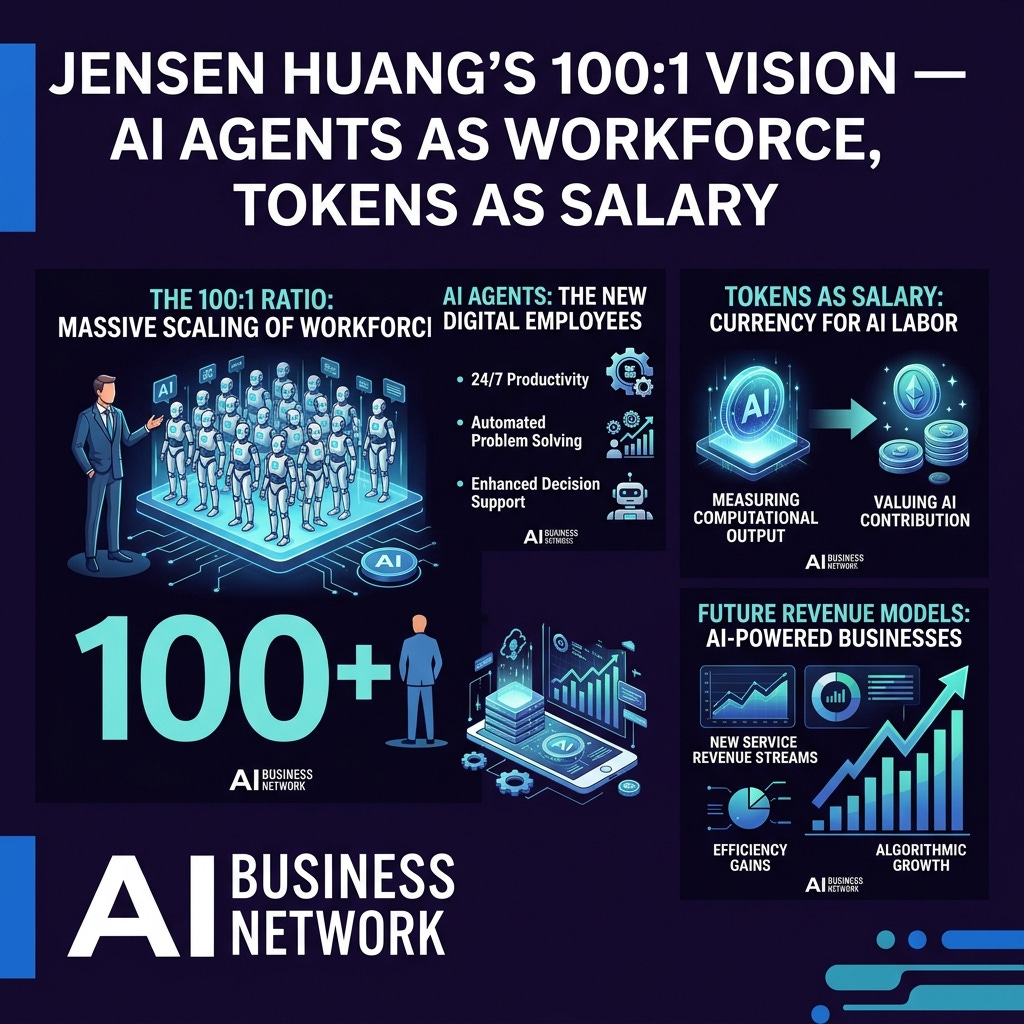
“7.5 million AI agents. 75,000 humans.”
That’s 100 agents per person. At NVIDIA. Not in a pitch deck. Not in a research paper. At one of the most operationally sophisticated companies on the planet.
Analysts heard a headline. VCs heard a thesis. I heard someone finally put a number on the thing I’ve been arguing from the field for the last year: the AI-native org doesn’t add agents to the existing structure. It replaces the structure entirely.
I run a 103-agent system. Not as a proof of concept. As my actual operating architecture for GTM work — content, research, competitive intelligence, sales enablement, revenue operations, the whole stack. And what Huang described isn’t science fiction from where I’m sitting. It’s Tuesday.
The ratio itself isn’t the insight. It’s what the ratio demands of the humans who remain.
The End of “Managing” as a Job Description
The typical VP of Sales manages 8-12 people. Maybe 20 if the span is wide. The job is 1:1s, coaching, pipeline reviews, conflict resolution, career development. It’s relationship-intensive, time-intensive, and — let’s be honest — it doesn’t scale.
Now imagine that same VP orchestrating 100 agents. The skillset inverts completely.
You don’t coach agents. You configure them. You don’t do 1:1s. You review output quality and adjust routing logic. You don’t resolve conflicts between personalities. You resolve conflicts between competing optimization functions.
This isn’t an incremental change. It’s a different job. And most leaders I talk to haven’t internalized that yet.
I was on a call two weeks ago with a CRO at a $400M SaaS company. Smart guy. Aggressive growth targets. He told me he was “exploring AI agents for the team.” When I asked what that meant, he described giving his reps access to a chatbot that could draft emails.
That’s not a 100:1 org. That’s a 0.1:1 org with better autocomplete.
Which Human Roles Survive (And Which Don’t)
These are the human roles that get more valuable at 100:1, not less:
Architects — Someone has to design the system. Which agents exist, how they connect, what data flows between them, where human judgment gates sit. This is the new org design. When I built my routing table — literally mapping task patterns to specific agents across 9 departments — that was architecture work. No agent did that for me.
Governors — At 100:1, one misconfigured agent creates cascading failures. Someone has to set guardrails, monitor for drift, audit outputs, and decide when the system’s confidence threshold requires human override. I run drift detection on my agent specs. If the source material changes but the agent hasn’t been updated, I get flagged. That governance layer is a human job.
Relationship holders — Agents don’t build trust. They don’t read the room in a board meeting. They don’t know that your champion at the prospect company just went through a divorce and needs you to be a human being before you’re a seller. The judgment calls — when to override the system, when to ignore the data, when to just listen — those stay human.
Taste-makers — Agents can generate a hundred variants of a LinkedIn post. Someone has to know which one sounds like you. The editorial judgment, the brand instinct, the “that’s not quite right” feeling — that’s irreplaceable. I review every piece of content my writing agent produces. The agent gets me 80% there. The last 20% is taste.
What gets absorbed into agent workflows? Research. First-draft creation. Data analysis. Competitive monitoring. Lead scoring. Email sequencing. Meeting prep. Follow-up cadences. Report generation. Most of what a typical BDR, SDR, or marketing coordinator does today.
That’s not a prediction. That’s what’s already happening in my system.
What Managing Agents Actually Requires
Let me be specific about what my day looks like orchestrating 103 agents, because the “100:1 ratio” sounds clean and the reality is messier.
Routing is the new management. Every task that enters my system hits a routing layer. Is this a Tier 1 obvious match — a writing task that goes straight to the content writer? Or is it Tier 3 — a novel cross-domain problem that needs multiple specialists in sequence? Getting the routing right is 60% of the job. Bad routing wastes more time than bad agents.
Memory is the new moat. My agents share a knowledge graph. When the competitive intelligence agent discovers something, the content writer can reference it. When the product marketing agent updates positioning, the sales enablement agent adjusts its playbooks. This compound learning is the actual competitive advantage — not any individual agent’s capabilities.
Context windows are your bottleneck. Every agent has a finite amount of information it can hold at once. Managing what goes into that window — and what gets folded, summarized, or archived — is a genuine operational discipline. I built a context management system with token budget tiers. It sounds like infrastructure. It’s actually the difference between agents that hallucinate and agents that produce.
Observation beats instruction. The best agents in my system aren’t the ones with the most detailed prompts. They’re the ones where I’ve built feedback loops — tracking what works, what doesn’t, and adjusting the system. I have a proactive monitor that checks 9 conditions across the system: inbox age, content staleness, queue status, agent freshness, orphan notes. The system tells me where to look. I decide what to do about it.
The Token Salary Signal
One more thing Huang said that deserves separate attention: NVIDIA plans to offer engineers $100K-$150K in AI compute tokens on top of their cash compensation.
Read that again. They’re not offering a perk. They’re offering capacity.
An engineer with $150K in compute tokens can spin up more agents, run more experiments, train more models than an engineer without them. The gap between the two isn’t about money. It’s about leverage. One engineer ships the output of ten. The other ships the output of one.
This is where the 100:1 ratio meets compensation design. If your agents are your workforce, and tokens are what powers those agents, then token access IS workforce capacity. The companies that figure this out first will attract and retain the engineers who can actually operate at 100:1 scale.
What To Do This Week
If you’re leading a GTM team and the 100:1 number made you feel something — excitement, anxiety, skepticism — channel it into one action:
Audit your current ratio.
Not “how many AI tools does my team use.” That’s the wrong question. The right question is: how many autonomous workflows run without a human in the loop?
Count them. Be honest. If the answer is zero, you’re not behind on AI adoption. You’re behind on architecture. The tools are available. The system design is what’s missing.
Huang didn’t announce new technology at GTC. He announced a new operating model. The technology has been here. The question is whether your org structure has caught up.
The leaders who build their 100:1 architecture in 2026 will own their categories by 2028. The ones waiting for it to “mature” will be buying the playbook from the first group.
Start with one agent. Then five. Then the ratio will tell you where to go next.