

1 million tokens. Who has it. Who doesn’t. Whether it’s “real” or just marketing. I watched smart people spend serious energy debating whether Gemini 3.1 or Claude’s new models win the context benchmark.
Meanwhile, something far more consequential happened quietly in the background.
AI moved off the server and onto the desktop. Memory became persistent by default. Autonomous agents started doing actual work inside Excel spreadsheets. Automation platforms wired themselves into the intelligence layer. And two healthcare companies took their first real steps into an industry that has resisted technology for two decades.
The model race is a distraction. What happened this week wasn’t about which model scores higher—it was about where AI lives now, and what it can finally do when it lives there.
The Context War Is an Architecture War
Let’s start with the “boring” one: context windows.
Anthropic shipped Claude Opus 4.6 and Sonnet 4.6 with 1 million token context. Google followed with Gemini 3.1 Pro at 1 million tokens. The benchmark crowd immediately started arguing about latency and accuracy and whether either company actually delivers on that promise in practice.
That’s the wrong conversation.
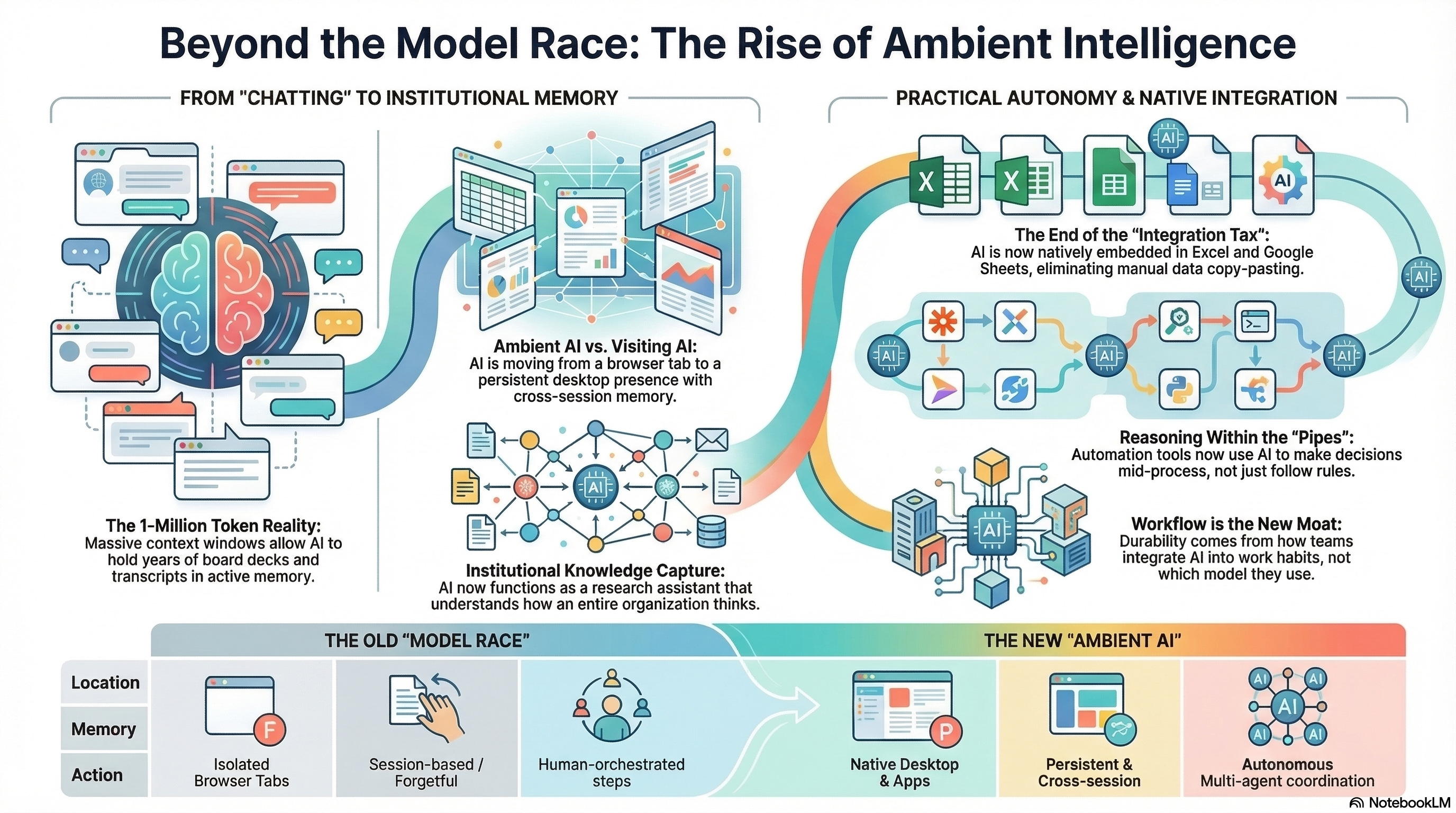
Here’s the right one: 1 million tokens is roughly the size of a full product spec, the last six months of customer support tickets, an entire sales team’s call transcripts for a quarter, or your company’s last three years of board decks. When AI can hold that in working memory—genuinely hold it, not just technically support it—the nature of what you’re building with AI changes completely.
We stop asking AI to answer questions from isolated context. We start giving AI institutional memory.
NotebookLM accelerated this same week. The product added 1 million token support plus 6x improvement in multi-turn reasoning plus Custom Goals and Personas. That’s not a feature update. That’s the difference between a research assistant who reads what you hand them and one who actually understands how you think.
The context war isn’t about raw numbers. It’s about whether AI can finally carry the full weight of organizational knowledge. This week, it got meaningfully closer.
AI Showed Up on Your Desktop
The announcement I’ve been watching for: Anthropic shipped Cowork.
If you haven’t seen it yet—it’s a desktop app that puts an AI agent directly into your working environment. Not a browser tab. Not a sidebar. On your computer, with access to your files, your running applications, your actual workflow.
I’ve spent 21 years building operations at companies from pre-revenue to $15B+ scale. The single most consistent pattern across all of them? The gap between where decisions are made and where work gets done. Leadership sits in dashboards. Operators sit in spreadsheets, email chains, and document folders. That gap costs more than most companies realize.
Cowork—and tools like it—start to close that gap at the infrastructure level.
This matters less as a product announcement and more as a signal about where the category is going. When AI moves from being something you visit to something that lives in your workflow, the nature of human-AI collaboration changes fundamentally. You stop context-switching to use AI. You start working alongside it.
Anthropic also shipped Memory for All this week—persistent cross-session memory enabled for all users by default. That’s the other half of this equation. Cowork puts AI in your environment. Memory means it knows your environment over time.
This is what ambient AI looks like. And it’s more important than any benchmark.
Autonomous Work Got Real
Here’s the one that should get your sales and operations leaders off their phones for five minutes: GPT-5.4 is now natively embedded in Microsoft Excel and Google Sheets.
Not an add-in. Not an API integration you have to build. Native.
That means the people who live in spreadsheets—which, let’s be honest, is most of your company’s analytical horsepower—now have AI that doesn’t require them to copy-paste data into a chat interface and hope the model formats the output correctly. It reasons inside the tool they already use.
I’ve built operations at companies that spend millions on reporting infrastructure that ultimately produces Excel files anyway. If I’m being direct: the intelligence layer has now arrived at the place where most analytical work actually happens.
Cursor shipped Cloud Agents this week too. That’s autonomous AI executing multi-step engineering tasks in the cloud—not assisted coding, but agents doing independent work and handing it back when finished. Grok 4.20 added multi-agent coordination, letting specialized models collaborate on complex tasks without a human orchestrating each step.
The through-line here isn’t “AI is getting smarter.” It’s that AI is getting autonomous in ways that are practical and immediate. Not someday. Not in a future product roadmap. This week, in tools your teams are already using.
The Automation Stack Finally Grew Up
Zapier shipped AI Enrich. Make.com launched Visual AI Agents. n8n upgraded its AI capabilities.
These aren’t glamorous announcements. Nobody’s going to write breathless Medium posts about Zapier. But if you’re running operations at any company above a certain size, you should pay attention.
The automation layer—the pipes that connect your tools—has historically been dumb. It moves data. It triggers actions. It follows rules you define explicitly. Smart operations teams have gotten impressive mileage out of that, but the ceiling was always: as good as the rules you write.
When AI gets embedded natively into the automation layer, the ceiling rises dramatically. Zapier’s AI Enrich means automated workflows can now do research, enrichment, and inference mid-process—not just move a record from one place to another, but add intelligence to it in transit. Make.com’s Visual AI Agents means you can build workflows that make decisions, not just follow them.
This is the maturation of the AI automation stack. It’s taken longer than the hype predicted, but it’s here, and the companies that build on this infrastructure in the next 12 months will have leverage that’s genuinely hard to replicate.
AI Entered the Last Analog Strongholds
Two announcements this week deserve more attention than they got.
ChatGPT Health launched with real-time health data integration. Manus AI, one of the more capable general-purpose agent platforms, surfaced acquisition rumors with Meta—which would give one of the world’s largest technology companies a serious agentic AI capability almost overnight.
Healthcare is the industry that has resisted technological transformation most successfully. I say that with both admiration and frustration—I work at Experity, a $200M+ ARR healthtech company, and I’ve spent the last several years building out Care Agent, our clinical intelligence platform for urgent care. I know exactly how hard this industry is to move.
ChatGPT Health won’t transform healthcare this quarter. But OpenAI entering the space with real product ambition—not just API access—shifts the dynamics of what patients expect, what providers have to respond to, and what the competitive landscape looks like for every healthtech company building in this space.
When a general-purpose AI platform with 100 million users enters your vertical, the question isn’t whether it will matter. It’s how fast and for whom.
What This Actually Means for You
The companies I’ve watched win over the past five years—across industries, across business models, across market conditions—share a pattern. They don’t adopt technology because it’s new. They adopt it because it changes a core constraint.
Here’s what this week’s releases change, practically:
The constraint on institutional knowledge is weakening. With 1M context and persistent memory, AI can finally carry more of what your company knows. If you’re still treating AI like a search engine—give it a question, get an answer—you’re leaving leverage on the table. Start thinking about what it would mean to give your AI the full context of your domain.
Autonomous work is real now, in the tools your people already use. AI in Excel. Agents in your automation layer. Cloud-native agents in your development workflow. The integration tax is dropping. The question is whether you’re building the processes and habits to use these capabilities, or whether you’re waiting for them to be more “mature.”
The workflow is the moat, not the model. None of this week’s releases—taken individually—create sustainable competitive advantage. The model race will continue. The context window numbers will grow. New features will ship. What creates durability is how your team actually integrates AI into how work gets done. That’s organizational, not technological. And it requires decisions you can make right now.
Three Questions Worth Sitting With
I end every AI strategy conversation I have with some version of these:
One: Where in your business is institutional knowledge locked in people’s heads right now—not in any system, not retrievable without a meeting? That’s your first 1M context experiment.
Two: What does your team do manually today that follows a clear but complex enough pattern that they’d struggle to write a precise rule for it? That’s your AI automation opportunity.
Three: If AI is now present in your tools rather than adjacent to them—if it moves from a tab you switch to into the environment you work in—how does your definition of a “skilled employee” change over the next 24 months?
The third one is the one nobody wants to sit with. But it’s the one that matters most.
The Bottom Line
The model race will continue. GPT-6 will come. Claude will respond. Gemini will release another version. The context windows will grow. Everyone will post about benchmarks.
But the more important race isn’t between models. It’s between the organizations that understand what’s actually being built—an ambient intelligence layer that lives in your tools, remembers your context, works while you sleep, and scales without headcount—and the organizations that are still treating AI like a slightly better Google.
This week, the former got closer to being inevitable.
The question isn’t whether AI will change how your company operates. It’s whether you’ll be the one driving the change, or reacting to someone who was.