

What I’m seeing right now is the biggest structural shift in the function’s history. And most RevOps leaders are sleepwalking through it.
Let me explain.
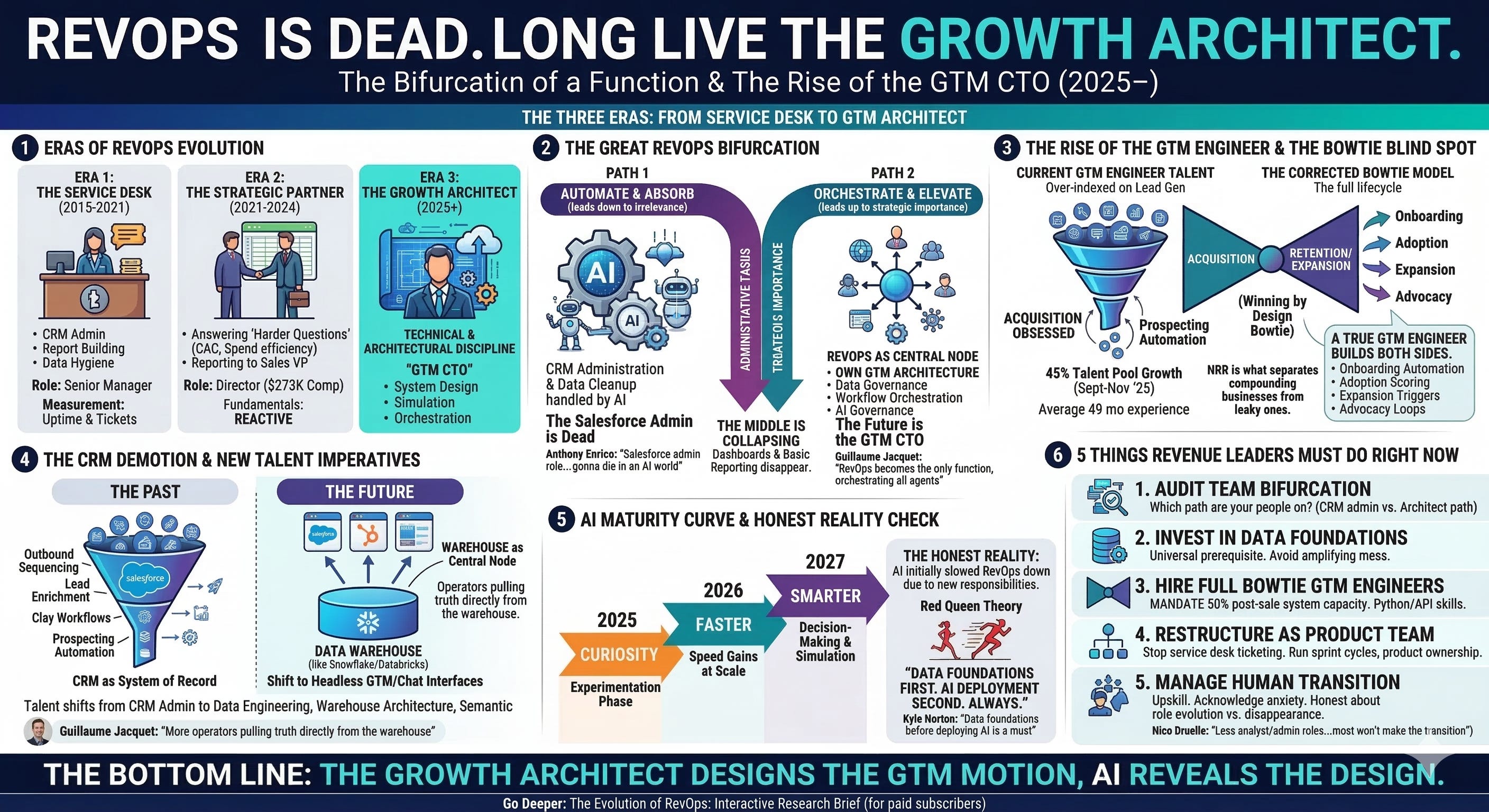
The Three Eras (and Why Era 3 Changes Everything)
Era 1: The Service Desk (2015–2021). RevOps was the team that kept the lights on. CRM admin, report building, data hygiene. The career ceiling was “Senior Manager.” Measurement was system uptime and ticket turnaround.
Era 2: The Strategic Partner (2021–2024). The 2022 SaaS correction forced a reckoning. When “growth at all costs” became a punchline, someone had to answer harder questions — What’s our real CAC? Why are we spending $400K on a channel producing $50K in closed-won? RevOps teams that could answer those questions got promoted. Leaders moved from reporting to VP Sales into senior leadership meetings. Directors started commanding $273K total comp.
But even in this elevated state, most RevOps teams remained fundamentally reactive. Better at answering questions. Not designing the system that generates them.
Era 3: The Growth Architect (2025–). This is where we are now. And it’s genuinely disruptive.
RevOps is evolving from a service function to a technical, architectural discipline. The Vasco 2026 RevOps Trends & Predictions Report — built from interviews with fifteen GTM leaders including Jacco van der Kooij, Kyle Norton, Jen Igartua, and Jeff Ignacio — frames it bluntly:
“RevOps is shifting from a service desk to a growth architect and GTM CTO.”
Teams are moving from busywork and reporting to system design, simulation, experimentation, and orchestration.
The Bifurcation No One Is Talking About
Here’s the uncomfortable truth that most RevOps content avoids: RevOps doesn’t have a future. It has two. And they’re diverging fast.
Path 1: Automate and Absorb. The software performs the RevOps function. CRM administration, basic reporting, dashboard maintenance, data cleanup — AI handles all of it. The traditional RevOps team shrinks or disappears. Anthony Enrico of Leanscale is direct: “The Salesforce admin role is gonna die. It’s not gonna exist in an AI-driven world.”
Path 2: Orchestrate and Elevate. RevOps becomes the central node orchestrating all GTM agents — human and artificial. The function owns system architecture, data governance, workflow orchestration, and AI governance.
Guillaume Jacquet of Vasco captures the uncertainty: “Future number one: the software performs the RevOps function and the team disappears. Future number two: RevOps becomes the only function, the central node orchestrating all the GTM agents. I actually don’t know which one wins.”
What’s clear is that the middle is collapsing. RevOps as a support desk that builds dashboards and manages CRM fields — that’s dead. Nico Druelle of The Revenue Architects: “RevOps that stays at the surface — dashboards, basic reporting, CRM admin — AI will do most of that. That whole layer disappears.”
The Rise of the GTM Engineer (and Its Critical Blind Spot)
The most significant new role in the revenue org is the GTM Engineer. Between September and November 2025 alone, the GTM Engineering talent pool expanded by 45%. AI mentions in profiles rose from ~40% to ~60%. Average experience jumped from 27 to 49 months as the role professionalized.
But here’s where I push back on the prevailing narrative.
The GTM Engineer role — as currently practiced — is massively over-indexed toward the top of funnel. Look at where the talent clusters: Clay workflows, outbound sequencing, lead enrichment, prospecting automation, intent signal routing. It’s acquisition-obsessed.
This is the exact mistake that Winning by Design’s bowtie model was designed to correct: treating revenue as something that happens before the signature.
The bowtie isn’t a metaphor. It’s math. In a SaaS business with healthy unit economics, the majority of lifetime value comes from onboarding, adoption, expansion, and advocacy — the right side of the bowtie. NRR is what separates compounding businesses from leaky ones. Yet the overwhelming majority of GTM engineering energy goes into filling a funnel that’s leaking out the bottom.
A true GTM Engineer should be building across the full lifecycle:
Acquisition systems — but also onboarding automation that cuts time-to-value from weeks to days
Pipeline orchestration — but also adoption scoring that predicts churn before your CSM sees the signals
Lead enrichment — but also expansion triggers that surface upsell from product usage data
Outbound sequencing — but also advocacy loops that turn power users into referral engines
If your GTM Engineer spends 80% on acquire/convert and 20% on onboard/adopt/expand/advocate, your “revenue system” isn’t a system. It’s a funnel with a new job title attached.
The CRM Demotion
The most provocative structural shift: the CRM is no longer the system of record. The data warehouse is.
“More and more operators are pulling truth directly from the warehouse now, because the CRM just can’t describe the real state of the customer anymore.” — Guillaume Jacquet
Kyle Norton takes it further: “We’ll start seeing headless CRMs or chat interfaces built directly on top of the data layer. The UI won’t matter anymore.”
This has massive implications for RevOps talent. If the CRM becomes an interface layer rather than the source of truth, the skills that matter shift from Salesforce administration to data engineering, warehouse architecture, and semantic layer design.
Where We Actually Are on the AI Curve
The Vasco report introduces a useful framework:
2025 = Curiosity. Experimentation phase.
2026 = Faster. Speed gains at production scale.
2027 = Smarter. True intelligence — decision-making, simulation, relevance.
But here’s the honest reality check. Matt Volm of RevOps Co-op: “AI has actually slowed RevOps down this year. On top of our normal work, we’ve added new AI responsibilities, which stretches teams thinner rather than making them faster.”
Stuart Watson invokes the Red Queen Theory: “Finishing something faster doesn’t mean you rest — it just raises the bar. You run faster just to stay in the same place.”
We’re in a skilling phase where the investment hasn’t yet paid off in productivity. But the teams that invested in data foundations before deploying AI are starting to see results. Norton’s team saw 85% improvement in BDR decision-maker connects from a two-week pilot and claims reps are 3-4x more efficient than competitors.
The takeaway: data foundations first, AI deployment second. Always.
The Human Cost No One Talks About
RevOps professionals who built careers on CRM expertise are watching their core competency get automated. The transition to systems architect requires fundamentally different skills — and not everyone will make it.
Nico Druelle says it plainly: “There will be less analyst/admin-only roles. AI will take that over. The reality is: most won’t make the transition.”
Kyle Norton captures the urgency: “If your RevOps team has not already evolved, you’re in serious trouble. We’re over 24 months into the AI era, and if your team is operating the same way it did two years ago, that’s not the right leadership.”
This isn’t just organizational restructuring. It’s a workforce transformation that will leave some people behind.
Five Things Revenue Leaders Should Do Right Now
1. Audit your team against the bifurcation. Which path are your people on? If the majority of time goes to CRM admin, reporting, and manual data work — you’re building on a foundation AI is about to automate.
2. Invest in data foundations before AI deployment. The universal prerequisite. Every single leader I’ve talked to converges on this. If your data is fragmented, AI will amplify the mess.
3. Hire (or develop) GTM Engineers — across the full bowtie. Target RevOps managers and data engineers who can write Python, design APIs, and think in systems. But mandate that at least half their capacity touches post-sale systems.
4. Restructure RevOps as a product team. Stop running it as a service desk with a ticket queue. Organize around product ownership of the revenue system — sprint cycles, user research, dedicated engineering capacity.
5. Manage the human transition deliberately. Acknowledge the anxiety. Invest in upskilling. Create clear career paths from admin to architect. Be honest about which roles are evolving and which are disappearing.
The Bottom Line
RevOps is not dying. But the RevOps most companies have today — reactive, admin-heavy, CRM-centric — is.
What’s emerging is more ambitious, more technical, and more strategically important than anything the function has been before. The Growth Architect doesn’t just support the GTM motion. They design it.
As Jacco van der Kooij puts it: “Once you see growth as a system to be designed rather than a funnel to be staffed, you start to understand why 2026 marks a true inflection.”
The RevOps evolution isn’t about AI replacing people. It’s about AI revealing which people — and which organizational designs — were built for a world that no longer exists.
Go Deeper: The Full Interactive Research Brief
I put together a comprehensive interactive research brief that covers everything in this article and more — including the recommended org chart for the future RevOps team, the four-pillar model, compensation data, the full talent analysis, and the contrarian GTM Engineer argument in detail.
Paid subscribers can dive into the full interactive brief here
