

OpenAI announced they’re bringing ads to ChatGPT.
800 million users. Testing in the US “in coming weeks.” Free and Go tier only. Ads at the bottom of responses “when there’s a relevant sponsored product or service.”
The tech press covered it like a pricing story. “OpenAI needs revenue.” “Subscription revenue isn’t enough.” “This was inevitable.”
They’re missing the bigger picture.
This isn’t about OpenAI’s business model. This is about the complete reinvention of how products get discovered, evaluated, and purchased.
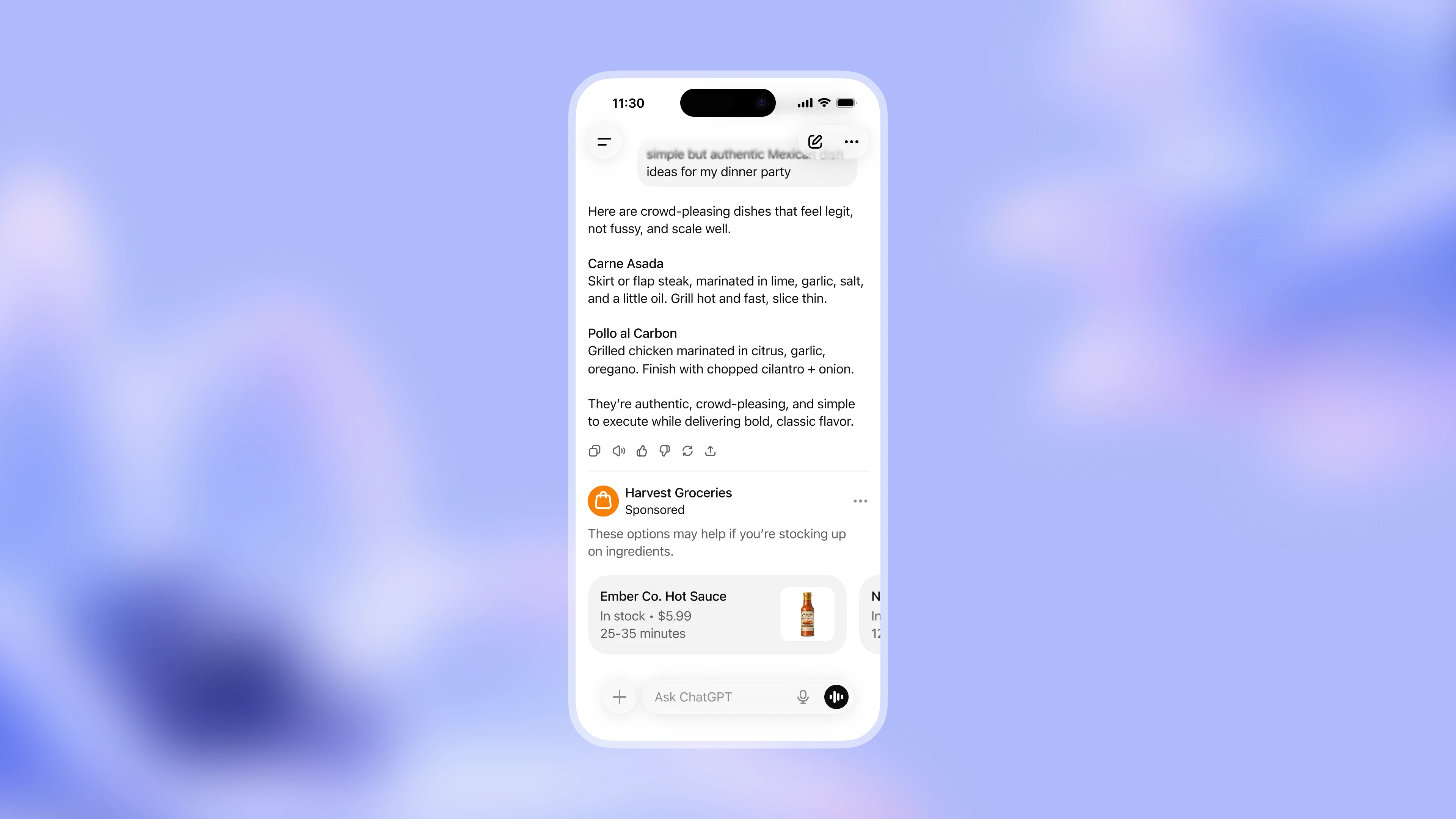
Source: OpenAI
The Intent Gap Just Closed
When someone searches Google for “best CRM for small business,” that’s a keyword match. The algorithm knows you typed those words. It doesn’t know you’re a 10-person company, that you’re frustrated with HubSpot’s pricing, that you need something that integrates with QuickBooks, or that you have a $50/month budget.
You’ll see ads from Salesforce. From Zoho. From Monday. From anyone willing to bid on those terms.
When someone asks ChatGPT the same question? The AI knows context. It knows you mentioned your team size three messages ago. It picked up that you’re price-sensitive from how you phrased your question. It remembers you asked about QuickBooks integrations last week.
The intent signal isn’t a keyword. It’s a conversation.
That’s a fundamentally different advertising surface.
Google ads target what you typed. ChatGPT ads can target what you mean.
And according to OpenAI’s announcement, “soon you might see an ad and be able to directly ask the questions you need to make a purchase decision.” You’re not clicking through to a landing page. You’re starting a conversation with the brand.
This is the highest-intent advertising placement that’s ever existed.
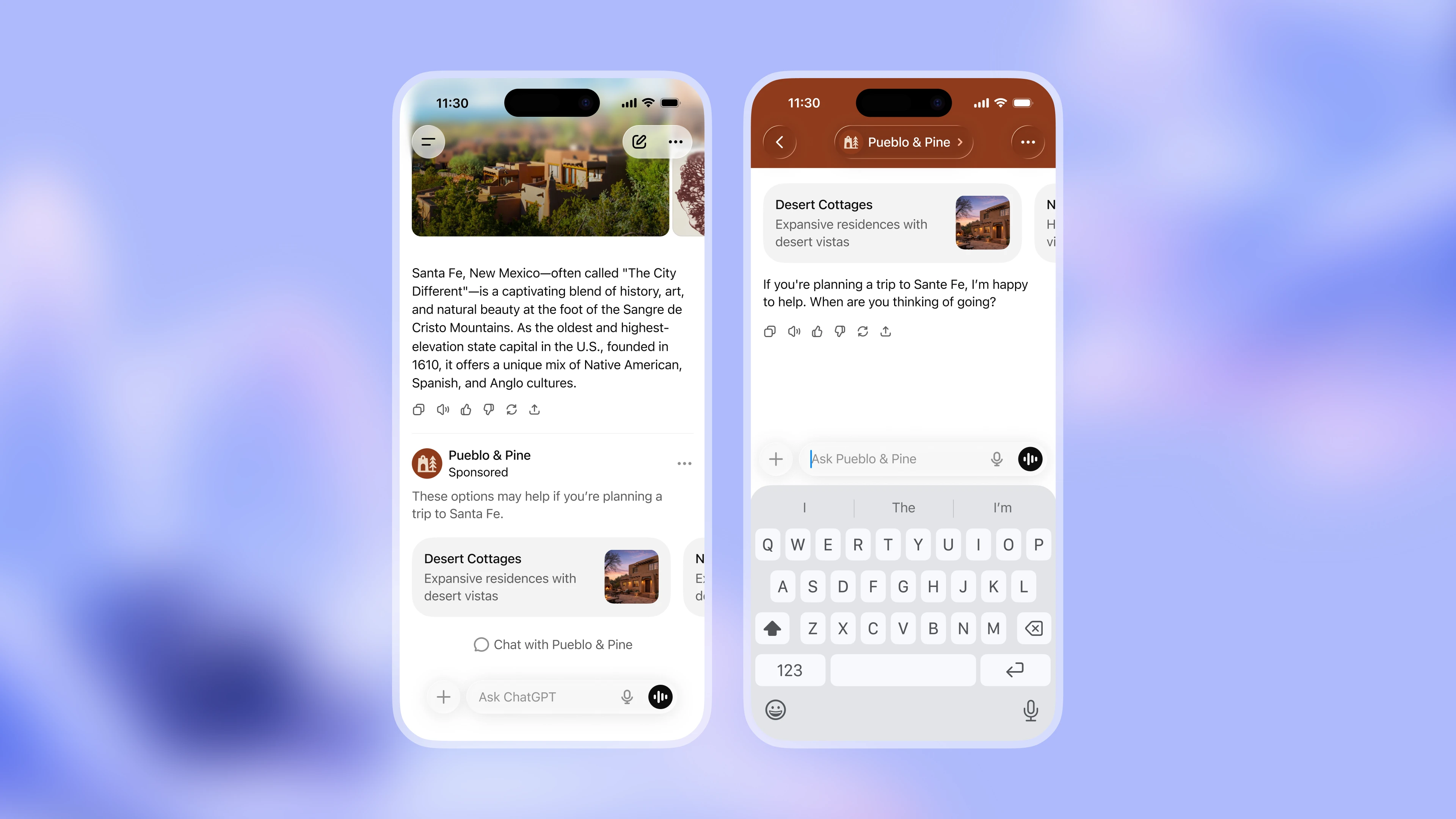
Source: OpenAI
The Promises That Should Make You Skeptical
OpenAI made five commitments. Let me walk through them—and why I’m watching carefully.
“Answer independence: Ads do not influence the answers ChatGPT gives you.”
Every ad-supported platform has said this. Google said search results wouldn’t be influenced by advertisers. Facebook said the news feed would prioritize what users wanted. Over time, incentive structures shift. When ad revenue becomes material to OpenAI’s business—and it will—the pressure on this firewall becomes immense.
I’m not saying they’ll break this promise. I’m saying we should watch how they keep it.
“Conversation privacy: We keep your conversations with ChatGPT private from advertisers.”
True as stated. But your conversations clearly inform targeting. There’s a meaningful difference between “selling data” and “using data to target”—but it’s an increasingly technical distinction that most users won’t understand.
“We never sell your data to advertisers.”
This is the standard tech platform language. Google doesn’t “sell” your data either. They sell access to audiences defined by your data. The semantic distinction matters legally. It doesn’t matter much practically.
“You control how your data is used.”
The default is personalization. Most users won’t change it. That’s by design. The people who opt out are the ones who were never going to click anyway.
“We do not optimize for time spent in ChatGPT.”
This is genuinely interesting. It’s a rejection of the engagement-maximization model that broke social media. But it’s also hard to verify, and it will be tempting to revise as the ad business grows.
I’m cautiously optimistic. But I’ve watched enough platform evolutions to know that Day 1 principles and Year 5 realities often diverge.
What This Means for Founders
If you’re building a company, here’s what changed yesterday:
Your brand needs a conversational presence.
Not a chatbot with decision trees. Not a FAQ with canned responses. A genuine AI agent that can hold a real conversation about your product.
OpenAI’s screenshot showed something telling: when a user asks about Santa Fe trips, an ad appears for a cottage rental business—with an option to “start a direct chat” with that advertiser’s bot.
The funnel is now: ChatGPT conversation → ad exposure → brand AI conversation → purchase decision.
If your brand can’t hold an intelligent conversation, you’re going to lose to competitors who can. This isn’t optional. It’s table stakes for the next era of discovery.
Early movers will establish conversational market share.
Just like search had “rankings” and social has “following,” conversational AI will develop its own authority signals. The brands that build deep, knowledgeable AI presences now will have a structural advantage.
Think about it: if ChatGPT’s users consistently have good conversations with your brand’s AI, that becomes a signal. OpenAI will use those signals somehow. Maybe in ad quality scores. Maybe in organic recommendations. We don’t know yet.
But I can tell you from experience: the time to establish presence on a new platform is before everyone else arrives.
Your attribution models are about to get complicated.
Good luck tracking: organic ChatGPT response → influenced by conversation context → ad exposure → brand AI conversation → website visit → eventual purchase.
If you thought multi-touch attribution was hard before, welcome to conversational commerce.
What This Means for GTM Operators
The opportunity here is real. But so is the capability gap.
New skills required:
Most marketing teams can write ad copy. Can they write conversational AI personalities? Can they design the opening line of a brand conversation? Can they train an AI agent on product knowledge that sounds natural, not robotic?
This is a new competency. And right now, almost nobody has it.
New metrics emerge:
CTR becomes less meaningful when the “click” is actually “starting a conversation.” You’ll need to track: conversation depth, question-to-conversion rate, AI-assisted deal velocity, conversational share of voice.
None of your current dashboards measure these.
Integration complexity:
Your RevOps team needs to instrument a channel that doesn’t exist yet. Your enablement team needs to train people on conversational commerce. Your product marketing team needs to think about AI-native positioning that works in a dialogue, not a landing page.
This touches everything. And most organizations aren’t ready.
What This Means for Users
Let’s be honest about the trade-off.
OpenAI positioned this as “mission aligned”—ads help them make AI accessible to everyone. That’s true. Running inference at scale is expensive. Subscriptions alone won’t fund universal access.
But there’s a Faustian bargain here.
Free users get powerful AI—in exchange for being the product. Same model as Google. Same model as Facebook. Different interface, same economics.
The two-tier reality is now explicit: Plus, Pro, Business, and Enterprise subscriptions remain ad-free. Those who pay get clean AI. Those who don’t get the ad-supported version.
If you’re someone who uses ChatGPT for important decisions—career advice, business strategy, research—consider whether the paid tier is worth it. You’ll get the same AI, without someone else’s message mixed into your decision-making process.
The Bigger Picture
Here’s what I keep coming back to.
OpenAI signed $1.4 trillion in infrastructure deals in 2025. They’re on a $20B revenue run rate. But they have 800 million users, and most of them won’t pay.
Advertising is the obvious answer. It’s how every consumer platform has eventually monetized. Search. Social. Streaming. Now conversational AI.
The question isn’t whether this model will succeed. It will. The economics are too compelling.
The question is what it does to the nature of AI assistance.
When your conversation partner has a commercial interest in your decisions, that changes the relationship. Even if the answers are “independent,” even if the privacy is “protected,” even if you “control” your data—you’re now in a conversation that includes a third party’s agenda.
That’s not inherently bad. We navigate commercial relationships all the time. But it’s worth understanding clearly.
What I’m Watching
Whether “answer independence” holds. If users start feeling like recommendations are tainted, the product value collapses. OpenAI knows this. The question is whether they can resist the pressure as ad revenue grows.
How quickly competitors follow. Google already expanded AI Overview ads to 11 countries in December. This is becoming the industry standard, not an OpenAI-specific choice.
The emergence of “AI adblock.” Just as web advertising spawned blockers, conversational AI advertising will spawn countermeasures. Some smart startup is already building this.
Enterprise bifurcation. Business use of AI will increasingly separate from consumer use. Different trust levels. Different value propositions. Different futures.
The Bottom Line
We’re watching a new advertising platform emerge in real time. The last one—social media—created trillion-dollar companies and reshaped elections. This one will be bigger.
For founders: your conversational brand presence is now a strategic asset. Start building it.
For operators: new channel, new skills, new metrics. The playbook is being written now.
For users: understand the trade-off you’re making. The AI is still powerful. It’s just no longer disinterested.
For everyone: this is what the next decade of commerce looks like. Conversational. Contextual. Commercial.
The age of ad-supported AI is here.