

There’s a moment every company eventually hits when the story they’ve been telling the market and the story their spreadsheets are telling them stop matching up. It’s uncomfortable. It usually gets papered over with a press release about “strategic focus” or “doubling down on core strengths.”
OpenAI hit that moment last week. And they at least had the decency to be honest about it.
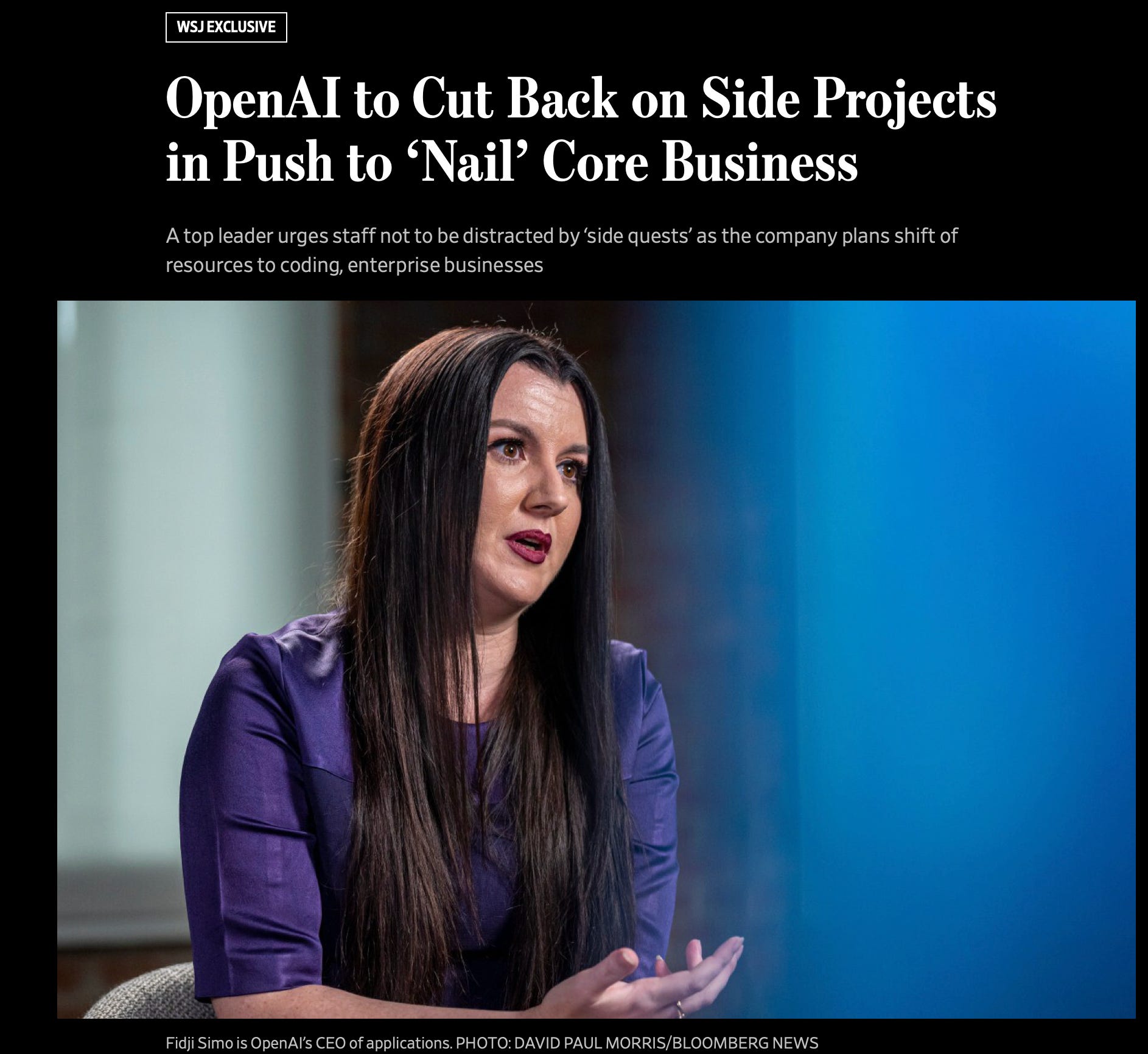
Fidji Simo—the CEO of applications who ran Instacart before Sam Altman brought her in last August—stood in front of OpenAI employees and told them the company couldn’t afford to be distracted by “side quests.” The message was simple: stop chasing everything. Start winning where it actually matters.
What she didn’t say out loud, but what the numbers say clearly: the consumer AI chatbot business they built ChatGPT into is commoditizing so fast it can’t finance the losses required to stay competitive in it.
The Numbers Tell the Story
OpenAI generated $13.1 billion in revenue last year. That sounds like a lot until you see the other column: $8 billion in operating losses.
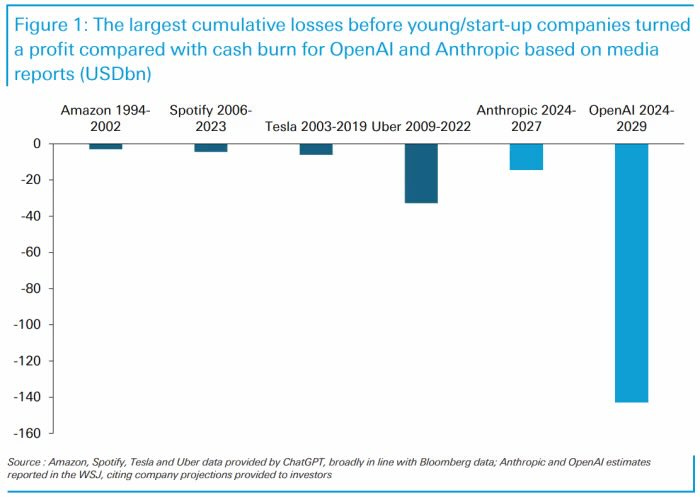
The internal projections from there are the part that should stop you cold. The company is looking at $14 billion in losses for 2026 alone. Cumulative losses reaching $143 billion by 2029.
Let that sit for a second. $143 billion in the hole before they expect to turn profitable.
For context: Amazon burned through roughly $3 billion over eight years before finding its footing. Uber—often held up as the poster child for burning investor money—ran a $31 billion cumulative deficit before reaching profitability. OpenAI is projecting nearly five times Uber’s hole. And they expect to still be filling it three years from now.
The chart that’s been circulating from media reports plots OpenAI’s projected losses against Amazon, Spotify, Tesla, and Uber. Every other company on that chart looks like a rounding error compared to what OpenAI is planning to spend.
This isn’t a startup burning cash to buy market share. This is a company building something that requires a level of capital so extreme that winning the consumer market—even winning it decisively—might not cover the cost of getting there.
What “Winning” Consumer AI Actually Looks Like
ChatGPT had an 86.7% share of web traffic among AI chatbots twelve months ago. Today that number is 64.5%.
Google Gemini went from 5.7% to 21.5% over the same period.
Those aren’t just competitive losses. That’s the consumer AI market compressing in real time—multiple capable, well-funded products chasing the same users at the same price points. The floor on what a good AI model costs to run keeps dropping (more on that in a minute), which means the product that got people to pay $20/month is facing the same fate as every software category that got commoditized before it.
The consumer subscription math doesn’t work at this scale. It never really did. A $20/month Pro subscriber would need to renew for 7,150 months to cover their share of the $143 billion in projected losses. That’s not a business model—it’s a research project with a checkout page bolted on.
Where the Real Money Lives
Meanwhile, something different was happening on the enterprise side.
Codex—OpenAI’s coding agent product—crossed 1.5 million weekly active users with 20x growth since August 2025. Enterprise seats grew 9x year over year. 92% of Fortune 500 companies are currently using ChatGPT products in some capacity.
The revenue per user in enterprise isn’t just higher—it’s a different order of magnitude. And the switching costs are astronomical compared to a consumer subscriber who can cancel in two clicks and sign up for a competitor the same afternoon.
Simo ran Instacart. She understands unit economics better than almost anyone. When unit economics break in consumer, you go where the margins are real and the customers can’t easily leave. Enterprise software sales have known this for twenty years. It’s why Salesforce isn’t trying to win the consumer CRM market.
Coding agents and enterprise API access are that business. Sora and robotics and whatever else falls under “side projects” are capital incinerators with no visible revenue timeline. Cutting them isn’t a strategic failure—it’s a company finally deciding to be honest about what it’s actually building.
The DeepSeek Problem Nobody Wants to Talk About
Here’s the thing that makes this pivot more urgent than most coverage acknowledges.
DeepSeek—the Chinese AI lab that triggered a global stock selloff earlier this year—has matched GPT-5 level performance at somewhere between one-tenth and one-thirtieth the cost.
One-thirtieth.
That’s not a competitive advantage eroding at the margins. That’s the entire competitive moat for consumer AI products evaporating. If the model quality that justifies a premium subscription can be replicated at 3% of the training cost, the floor on consumer AI pricing is falling faster than anyone expected. You can’t build a $143 billion loss-recovery plan on a product where the commodity version is nearly as good as yours and costs next to nothing.
The only defensible position in a commoditizing market isn’t model quality. It’s integration depth. Switching costs. The enterprise customer who has Codex embedded in their engineering workflow, their CI/CD pipeline, their code review process—that customer doesn’t leave because a cheaper model exists. They leave when something better and more integrated comes along. That’s a much higher bar.
OpenAI is trying to be that product. The pivot to coding and enterprise isn’t abandoning their vision. It’s acknowledging that their vision only survives if they own the infrastructure layer that enterprises can’t easily rip out.
The Part That Doesn’t Get Said Out Loud
OpenAI was founded on a specific mission: AGI for humanity. Ensure that artificial general intelligence benefits everyone. Sam Altman has said versions of this in every major interview for the past five years.
The strategy Simo outlined last week isn’t AGI for humanity. It’s Codex for Fortune 500 engineering teams. Enterprise API contracts. Productivity software for developers who can expense the usage fee.
Those are different companies. Not incompatible—plenty of companies serve both a mission and a market—but the gap between “AGI for humanity” and “the coding copilot preferred by Goldman Sachs’ engineering team” is wide enough to drive a truck through.
I don’t think this makes OpenAI villainous. I think it makes them a company, which is what they’ve been for a while even if the nonprofit origin story lingered in the branding. The $280 billion revenue target by 2030 requires roughly 2.3x growth this year, 2x in 2027, and sustained compounding from a $25 billion ARR base. That math only works if they own the enterprise infrastructure layer. Consumer subscriptions at $8 and $20 a month do not get you to $280 billion. Codex at usage-based pricing across every Fortune 500 engineering team might.
But it’s worth naming what changed. The company that was going to democratize intelligence is pivoting to selling it as a service to companies that can pay for it at scale. That’s not wrong. It’s just honest.
If You’re Watching from the Outside
A few things I keep coming back to:
The enterprise coding market just became the most important battleground in AI. Anthropic’s Claude Code, OpenAI’s Codex, GitHub Copilot—these aren’t just developer tools. They’re the integration points that determine which AI company owns the enterprise relationship long-term. Whoever gets embedded deepest in how engineering teams work builds a moat that won’t matter how cheap the next open-source model gets.
Consumer AI is heading toward the same fate as cloud storage. Commoditized, mostly free at entry level, real revenue only at enterprise scale. The companies still trying to win consumer AI on model quality alone are going to have a rough 2026.
Fidji Simo is probably the most important hire in OpenAI’s history. Not because she’s smarter than anyone else there. Because she’s the one who ran a company with brutal unit economics—grocery delivery, where every order can lose money if you’re not obsessive about the math—and learned how to find the customer segments where the numbers actually work. OpenAI needed someone who’d been inside that kind of pressure. They found one.
The mission statement and the business strategy have officially diverged. This doesn’t mean OpenAI fails. It means they’re becoming a different company than the one they said they were building. That happens. The interesting question is whether the mission catches back up to the business once the business is sustainable, or whether it quietly disappears from the About page over the next few years.
The consumer AI race was always going to end this way. Too many capable competitors, too much capital chasing too few paying customers, and the underlying models getting cheaper and better at a pace nobody can sustain a premium on forever.
What’s surprising isn’t that OpenAI is pivoting. It’s that it took this long for someone to say it out loud.
The question now isn’t whether enterprise AI is the better business. It obviously is. The question is whether OpenAI gets there before Anthropic locks up enough Fortune 500 contracts to make the whole race irrelevant.
They’re three to five years and $143 billion of losses away from finding out.
What are you seeing in how your enterprise is thinking about AI vendor selection? Curious whether the OpenAI/Anthropic competition is actually showing up in buying decisions or if most companies are still hedging across both.