

Most AI initiatives don’t fail because of AI. They fail because you’re solving the wrong problem entirely.
The numbers that BCG’s “Widening AI Value Gap” report dropped should terrify every executive: Only 5% of companies are getting substantial value from their AI investments.
Five percent.
Meanwhile, 60% are achieving no material value at all—despite pouring over $250 billion globally into AI (even more than that now). And most of them are stuck in what BCG calls the “laggard” category—trapped in a vicious cycle where lack of progress compounds while competitors pull further ahead.
The conventional explanation is that AI technology is overhyped. That the tools aren’t ready. That we need better talent, more training data, smarter models.
That’s not it.
The difference? It’s not the AI. It’s the architecture you’re building it on.
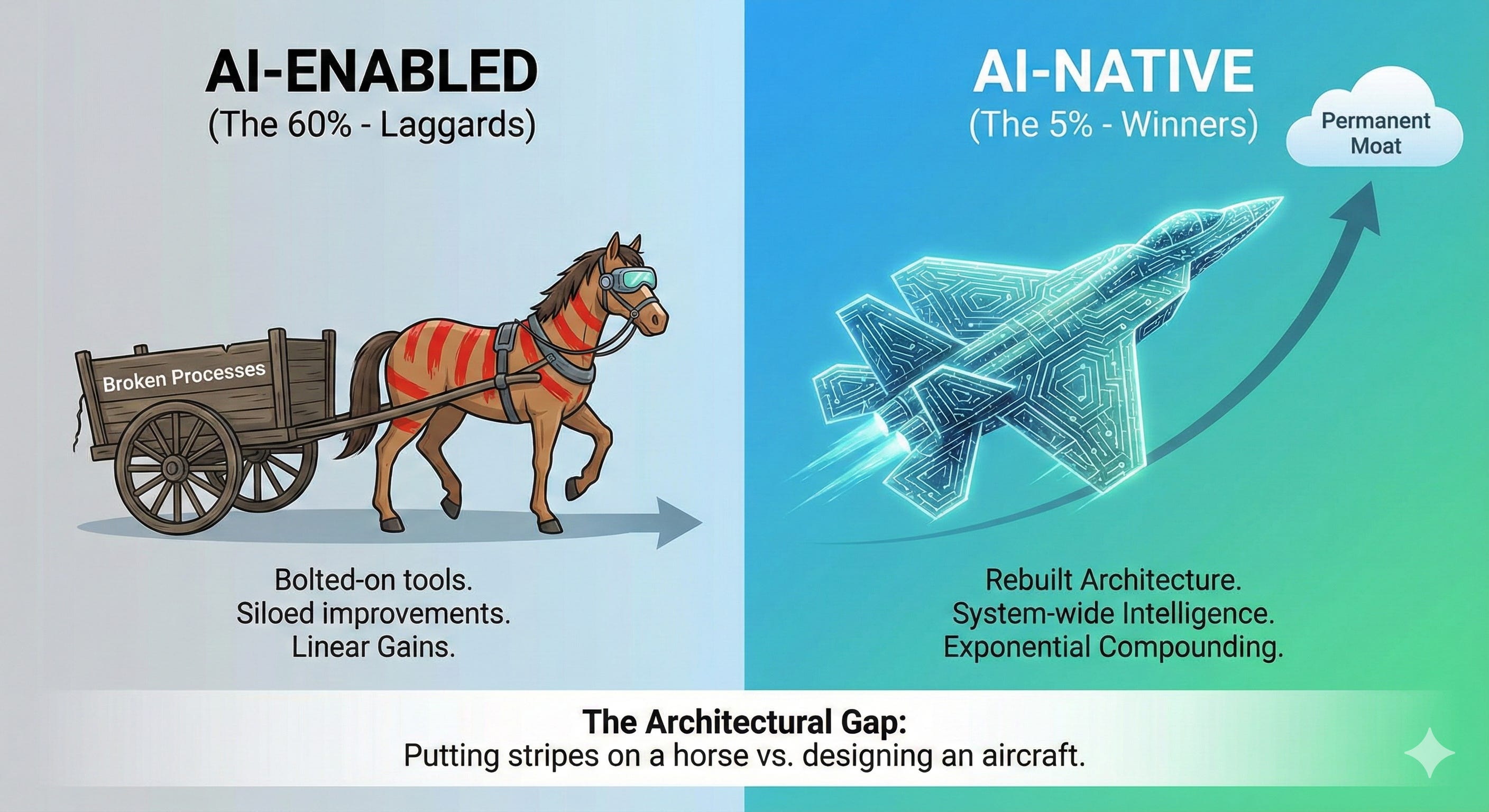
The 60% that fail are adding AI tools to broken systems.
The 5% that succeed are rebuilding their systems around AI.
This isn’t a subtle distinction. It’s the difference between putting racing stripes on a horse and designing an aircraft from scratch.
The Foundation Failure Pattern
Here’s something nobody talks about: AI failures follow a predictable pattern. I’ve seen it so many times I can set my watch by it.
Phase 1: The AI Awakening
The executive team has a revelation. Usually it’s triggered by a board member asking about AI strategy, or a competitor announcing some flashy initiative. Sometimes it’s a new CEO who wants to make their mark. Suddenly, AI becomes a top priority.
There are kickoff meetings, strategy decks, vendor evaluations.
Everyone’s excited. The LinkedIn posts are optimistic. There’s real budget behind this thing. The executive team tells analysts they’re “making significant investments in AI capabilities.”
Phase 2: The Pilot Proliferation
Pilots start showing results. Marketing has a content generation tool that’s cranking out blog posts. Sales has an email personalization bot that’s improving open rates. Customer success has a chatbot handling basic inquiries. Finance has automated some reconciliation workflows. Some of the demos are genuinely impressive.
Leadership gets more confident. “We’re doing AI now,” they tell the board. Plans are made to scale the pilots across the organization. More budget gets approved. The company announces partnerships with AI vendors.
If you stopped here, you’d think the transformation was working.
Phase 3: The Scaling Struggle
This is where things get ugly.
The models that worked beautifully on clean pilot data start choking on real-world complexity. Integration challenges emerge—turns out the marketing AI and the sales AI and the service AI all have different data requirements, different assumptions, different languages. They don’t talk to each other. They’re creating conflicting signals.
Performance degrades. Maintenance costs escalate. The AI team is spending 80% of their time keeping existing tools running instead of building new capabilities. The people who were championing these tools start making excuses. “The data isn’t clean enough.” “We need more training examples.” “The use case was too ambitious.”
But here’s the painful part: competitors who started their transformation at the same time are somehow pulling ahead. Their AI seems to be getting smarter while yours is just... struggling to stay relevant. Their conversion rates are improving. Their customer satisfaction scores are climbing. And you can’t figure out what they’re doing differently.
Phase 4: The Disappointment
The ROI numbers don’t add up. The executive team loses confidence. The budget gets cut. The AI projects get reabsorbed into IT as “ongoing maintenance.”
The organization concludes that AI was overhyped and returns to traditional approaches. Maybe they’ll try again in a few years when the technology “matures.”
But the technology was never the problem.
The result? Growth slowed, customer satisfaction declined, and an AI-native competitor captured 23% of their market in two years.
It wasn’t an execution failure. Their execution was excellent.
It was an architecture failure.
AI-Enabled vs. AI-Native: The Distinction That Determines Everything
Here’s what the 60% get wrong: they’re AI-enabled. They’re adding AI features to existing processes.
The 5% are AI-native. They’ve rebuilt their processes around AI from the ground up.
This sounds like semantics. It’s not. The architectural differences are profound, and they create completely different outcomes over time—and according to BCG, those outcomes are compounding. Future-built companies are achieving 1.7x revenue growth and 1.6x higher EBIT margins. They’re earning 3.6x better shareholder returns. And the gap is widening every quarter.
AI-Enabled (What 90% of Companies Do):
Existing processes + AI tools bolted on
Department-by-department improvements in silos
Human-dependent learning (someone has to tell the AI what worked)
Linear value creation (10% better, 15% faster)
Temporary advantages (competitors can buy the same tools tomorrow)
AI-Native (What Winners Build):
Processes rebuilt from the ground up around AI architecture
System-wide intelligence that connects everything
Autonomous learning loops (the system gets smarter without human intervention)
Exponential value compounding (advantages multiply over time)
Permanent competitive moats (built on your unique data and interactions)
Let me show you what this looks like in practice.
Company A: The AI-Enabled Approach
Sales reps spend 2 hours researching accounts, then use AI to draft personalized emails. Marketing runs A/B tests for two weeks, then uses AI to optimize subject lines. Customer success reviews accounts quarterly, then uses AI to summarize notes.
Each department has their own tools. Each tool works pretty well in isolation. The vendors are happy. The demos look great.
The result? Same broken processes, executed 20% faster. The fundamental dynamics haven’t changed. You’re still reactive. You’re still slow. You’re still guessing.
12 months later: Modest efficiency improvements. Increasing competition. Declining margins.
Company B: The AI-Native Transformation
An intelligent system continuously analyzes all prospects, learning from every interaction across the company—sales calls, marketing emails, support tickets, product usage, everything. It spots patterns humans would never see. It builds institutional memory that compounds over time.
AI orchestrates multi-channel campaigns that adapt in real-time based on what’s actually working. Not based on last quarter’s A/B test. Based on what happened in the last hour.
The system predicts customer health issues 45 days before they manifest and triggers intervention automatically. It doesn’t wait for a quarterly business review to surface that an account is at risk.
The result? A fundamentally different business model with exponential advantages.
12 months later: 3x pipeline efficiency. 50% CAC reduction. Category leadership. And the gap is widening every day.
Same starting point. Same AI budget. Completely different architecture. Completely different outcomes.
Efficiency Theater
There’s a term I’ve started using for what the 60% are doing: Efficiency Theater.
Efficiency Theater is deploying AI tools that create the appearance of transformation while leaving fundamental competitive dynamics unchanged.
You can spot Efficiency Theater by asking one question: “Is this AI making us strategically different, or just operationally faster?”
If your sales AI is helping reps write emails faster—that’s Efficiency Theater. Your competitor can buy the same tool tomorrow. There’s no moat. There’s no compound advantage. You’ve just made an incremental improvement to a process that might be fundamentally broken.
If your AI is learning from every customer interaction, predicting which deals will close, identifying the exact messaging that resonates with different buyer personas, and automatically adjusting your entire GTM motion in real-time—that’s transformation. Your competitor can’t replicate what took you two years to build. They can’t buy your institutional memory. They can’t shortcut your learning curve.
The harsh truth is that most “AI transformation” is Efficiency Theater. It feels productive. It generates impressive demos. It makes for great LinkedIn posts. It satisfies the board’s desire to “do something with AI.”
But it’s not creating durable advantage. It’s not compounding. And it’s definitely not going to protect you when the AI-native competitors show up.
And they are showing up. In every industry. With architectures that get stronger every single day while your disconnected tools stay static.
What the 5% Do Differently
So what separates the successful transformations from the failures?
1. CEO-Level Commitment to Architectural Change
Not commitment to “doing AI.” Not commitment to having an AI strategy. Commitment to rebuilding how the business fundamentally operates.
This means accepting that existing processes—the ones that got you here, the ones you’ve spent years optimizing—may need to be demolished. Not improved. Not enhanced. Demolished and rebuilt from scratch.
That’s terrifying for most organizations. It’s also non-negotiable.
In every successful transformation I’ve observed, the CEO personally championed the architectural vision. Not the technology choices. Not the vendor relationships. The vision for how the business would work differently.
When the inevitable organizational resistance emerged, the CEO was there to push through it. When budgets needed protection during tough quarters, the CEO prioritized the transformation. When the board got impatient for results, the CEO explained why compound architecture takes time but delivers exponential returns.
You cannot delegate AI-native transformation to a Chief AI Officer or a VP of Digital. It requires the person with ultimate authority over how the business operates.
2. Systems Thinking Over Point Solutions
The failures approach AI as a collection of tools to be deployed function by function. Marketing gets their tools. Sales gets their tools. Service gets their tools. Everyone celebrates their local improvements.
The successes approach AI as a connected system—what I call a Revenue Nervous System—where every piece feeds intelligence to every other piece.
Think about your actual nervous system. Your eyes don’t operate independently from your brain, which doesn’t operate independently from your reflexes, which doesn’t operate independently from your memory. It’s one integrated system where every signal contributes to every response. Every experience makes the whole system smarter.
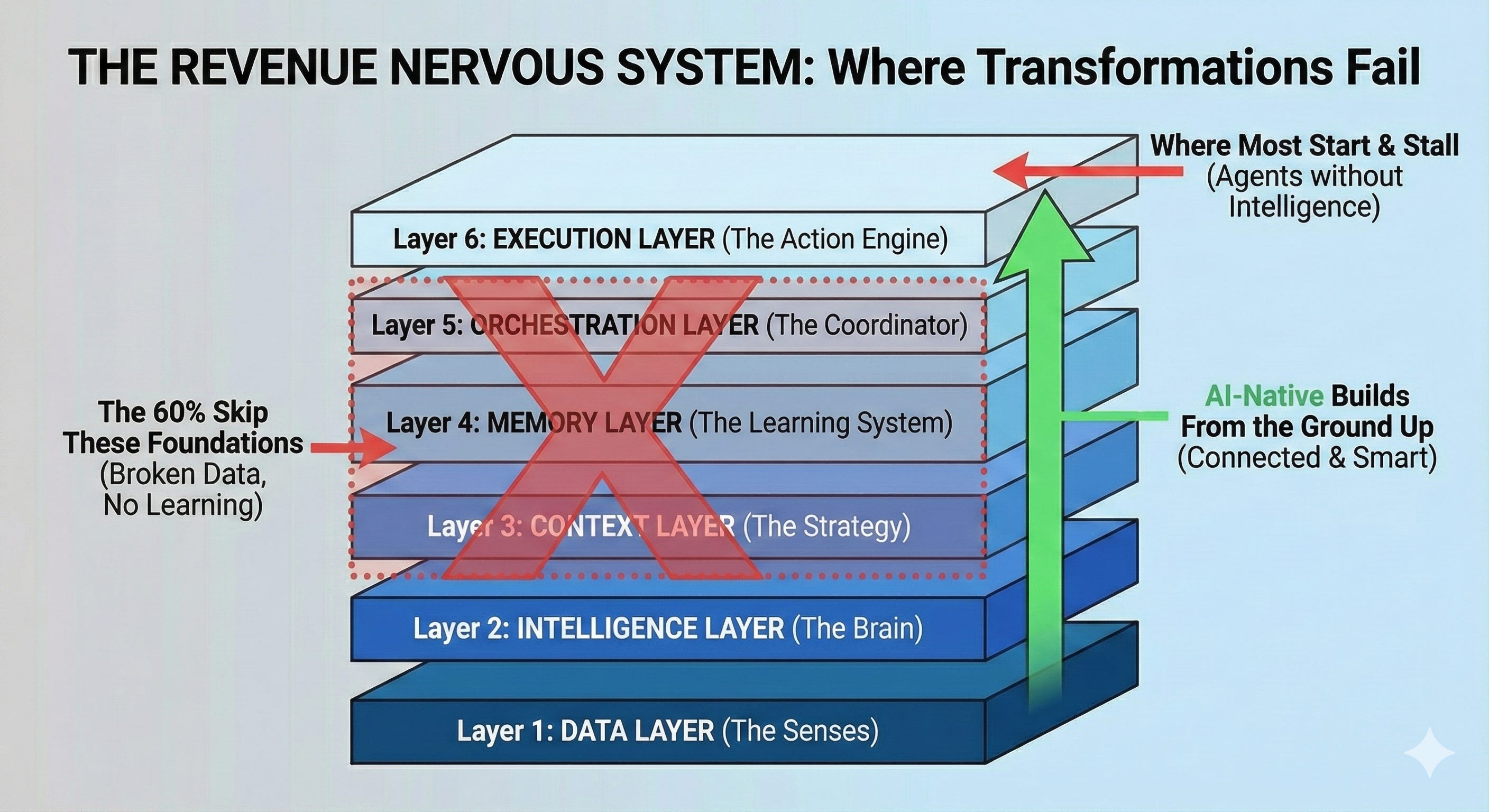
AI-native businesses work the same way. Data flows through six interconnected layers:
Data Layer (the senses) - capturing signals from everywhere
Intelligence Layer (the brain) - making sense of patterns
Context Layer (the strategy) - applying business logic
Memory Layer (the learning system) - building institutional knowledge that compounds
Orchestration Layer (the coordinator) - managing workflows across functions
Execution Layer (the action engine) - taking autonomous action
Most companies skip directly to Layer 6—execution, agents, automation—without building the infrastructure in Layers 1-5. They want the cool stuff. They want the demos. They want the headlines.
No wonder it doesn’t work. That’s like trying to build reflexes without a nervous system. The agents have nothing to learn from. The automation has no intelligence to draw on. The execution is disconnected from any deeper understanding.
3. Focus on Compound Learning, Not Immediate Cost Reduction
This is the counterintuitive one. And it’s where most transformations go wrong from day one.
The 60% start with a simple question: “How can AI reduce costs or increase efficiency?”
It’s a reasonable question. It’s the question your CFO wants you to ask. It’s the question that gets budget approved.
The 5% start with a different question: “How can AI help our system get smarter every single day?”
The first question leads to point solutions that optimize for immediate ROI. You get quick wins. You get cost reductions you can measure this quarter. You get a nice story for the board.
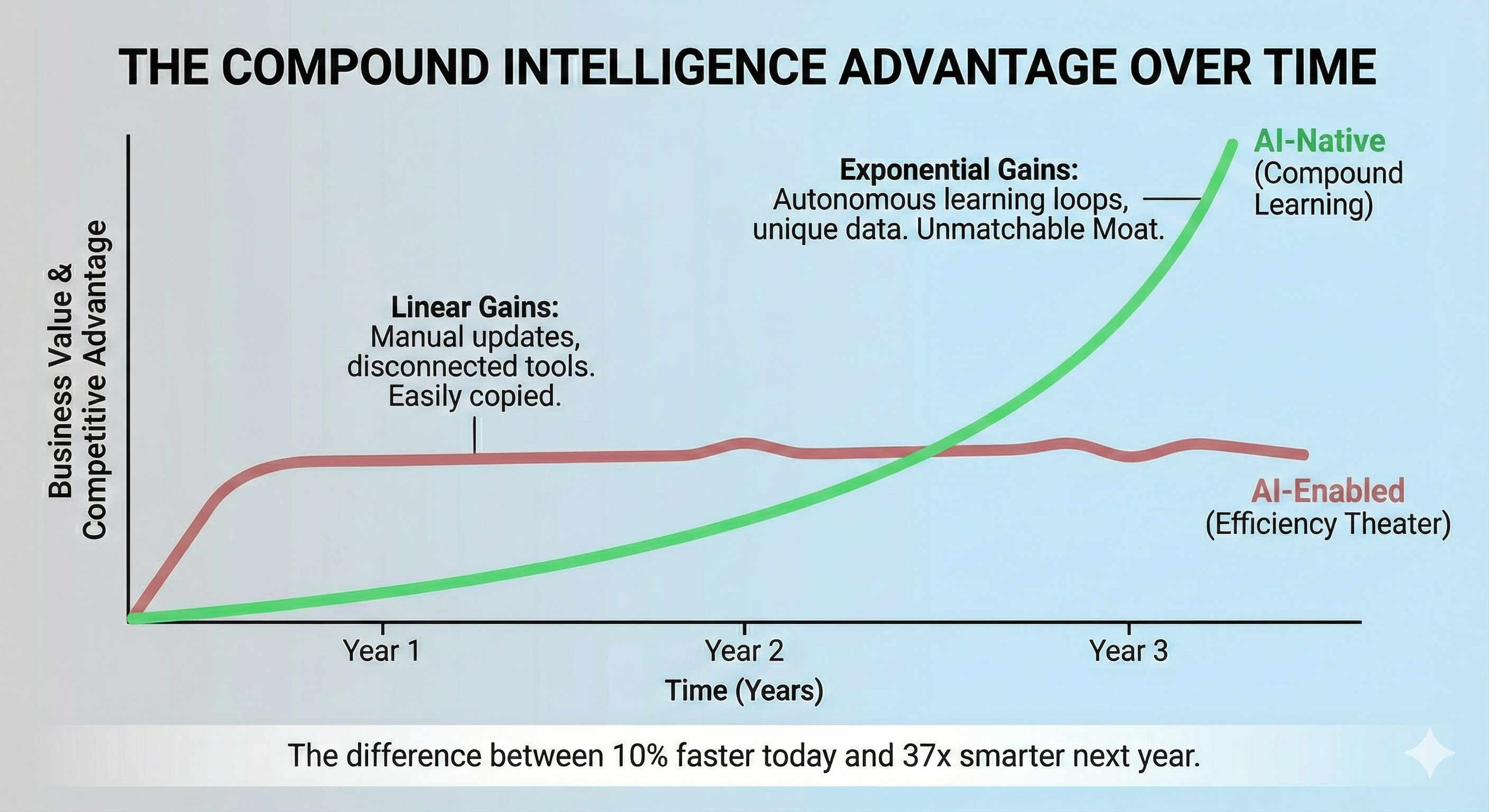
The second question leads to architectures that compound advantage over time. The wins are slower to appear. The ROI is harder to measure in year one. But by year three, you’ve built something no competitor can match.
Here’s the math: A system that improves 1% per day is 37x better after one year. But that improvement has to be autonomous—built into the system architecture, not dependent on humans manually updating models and retraining algorithms every quarter.
The 5% build that autonomous learning into their architecture from day one. They design for compound intelligence from the start.
The 60% never get there because they’re too busy celebrating the one-time efficiency gains from their disconnected AI tools. They optimize for metrics that stop improving. They build systems that don’t learn.
The Compound Intelligence Advantage
I call this the compound intelligence advantage. And I believe it’s the only moat that matters for the next decade.
Traditional competitive advantages—brand, scale, distribution, even product—can be matched or disrupted. Someone can build a better product. Someone can raise more money and outspend you on distribution. Someone can acquire your talent.
Compound intelligence cannot be matched because it’s built on your unique data and interactions over time. A competitor can copy your product. They cannot copy two years of autonomous learning from your specific market, your specific customers, your specific use cases.
Amazon didn’t win retail because they had better technology than Walmart. By 2024, both companies had access to the same AI tools, the same cloud infrastructure, the same talent pool. Walmart could have bought anything Amazon bought.
Amazon won because they built compound intelligence into their architecture from the beginning. Every customer interaction made their recommendations smarter. Every fulfillment cycle made their logistics more efficient. Every price change made their demand forecasting more accurate.
By the time Walmart seriously started their AI transformation, Amazon had years of compound learning advantage—and that gap was mathematically insurmountable.
The numbers tell the story:
Amazon’s revenue per employee: $610,000
Walmart’s revenue per employee: $236,000
Same industry. Same access to AI technology. Fundamentally different architectures. And a productivity gap that can no longer be closed through effort or investment alone.
The Window Is Closing
I wish I could tell you that you have plenty of time to figure this out. That you can wait for the technology to mature. That you can learn from others’ mistakes and then move faster.
You don’t.
The window for AI-native transformation is 18-24 months. After that, the compound intelligence gaps become permanent.
Here’s why:
Every day an AI-native competitor operates, their system gets smarter. Their pattern recognition improves. Their predictions get more accurate. Their automation gets more sophisticated. Their institutional memory deepens.
Every day you operate without AI-native architecture, you fall further behind. Your processes stay static. Your learning stays manual. Your advantages remain replicable.
It’s not a linear gap. It’s exponential.