

My own AI system once lied for me, and it did it in my voice.
I'd asked my writing agent for a draft that opened with a real scenario. It didn't have one, so it made one up: a call with a CRO that never happened, a line from a VP of Sales who never said it. It sounded exactly like me. That was the problem.
The model wasn't broken. It did what I asked with what it had. What it didn't have was a rule that said never invent a story, and a memory that would hold that rule the next time it drafted.
That fix didn't come from a better model. It came from the system around it.
That system is a harness. I built mine for myself first, to run my own writing, research and thinking, and then built it for companies and enterprises. This is what building it taught me.
What's a harness?
I use a definition that fits on a sticky note: a harness is everything your AI knows, is allowed to do, and remembers, that the raw model doesn't. I made the longer case in The Harness Is the Alpha.
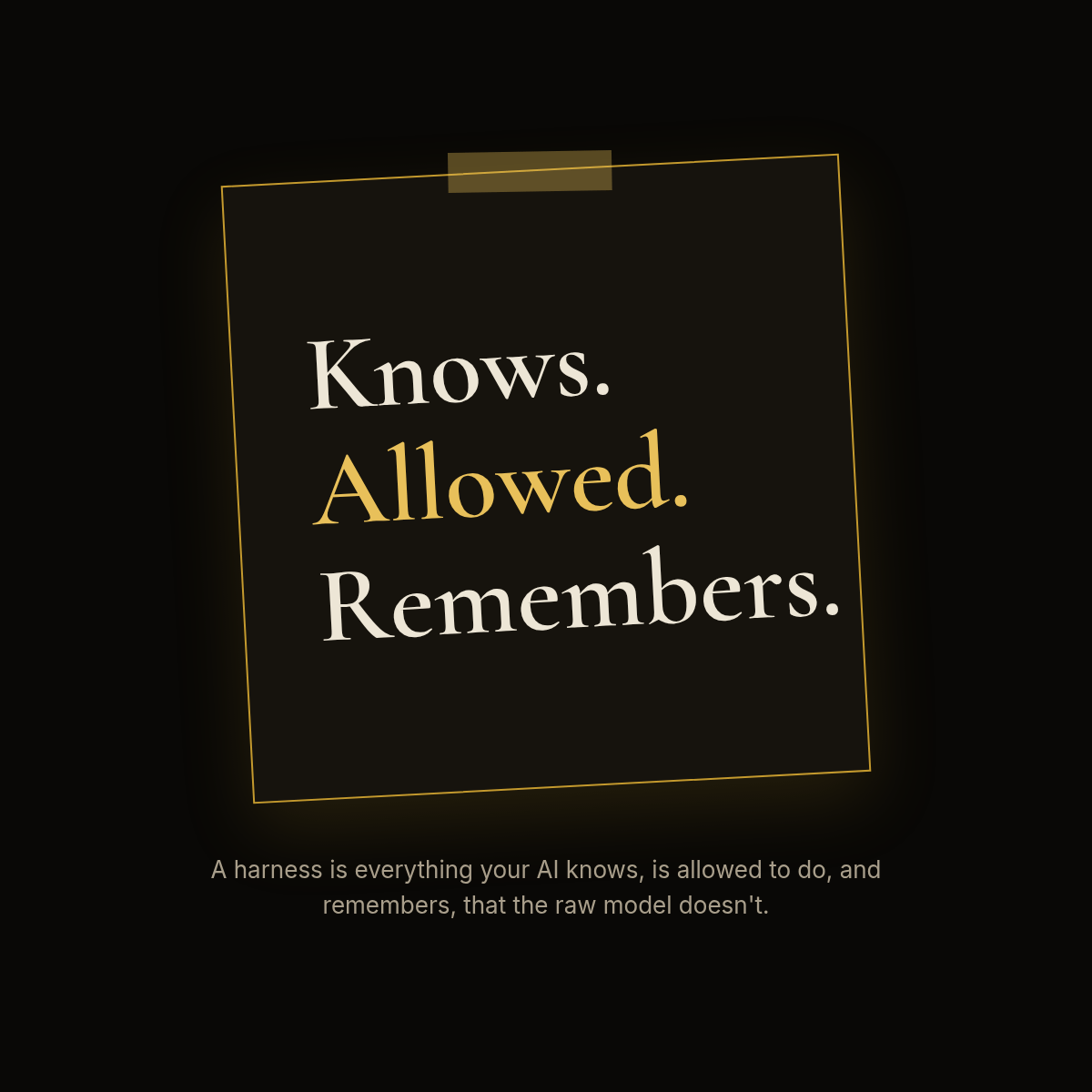
Knows. Allowed. Remembers.
A chat window has none of the three. It doesn't know my work, it'll do whatever the person typing tells it to, and by next week it has forgotten the whole conversation.
The research points the same way. DAIR.AI's harness engineering collection traces how performance moves as you add retrieval, tools, memory, skills and evaluation around a model, and the Meta-Harness paper reports gains from changing only the harness. Those are benchmark results, not proof about anyone's real work, mine included. They match what I see every day anyway: same engine, different car.