

A year ago, ChatGPT ran my entire AI workflow.
80% of everything I did. Research. Writing. Analysis. Strategy work. It was my default for basically every AI interaction, and I’d built my whole system around it.
Claude? Just 15% of my stack. A tool I’d pull up when I wanted a second opinion or ChatGPT was being weird. Gemini barely registered at 5%.
Fast forward to January 2026. My stack looks nothing like it did 12 months ago.
Claude now runs 60% of my work. ChatGPT dropped to 10%. And Manus—a tool that didn’t even exist in my workflow a year ago—handles 25% of what I do.
But here’s the thing nobody’s talking about: this shift had nothing to do with which model is “smarter” or “better.” The benchmarks didn’t change my behavior.
What changed was what I could build.
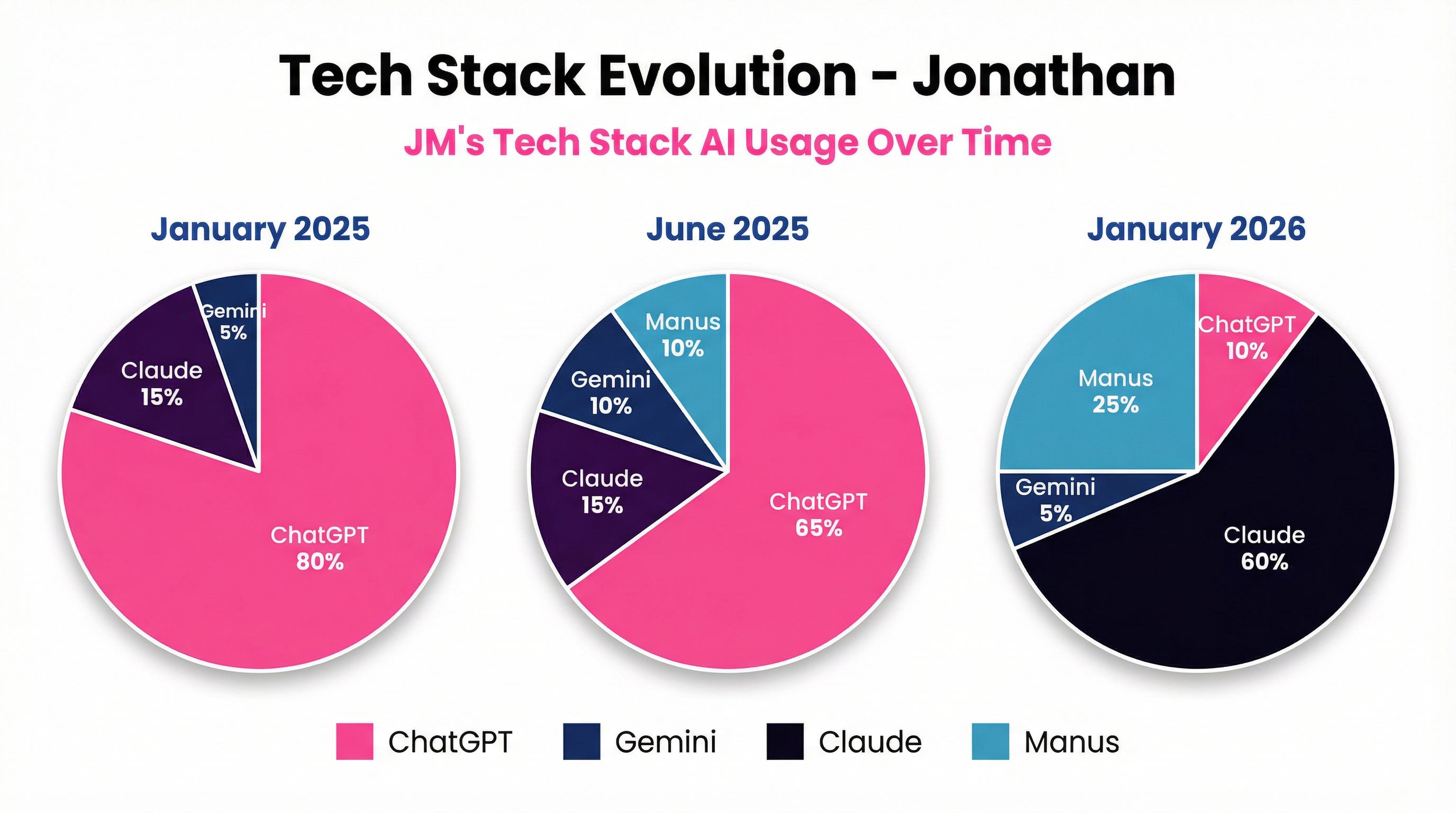
January 2025: The Consumer Era
Let me paint the picture of where I started.
ChatGPT was my everything. And honestly? It was great for what I was doing—which was basically treating AI like a really smart intern. Ask questions. Get answers. Copy, paste, move on.
I’d built custom GPTs. Had my prompts dialed in. Knew exactly how to phrase things to get the outputs I wanted. Muscle memory, fully developed.
Claude was interesting but felt... optional. I’d use it when I wanted something written with more nuance, or when ChatGPT was hallucinating too hard on a complex task.
But it wasn’t essential to my workflow.
That’s the key word: workflow.
Because I wasn’t building workflows. I was having conversations. And ChatGPT was optimized for exactly that—consumer-grade conversations that felt smart and got you 80% of the way there.
The problem is that 80% stops being enough when you’re trying to build systems that actually run without you.
The Builder vs. Consumer Divide
Here’s the mental model that completely reframed how I think about AI tools.
Consumer AI tools are designed for conversations. You ask, you receive, you move on. The value is in the individual interaction. ChatGPT excels here. It’s fast, it’s accessible, it’s good at surface-level tasks across a massive range of domains.
Builder AI tools are designed for systems. You create components that persist. You connect to external data. You build artifacts that do work without you being in the conversation. Claude—especially with skills, MCP servers, Claude Code, and now Cowork—plays a completely different game.
The moment I started thinking about AI as infrastructure instead of interaction, my entire stack had to change.
Let me show you what I mean.
What I Actually Build Now
Skills That Persist
In Claude, I’ve built custom skills that carry my voice, my frameworks, and my preferences across every conversation. When I write content, I don’t have to re-explain my brand voice every time. The skill knows how I think, how I structure arguments, even which phrases I overuse and should avoid.
This isn’t a custom GPT that loses context after every session. It’s actual infrastructure—knowledge and capabilities that compound over time.
I’ve got skills for:
Content creation in my specific voice
GTM strategy analysis using my frameworks
Healthcare expert panels that simulate stakeholder feedback
Hook generation for social posts
Pitch deck analysis from a VC perspective
Each one took maybe an hour to build. And now they run in the background of everything I do.
ChatGPT can’t do this. Not at this level. Not with this persistence.
MCP Servers and Real Data
This is where it gets interesting.
Through MCP (Model Context Protocol), Claude connects directly to:
Notion databases for my research and notes
Google Drive for documents
Vercel for deployments
Actual databases with real business data
I’m not copying and pasting data into prompts anymore. Claude pulls from the source, works with real information, and produces outputs that are grounded in actual facts—not hallucinated approximations.
When I’m analyzing GTM performance, Claude’s looking at real numbers. When I’m building a presentation, it’s pulling from actual research I’ve saved. When I’m deploying a web app, it’s pushing code to real infrastructure.
This is the difference between having an AI assistant and having an AI co-worker.
Claude Code and Actual Development
This one surprised me the most.
I’m not a developer. I can read code. I can debug simple issues. But I’m not shipping production software on my own.
Except now I kind of am.
Claude Code lets me describe what I want to build and actually builds it. Not just snippets to copy-paste—actual working applications. Artifacts I can deploy, share, and iterate on.
Last month I built a custom dashboard for tracking content performance across platforms. Would have taken a developer days. Claude Code did it in an hour with me describing what I needed.
The gap between “idea” and “working thing” has collapsed. That changes everything about what’s possible.
Cowork: AI That Does Work, Not Just Talks About It
Anthropic’s new Cowork capability takes this even further.
Instead of AI that responds to prompts, Cowork creates AI that executes tasks. File management. Document creation. Automated workflows. The kind of operational work that used to require either my time or a human assistant’s time.
It’s early, but the trajectory is clear: Claude isn’t positioning itself as a better chatbot. It’s positioning itself as an entirely different category of tool.
Where Manus Fits: Multi-Agent Orchestration
Now here’s why Manus went from 0% to 25% of my stack.
Manus does something neither ChatGPT nor Claude do well: multi-agent orchestration for complex, multi-step tasks.
When I need:
Research compiled from multiple sources with citations
Presentations built with proper visuals and formatting
Automated agents that run recurring tasks
Complex workflows that require multiple AI “workers” coordinating
Manus handles it.
The mental model is different. You’re not having a conversation. You’re deploying a team of agents that work together to accomplish a goal. One agent researches. Another synthesizes. Another formats. Another quality-checks.
For deep research projects, competitive analysis, and presentation creation, Manus has become indispensable. It’s not competing with Claude for my attention—it’s handling a completely different category of work.
What ChatGPT Is Still Good For
I don’t want to be unfair to ChatGPT. It still handles 10% of my work, and that 10% is real.
Quick lookups when I just need a fast answer. Voice mode for thinking out loud while driving. Consumer-level tasks where I don’t need persistence or integration—just fast, good-enough outputs.
ChatGPT is an incredible consumer product. Maybe the best AI consumer product ever built.
But I’m not a consumer anymore. I’m a builder. And the tools I need are different.
The Pattern Nobody’s Seeing
Here’s what I think most people are missing about the AI tool landscape right now.
The “which AI is best” debate completely misses the point. It’s like arguing about whether a hammer or a screwdriver is the better tool. The answer is: it depends on what you’re building.
The real shift happening:
ChatGPT dominates consumer AI—conversations, quick tasks, accessibility
Claude dominates builder AI—systems, infrastructure, persistent capabilities
Manus dominates orchestration AI—multi-agent workflows, complex deliverables
Gemini... I’m honestly not sure where Gemini fits yet (hence the drop from 10% to 5%)
The future isn’t “one AI to rule them all.” It’s knowing which tool to reach for based on what you’re actually trying to accomplish.
What This Means for GTM Leaders
If you’re running GTM for a company—sales, marketing, revenue operations, customer success—here’s what this stack evolution means for you:
Stop thinking about AI adoption. Start thinking about AI infrastructure.
The companies that will win aren’t the ones that use AI the most. They’re the ones that build systems powered by AI—systems that learn, persist, and compound over time.
That means:
Moving beyond chatbots to builder platforms
Connecting AI to your actual data, not just prompts
Creating reusable capabilities (skills, agents, workflows) that improve over time
Orchestrating multiple AI tools based on their actual strengths
My stack evolved because my thinking evolved. From “which AI gives the best answers” to “which AI lets me build the best systems.”
The Practical Takeaway
If you’re still running your entire AI workflow through a single tool, you’re probably leaving massive value on the table.
Here’s my current mental model for routing work:
Claude (60%): Anything requiring persistence, custom skills, data integration, code generation, artifact creation, or nuanced long-form work. The builder platform.
Manus (25%): Multi-step research, presentations, complex deliverables requiring multiple AI agents working together. The orchestration layer.
ChatGPT (10%): Quick lookups, voice interactions, consumer-grade tasks where speed matters more than depth. The fast-answer tool.
Gemini (5%): Honestly, still experimenting. Mostly Google ecosystem integration when I need it.
Your percentages will differ based on what you’re building. That’s the point. The question isn’t “which AI should I use?” It’s “what am I trying to build, and which tool was designed for that?”
The Bigger Picture
A year ago, I would have laughed at anyone who told me ChatGPT wouldn’t be my primary AI tool by 2026.
I was wrong.
But I wasn’t wrong because ChatGPT got worse or Claude got “smarter.” I was wrong because I was thinking about the category incorrectly.
The shift from consumer AI to builder AI is the single biggest evolution in how I work. And if you’re still treating these tools like fancy search engines with personality, you’re missing what’s actually happening.
We’re moving from “AI that answers questions” to “AI that builds systems.”
My tech stack evolved to reflect that. Has yours?
This piece realy made me think, and you are totally spot on about the shift being about what we *build*, not just 'smarter' models, that's so important.