Most people build AI systems the way you’d build a spice rack. Collect the jars. Label them. Arrange them neatly. Stand in front of the rack every time you cook, read the labels, pick a jar, wonder why dinner takes two hours.
A real kitchen has a line. Ticket comes in, the expediter reads it, it goes to the station that can cook that plate, the plate comes back, it ships. The cook doesn’t read every label every time. The expediter does. The cook cooks.
That’s the difference between a prompt library and an orchestrated system. It’s also why most AI rollouts stall the second the novelty wears off.
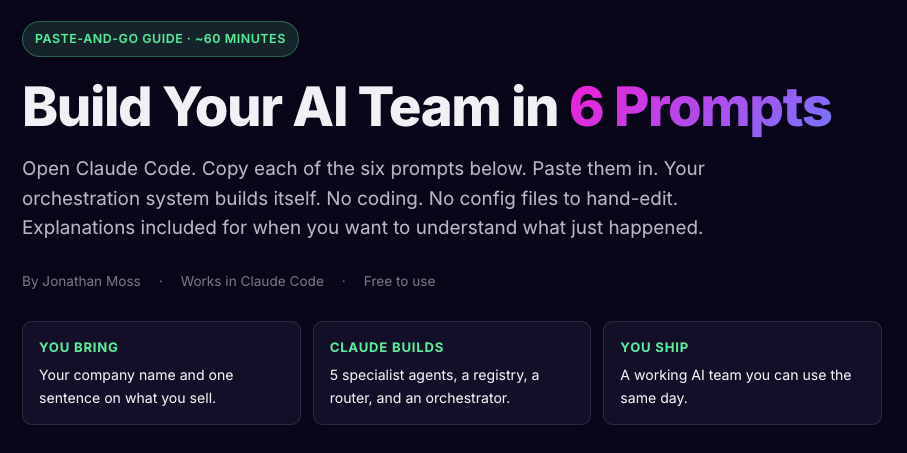
This guide is how you build the expediter. Three working layers by the end: a registry that lists your specialists, a router that picks the right one for a given task, and an orchestrator that coordinates handoffs when the job needs more than one pair of hands.
You don’t need to be technical. You need to be able to write a clear one-sentence job description and name the things your team actually ships. That’s the whole skill. If you can run a team, you can build this. The parts that look like code (the registry, the instruction files) are patterns your AI can generate for you once you tell it what each specialist does. Your job is the thinking. The typing is automatable.
If you’re a founder, a GTM operator, or an exec who has been watching your people bounce between ten tools and ten chat windows, this is the piece that makes the mess coherent.
The Problem With One Giant Prompt
You’ve probably tried the one-giant-prompt approach. A single system prompt that says “you are a world-class marketer and salesperson and engineer and legal advisor.” It kind of works. Until it doesn’t.
Three things break it:
Context dilution. Every capability you bolt on makes every answer a little blurrier. The model can’t specialize in ten things at once, because specialization is depth of frameworks, not just knowledge of terminology.
No composability. You can’t hand off a sub-task. It’s one persona, so every task starts from zero context.
No accountability. When the output is wrong, you don’t know which part of the prompt failed. You tune the whole thing and hope.
Orchestration fixes all three. Each agent gets a narrow job, a clear handoff interface, and a visible mandate that either works or needs rewriting. The system becomes diagnosable. Diagnosable is the precondition for improvable.