

The software category that was supposed to be the safest -- serve every industry, avoid vertical risk, build the universal workflow -- just posted a 35% decline while vertical SaaS went up.
That’s not a market correction. That’s the market telling you that “works everywhere” was never a moat. It was a vulnerability with good branding.
Redpoint’s 2026 market update puts the number on what a lot of operators have been feeling for months. Horizontal SaaS didn’t just underperform. It got repriced as a category.
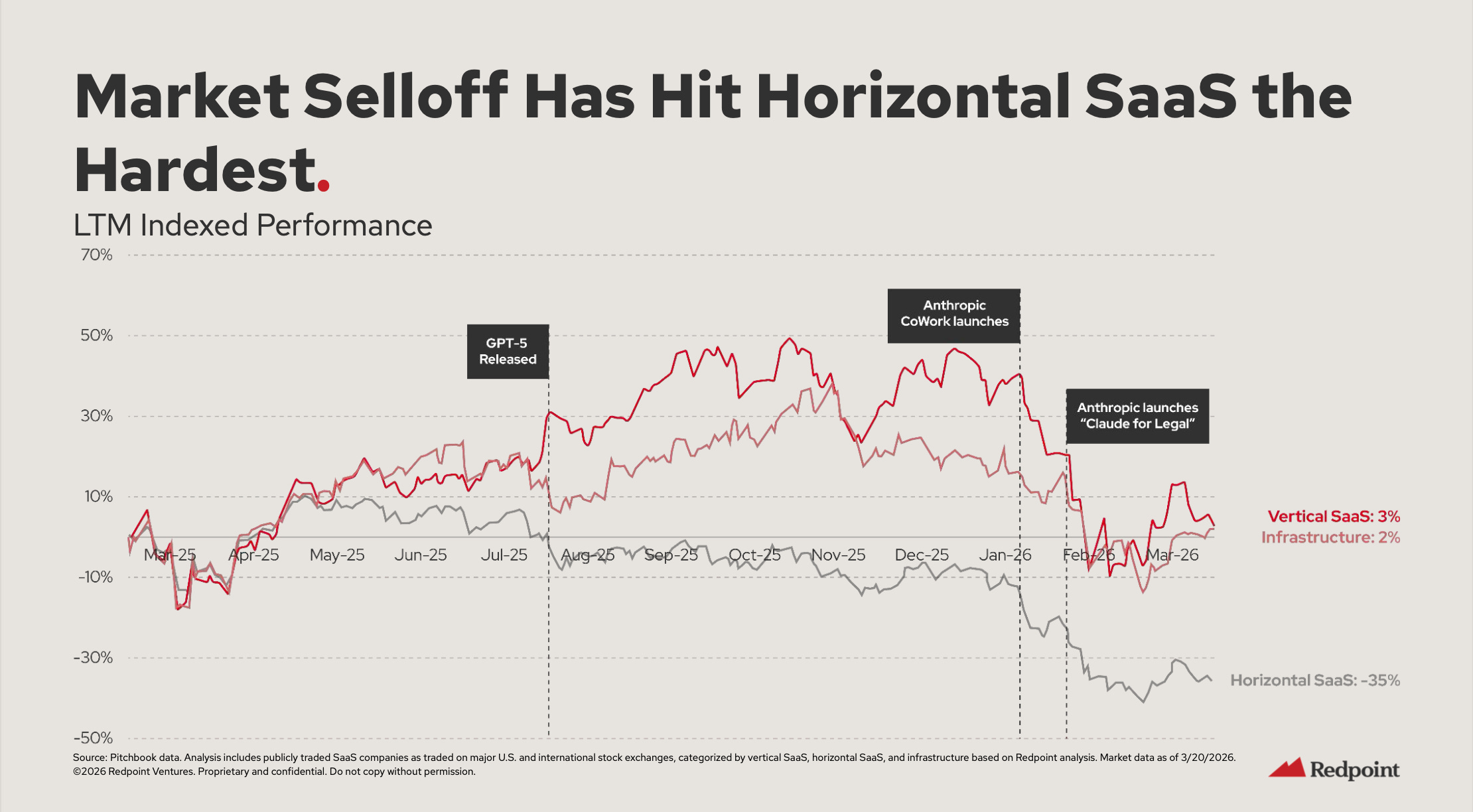
The last twelve months, indexed: vertical SaaS up 2-3%. Infrastructure up 2%. Horizontal SaaS down 35%. That’s not a correction. That’s a reclassification. The market looked at three categories of software and decided one of them has a fundamentally different risk profile than the other two.
The question isn’t whether the market is right. It’s why.
The Three Layers, Three Fates
Redpoint breaks the software universe into three layers and explains why AI hit each one differently. This is the slide I keep sending to founders who ask me “is my category safe?”
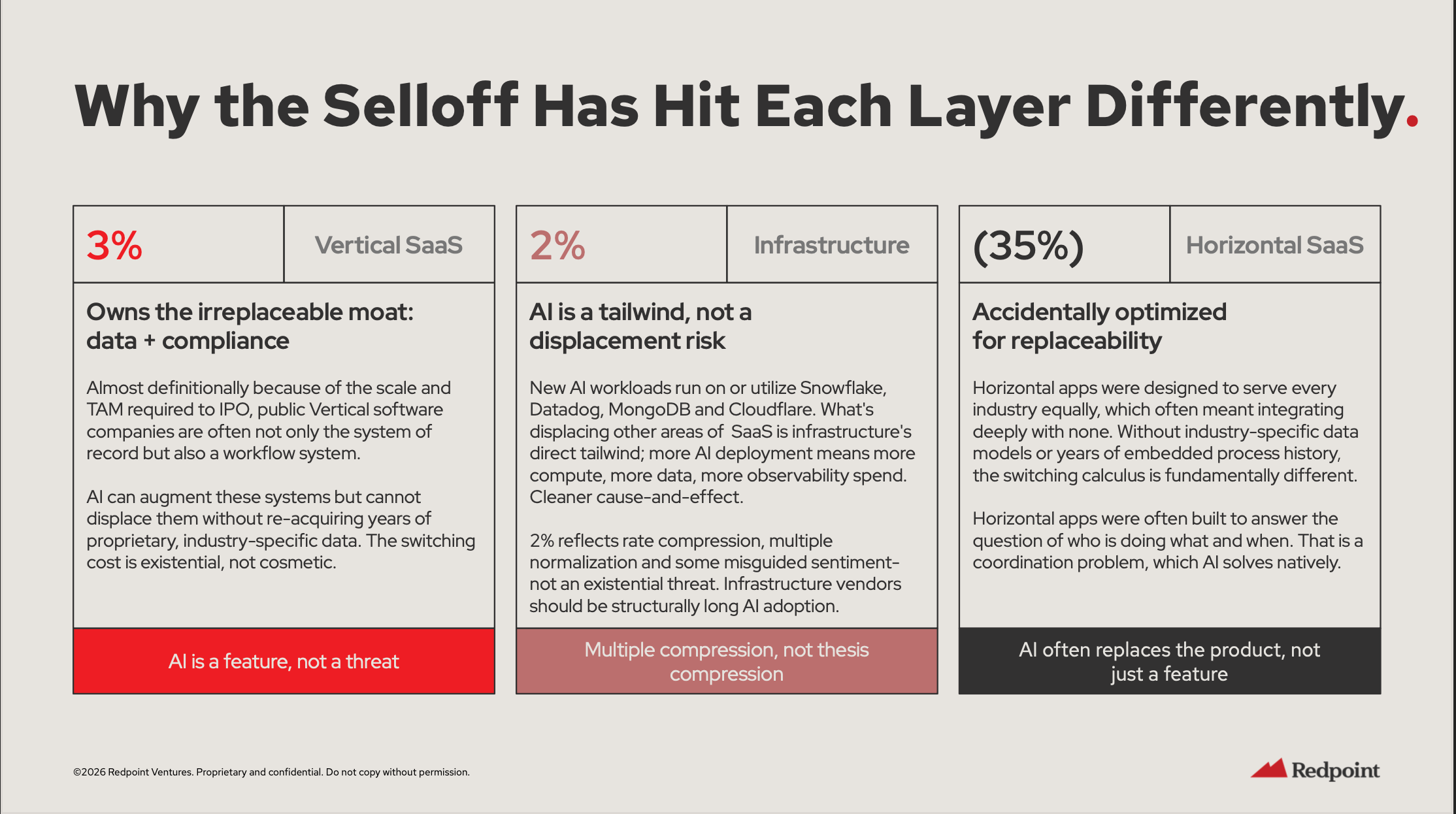
Vertical SaaS (+2-3%). Owns the irreplaceable moat: data plus compliance. When you’re the system of record for a dental practice or a property management company, AI is a feature you add, not a threat you face. The switching cost is existential, not cosmetic. Nobody is ripping out their EHR because a startup has a better chatbot. They might add the chatbot on top, but the vertical platform stays.
Infrastructure (+2%). AI is a tailwind, not a displacement risk. More AI means more compute, more data pipelines, more observability. Every agent someone deploys needs to run somewhere, log somewhere, fail somewhere. Infrastructure companies sell picks and shovels to both sides of the AI war. Their multiples compressed a bit, but their thesis got stronger.
Horizontal SaaS (-35%). And here’s the line that hit me: “Accidentally optimized for replaceability.”
That phrase is doing more work than any three-word description has a right to. Let me unpack it.
Horizontal SaaS was designed -- intentionally, deliberately, as a strategy -- to serve every industry equally. That was the pitch to investors. “We don’t need to build vertical-specific features. Our platform is flexible enough to work everywhere.” And it was true. Horizontal tools do work everywhere. The problem is that “works everywhere” and “integrated deeply with none” are the same statement.
I’ll be honest -- I’ve pitched “works everywhere” as a strength in past roles. I’ve sat in the room and said “we don’t need vertical-specific features, our platform is flexible enough.” It sounded like a moat. It was a vulnerability with good branding.
When your product is a coordination layer -- moving information between people, triggering workflows, displaying dashboards -- you’re doing exactly what AI does natively. You’re a middleman between humans and data. And AI just cut out the middleman.
The coordination problem that horizontal SaaS was built to solve? AI solves it natively. Not by being a better tool for coordination, but by eliminating the need for coordination in the first place. When an agent can pull data from six systems, synthesize it, and take action, the dashboard that displayed data from those six systems becomes a loading screen nobody needs.
Two Playbooks for Eating the Incumbents
So the horizontal giants are vulnerable. Who’s coming for them? Redpoint maps two distinct startup playbooks, and the distinction matters enormously for which incumbents should be scared and which have time.
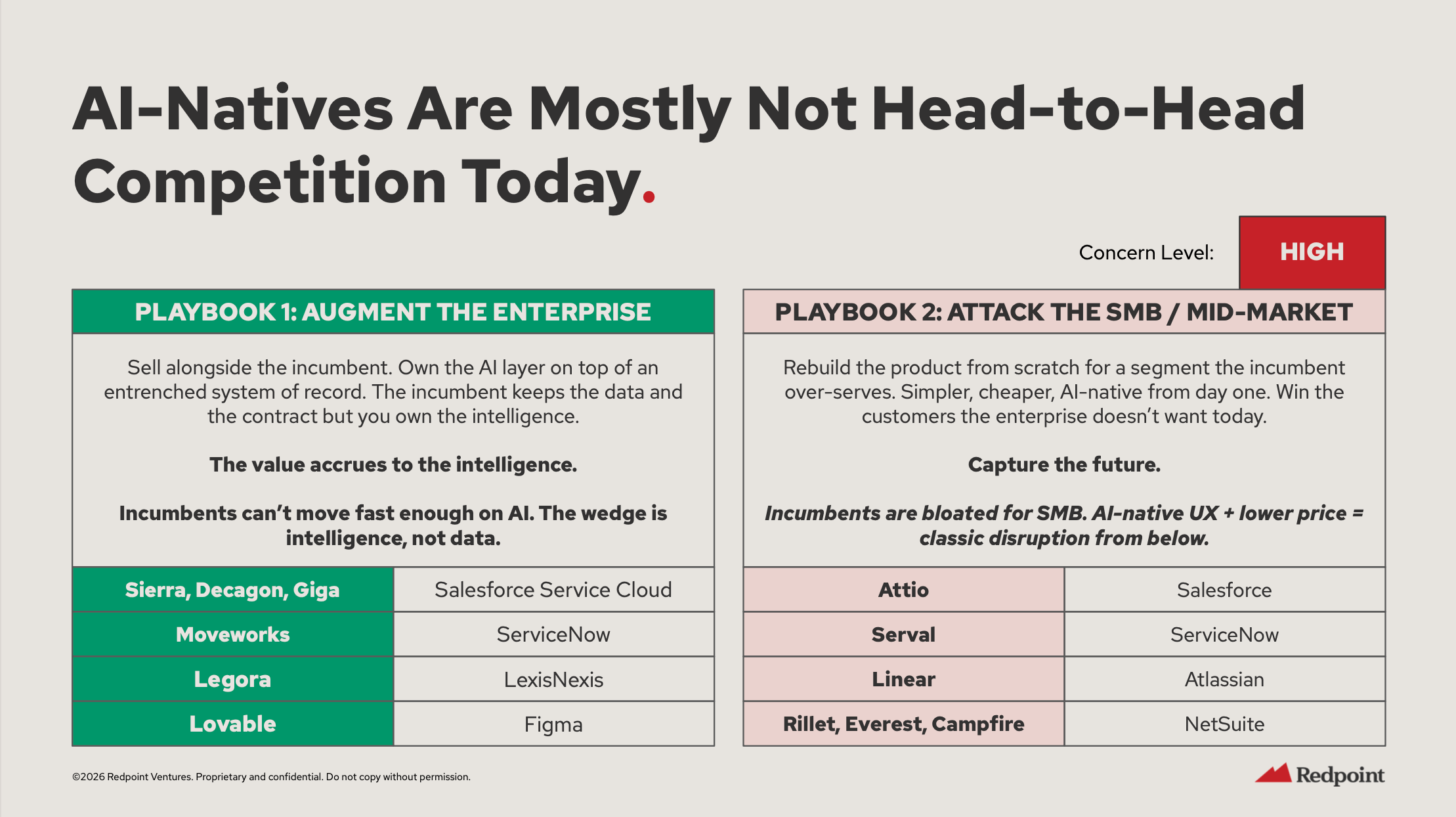
Playbook 1: Augment the Enterprise. Sell alongside the incumbent. Own the AI layer on top. Don’t replace Salesforce Service Cloud -- sit on top of it. Sierra and Decagon are doing this in customer service. Moveworks is doing it on ServiceNow. Legora on LexisNexis. Lovable on Figma.
This playbook is smart because it doesn’t require the customer to rip and replace. It’s additive. The incumbent barely notices until the AI layer is handling 60% of the workload and the customer starts asking why they’re paying full price for a platform that’s mostly a data store now.
Think of it like ivy on a building. Looks decorative at first. Even charming. The building owner likes it -- adds character, doesn’t cost anything, and guests compliment it. Then one year you realize the ivy is load-bearing and the building is just a frame. That’s the moment the incumbent realizes the “AI integration partner” owns 60% of the customer’s workflow and they’re just the database underneath.
Playbook 2: Attack the SMB/Mid-Market. Rebuild from scratch for the segment the incumbent under-serves. Attio vs. Salesforce. Serval vs. ServiceNow. Linear vs. Atlassian. Rillet and Everest vs. NetSuite.
This one is the classic disruption pattern -- go downmarket where the incumbent’s cost structure can’t follow. But AI accelerates it because the rebuild is 10x faster. What used to take a startup three years and $20M in funding to build (a credible CRM alternative) now takes 12 months and $3M. The attack surface expanded because the cost of building enterprise-grade software collapsed.
Both playbooks are dangerous, but in different timeframes. Playbook 1 is a slow squeeze -- the incumbent keeps the account but loses the value and eventually the pricing power. Playbook 2 is a fast grab -- the startup takes the customers the incumbent never prioritized and works upmarket.
If I’m a horizontal SaaS CEO, I’m worried about Playbook 1 in my enterprise accounts and Playbook 2 in my mid-market. Which means I’m worried about everything.
