

A friend of mine is building a startup.
Pre-seed. Two people on the team. Except the second person is Claude.
He doesn’t call it a tool. He calls it his technical co-founder.
I laughed when he said it. He didn’t.
That sentence stopped me cold. Because I’ve known this guy for years. He’s not the type to reach for hyperbole. He doesn’t say things he doesn’t mean. So I did what any reasonable person would do when confronted with a statement like that.
I asked him to walk me through his actual day.
What I heard over the next thirty minutes made me put my phone down and stare at the ceiling for a while.
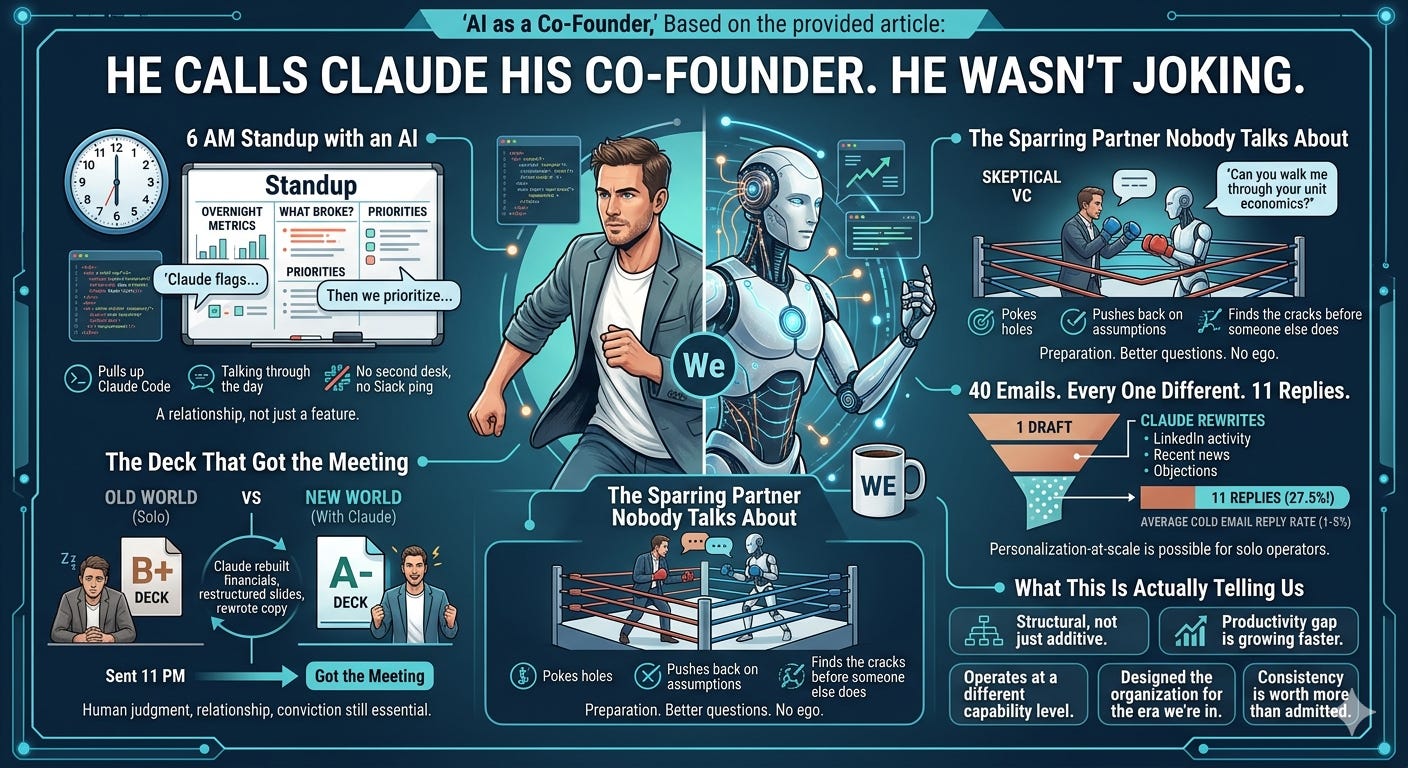
6 AM Standup. With an AI.
Every morning, he starts his day the same way. He pulls up Claude Code, looks at his overnight metrics, and starts talking through what happened while he slept.
“Claude flags what moved, what broke, what needs attention,” he told me. “Then we prioritize the day.”
We.
He said “we” four times before I realized there was nobody else there.
No second desk. No Slack ping from a human co-founder. Just him and a model that, apparently, gives a damn about his retention numbers at 6 in the morning.
I’ve watched a lot of operators describe their AI workflows over the past two years. Most of them describe augmentation — Claude helped me write this, Claude summarized that. It’s a feature. It’s a speed boost.
This was different. He was describing a relationship. A working rhythm. The kind of thing you develop with a person you trust enough to think out loud with every day.
The Deck That Got the Meeting
A few weeks ago, an investor asked him to turn around an updated deck in 24 hours.
If you’ve ever been a founder, you know what that request actually means. It means the investor is interested but hasn’t committed, the current deck isn’t doing enough work, and you have one shot to tighten the narrative, rebuild the financials, and make the case stick — all overnight.
He said “Claude and I went dark for a full afternoon.”
He talked through the narrative. Claude rebuilt the financials, restructured the slides, rewrote the copy.
They sent it at 11pm. He got the meeting.
Now — I want to be careful here, because this is the part where a lot of AI content gets sloppy. Claude didn’t close the deal. Claude didn’t walk into that investor meeting and charm anyone. My friend still had to do all of that. The human judgment, the relationship, the conviction — that’s all him.
But here’s what I keep thinking about: in the old world, a pre-seed founder with no co-founder and no team would have sent a B+ deck because that’s all one person at midnight could produce. He sent an A- deck. Maybe an A.
That gap matters.
The Sparring Partner Nobody Talks About
Here’s the part that got me the most.
He preps for every investor call using Claude as a sparring partner. Not like flashcards. Not like a practice run where you recite your talking points into the void.
Claude plays the skeptical VC.
It asks the hard questions. It pokes holes in the unit economics. It pushes back on assumptions he’s gotten too comfortable with.
“Claude asked me a question about churn last Tuesday,” he said, “that no actual investor has been smart enough to ask yet.”
Read that again.
An AI model asked a harder churn question than the humans who do this for a living.
I don’t say that to embarrass any investors. I say it because it points at something important: when you have a sparring partner who has no ego in the outcome, no relationship to protect, no reason to soften the blow — you get different questions. Better questions. The kind that find the cracks before someone else does.
This is one of the most underrated use cases in the entire AI conversation. Not productivity. Not content. Preparation. Having something in your corner that is constitutionally incapable of telling you what you want to hear.
40 Emails. Every One Different. 11 Replies.
His cold outreach process is where the thing becomes genuinely hard to explain without sounding like a product demo.
He writes one draft. One. Then Claude rewrites it for each prospect — based on their LinkedIn activity, their company’s recent news, what their likely objections are, what they probably care about this quarter.
40 emails last week. Every single one different. He got 11 replies.
For context: the average cold email reply rate in B2B sits somewhere between 1-5%. He’s not operating in that world.
What he’s doing isn’t spray-and-pray at scale. It’s personalization-at-scale, which is a category that wasn’t really available to a solo operator eighteen months ago. You either had the headcount to do real research on every prospect, or you sent generic blasts and hoped volume covered for relevance. There was no door three.
Now there is. And he walked through it.
“I’ve Had Human Co-Founders Who Did Less.”
I asked him, eventually, whether it ever felt strange. Having an AI as his co-founder. Talking to it every morning. Saying “we” without a second human in the room.
He paused for maybe two seconds.
“I’ve had human co-founders who did less.”
I’ve been sitting with that line for a week.
There’s real complexity buried in it. Human co-founders bring things Claude can’t — accountability, shared risk, judgment forged by failure, the ability to look you in the eye at 2am when everything is on fire and say we’re going to figure this out. That’s not nothing. That’s actually a lot.
But he’s not making a philosophical argument. He’s making a practical one. In the day-to-day mechanics of building a company — prep, analysis, writing, research, iteration — Claude Code shows up. Every morning. Does the work. Doesn’t check out. Doesn’t have a competing priority. Doesn’t need equity or a title or a three-month onboarding ramp.
For a pre-seed founder trying to survive long enough to find product-market fit, that consistency is worth more than most people are willing to admit.
What This Is Actually Telling Us
I’ve been in and around growth and operations for 21 years. I’ve watched technology change how teams work dozens of times. Usually the change is additive — new tool, new capability, roughly same organizational structure underneath.
What my friend is describing isn’t additive. It’s structural.
He didn’t hire Claude to help his process. He built his entire operating model around the assumption that Claude would be there, would be capable, and would keep getting better. The team design came second. The tooling came first.
That inversion is new.
Most companies are still in the phase where they hand Claude to a team that was built for a different era. Here’s a guy who built the team for the era we’re actually in.
Two things I keep coming back to:
First, the productivity gap between a founder with a well-developed AI workflow and one without is growing faster than most people realize. He’s not slightly more efficient. He’s operating at a different capability level. And the delta compounds — every week he gets better at working with Claude, the gap widens.
Second, we’re still in early innings on what “AI co-founder” actually means. Right now it means a really good thinking partner and execution accelerator. In 18 months? I genuinely don’t know. The capability curve is steep enough that I’d feel foolish trying to put a ceiling on it.
What I know is this: the question used to be whether AI could do meaningful work. That conversation is over. The question now is whether founders — and operators, and teams — are designing their organizations to take the work seriously.
My friend is. Every morning at 6am.
The rest of us are still arguing about whether it counts.