

Anthropic shipped Cowork—a general-purpose AI agent for non-coders—in roughly a week and a half. And here’s the part that broke a few brains: Claude Code wrote the whole thing. An AI coding agent built its own non-technical sibling. And it shipped to production.
Marc Andreessen, on Lenny’s Podcast, looked at this and basically offered two ways to think about it.
The first: “Obviously really impressive.” People are calling Cowork magical, incredibly functional, incredibly valuable. Fair enough.
The second: If you can build the thing in ten days, how much complexity can there really be? Where’s the moat? Every other model company is going to look at this and think, “We can just build our own version. Tomorrow.”
Both takes sound reasonable. And both completely miss the point.
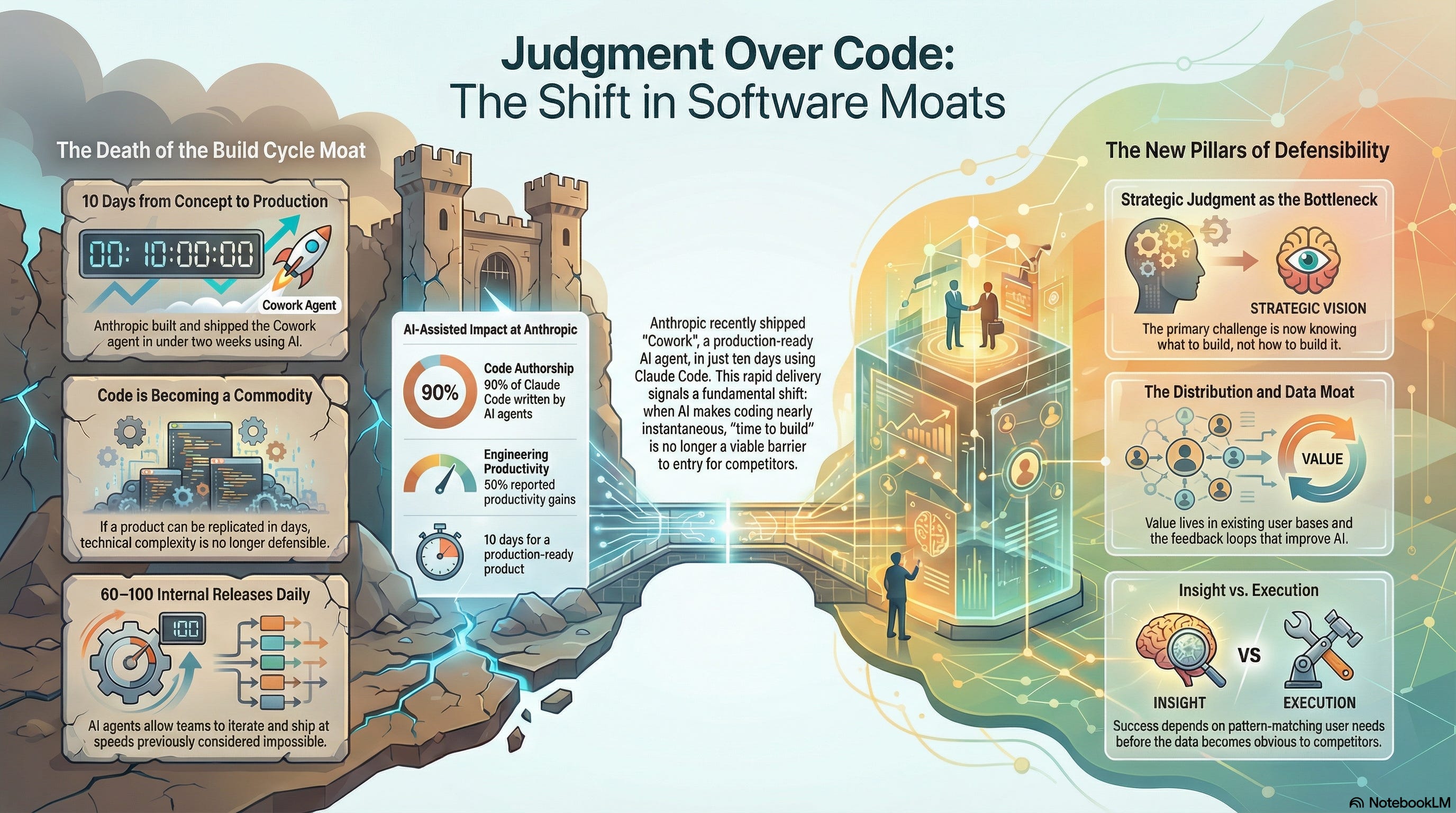
The Moat Question Is a Red Herring
Here’s my issue with the defensibility framing. It assumes the value of a product lives in the code. In the features. In the technical complexity of what got built.
That was true in 2015. Maybe even 2020.
It’s not true anymore.
Think about what actually happened here.
Boris Cherny, head of Claude Code at Anthropic, said his team described what they needed, let Claude handle implementation, and steered as they went.
Felix Rieseberg, an Anthropic engineer, put it even more directly: “We built Cowork the same way we want people to use Claude.”
They didn’t spend 18 months in a product development cycle. They didn’t burn through three rounds of architecture reviews. They told an AI agent what to build, guided the direction, and shipped in ten days.
Andreessen looks at that speed and sees vulnerability. I look at it and see a completely different game being played.
Speed Isn’t the Weakness. It’s the Weapon.
Here’s what Andreessen’s framing misses—and this matters for every founder, operator, and GTM leader reading this.
When code becomes cheap and fast to produce, the bottleneck shifts. It moves upstream. Way upstream. The scarce resource isn’t engineering capacity or development time anymore. It’s knowing what to build in the first place.
Anthropic didn’t stumble into Cowork. They watched how people were actually using Claude Code—conducting vacation research, organizing emails, creating slide presentations, cancelling subscriptions, retrieving wedding photos from hard drives, tracking plant growth. One person used it to control their oven. I’m still digesting that one.
Most product teams would see off-label usage like that and panic. Write a blog post clarifying intended use cases. Steer people back toward the “core value prop.”
Anthropic did the opposite. They recognized their users understood the product’s real value better than they did. Claude Code’s power was never just about coding. It was about agency—the ability to execute real tasks on your computer without doing them manually.
That insight didn’t come from a week and a half of coding. It came from months of watching, listening, and pattern-matching across thousands of user behaviors. The code was the easy part.
The Third Way to Think About This
So Andreessen gives us two frames: impressive tech or no defensibility. Let me offer a third.
What Cowork actually demonstrates is the collapse of the build cycle as a competitive advantage.
For decades, the moat in software was time. Time to build. Time to iterate. Time to ship. If it took your competitor 18 months to replicate what you built, you had an 18-month head start to acquire customers, build integrations, and lock in distribution.
That math is broken now.
When Claude Code can build a production-ready product in ten days, the question isn’t whether your competitor can copy you. Of course they can. The question is whether they have the judgment to know what’s worth building next. Whether they’ve built the feedback loops that surface what users actually need. Whether their team can direct an AI agent toward the right problem, not just any problem.
This is the shift I keep talking about with the Revenue Nervous System framework. We’re moving from a world where execution is the bottleneck to a world where intelligence is the bottleneck. The companies that win aren’t the ones that build fastest—everybody can build fast now. They’re the ones that know what to build. That see the pattern before the data is obvious.
Anthropic saw non-coders hacking Claude Code into a general productivity tool and said, “That’s not a bug. That’s our next product.” Ten days later, it existed.
What This Means for Builders
If you’re a founder, here’s the uncomfortable truth: your code is not your moat. It probably hasn’t been for a while. But the speed at which that moat is eroding just went from gradual to vertical.
Andreessen himself has said this in other contexts—pure product defensibility is “really rare in the Valley” because there are too many good engineers. Now add AI agents that can code entire products from prompts. The defensibility equation doesn’t just shift. It inverts.
So where does defensibility actually live now?
It lives in distribution. Anthropic ships Cowork to their existing Claude Max subscriber base—people already paying $100-200/month. That’s not a product moat. That’s a distribution moat.
It lives in data. Cowork gets smarter through usage. Every task someone delegates, every folder it organizes, every workflow it automates—that’s a feedback loop no competitor can replicate from a standing start.
It lives in context. Understanding the domain. Understanding the user. Understanding what the AI should do versus what it can do. A16z’s own research team published a piece last year called “Context is King” that basically argued this exact point—moats come from knowing why AI matters in a given domain, not just knowing what AI can do.
And it lives in speed-to-insight. The ability to observe user behavior, extract the signal, and ship a response faster than anyone else. Anthropic did that in ten days. Not because the code was simple. Because the insight was already there.
The Real Lesson Nobody’s Talking About
Here’s what I think people will look back on about the Cowork story, and it has nothing to do with moats or defensibility.
We just watched a product get conceived, built, and shipped by an AI agent in a week and a half—and it works. Users are calling it functional and valuable. Enterprises are already integrating it.
That’s not a data point about Anthropic’s competitive position. That’s a data point about the future of how every company will build products.
Right now, 90% of Claude Code’s own codebase was written by Claude Code. Engineers at Anthropic report 50% productivity gains. They ship 60 to 100 internal releases per day for Claude Code alone.
We’re not talking about a marginal improvement. We’re talking about a fundamentally different production model. One where the question isn’t “can we build this?” but “should we build this?” and “what should we build next?”
Andreessen framed Cowork as either a breakthrough or a warning sign. I think it’s neither. I think it’s a preview.
A preview of a world where the build cycle compresses to near-zero and the only thing that matters is the quality of your thinking. Your pattern recognition. Your ability to see what users need before they can articulate it. Your judgment about which problems are worth solving.
Code is becoming commodity infrastructure. Judgment is becoming the scarce resource.
And the companies that figure that out first? They won’t need an 18-month head start. They’ll just need to be right—and fast.