

My friends!
Once again, just as a reminder, we have moved the full newsletter to www.gtmaipodcast.com where you can sign up for free or the paid tier.
In our free tier, you’ll still get:
1. Podcast In-Depth Notes: Key takeaways and actionable insights from each episode.
2. GTM AI Tool of the Week: In-depth reviews and practical applications.
3. Weekly Research Update: Expert analysis of the latest trends in GTM and AI.
Introducing the Paid Tier
For those looking to dive even deeper, we’re launching a premium tier packed with exclusive resources like:
• Advanced AI Prompts and Templates
• In-depth Case Studies and Success Stories
• Video Breakdowns and Exclusive Events
This new structure allows you to choose the level of insights you need to elevate your GTM strategy.
Thank you for being a part of this journey! Let’s continue pushing the boundaries of what AI can do for GTM.
GTM AI PODCAST AND NEWSLETTER
The newsletter and GTM AI Podcast & Newsletter are sponsored by GTM AI Academy with additions article submissions, and my cohost of Jonathan Moss of AI Powered GTM.
Business Impact> Learning Tools
We have the SLACK COMMUNITY around AI , come hang with your fellow GTM professionals, get insights, and content free to help in your teams and roles.
Now with all that being said, lets move forward with todays newsletter which is:
We have #39 GTM AI Podcast with Dustin Beaudoin with ChatAE talking about his tech and solving major problems in sales with his tech.
To access the rest of the articles and reviews, subscribe for free to the newsletter
The Walt Disney Company forms business unit for AI.
Can AI Agents. save Higher Ed from Collapse
Google Road to AGI
Boston Consulting Group (BCG) report the Value of AI
GTM AI Tool of the week: Lindy
Some AI posts from this last week in case you missed it:
AI Impact on Education and Enablement
And now the Podcast:
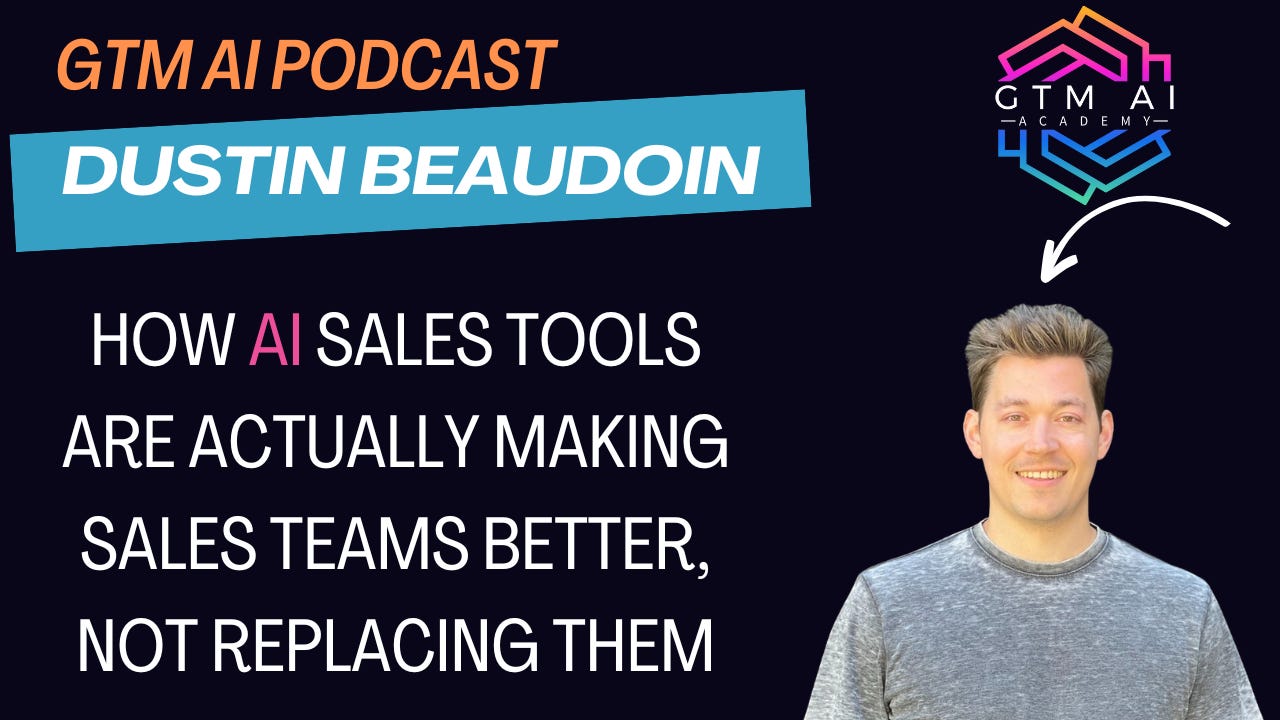
You can go to Youtube, Apple, Spotify as well as a whole other host of locations to hear the podcast or see the video interview.
Here's a first-person newsletter breakdown of my interview with Dustin from ChatAE:
Why I'm Excited About This Conversation
Just had a fascinating chat with Dustin, the founder of ChatAE, who's bringing a fresh perspective to AI in sales. What caught my attention immediately was their tagline: "Not another AI SDR." In a space crowded with tools claiming to replace salespeople, Dustin's approach is refreshingly different – focusing on making salespeople better rather than replacing them.
Key Takeaways
The Real Problem ChatAE Solves
The heart of what Dustin's building addresses two critical issues I see daily in sales:
- Most sales reps aren't using AI effectively in their workflow
- Teams are constantly pressured to do more with less resources
Why It's Different Than Just Using ChatGPT
This resonated with me deeply as someone who teaches AI to sales teams. While ChatGPT is powerful, most salespeople don't have the time or interest to become prompt engineering experts. ChatAE removes that barrier by pre-configuring the AI to think like an on-demand sales manager, specifically for pre and post-call tasks.
Impact on Sales Teams
What really got me excited was hearing about the results with junior reps. One sales manager reported that ChatAE helped their 6-12 month new AEs perform like much more tenured reps in their call preparation and strategy. This is exactly what good enablement should do – remove barriers while improving performance.
Memorable Quotes from Dustin
> "The thing that gets me most excited is how we can help grow C+ AEs into B+ AEs by helping them do these pre and post call activities the right way."
> "Our competition is actually Chat GPT – like people paying for Chat GPT pro and creating custom GPTs. But there's both a raw time savings component and a user experience difference with ChatAE."
> "We're not trying to be things that already work... focus on the areas they're ignoring, which is these routine administrative tasks and do so in an accessible way."
Looking Ahead
What struck me most was Dustin's vision of AI becoming like electricity – just part of how software works rather than a standalone feature. This aligns perfectly with my view of where sales enablement is heading: tools should take weight off plates rather than add to them.
If you're interested in checking it out, ChatAE is accessible at ChatAE with a free trial and a straightforward $19/month tier with unlimited usage. This kind of accessibility is exactly what the market needs – no complex enterprise rollouts, just practical tools that make sales professionals more effective.
This conversation reinforced my belief that the future of sales isn't about replacing humans with AI, but about using AI to make humans better at what they do best – building relationships and closing deals.

Walt Disney Corp Forms AI business unit
I just read a Reuters piece on Disney’s strategic step into the world of AI and mixed reality (XR), and it’s a real marker for how big brands are gearing up for the future. Disney, an iconic media giant, isn’t just dabbling in these technologies; it’s setting up an Office of Technology Enablement to weave AI and XR into its core offerings across film, TV, and theme parks. What Disney’s doing here feels less like a tech experiment and more like a calculated approach to redefine the experience economy—something every GTM professional should note.
The office, led by Jamie Voris, is focused on ensuring the rapid development of these technologies aligns with Disney’s larger strategy. It’s a clear message: if you’re not already thinking about how AI and immersive tech can augment customer experiences, you’re at risk of being left behind. Disney isn’t trying to centralize innovation; instead, it’s fostering alignment, so each division’s efforts complement the overall mission. For GTM leaders, this is a reminder that tech enablement is about cohesion, not just implementation.
Alan Bergman, Disney’s co-chairman, puts it bluntly: AI and XR aren’t just trends; they’re transformative forces that will reshape consumer experiences and business models alike. For those of us in go-to-market roles, this speaks directly to the evolving expectations of customers who aren’t just passive recipients of content—they’re participants in an immersive brand experience. In essence, Disney is leveraging technology not just to enhance but to expand the very framework of engagement.
Take the example of Disney’s theme parks. With people like Kyle Laughlin—who’s seasoned in AR, VR, and AI—back in Disney’s ranks, the focus isn’t only on bringing new tech into parks; it’s about reimagining every touchpoint. Whether it’s through augmented reality enhancements or fully immersive XR experiences, Disney is crafting environments where physical and digital realms blend seamlessly. The tech becomes the attraction, and the park visit becomes something more: a continuous narrative fueled by cutting-edge technology. Imagine translating that level of experiential integration into other industries—how would that impact customer loyalty or brand perception in SaaS or B2B environments?
For GTM professionals, Disney’s approach should be a wake-up call to consider how emerging technologies can help shape not only the product or service but also the entire customer journey. Disney’s Office of Technology Enablement will grow to 100 employees—a sizable investment in building the infrastructure to support these advances. This signals Disney’s commitment to future-proofing its business and, more importantly, recognizing the competitive necessity of embracing technology beyond the traditional scope.
In a time when AR/VR headsets sales hit 1.7 million units (with Meta holding over 60% of the market), it’s clear this tech is gaining traction. GTM professionals, especially those in high-growth and forward-thinking sectors, would do well to monitor how Disney and similar brands approach technological integration. It’s not about following Disney’s playbook exactly but about recognizing the importance of using technology to deepen engagement, streamline alignment, and ultimately, future-proof your offerings.
1. Build a Focused Tech Enablement Office with Clear Ownership
Like Disney’s Office of Technology Enablement, creating a dedicated team or office for AI initiatives helps centralize expertise while fostering organization-wide alignment. This isn’t just about housing technical skills; it’s about ensuring that every AI-driven initiative contributes to a unified vision and directly supports the business’s core objectives. By having clear ownership of the AI roadmap, organizations avoid fragmentation—where different teams may develop disconnected or redundant solutions.
Consequences:
• Positive: This approach ensures consistency, reduces silos, and makes scaling AI solutions more manageable. It provides a single source of truth for AI strategy, ensuring that every AI or XR project is aligned with the brand’s larger mission.
• Negative: Without buy-in from other departments, this centralized team could face pushback or lack of engagement. Teams may feel alienated if the centralized office becomes a bottleneck, stifling creative AI applications that other teams might envision.
2. Enable a Cohesive Strategy Across Departments, Not Silos
Disney’s decision to not centralize project work but instead align various teams with an overarching strategy is key here. Other teams can learn from this by not only empowering their departments with AI capabilities but ensuring every use case contributes to an overarching strategy. This means framing AI projects as transformative tools for customer experience or product enhancement, not just operational upgrades.
Consequences:
• Positive: This approach keeps AI initiatives coherent and customer-centric. When AI solutions are developed with a cohesive strategy in mind, they are more likely to yield meaningful and impactful results for end users. This alignment fosters cross-departmental collaboration and innovation.
• Negative: If the vision is too broad or lacks specificity, teams might struggle to see how their AI initiatives fit into the big picture. Without clearly defined roles and responsibilities, teams might either duplicate efforts or fail to take the necessary risks to innovate.
3. Prioritize Talent Development and Cross-Training in AI Skills
Just as Disney brings in specialized talent for its tech initiatives, teams looking to implement AI should focus on building a talent pipeline equipped with AI fluency. This isn’t limited to hiring experts; it includes cross-training existing team members in AI literacy so that the technology becomes embedded in their day-to-day thinking. Encouraging learning paths or certifications in AI for key staff can create a team culture ready for digital transformation.
Consequences:
• Positive: Developing in-house AI expertise fosters a sustainable culture of innovation and resilience. It enables quicker pivots, as teams won’t have to rely solely on external consultants or new hires for every AI-related initiative.
• Negative: Investing heavily in AI training without clear ROI can be risky. If the organization’s strategic AI goals aren’t well-defined, team members might get trained in areas that don’t support long-term needs, leading to costly but underutilized skills.
4. Embed AI Use Cases into Customer Experience and Product Development
Disney’s approach underscores the importance of tying AI directly to customer-facing outcomes. AI’s real value emerges when it enhances the customer journey—whether through personalization, predictive insights, or immersive experiences. For teams pursuing AI, focus on building applications that directly improve customer experience or product functionality, rather than treating AI as a behind-the-scenes operational tool.
Consequences:
• Positive: AI embedded in customer experiences can drive increased loyalty, engagement, and retention. It positions the company as a forward-thinking brand that offers differentiated value.
• Negative: AI-driven changes in customer experience require careful planning and a deep understanding of customer needs. Poorly implemented AI can lead to frustration (e.g., overly aggressive personalization or a sense of invasion of privacy), potentially damaging brand perception.
5. Conduct Continuous Risk Assessments and Ethical Evaluations
Bergman’s emphasis on exploring opportunities while navigating risks is essential. Teams need to establish a governance framework that regularly assesses both the ethical implications and potential biases in AI models. This ensures that AI aligns with company values and does not inadvertently create customer or regulatory risks.
Consequences:
• Positive: By proactively managing ethical concerns, companies can build trust and avoid the reputational fallout of unintended consequences (e.g., biased recommendations or breaches of privacy). Clear ethical standards ensure AI development aligns with broader social and corporate values.
• Negative: A strict governance model can slow down innovation if the team becomes overly cautious. If the review process is too rigid, teams may delay product releases, lose competitive edge, or miss out on market opportunities where faster-moving competitors succeed.
Conclusion
The key takeaway here is that adopting AI, much like Disney’s structured approach, requires intentional planning, alignment, and talent investment. When done right, AI can be transformative, but it also demands a strategic balance between oversight and creative freedom. For teams ready to embrace AI, the consequences of a focused, customer-centric strategy can bring tremendous value; however, failing to navigate the risks or lacking a clear vision can quickly turn AI adoption into a costly experiment with minimal return.

The Existential Challenge of Higher Education
A recent Forbes article dives into the impact of AI and struggling Higher Ed.
Higher education is at a crossroads. With a college closing almost every week and tuition costs soaring 141% in two decades, U.S. universities face unprecedented financial pressure. While much of the solution talk centers on alternatives like coding bootcamps or certificate programs, these bypass the root issues within traditional institutions. The real need is to transform existing universities for long-term sustainability, both operationally and financially.
The Weight of Administrative Bloat
One stark reality plaguing higher education is administrative bloat. Between 2002 and 2022, administrative roles nearly doubled, from 45 to 82 positions per 1,000 students, while faculty grew modestly. This surge is not solely due to increased student demand; it reflects a shift toward complex bureaucratic layers and non-academic services, often fueled by redundant software. Every added position and system inflates costs, but not outcomes. For GTM professionals, this is a familiar narrative: when overhead grows unchecked, profitability—and purpose—declines.
AI Agents: A Path to Operational Reinvention
The promise of artificial intelligence in higher education lies not in gimmicks but in operational overhaul. AI agents, unlike standard chatbots, offer a level of sophistication that can manage complex student interactions and integrate seamlessly into existing systems. These purpose-built AI tools can support universities across the entire student lifecycle, from recruitment to alumni engagement.
Transforming Operations Across the Student Lifecycle
AI agents can streamline operations at every stage of the student journey. Imagine AI-powered recruiters offering tailored admissions guidance 24/7 or AI advisors that assist students in navigating course selections or financial aid. Early results are promising; some universities report doubled student engagement and hundreds of administrative hours saved each month. This technology also plays a pivotal role for underrepresented groups, like first-generation students, by offering continuous support that ensures small issues don’t escalate.
Empowering Faculty and Staff
AI’s operational impact extends to faculty and staff by freeing them from repetitive tasks. Admissions officers can shift from email responses to fostering personal connections. Academic advisors can trade course scheduling for deeper discussions on career goals. This shift has a dual effect: it reduces burnout—39% of administrative staff report feeling overwhelmed—and elevates staff roles to focus on meaningful work that enhances the student experience.
Critical Considerations for AI Implementation
For AI to truly benefit higher ed, implementation must be strategic. Although 86% of higher ed leaders see AI’s potential, only 21% feel ready to adopt it. A key misstep would be settling for generic AI tools; universities need solutions built for academic environments, not customer service. Institutions should avoid fragmented implementations that would reintroduce siloed data in digital form, instead choosing comprehensive platforms to unify the student journey under one architecture.
The Future of Higher Education Operations
The disparity between higher ed and corporate America’s AI adoption is striking: 91% of companies expect AI productivity gains, yet only 40% of higher ed prioritizes AI. This isn’t merely a technology gap but one of foresight. Universities adopting AI aren’t just automating; they’re reimagining operations. Faculty and staff can focus on their core mission, and students receive essential support without bloated costs.
The universities that will succeed in this era are those that see AI as a tool to enhance their mission, addressing both operational challenges and accessibility. By moving decisively yet thoughtfully, these institutions can create a sustainable, inclusive model of higher education that meets today’s demands and tomorrow’s possibilities.
Here’s why this transformation matters to GTM teams:
1. Higher Education as a Microcosm of Market Trends
The challenges and solutions in higher education are a case study in addressing complex, outdated systems with AI-driven transformation—a parallel many GTM teams will find familiar. Universities are grappling with similar inefficiencies and pressures that exist in competitive markets, where aligning cross-functional teams, integrating disparate data systems, and driving cost efficiency are paramount. Watching how an institution as multifaceted as higher ed handles these challenges can inform GTM leaders on leveraging AI to streamline operations, break down silos, and create a unified, customer-centric approach.
2. Operational Efficiency as a Competitive Edge
GTM teams face constant pressure to drive revenue while reducing costs, all while improving customer experience. By integrating AI strategically across the buyer’s journey—from lead generation to post-sale engagement—GTM leaders can create a seamless experience similar to what universities aim to achieve with AI-driven student lifecycle management. AI agents can help automate repetitive tasks, enabling GTM professionals to focus on high-impact activities like strategic planning, personalized outreach, and value-driven conversations. This efficiency not only reduces operational overhead but also maximizes team productivity, setting a competitive advantage in the market.
3. Data Unification for Better Customer Insights
Just as universities benefit from AI-driven data sharing across admissions, student services, and alumni engagement, GTM teams can leverage AI to unify insights across lead generation, sales, and customer success. A unified AI platform can break down data silos and enable GTM professionals to gather a 360-degree view of customer journeys, behavior patterns, and engagement triggers. This integrated data approach allows for more accurate personalization, timely interventions, and strategic follow-ups that increase conversion rates and deepen customer relationships over time.
4. The Rise of Personalized Customer Experiences
AI enables universities to offer personalized support at scale—something GTM teams strive to achieve in competitive B2B and B2C landscapes. By observing AI’s role in providing tailored guidance, proactive support, and ongoing engagement for students, GTM teams can identify ways to apply similar technology in their customer interactions. For instance, AI-driven personalized outreach can improve lead nurturing, while proactive AI support can enhance customer success and retention, translating to a more loyal and engaged customer base.
5. Reframing Human Roles with AI as an Enabler
In both universities and GTM organizations, AI frees human talent to focus on tasks that require strategic thinking, creativity, and relationship-building. Just as academic advisors are moving from scheduling to meaningful student interactions, GTM roles can shift from administrative tasks to customer-facing strategies and innovation. GTM professionals can focus on building strong relationships, developing strategic partnerships, and executing impactful campaigns rather than being bogged down by manual tasks, boosting job satisfaction and effectiveness.
6. Bridging the AI Readiness Gap
With only 40% of higher ed institutions ready to implement AI, many universities are behind the curve—a situation many GTM teams can relate to. The path to AI adoption isn’t just about buying the latest tools; it requires careful alignment with strategy, culture, and end-user needs. GTM leaders can draw lessons from higher ed’s challenges in overcoming fragmented tech stacks and readiness gaps, applying similar principles to ensure seamless AI adoption that aligns with business goals and maximizes ROI.
7. Meeting Changing Consumer Expectations
Consumers today expect convenience, personalization, and responsiveness—traits AI is helping universities deliver to students and alumni. Similarly, GTM teams can use AI to meet evolving customer expectations for speed and personalization. In competitive markets, delivering an AI-driven experience isn’t just an enhancement; it’s becoming a necessity for attracting and retaining customers. GTM teams that can create seamless, responsive, and customized experiences will set themselves apart from slower-moving competitors.
In sum, the transformation in higher education provides a relevant lens for GTM professionals to consider AI as a tool to drive operational efficiency, enhance customer insights, and foster a more strategic, customer-centered approach across the entire buyer’s journey.
The Road to AGI
DeepMind’s recent podcast dives into the complex journey toward Artificial General Intelligence (AGI). Hosted by Hannah Fry, it offers insights from leading researchers like Shane Legg and David Silver on what AGI could look like, how it might evolve, and the transformative impact of reinforcement learning. Here’s a breakdown of key points:
1. Defining AGI: Different Perspectives, Same Goal
AGI—Artificial General Intelligence—is DeepMind’s ultimate aim, though it means different things to different researchers. Shane Legg, DeepMind’s co-founder, first popularized the term to describe a machine intelligence capable of achieving human-like understanding across diverse tasks. His vision of AGI surpasses mere replication of human intelligence, proposing that machines could perform even better in some areas, like reasoning or memory.
2. The Potential of Reinforcement Learning (RL) for AGI
David Silver, the principal scientist behind AlphaGo, argues that reinforcement learning alone could guide AI all the way to AGI. Here’s how:
• Reward-Based Learning: RL encourages agents to maximize “rewards” (or desired outcomes) as they learn, allowing them to adapt and excel at various tasks.
• Building Skills Through Goals: Much like a squirrel gathering nuts, an AI agent learns multiple complex skills while pursuing a single goal—an insight that has led DeepMind to explore AGI through this method.
• Challenges with RL: The technique isn’t perfect. Issues like the “credit assignment problem” (figuring out which action led to success) require further refinement for RL to reach its full potential in AGI.
3. Practical Applications: From AlphaGo to Real-World AI
DeepMind has made significant strides with reinforcement learning in games like Go, where AI can learn from itself. These principles are now being applied to real-world challenges:
• MuZero’s Adaptability: An extension of AlphaGo, MuZero can learn rules and strategies independently, making it effective in both digital and physical tasks.
• Video Compression for Efficiency: By treating video compression as a “game,” MuZero optimizes bit usage, resulting in a 6% reduction in data size. This has implications for global internet usage, especially in regions with limited bandwidth, enabling more people to access educational and other essential content.
4. Long-Term Vision: The Broader Impact of AGI
DeepMind’s researchers envision a future where AGI enhances healthcare, environmental management, and other critical areas. As AGI develops, the hope is to tackle complex global challenges through unified AI systems that excel across diverse, high-stakes environments.
DeepMind’s exploration of AGI is ambitious but grounded in practical applications that matter today. As research continues, AI’s capabilities will expand, moving us closer to a future where intelligent systems fundamentally reshape industries and everyday life.
Key Points Recap:
• AGI’s Definition: A human-like but potentially superior intelligence, handling diverse tasks.
• Reinforcement Learning: Central to AGI development, despite challenges.
• Real-World Impact: Applications like MuZero’s video compression demonstrate AI’s potential beyond theory.
• Future Scope: DeepMind sees AGI as a tool to transform industries and solve pressing global issues.
AGI remains a vision, but with each advance, DeepMind is laying the groundwork for an AI-driven future that’s increasingly within reach.
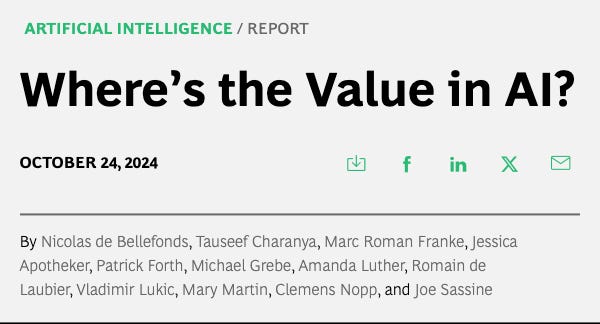
I highly highly recommend following BCG for these reports that are gold..
Here’s a summarized version of the BCG report, “Where’s the Value in AI?” that could resonate well in a newsletter format for GTM professionals.
Who’s Winning with AI—and How?
A steep learning curve marks AI adoption, with just 4% of companies standing as AI frontrunners. Despite a high interest (98% experimenting with AI), only 26% generate real value. Companies that succeed show 50% higher revenue growth and 60% higher shareholder returns over three years compared to their peers.
Key Insights:
• Leaders focus on core business processes, not just cost-saving support functions.
• Ambitious goals: These companies target substantial revenue and cost reductions.
• Strategic focus: Instead of many low-impact initiatives, they prioritize high ROI projects.
Surprising Sources of AI Value
AI’s impact spans beyond cost-saving to transforming core functions in operations, R&D, and sales/marketing, which generate 62% of AI’s total value. For example:
• Sales: AI drives personalized recommendations and automated selling.
• Customer Service: In insurance and banking, AI improves efficiency and response quality.
• R&D: Sectors like biopharma use AI for drug discovery and production.
Why Sector Matters
Industries like fintech, software, and banking lead in AI maturity, likely due to their early digital transformation efforts. They leverage AI for insights, customer interaction, and new revenue streams, while traditional sectors like retail see value in AI-driven personalization.
Case Example:
A telco achieved a 20% reduction in call center interaction time and cost savings by analyzing interactions with AI, showing the direct impact of a tailored approach.
The AI Playbook for Success
BCG outlines a playbook for companies to drive AI value effectively. Top recommendations include:
1. Commit Strategically: Leadership support is crucial.
2. Balance Priorities: Focus on a mix of process efficiency, transformational change, and AI-native offerings.
3. Prioritize Talent and Processes: A 10-20-70 rule suggests focusing most resources on people and processes over algorithms and technology.
By embracing this roadmap, organizations across sectors can capture AI’s full potential, achieving both short- and long-term gains.
This structure keeps the message concise while delivering the core insights of AI’s value, implementation challenges, and strategic approaches highlighted in the BCG report .
GTM AI TOOL OF THE WEEK: Lindy
For the record, I am not an affiliate nor do I get paid for the tool posts, these are just ones that I find and loved, and felt to share with you all. Today is Lindy
Deep Dive Review of Lindy AI: A Comprehensive Assistant for Modern Workflows
Lindy AI is a versatile AI-powered assistant tailored to streamline a wide array of professional tasks, from email management and meeting coordination to customer support automation. Designed for seamless integration, Lindy AI connects with numerous applications, making it an ideal solution for GTM professionals seeking to maximize productivity and efficiency in their day-to-day operations.
Why GTM Professionals Should Care
For GTM professionals, Lindy AI provides a robust platform that automates time-consuming tasks, helping teams focus more on high-impact activities. By integrating Lindy AI into workflows, GTM teams can minimize administrative overhead, enhance responsiveness, and improve the accuracy and consistency of customer interactions. This is particularly beneficial in fast-paced environments where managing communications, coordinating schedules, and maintaining consistent customer engagement are essential.
Practical Applications of Lindy AI for GTM Professionals
1. Email Management: Lindy AI automates email drafting and triaging, allowing GTM teams to manage high volumes of communication without compromising on personalization. The AI drafts contextually relevant responses, adapts to the user’s style, and can be customized based on specific business needs.
2. Meeting Assistance and Summaries: Lindy AI’s scheduling feature identifies optimal meeting times across participants’ calendars, eliminating the back-and-forth of coordination. It also records and summarizes meetings, providing concise notes that keep team members aligned and reduce the need for manual notetaking.
3. Customer Support Automation: For GTM teams handling customer inquiries, Lindy AI can automate responses to frequently asked questions, helping streamline support processes. This reduces response time and enables customer support representatives to focus on more complex, value-added tasks.
4. Data-Driven Insights for Campaigns and Sales: Through Lindy AI’s integrations, GTM professionals can gain insights from customer interactions, allowing for more targeted and effective marketing campaigns. This data-driven approach enhances campaign precision and helps in crafting personalized sales pitches.