

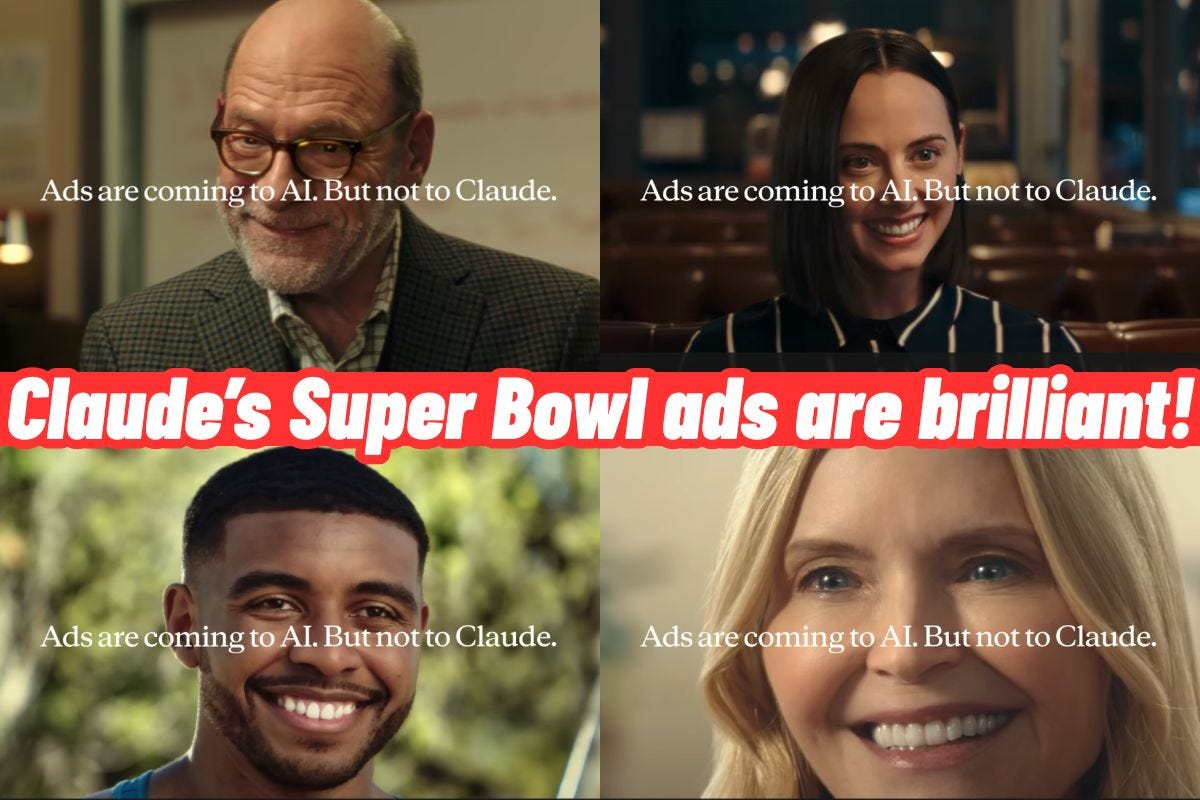
Anthropic dropped millions on Super Bowl ads this weekend. Not to show off a flashy demo. Not to announce some new model nobody outside of Twitter would care about. They ran satirical spots mocking the idea of ads inside AI conversations—and aimed the whole thing squarely at OpenAI.
The tagline: “Ads are coming to AI. But not to Claude.”
Bold move for a company that most consumers have never heard of. But when you look at the chess pieces on the board right now, it might be one of the smartest plays anyone in AI has made this year.
Source: Global Nerdy
The Enterprise King With a Consumer Problem
Here’s the thing most people don’t realize about Anthropic. They’re absolutely crushing it in the enterprise. And I don’t mean “doing well.” I mean running away with it.
Menlo Ventures’ latest State of Generative AI report shows Anthropic now commands 40% of enterprise LLM API market share. Up from 24% a year ago. Up from 12% in 2023. They’ve tripled their enterprise footprint in two years while OpenAI’s share fell from 50% to 27% over that same period. In coding specifically—which has become the gateway drug for enterprise AI adoption—Claude owns 54% of the market. More than double OpenAI’s 21%.

The enterprise game? That’s been won. Or at least Anthropic has a commanding lead that’s only accelerating.
But here’s where it gets uncomfortable. Pull up the consumer numbers, and it’s a completely different story.
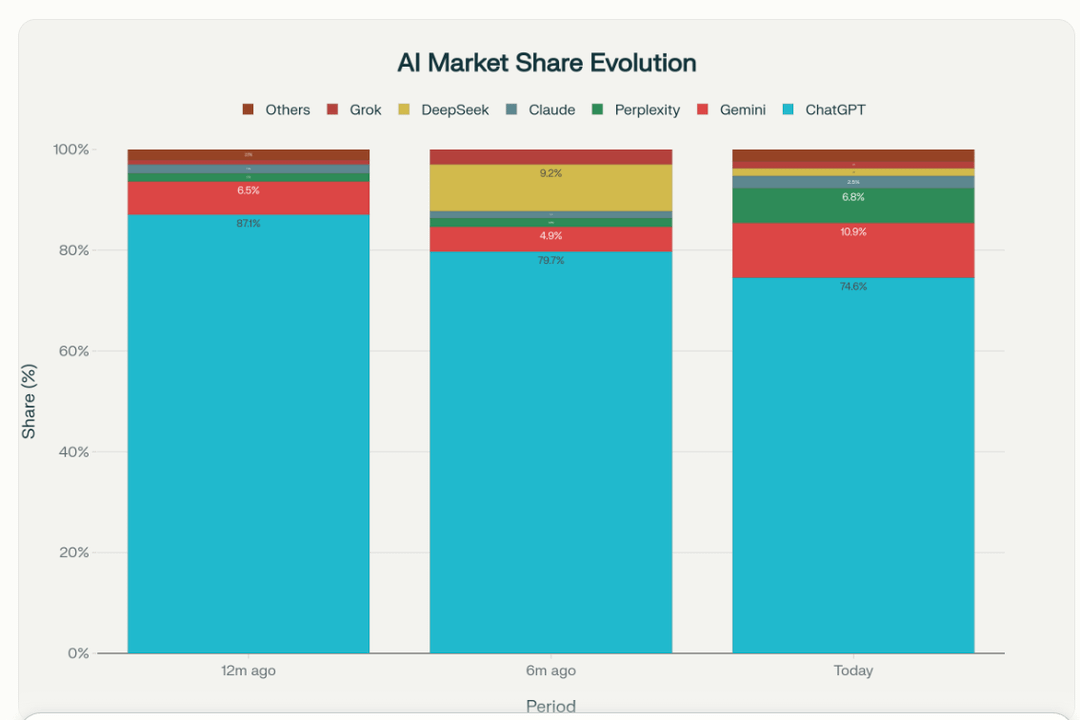
ChatGPT still holds roughly 68% of consumer AI market share. Gemini has surged to somewhere between 18-21%. And Claude? Sitting at approximately 2-3.5%, depending on whose data you trust. That’s not a typo. The company that dominates enterprise AI barely registers on the consumer radar.
This is the gap Anthropic is trying to close. And the Super Bowl was their opening salvo.
Why This Moment, Why This Message
The timing wasn’t accidental. A few things converged that made this the perfect window.
First, OpenAI announced in January that it would start testing ads with free ChatGPT users. This is a company that positioned subscriptions as the monetization strategy. Sam Altman himself called ads a “last resort” as recently as November 2025. Then they did it anyway. That created a crack in the narrative—and Anthropic drove a truck through it.
Second, Anthropic has been on an absolute product shipping tear. Look at what they’ve released in the last 90 days or so:
Claude Code went from a research preview to a billion-dollar product in six months. That’s not hyperbole—Claude Code hit over $500 million in run-rate revenue, with usage growing more than 10x in three months after general availability.
Cowork launched in January as “Claude Code for the rest of your work.” Built on the same agent SDK, but designed so you don’t need to open a terminal. You point it at a folder, describe the outcome you want, and Claude just... does it. Reorganizes your files, builds spreadsheets from receipt screenshots, drafts reports from scattered notes. They noticed developers were using Claude Code for vacation research and oven control, so they built a product for everyone else.
Plugins for Cowork dropped a week later—specialized automation for sales, finance, marketing, legal. Enterprise departments getting their own agentic workflows.
Claude in Chrome brought browser automation to the mix.
And here’s the part I keep coming back to. All of this runs through one desktop app. Chat. Cowork. Code. Three tabs, one interface, seamless switching between them. That’s not a random product decision. That’s an intentional ladder.
You start with Chat because it’s familiar. You graduate to Cowork when you realize Claude can do more than answer questions. You step up to Code when you want full developer-grade automation. Each step increases engagement, increases value, increases the likelihood you’re paying $20, $100, or $200 a month.
It’s a funnel disguised as a product suite.
The Real Strategy Behind the “No Ads” Play
Let’s be clear about something. Anthropic isn’t running Super Bowl ads because they think ads in AI are morally wrong and they just had to tell the world. This is a calculated consumer acquisition strategy wearing the clothes of a principled stand.
And I actually think that’s fine. Because the principle is also real.
Think about what you share with your AI assistant. Your anxieties about your career. Your health questions. Your half-formed business ideas. Your relationship frustrations. That’s not the same as scrolling through an Instagram feed. The context is fundamentally different, and injecting ads into that conversation—even “clearly labeled” ads “at the bottom of responses”—changes the relationship.
Anthropic’s blog post put it simply: the personal nature of users’ conversations with Claude makes ads feel “incongruous” and “in many cases, inappropriate.”
But they’re not naive. They explicitly said they’re interested in agentic commerce—where Claude handles a purchase or booking on your behalf, end to end. So it’s not like they’re allergic to money changing hands. They’re drawing a line between Claude serving you versus Claude serving an advertiser. That’s a distinction worth paying attention to.
The Super Bowl play translates that distinction into something 120 million people can understand in 30 seconds. You don’t need to know what an LLM API is. You don’t need to care about SWE-bench Verified scores. You just need to see a fake AI therapist pivoting from “try a nature walk” to pitching a cougar dating site called Golden Encounters—and think, “Yeah, I don’t want that.”
It’s Anthropic’s version of Apple’s “Think Different.” Except instead of contrasting themselves with IBM, they’re contrasting themselves with OpenAI’s monetization choices.
Sam Didn’t Love It
Sam Altman’s response was... revealing. He called the ads “funny” but “clearly dishonest,” saying OpenAI would “obviously never run ads in the way Anthropic depicts them.” Fair enough—the spots were satirical exaggerations. Nobody thinks ChatGPT is going to start pitching height-boosting insoles mid-conversation.
But then he went further. He said Anthropic “serves an expensive product to rich people” and “wants to control what people do with AI.” He used the word “authoritarian” in response to a cheeky Super Bowl commercial.
When a competitor’s marketing gets under your skin that much, it’s usually because it’s landing somewhere uncomfortable.
The reality is both companies have free tiers and comparable subscription pricing. Claude’s plans run $0, $17, $100, and $200. ChatGPT’s run $0, $8, $20, and $200. The “expensive product for rich people” framing doesn’t hold up to basic math. But Altman’s defensiveness tells you the positioning hit a nerve—particularly because OpenAI is trying to figure out how to monetize 800 million weekly users, and the answer they landed on (ads) is exactly what Anthropic just made look ridiculous on the biggest stage in American media.
What This Means for the Market
Here’s my read on what’s actually happening.
Anthropic looked at the board and realized they’ve got the enterprise locked down. Claude Code is a machine that prints developer loyalty. Cowork extends that into every department. The API business is growing faster than anyone else’s. Seventy percent of Fortune 100 companies are already using Claude in some capacity.
But enterprise dominance doesn’t build a consumer brand. And in AI, the consumer brand matters because it drives developer mindshare, which drives the next generation of applications, which drives enterprise contracts. It’s a flywheel, and right now ChatGPT owns the consumer end of it.
So Anthropic is making their move. The Super Bowl ads weren’t just brand marketing—they were a declaration. We’re in the consumer game now, and we’re going to compete on trust, not ad revenue.
The product lineup backs it up. Chat for the mainstream. Cowork for the power user. Code for the developer. The F1 partnership with Williams for ongoing brand visibility. The “Keep Thinking” campaign from September establishing Claude as the serious tool for serious work.
This feels like a company that spent the last two years quietly winning the enterprise, building the product stack, and is now turning to the consumer market with momentum, product-market fit, and a differentiated message.
Is 2-3% consumer share going to flip to 20% overnight? Obviously not. But they don’t need it to. They need enough consumer awareness to feed the flywheel—to get the college student who discovers Claude Chat to become the developer who uses Claude Code to become the enterprise champion who brings Claude into their company.
The Bigger Picture
We’re watching something that I think will be studied in business schools. Two companies, born from the same research lab, pursuing fundamentally different growth strategies.
OpenAI went consumer-first, built massive scale, and is now trying to figure out monetization at that scale—which led them to ads. Anthropic went enterprise-first, built profitable customer relationships, and is now using that financial foundation to make a play for consumers—on their own terms.
OpenAI’s bet: reach matters most, and ads subsidize universal access.
Anthropic’s bet: trust matters most, and trust is the premium consumers will pay for.
Both could be right. The AI market is big enough. But if I had to pick which company just made the smarter 90-day move? Anthropic shipped a billion-dollar coding product, launched an agent platform for non-developers, bought a Super Bowl ad that made their biggest competitor visibly angry, and told the world their AI would never serve you someone else’s agenda.
That’s not just good marketing. That’s a company that knows exactly what it’s doing.
What do you think—is the no-ads pledge a real competitive moat, or just a marketing moment? Hit reply and let me know.