

Everybody’s covering Claude’s Agent Teams launch as a developer story.
Multiple AI agents coordinating in parallel. Shared task lists. Inter-agent messaging. One agent debugs while another writes tests while a third refactors the API layer. Cool. Great for engineering.
But here’s what nobody’s talking about: the exact same architecture works for go-to-market.
And that’s the part that should have every founder, revenue leader, and GTM operator paying very close attention right now.
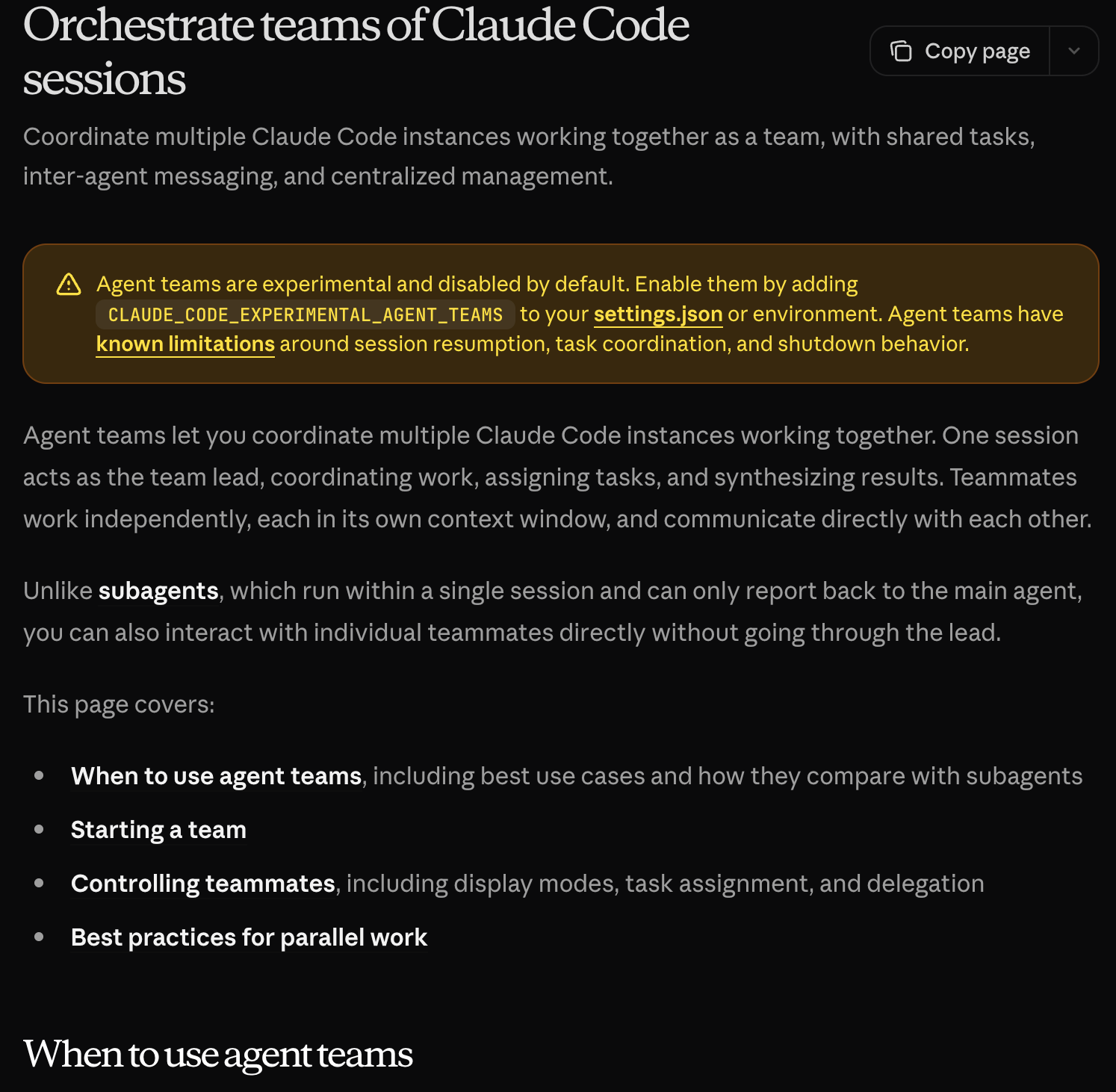
Because what Anthropic actually shipped isn’t a coding feature. It’s an orchestration primitive. A way for specialized AI agents to coordinate autonomously toward a shared goal—claiming tasks, sharing discoveries, challenging each other’s work, and synthesizing results without a human quarterbacking every handoff.
That’s not a better IDE. That’s a new org chart.
What Agent Teams Actually Does (30-Second Version)
Instead of talking to one AI that handles everything sequentially—and inevitably loses context on complex projects—you now get a team lead that spawns specialized teammates. Each teammate gets its own context window, its own focus area, and its own ability to communicate directly with the other agents.
Not through you. To each other.
Scott White, Anthropic’s Head of Product, told TechCrunch something that caught my ear: the company noticed “people who aren’t professional software developers were flocking to Claude Code simply because it was a really amazing engine to do tasks.” Product managers. Financial analysts. People from every industry imaginable.
The agent team architecture just supercharged that trend by an order of magnitude.
And the timing here is wild. Anthropic shipped this five days after their $350 billion tender offer valuation. Claude Code hit $1 billion in run-rate revenue just six months after GA. 44% of enterprises now run Anthropic in production. This isn’t a research experiment. This is a company betting that multi-agent orchestration—not chatbots—is where enterprise value gets created next.
Forget Code. Think About Your Revenue Engine.
Here’s where I need you to make a mental leap with me.
The architecture behind Agent Teams—a lead agent coordinating specialists who work independently, share findings, and converge on outcomes—maps almost perfectly onto how a high-performing GTM organization should operate. But rarely does.
Think about what happens when you launch a new product today. Marketing researches positioning. Sales builds talk tracks. Enablement creates training materials. RevOps configures the CRM. CS prepares onboarding playbooks. Each team works in its own silo, on its own timeline, with its own context. Then everyone meets in a room (or a Zoom) to try to stitch it together. Three weeks of coordination overhead later, you launch.
Now picture the agent team version.
You give a lead agent the launch brief. It spawns five specialists: a positioning agent that analyzes competitor messaging and buyer personas. A content agent that drafts sales collateral and email sequences. An enablement agent that builds training docs and objection-handling frameworks. A RevOps agent that configures lead scoring, routing rules, and pipeline stages. A CS agent that creates onboarding workflows and health score criteria.
They all work in parallel. The positioning agent shares its competitive findings directly with the content agent, which adjusts messaging in real time. The enablement agent pulls from both to build talk tracks that actually match the positioning. The RevOps agent configures scoring rules based on the ICP the positioning agent defined. And the CS agent builds onboarding flows that connect back to the value props marketing is promising.
Coordinated. Parallel. No three-week lag.
That’s not science fiction. That’s the architecture Anthropic just made publicly available. The only difference between what I described and what’s shipping today is the connective tissue between Claude Code and your GTM stack—and that gap is closing fast with MCP integrations into Salesforce, HubSpot, Slack, Jira, and basically every tool in your revenue tech stack.
Three GTM Use Cases That Change Immediately
Let me get specific, because I know how my audience thinks. You don’t want theory. You want “what do I do Monday morning.”
1. Competitive Intelligence That Actually Keeps Up
Right now, most companies do competitive analysis quarterly. Maybe monthly if they’re disciplined. It takes a person (usually in product marketing) a week to pull it together, and by the time it’s done, half the data is stale.
With agent teams, you spawn a competitive intel squad. One agent monitors pricing pages and feature announcements. Another tracks their job postings for strategic signals (hiring a Head of Enterprise Sales? They’re moving upmarket). A third analyzes their G2 and Gartner reviews for positioning weaknesses. A fourth maps their integration ecosystem. They share findings with each other as they go, and the lead agent synthesizes everything into a brief that’s current as of right now—not last quarter.
That “one person spending a week” becomes “a team of agents spending an hour.” And they can run again tomorrow.
2. The End of the Handoff Tax in Revenue Operations
I’ve seen this pattern at every company I’ve worked with across 21 years: the most expensive part of GTM isn’t the people doing the work. It’s the coordination between them.
Marketing generates a lead. It sits in a queue. Sales picks it up 36 hours later. They don’t have the context from the campaign that generated it. They send a generic follow-up. The lead goes cold. Sound familiar?
Agent teams attack this by collapsing the handoff. A lead-processing agent team could include: an enrichment agent that pulls firmographic and technographic data the moment a lead enters the system. A scoring agent that evaluates fit and intent signals. A routing agent that matches the lead to the right rep based on territory, segment, and capacity. A personalization agent that drafts the first outreach using the specific campaign context, content consumed, and buyer persona.
All of it happening simultaneously. No queue. No 36-hour lag. No lost context.
Here’s the stat that keeps rattling around my head: 70% of businesses reported significant increases in lead conversion rates after implementing agentic GTM tools, according to the 2025 Agentic AI report. And that’s with single-agent approaches. Multi-agent coordination should compound those gains.
3. Product Launches at the Speed of Decisions, Not Meetings
This is the one that excites me most, because it connects to something I see constantly at Experity and across the companies I advise.
The bottleneck on product launches isn’t building the product. It’s aligning the entire go-to-market machine around it. Messaging. Sales enablement. Pricing. Competitive positioning. Customer communications. Support documentation. Legal review.
Each of those is a workstream. Each requires coordination. Each has dependencies on the others. In a traditional org, that coordination happens through meetings, shared docs, and project managers who spend their entire day making sure everyone’s aligned.
Agent teams turn those workstreams into parallel agents. The lead agent manages dependencies (the pricing agent can’t finalize until the positioning agent completes market analysis). Agents share context as they work. And the output is a coordinated launch package—not a collection of disconnected deliverables that someone has to stitch together at the end.
From Org Charts to Work Charts: The Real Disruption Nobody’s Ready For
Okay, here’s where I want to go deeper than anyone else covering this launch. Because the tactical stuff I described above? That’s the first-order effect. The second-order effect is what actually keeps me up at night.
Agent Teams doesn’t just change how work gets done. It changes how go-to-market organizations get structured.
For a century, we’ve built companies around functional expertise. You have a marketing department because you need marketing expertise. A sales team because you need selling expertise. Customer success because you need retention expertise. RevOps because someone has to make the data talk to itself.
Each function gets a box on the org chart. Each box gets a leader. Each leader gets a budget, a headcount plan, and a set of OKRs that may or may not align with the box next to them. The whole thing is organized around who has the skills—not around what work needs to happen.
Microsoft’s latest Work Trend Index calls this the shift from “org charts” to “work charts”—a dynamic, outcome-driven model where teams form around the work that needs to be done, not around departmental boundaries. And agent teams are the forcing function that makes this shift inevitable.
Here’s why.
When you can spin up a team of AI agents to handle competitive analysis, lead enrichment, content production, CRM configuration, and onboarding documentation in parallel—the question stops being “which department owns this?” and starts being “what are the jobs to be done, and who or what is best suited to do each one?”
That’s a fundamentally different organizational question. And it demands a fundamentally different answer.
The New GTM Map: Jobs Agents Fill vs. Jobs Humans Fill
I’ve been thinking about this a lot, so let me lay out how I see the work actually splitting. Not in some abstract “AI will replace us all” way. In a practical, “here’s what changes on Monday morning” way.
Jobs agents should fill:
→ Data assembly and enrichment. Pulling firmographic data, technographic signals, intent scores, competitive intel, and buyer history into a unified picture before a human ever looks at it. This is pure execution work that humans are terrible at doing consistently and fast.
→ Pattern recognition across scale. Analyzing thousands of customer interactions to find which messaging resonates with which personas. Scanning every competitor’s website, job board, and review site for strategic signals. Identifying which leads in your pipeline match the profile of your best closed-won deals. No human can process this volume without sampling bias.
→ First-draft creation and iteration. Sales collateral, email sequences, training documentation, competitive battle cards, product one-pagers, customer communications. Not the final version. The 80% draft that gets a human to the finish line in 20 minutes instead of four hours.
→ Coordination and handoff management. This one’s huge. Rob Levin, McKinsey senior partner, said something that floored me: “50 to 100 AI agents can be managed by just two or three people.” The coordination tax—the meetings, the status updates, the “just following up on that deliverable” emails—is the first thing agents eliminate. They don’t need alignment meetings. They share context natively.
→ Continuous monitoring and alerting. Competitive changes, churn signals, pipeline anomalies, campaign performance drifts, pricing shifts in the market. Agents don’t check dashboards once a week. They watch everything in real time and surface what matters.
Jobs humans must own:
→ Strategic judgment calls. Should we move upmarket or double down on SMB? Is this competitive threat existential or noise? Do we acquire this company or build the capability? No agent is making these calls. This is where experience, intuition, and risk tolerance intersect—and it’s irreplaceable.
→ Relationship architecture. Enterprise deals don’t close because the proposal was well-written. They close because a human built trust with another human over months. Partnerships, board relationships, investor dynamics, key customer relationships—these are human-to-human and they stay that way.
→ Creative vision and brand. Agents can produce content. They can’t decide what your brand means. They can’t feel the cultural moment that makes a campaign resonate. They can’t tell you that your positioning is technically correct but emotionally dead. The creative director role doesn’t go away—it gets amplified because the execution bottleneck disappears.
→ Ethical guardrails and edge cases. When the enrichment agent flags a prospect who’s a former employee. When the content agent produces messaging that’s technically accurate but tonally wrong for a sensitive industry. When the competitive intel surfaces information that raises legal questions. Humans handle the gray areas. Agents handle the black and white.
→ Organizational design itself. Deciding which jobs get assigned to agents, which stay human, how the two interact, and when to override the system. This is the meta-job—the one that determines how effective everything else is.
See the pattern? Agents own the execution, coordination, and pattern recognition layers. Humans own the judgment, relationships, creativity, and governance layers.
That’s not “humans vs. AI.” That’s a work chart. Jobs to be done, assigned to whoever—or whatever—does them best.
What Dies: The Functional Silo
Here’s the part that will make some people uncomfortable.
If you organize your GTM around jobs to be done instead of functional departments, some of the structures we’ve taken for granted start looking pretty fragile.
Moderna already merged their HR and technology departments under a single Chief People and Digital Officer. Amazon and McKinsey are flattening management layers. Shopify’s CEO made headlines by mandating that no new position gets approved unless AI demonstrably can’t do the job. Fortune reports that at one AI-first healthcare company, a team of 10 engineers was replaced by a three-person unit overseeing AI agents.
The pattern is consistent. Companies that reorganize around agent-augmented work are:
Collapsing departments that existed to manage coordination overhead. If agents handle the handoffs, you don’t need a layer of project managers and program coordinators whose primary job is making sure Marketing and Sales are aligned.
Merging functions that share objectives but were separated by expertise boundaries. When an agent team can span positioning, content, enablement, and operations in a single coordinated workflow—why do those need to be four separate teams with four separate leaders?
Redefining “management” from overseeing people to orchestrating human-agent systems. McKinsey’s already seeing this: managers are becoming what Alexia Cambon at Microsoft calls “agent bosses”—people whose primary skill is decomposing complex objectives into agent-executable tasks and knowing when to intervene with human judgment.
This isn’t theoretical. Deloitte found that 71% of workers already perform work outside their formal job scope. The boundaries were already blurring. Agent teams just make the old lines indefensible.
This Is the Revenue Nervous System in Action
I’ve been writing about this framework for a while—the idea that businesses need six interconnected AI layers: Data, Intelligence, Context, Memory, Orchestration, and Execution.
Agent Teams is the Orchestration layer made real. Not as a concept. Not as a slide in someone’s pitch deck. As a production feature that lets multiple AI agents coordinate work across shared objectives with genuine inter-agent communication.
But the organizational shift I’m describing is what happens when you take that orchestration layer seriously. When you stop thinking about AI as tools that help your existing departments work faster—and start thinking about it as a new category of worker that demands a fundamentally different organizational architecture.
The companies that get this right won’t just have better GTM execution. They’ll have a structurally different kind of organization. Fewer functional silos. More outcome-oriented teams. Higher human-to-agent ratios in execution work, and higher human concentration in judgment work. Flatter hierarchies because the coordination layer that justified middle management is increasingly automated.
What makes Agent Teams different from every other “AI for GTM” pitch is the coordination piece. We’ve had AI tools that can write emails. AI tools that can score leads. AI tools that can analyze competitors. But they all operate in isolation—separate tools, separate contexts, separate outputs that a human has to stitch together.
Agent Teams introduces the missing primitive: agents that talk to each other, build on each other’s work, and converge on shared outcomes. That’s the piece that makes the organizational shift possible. You can’t replace functional silos with jobs-to-be-done teams if your AI tools are as siloed as your departments.
The Honest Constraints
I’d be doing you a disservice if I glossed over the limitations.
Agent Teams is experimental. It’s in research preview. Each agent instance burns tokens independently, so costs scale with team size. And the strongest results require genuine orchestration thinking—clear task decomposition, well-defined ownership boundaries, explicit communication protocols. Just like human teams, agent teams need structure to be effective.
There’s also a maturity gap between what’s possible in Claude Code today and the full GTM scenarios I described above. Those scenarios require MCP integrations with your specific revenue stack, custom agent configurations for your workflows, and thoughtful architecture around what gets automated versus what stays human.
But here’s the thing I keep telling founders: the companies that wait for these systems to be turnkey will be 18 months behind the companies that start building the muscle memory now. Gartner’s reporting a 1,445% surge in multi-agent system inquiries. By end of 2026, they predict 40% of enterprise applications will include task-specific AI agents. The AI agent market is projected to grow from $7.8 billion in 2025 to over $50 billion by 2030.
The infrastructure is arriving. The question is whether your organization has the orchestration capability—and the organizational courage—to use it.
The Question That Should Keep Every GTM Leader Up Tonight
Here’s where I’ll leave you.
We’re not in a “should we use AI tools?” moment anymore. We left that behind a year ago.
We’re in a “how do we redesign our organization around the assumption that AI teams handle execution and coordination, while humans handle judgment, strategy, and relationships?” moment.
That’s a harder question. It means looking at your org chart and asking which boxes exist because the work demands them—and which boxes exist because that’s just how we’ve always organized. It means asking whether your VP of Marketing and VP of Sales need separate empires, or whether a unified revenue team with specialized agents and a smaller group of senior humans making judgment calls would actually produce better outcomes.
It means accepting that the competitive advantage isn’t “we have AI tools.” The advantage is “we redesigned our organization to be native to a world where agents handle execution and humans handle everything agents can’t.”
Because we’re not moving from “there’s an AI for that” to “there’s a better AI for that.”
We’re moving to “there’s a team of AIs for that.”
And the org chart that works for that world looks nothing like the one you have today.
I’m building a lot of my own thinking around multi-agent GTM orchestration and organizational redesign in real time. If you’re experimenting with agent teams for non-engineering use cases—or if you’re actively restructuring your GTM org around human-agent collaboration—I want to hear about it. Reply to this email or drop it in the comments. The most interesting use cases always come from operators in the field, not people writing about it from the sidelines.