

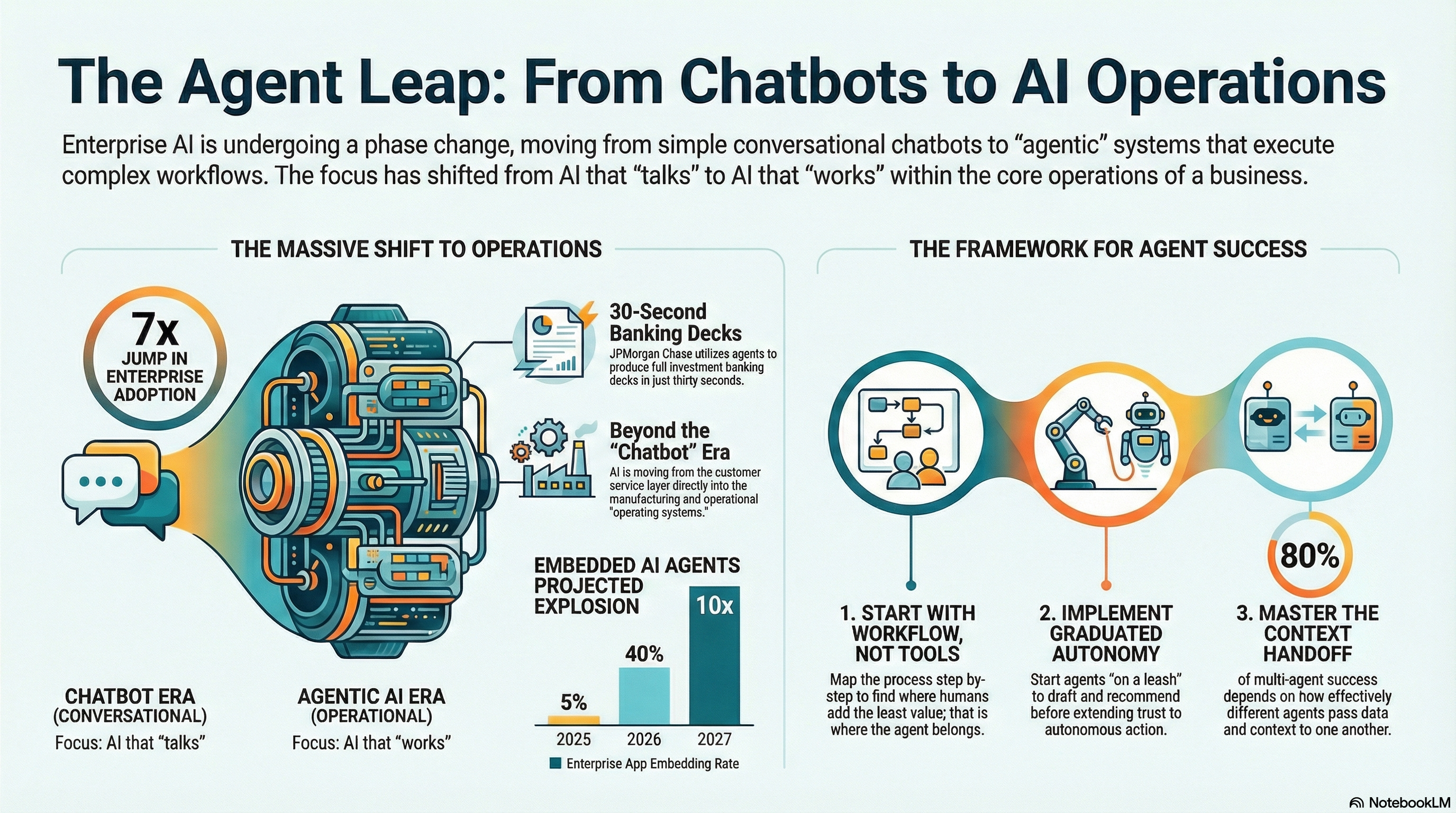
Enterprise adoption of agentic AI jumped 7x in a single quarter. Not 7 percent. Seven times. PYMNTS published the number—12% of enterprises are testing AI agents right now, and another 12% have already baked them into daily operations.
JPMorgan Chase is using agents to produce investment banking decks in 30 seconds.
Thirty seconds.
I don’t care where you land on the AI spectrum—skeptic, evangelist, somewhere in the middle. That number demands your attention.
The Chatbot Era Is Already Over (We Just Haven’t Admitted It)
For three years, “AI in business” meant chatbots. Stick a conversational interface on your product, call it AI-powered, ship the press release. Repeat.
That chapter closed. Quietly. Without a formal announcement.
What’s actually happening right now is different in kind, not just degree. We’re watching AI migrate from the customer service layer to the operations layer. From answering questions to running workflows. From a feature you bolt on to an architecture you build around.
BMW is running multi-agent systems across manufacturing plants—not piloting, not sandboxing. Production. Capital One embedded agents directly into operational systems. These aren’t experiments dressed up as transformation. This is how those companies work now.
The shift isn’t subtle. If you’re still treating this like a wave to track rather than a current to navigate, you’re already downstream of where you need to be.
The Part Nobody’s Talking About
Here’s what most of the coverage misses entirely: there’s a massive gap between “we deployed an AI agent” and “AI agents run our operations.”
I know because I’ve been building AI-native GTM systems for the past year. Multi-agent setups where specialized AI handles competitive intelligence, content creation, pipeline research, prospect analysis—coordinated across functions, not siloed inside one team or one tool.
And the hardest part of all of it?
It’s never the technology.
It’s always the humans.
A YC-backed startup called Trace just raised $3M on exactly this thesis. Their entire argument is that the biggest barrier to agent adoption isn’t capability—it’s people. Their “graduated autonomy framework” shows 2-3x higher agent utilization when teams design the human-AI handoff intentionally, rather than just dropping automation on top of existing workflows and hoping for the best.
I’ve watched this same pattern play out six times across 21 years of scaling operations. CRM adoption. Marketing automation. Cloud infrastructure. Data analytics. Every major technology shift hit the same wall in the same sequence: the tech worked, the org didn’t. People weren’t wrong to resist—they were responding rationally to tools that didn’t account for how real work actually happens.
AI agents are running directly into that wall right now.
What Actually Works (From Building This Stuff)
I’ve made most of the mistakes you can make building multi-agent systems. Here’s what I wish I’d known before making them.
Start with the workflow, not the tool.
Don’t ask “what can AI do?” Ask “what does this process actually look like, step by step—and where does a human add the least value?” That’s where your agent goes.
Early on, I built agents around capabilities. “This agent can do research!” Great. Research for what? In what context? Feeding which decision? When I rebuilt everything around actual workflows—competitive analysis that feeds battle cards that feed sales enablement—things clicked fast.
Graduated autonomy isn’t just smart. It’s non-negotiable.
You can’t go from zero to fully autonomous. Well, you can. But you’ll break things. I have the war stories.
Start agents on a short leash. Let them draft, not publish. Let them recommend, not decide. Let them flag, not act. Then, as trust builds and the agent proves it understands context, you extend the leash incrementally. This is exactly what Trace is building into their product, and it maps almost exactly to what I arrived at through expensive trial and error.
The 80/20 of multi-agent systems is context passing.
The flashy part of multi-agent AI is the architecture diagram. Multiple specialized agents, coordinating like a high-functioning team. Impressive on a slide.
The unglamorous reality? 80% of getting it right is figuring out how agents pass context to each other. What does Agent A know that Agent B actually needs? What format does the handoff take? What gets dropped in translation?
This is the same challenge human teams face. Except agents don’t complain about it in Slack. They silently produce garbage output. And you only find out three steps later when a decision gets made on bad information.
Measure time-to-decision, not task completion.
The real metric isn’t “did the agent finish?” It’s “how much faster did the human make a better decision?”
When I run competitive intelligence through my agent system, the agent doesn’t replace the strategic analysis. It eliminates the 4-6 hours of research that used to happen before the analysis. The human still decides. They just decide faster, with better inputs. That’s where the leverage actually lives.
The Numbers That Should Be Keeping You Up
Gartner projects that 40% of enterprise applications will have embedded AI agents by the end of 2026. In September 2025, that number was 5%.
5% to 40% in roughly a year.
IDC projects a 10x jump in AI agent usage by 2027.
These aren’t incremental adoption curves. This is a phase change. And phase changes reward early movers disproportionately—not because they’re smarter, but because they’re building the institutional knowledge and the infrastructure while everyone else is still debating whether to start.
The companies that spent 2025 experimenting are now operationalizing. The companies that spent 2025 watching are now scrambling. That gap compounds every quarter.
What This Means For You, Specifically
If you’re a founder: The wrapper era is dead. Google’s VP of Startups said this explicitly this week—so it’s not a hot take anymore, it’s settled. Build agents that understand your customer’s actual operations. Vertical depth is the only moat that holds.
If you’re an operator: Start small, but start now. Find one workflow that eats 5+ hours a week of skilled human time. Build an agent for it. Not a chatbot—an agent that does the actual work. Map the workflow first. Build second.
If you’re a leader: The biggest risk isn’t moving too fast on AI. It’s moving too slow while your competitors operationalize. And the way that risk compounds is quiet—you don’t notice until the gap is already hard to close.
The chatbot era taught us AI could talk. The agent era is proving AI can work.
And work is where the value has always been.
One thing to try this week: Map out one workflow in your business—research → analysis → output. Time how long a human takes to get through the research step. Then ask honestly: could an agent handle that step with 80% accuracy? If yes, you just found your first real deployment.