

So today we have some PACKED resources for you in some skill.md files
And have my good friend Mark Fershteyn from https://www.masteringai.io/ on the podcast returning with some gold nuggets and at the end of this newsletter, I have 7 skill.md files inspired by the podcast for you to download for free along with Full Enrich.
In partnership with FullEnrich — I built a Claude skill that reads a business signal such as a funding round, a new exec hire, a job posting and then reasons out the right buyer, and enriches them live via FullEnrich’s MCP, no dashboard or CSV required. You can try FullEnrich.com and the skill.md with 50 credits free, it is embedded here, copy it into your Claude skills folder and you’ll be running it in under 5 minutes. The MCP they have is insanely easy to use as well. Just point your AI to this https://fullenrich.com/mcp and it will connect your account.
Let’s get into the podcast!
Mark Fershteyn spent four years, millions of dollars, and a 26-person team to take his startup, Recapped, to seven figures. Then he shut it down and returned money to his investors.
Six months after going solo, working part-time, he is on pace to pass a half-million-dollar run rate.
He does not code. He describes himself as “a dumb sales guy with too many ideas.” For his whole career, every idea came with the same tax: raise money, hire engineers, wait. In his words: “AI allowed me to do that by myself.”
Mark came back for his second time on the GTM AI Podcast. I’ve followed his journey for years and I admire him a lot. He’s had real ups and downs with being a founder (huge shoutout for his transparency), and he’s winning now because he stopped asking for permission. He opened Claude Code live and showed us how the whole machine works. He does a great job digging in at and I have some free skill.md files at the end so you can build the first piece yourself.
1) Stop trying to keep up. Filter for step changes.
Mark spends most of his day on X and YouTube and still feels behind. “In a week, we’re getting 6 months’ worth of advancement sometimes.”
I tell people the same thing all the time. You’re not going to keep up. At Ai4, I heard Geoffrey Hinton and Andrew Ng both say on stage they can’t keep up either. Let go of that pipe dream and take the pressure off.
Mark’s filter is simple. Ask one question of every release: is this a small improvement, or a step change that unlocks a new kind of work (like a model suddenly good enough to edit video)?
Small improvement: skip it
Step change: block a weekend and build something with it
Build anything, even something for your kids
For me personally, this past weekend my daughter drew a stick figure and I turned it into a one-minute video of her character singing and dancing. Now she wants AI videos all the time.
The one thing I tell teams is be willing to ask themselves one question when working with AI.
That is:
“I wonder if I could do this with AI?” And then start playing, iterating, and making it better.
2) Use AI to use AI. Start in plan mode.
Mark talks to Claude before he asks it to build anything. He dictates what he’s working on, the challenge, and the outcome he wants, then says “help me think through this.”
He starts almost every session in plan mode. “We spend a lot of time thinking and planning up front, and then the execution is more or less usually flawless.”
In Claude Code (terminal): press Shift+Tab until you reach plan mode
In the Claude app: turn on plan mode before you start
Approve the plan, then switch to build
On terminal vs. app: Mark runs up to 12 terminal windows across 3 or 4 projects at once. The app creates a separate git worktree per session, which makes running 7 things in parallel hard for him. His advice: if you’re not building three products at a time, the app is more than enough.
3) One agent per task.
This was the most useful rule in the episode. Every agent Mark builds has one job and a clear test for success: is it working or not?
He has an agent that fetches mail. A separate agent that triages it. An agent that only edits. His content pipeline used to be one agent. Now it’s six:
Idea generation
Drafting
Editing
Hooks
Repurposing to other platforms
One skill that runs all of them in order
When output is weak, he knows which agent to fix. A single agent doing six jobs fails in six places and you can’t tell which one broke.
Here’s the prompt Mark would use to start:
“I want to create a set of skills that interview me on a specific topic, minimum of 10 interview questions. Then create a set of agents, each with their own skill file, that will edit, break it down, create viral hooks, and repurpose my content. Help me build this.”
4) Treat every skill like a new intern. Then coach it four times.
Mark’s analogy: if you tell a new intern “go write me a blog post,” they have no idea who it’s for, what it should accomplish, or what good looks like. Give them 5 examples, the format, and the tone, and the work gets dramatically better. AI works the same way.
His example: he scraped about 300 LinkedIn posts from Adam Robinson and built a skill around them. When he types /adam, it:
Interviews him on a topic
Drafts a post in that style
Receipt-grades the numbers
Adds a radical transparency takeaway
Writes 5 hooks and scores them
Here’s where I see most people go wrong. They open Claude, ask for a skill in one shot, and stop. The skill ends up too broad, or it has too little context to do its one job well. In my experience it takes at least four rounds of feedback before results get really good: run it, test it, evaluate it, give feedback, run it again. That’s about 30 minutes. The results you get after that hold every time you run it.
Mark adds one more move: end every skill by asking, “What went well, what didn’t, and what can we improve next time?” The answers feed back into the skill. It improves itself.
5) Give your AI a memory it can navigate.
Every folder on Mark’s computer is backed up to a GitHub repo, and he writes markdown files as he works. The standout is a /clients folder. Every email, Slack thread, and LinkedIn message for each client lands there. When he says “help me draft a proposal for Coach K,” Claude pulls from everything.
A year and a half ago he started building a personal wiki, before Andrej Karpathy’s LLM wiki idea took off. It pulls in LinkedIn, email, Slack, CRM data, scraped company data, and news alerts, and connects them as nodes. Jonathan connects to Salesforce, so anything touching both is linked.
I asked him about hierarchy vs. graph structure, the idea Jack Dorsey pushed at Block. Mark’s view: models are now good enough that you rarely need to build your own retrieval system, but you still need to create the structure behind the scenes.
Start here: one folder per client or account, and a habit of dropping every conversation into it.
6) Build the interface you actually want to work in.
Mark hated living in a chat window. “I’m a visual person. I need something visual.” So he built Zealos, a super app, using Claude Code. The AI runs on Claude’s APIs, the app is hosted on Vercel, and Supabase handles the database and login.
5 calendars in one view
Every inbox in one place
LinkedIn, Slack, and Discord messages together (iMessage is next)
A website snippet that identifies anonymous visitors by waterfalling several data providers
People who engage with his LinkedIn topics get captured, enriched, or enrolled in a sequence
He started it to cut a couple hundred dollars a month in tools. After about 300 hours of fine-tuning, his consulting clients now pay for access. His pitch to them: “You can build this yourself, or I’ve been fine-tuning this across 300 hours. Do you want to pay for access?”
The receipts
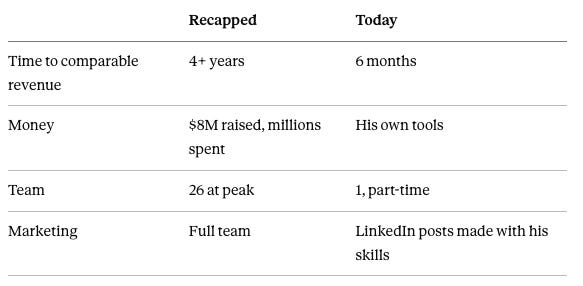
Where this goes: build, buy, or hire?
Mark’s read on the market:
SMBs are building their own tools and cutting subscriptions
Enterprises need reliability and compliance, so they keep buying. “That’s why Salesforce isn’t going anywhere.”
The middle gets squeezed. Sell the shovels, or sell the 99.999% uptime.
He also expects a pendulum. Companies will go build-happy for a couple of years, then realize that putting their top people on maintaining an internal CRM is a waste when $1,000 a month buys it from professionals. Then they’ll refocus on their core and put AI behind it.
I agree, and I’d add the migration reality. I’ve moved a company off a CRM. It took months and it hurt. Enterprise systems with years of data, governance, and security are sticky. My rule for leaders: build the things that are specific to how you win. Buy the things that are plumbing.
Mark’s boldest prediction, which he offered with “maybe I’m completely wrong”: within 10 years, 10 to 20 percent of people will do 20 times the work for 10 to 100 times the pay, and many others won’t need to work. You don’t have to agree to take the signal. The gap between people who use AI to multiply themselves and people who wait is widening every quarter.
Your free skill: The Content Engine
I turned Mark’s one-agent-per-task content workflow into a skill you can install today. It runs six jobs in order: Interviewer, Drafter, Editor, Hook Writer, Repurposer, and a Retro that saves your feedback so it gets better every run.
It’s seven skills: one runner plus one skill per job. The editor, hook writer, and repurposer each ship with a small script that checks the work (AI phrases, dashes, hook length, channel limits) so quality doesn’t depend on the model’s mood that day.
How to install:
Claude Code: copy all seven folders into
~/.claude/skills/Claude app: upload each of the seven skill zips in the Skills section of Settings
Add a
voice/folder with 10 or more of your best posts so it matches your style
Then type: “Run the content engine on [topic].” Or use any piece alone: “Write 5 hooks for this post.”
What to do this week
Install the Content Engine and run it on one topic you know cold
Give it four rounds of feedback before you judge it
Create one folder per top client or account and start dropping every conversation into it
Pick one step change from the last 90 days and spend a weekend building with it
Mark didn’t wait for an engineer, a funding round, or anyone’s permission. As he put it at the end: “You don’t need to be a crazy genius engineer to build this stuff.” Go build.
Reminder that the Skill.md files are here from FullEnrich and the content suite from Mark!