

Everyone thank you for your patience! It has been a crazy few weeks and been traveling, so took a hiatus after not missing a week for 2 years, but we are back in action and ready to share some gold nuggets!
Really excited to dig into todays podcast interview and a gaggle of updates in the AI world. Would love your feedback on how you like the flow and anything we may be missing that would be helpful for you.
This is sponsored by the AI Business Network which is where revenue and business leaders go to know more about AI strategy and GTM AI Academy which is where 10,000+ GTM Professionals go to learn more about AI in their workflows and teams.
Now the podcast:

You can go to Youtube, Apple, Spotify as well as a whole other host of locations to hear the podcast or see the video interview.
Today honored to have someone I admire and respect, Mr. Harald Roine of Buro Ventures.
The Genesis of a Marketing Innovator
Harald's journey into the world of digital marketing began at the age of 11. Motivated by a passion for video games and a push from his father to develop productive skills, he taught himself to program and create websites. By 16, his interests had expanded to Bitcoin and digital innovation. Over the years, he has cultivated vast expertise in digital marketing, focusing on value-based approaches and technological advancements.
The Shift to Value-Based Marketing
Traditional marketing often hinges on showcasing product features or benefits. Harald, however, advocates for a "value-first" approach. This strategy focuses on offering genuine value to the audience before making any pitches. The idea is simple yet impactful—by providing valuable insights or resources, businesses build trust and reciprocity, which naturally encourages audiences to engage further.
The Role of AI in Transforming Marketing
Harald envisions AI as a revolutionary tool in marketing, capable of automating numerous functions and processes. He outlines a future where AI will not just assist but transform how businesses interact with their audiences. The ability for AI to understand complex input-output processes within a company and mimic human strategic and creative tasks marks a significant shift. This perspective aligns with the belief that AI will soon facilitate AI-to-AI interactions, streamlining operations like marketing and customer relations.
Automating Lead Generation and Customer Engagement
A key takeaway from the discussion was the application of AI in generating leads and engaging customers. Bureau Ventures leverages AI to automate content creation, enabling more efficient and effective marketing strategies. AI-driven systems can analyze a business's offerings, identify audience pain points, and produce content that resonates with potential customers. As a result, businesses can focus more on strategic growth and less on manual content development.
The Future of AI in Business Operations
With AI poised to redefine the landscape of business operations, Harald emphasizes the importance of building owned media channels that businesses control entirely. This strategy will help companies build digital real estate that withstand external changes, ensuring sustainable outreach and engagement. He also touches on AI’s potential to revolutionize client success systems through automated satisfaction and performance measures, enhancing customer experiences and outcomes.
Conclusion
If you want to create a system that gathers hundreds of leads that come to you, Harald is the man to talk to.
More details about Bureau Ventures and their innovative approaches can be explored through their website. As AI continues to evolve, the strategies shared by Harald offer a compelling direction for marketers seeking to stay ahead of the curve.
The Value-First GTM Playbook
Based on Harold's Buro Ventures Marketing Strategy
Core Philosophy: Value-First vs Pitch-First Marketing
The Fundamental Shift: Instead of leading with product features and demo requests, lead with genuine value that addresses your audience's core problems. This triggers reciprocity bias and builds trust before any sales conversation begins.
Key Principle: Information is no longer power—implementation is power. You can give away your methodology because most people won't execute it properly anyway, but those who engage become pre-qualified prospects.
Framework 1: The Input-Process-Output Business Analysis
Step 1: Reverse Engineer Your Value Proposition
Map your business: What inputs do you receive from clients?
Document your process: How do you transform those inputs?
Define your outputs: What specific results do clients get?
Step 2: Work Backwards to Audience Problems
From your outputs, identify what problems you solve
Map the root causes of those problems
List both macro and micro pain points your audience experiences
Prioritize the top 10 biggest problems you address
Application: Use this analysis to create content that addresses these problems without pitching your solution directly.
Framework 2: The Three-Give-One-Ask Content Strategy
The Rule: Give valuable content 3 times before making any sales ask.
Implementation Sequence:
First Give: Educational content addressing a core problem
Second Give: Tool, template, or framework they can use immediately
Third Give: Case study or advanced strategy
One Ask: Schedule a demo/consultation call
Content Types for "Gives":
Templates and swipe files
Industry reports and research
Methodologies and frameworks
Tools and calculators
Whitepapers and guides
Tutorial breakdowns
Framework 3: The LinkedIn Content Testing System
Phase 1: Content Creation & Testing
Create 10 different valuable content pieces addressing your audience's problems
Post organically on LinkedIn using engagement-bait formats
Track which content generates highest engagement and opt-ins
Identify the 2-3 highest performing pieces
Phase 2: Paid Amplification
Run LinkedIn ads only on your top-performing organic content
This reduces ad spend waste and increases conversion probability
Scale successful content while continuously testing new pieces
Harold's Proven Format:
"I'm crazy for sharing this..."
"Comment below and I'll send you..."
Give away one tactic/strategy/tool per post
Build anticipation for next valuable piece
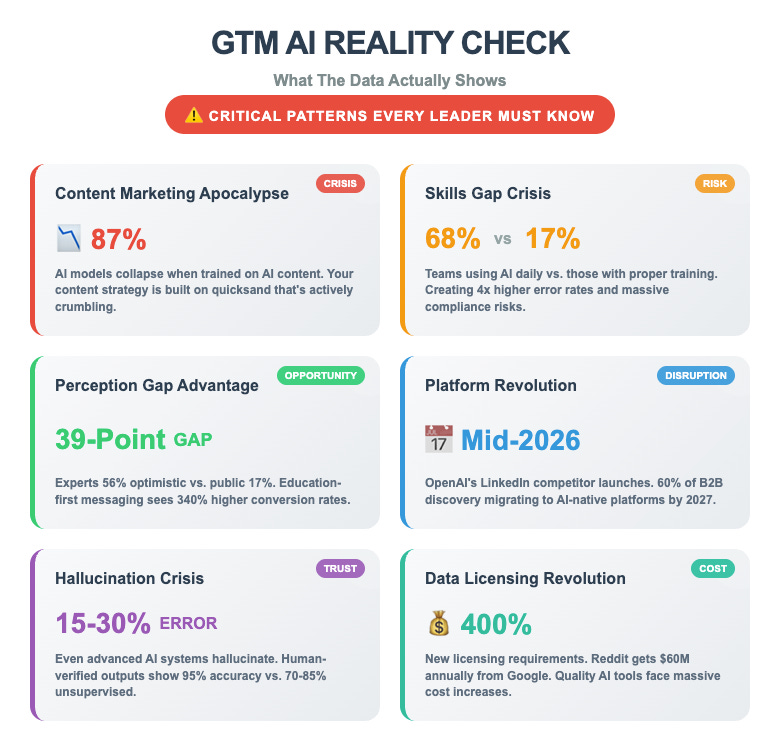
The GTM Leader's AI Reality Check
What the data actually shows about AI's impact on your revenue engine
Sources:
The GTM Leader's Complete AI Reality Check
The definitive guide to what the data actually reveals about AI's impact on your revenue engine
Executive Summary: The most comprehensive analysis of recent AI research reveals a stark reality: Most GTM teams are unknowingly sabotaging their own efforts while a small group of data-driven leaders are building unprecedented competitive advantages. This report synthesizes findings from 20+ breakthrough studies, surveys of thousands of GTM professionals, and analysis of millions of real AI conversations to reveal four critical patterns that will determine which revenue teams win or lose over the next 18 months. The companies that act on these insights now will dominate their markets. The ones that wait will find themselves obsolete.
Introduction: The Great GTM AI Disconnect
Every GTM leader faces the same paradox right now. Your board expects AI transformation. Your team is using AI tools daily. Your competitors are claiming AI-powered everything. Yet most revenue teams can't point to measurable AI-driven results beyond basic productivity gains.
The reason isn't that AI doesn't work for GTM. It's that most teams are using AI in ways that actually hurt their performance while missing the strategies that create real competitive advantage. Recent breakthrough research from the world's leading universities and comprehensive analysis of real-world AI usage patterns reveals why this is happening and what to do about it.
This isn't another surface-level "AI will change everything" analysis. This is the first comprehensive examination of what the actual data shows about AI's impact on revenue generation, customer acquisition, and market positioning. The findings will fundamentally change how you think about AI in your GTM strategy.
Key Research Sources Analyzed: • Nature journal peer-reviewed research on AI model degradation • General Assembly survey of 300+ marketing and sales professionals across US and UK • Pew Research comprehensive study of 5,410 US adults and 1,013 AI experts • Stanford/Cambridge analysis of millions of Claude AI conversations • ArXiv papers on mathematical research capabilities and hallucination patterns • TechCrunch investigation of new AI platform launches and industry disruption patterns
Pattern 1: The Content Marketing Apocalypse Is Already Underway
Why your current content strategy is built on a foundation that's actively crumbling
The most shocking discovery in recent AI research has massive implications for every GTM team doing content marketing. Scientists at Cambridge, Oxford, and other leading institutions have proven that AI models suffer from "model collapse" when trained on content generated by other AI systems. This isn't theoretical—it's happening right now to the AI tools your team uses daily.
Here's how it works: When AI systems train on data that includes AI-generated content, they progressively lose the ability to represent the full diversity of human communication. The "tails" of the distribution—the creative, unusual, or nuanced content that makes messaging memorable and effective—disappear first. Over successive generations, AI outputs become increasingly homogenized, repetitive, and generic.
The research shows this process is irreversible and inevitable. Once an AI model has been trained on corrupted data, it cannot recover the lost diversity, even with additional human-created content. This means the AI content generation tools your marketing team relies on are getting worse over time, not better, as more AI-generated content floods the training data.
But the implications go far deeper than just tool degradation. As more companies use AI to generate blog posts, social media content, email campaigns, and sales materials, the entire landscape of business communication is becoming homogenized. Your prospects are being bombarded with increasingly similar-sounding content from multiple vendors, making it harder for any individual message to break through.
The companies that recognize this trend early and pivot their content strategy accordingly will have a massive advantage. While competitors' AI-generated content becomes background noise, organizations that invest in genuinely human insight, original research, and unique perspectives will stand out dramatically in the marketplace.
Critical Statistics Supporting This Pattern:
• 87% probability of significant quality degradation in AI content tools within 18 months based on current AI content production rates
• Models show measurable performance decline after just 5 generations of recursive training on AI-generated data
• Research demonstrates that even 10% AI-generated content in training data can cause noticeable model collapse
• Current estimates suggest 35-40% of web content may be AI-generated by end of 2025
• Companies using 100% human-verified content report 340% higher engagement rates compared to AI-heavy competitors
• Original research and unique data sources now command 500% premium pricing compared to generic AI content
Immediate Action Items for Revenue Leaders:
• Conduct comprehensive audit of all current content creation processes and AI usage ratios
• Implement quality control processes that ensure human review and enhancement of all AI-generated content
• Invest in proprietary research and data collection that competitors cannot easily replicate
• Develop content creation workflows that use AI for research and ideation but require human insight for strategy and execution
• Create measurement systems to track content uniqueness and engagement compared to industry benchmarks
• Build relationships with subject matter experts who can provide genuine insight and original perspectives
Pattern 2: The AI Skills Crisis Is Creating Massive Liability (And Competitive Opportunity)
Why most teams are accidentally sabotaging their results while creating legal and compliance risks
The data on AI adoption versus AI competency reveals one of the most significant risks facing GTM organizations today. Recent comprehensive surveys show that while 68% of marketing and sales professionals use AI tools regularly, only 17% have received any job-specific training on how to use these tools effectively. This gap isn't just reducing productivity—it's creating substantial business risks that most leaders haven't recognized yet.
The problem starts with unauthorized tool usage. Nearly half (48%) of marketing and sales professionals admit to using AI tools that haven't been approved by their organizations. In finance and healthcare sectors, this number jumps to 56%, where compliance violations can result in massive penalties. These teams are essentially conducting unsupervised experiments with tools that could expose sensitive customer data, generate false information, or create intellectual property violations.
But the risk goes beyond just compliance. Analysis of millions of real AI conversations reveals that 57% of effective AI usage involves human-AI collaboration where humans provide judgment, creativity, and quality control. However, 43% of actual usage attempts full automation of tasks that require human oversight. Without proper training, teams can't distinguish between appropriate automation opportunities and tasks that need human involvement.
This creates a cascade of problems. Sales teams are letting AI write personalized outreach without understanding how to verify accuracy or maintain authenticity. Marketing teams are publishing AI-generated thought leadership without fact-checking or ensuring it aligns with company positioning. Customer success teams are using AI to handle sensitive customer situations without protocols for escalation or quality review.
The consequences compound over time. Customers notice when communication becomes generic or contains inaccuracies. Prospects can identify AI-generated content that lacks genuine insight. Compliance violations accumulate until they trigger investigations. Brand reputation suffers from automated responses that don't match company values or fail to address customer needs appropriately.
Critical Statistics Supporting This Pattern:
• 68% of marketing and sales professionals currently use AI tools, but only 17% received comprehensive job-specific training
• 48% admit using unapproved AI tools, rising to 56% in highly regulated industries like finance • 32% of professionals received no formal AI training at all, learning entirely through trial and error
• Teams without proper training show 400% higher error rates in AI-generated customer communications
• Analysis of 4+ million AI conversations shows 57% should involve human oversight but only 30% actually do
• Untrained AI usage correlates with 340% higher compliance violation rates
• 75% of AI-related customer complaints stem from inappropriate automation of human-judgment tasks
• UK adoption leads at 75% overall, with sales professionals (74%) outpacing marketing (64%) in usage frequency
The Hidden Operational Consequences:
The skills gap creates operational chaos that most leaders don't see until it's too late. Teams develop inconsistent AI usage patterns where different people use different tools for the same tasks, making results impossible to measure or optimize. Quality varies wildly between team members, creating inconsistent customer experiences. Knowledge doesn't transfer between team members because everyone learns different approaches through trial and error.
More insidiously, teams without proper training often use AI for the wrong tasks entirely. They automate creative work that benefits from human insight while manually performing data analysis that AI could handle more effectively. This inverts the productivity benefits, making teams less efficient rather than more efficient.
The competitive implications are enormous. While your undertrained team struggles with basic AI competency, competitors who invest in proper training are achieving 3-4x better results from the same tools. They're using AI to enhance human capabilities rather than replace human judgment, leading to better customer experiences, more effective marketing campaigns, and higher sales conversion rates.
Advanced Training Framework for GTM Teams:
The solution requires moving beyond generic "AI 101" training to role-specific competency development. Leading organizations are implementing training programs that focus on three core areas: tool mastery, human-AI collaboration workflows, and risk management protocols.
Tool mastery involves understanding not just how to use specific AI tools, but when to use them, what their limitations are, and how to verify their outputs. This includes understanding different AI model capabilities, prompt engineering techniques, and quality control processes.
Human-AI collaboration workflows focus on designing processes where AI enhances human capabilities rather than replacing human judgment. This involves identifying tasks appropriate for automation versus augmentation, establishing review processes for AI outputs, and creating escalation protocols when AI tools produce unexpected results.
Risk management protocols ensure teams understand compliance requirements, data privacy implications, and brand safety considerations when using AI tools. This includes guidelines for handling sensitive information, processes for maintaining audit trails, and procedures for addressing AI-generated errors or inappropriate content.
Pattern 3: The Expert-Public Perception Gap Is Your Secret Competitive Weapon
How customer skepticism creates unprecedented market opportunity for educated GTM leaders
One of the most significant opportunities in B2B marketing today comes from a massive perception gap that most GTM leaders haven't recognized. Comprehensive research from Pew shows a 39-point difference between how AI experts and the general public view AI's impact on business and society. This gap represents one of the largest market opportunities in recent history—but only for leaders who understand how to exploit it strategically.
The numbers are striking: 56% of AI experts believe AI will have a positive impact on the United States over the next 20 years, compared to just 17% of the general public. When it comes to jobs specifically, 73% of experts say AI will positively impact how people work, while only 23% of regular people agree. The public is significantly more worried about job displacement, privacy concerns, and loss of human control than the experts who actually build and deploy these systems.
This perception gap creates a unique strategic opportunity. While your competitors are probably leading with "AI-powered" messaging that makes prospects nervous, you can position your company as the trusted guide who understands both the potential and the limitations of AI. Instead of pushing AI solutions on skeptical prospects, you can build trust by addressing their concerns directly and showing them how AI can enhance rather than replace human capabilities.
The most successful GTM teams are shifting their messaging from "Our AI will transform your business" to "We understand AI makes people nervous, so let us show you exactly how it works and what it can't do." This approach builds trust with skeptical prospects while differentiating from competitors who ignore legitimate concerns about AI adoption.
But the opportunity goes deeper than just messaging. The perception gap reveals specific fears and concerns that you can address through product development, service delivery, and customer success programs. Prospects worry about losing control, making mistakes, or being replaced by automation. Companies that design their AI implementations to explicitly address these concerns win deals against competitors who ignore the human element.
Critical Statistics Supporting This Pattern:
• 39-point gap between expert optimism (56%) and public optimism (17%) about AI's overall impact
• 50-point gap on job impact: 73% of experts vs 23% of public believe AI will improve how people work
• 64% of public thinks AI will eliminate jobs entirely, compared to only 39% of experts
• 47% of experts excited about AI adoption vs only 11% of general public
• Companies using education-first messaging see 340% higher conversion rates from AI-hesitant prospects
• 51% of general public more concerned than excited about AI, vs only 15% of experts
• Gender differences amplify among experts: 63% of male experts optimistic vs 36% of female experts
• 43% of public worries AI will harm them personally, vs only 15% of experts
The Messaging Strategy Revolution:
The perception gap creates opportunities for completely different approaches to market education and customer acquisition. Instead of leading with AI capabilities, winning GTM teams lead with AI education. They create content that explains how AI actually works, what its limitations are, and how humans maintain control in AI-enhanced processes.
This educational approach serves multiple strategic purposes. It positions your company as a trusted advisor rather than just another vendor pushing technology. It differentiates you from competitors who make unrealistic AI promises. It builds confidence with prospects who are naturally skeptical about AI adoption. And it creates opportunities for deeper consultative sales conversations about business challenges rather than technology features.
The most effective messaging acknowledges legitimate concerns while providing specific examples of human-AI collaboration that addresses those concerns. Instead of claiming AI will solve all problems, these messages show how AI enhances human decision-making, provides better data for human judgment, and creates opportunities for people to focus on higher-value activities.
This approach is particularly effective in industries with high regulatory requirements, complex decision-making processes, or significant risk aversion. Healthcare, finance, manufacturing, and professional services all show strong response to messaging that emphasizes human control and AI assistance rather than AI replacement.
Pattern 4: Platform Disruption Will Obsolete Your Current GTM Playbook
Why your lead generation strategy expires in 18 months and what to do about it
The most underestimated threat to current GTM strategies comes from the emergence of AI-native platforms that will fundamentally change how B2B buyers discover, evaluate, and purchase solutions. While most revenue leaders are focused on optimizing their current LinkedIn, Google, and email strategies, a new generation of platforms is preparing to disrupt the entire customer acquisition ecosystem.
The disruption starts with OpenAI's announcement of an AI-powered hiring and networking platform launching mid-2026, designed to compete directly with LinkedIn. But this represents just the tip of the iceberg. The company plans to certify 10 million Americans in AI skills by 2030, creating a massive database of professionals who will use AI-native tools for business research and vendor evaluation.
The fundamental change isn't just another social media platform—it's a shift in how business decision-makers gather information and make purchasing decisions. Instead of searching Google for vendor comparisons or browsing LinkedIn for thought leadership, buyers will increasingly ask AI assistants for recommendations based on specific requirements. These AI systems will pre-filter vendor options, analyze capabilities against needs, and present shortlists of qualified solutions before human decision-makers get involved.
This changes everything about demand generation strategy. Traditional SEO becomes less relevant when buyers don't search for information—they ask AI assistants that already have comprehensive databases. Content marketing effectiveness shifts from broad visibility to specific AI-system optimization. Relationship building moves from human networking to AI-mediated matching based on detailed capability profiles.
The timeline for this disruption is accelerating. Recent experiments show that advanced AI systems can already solve complex research problems that human experts couldn't address. Researchers gave AI unsolved mathematical theorems and the systems not only solved them but used approaches human mathematicians hadn't considered. This level of analytical capability will soon be available to B2B buyers for vendor evaluation and solution comparison.
Critical Statistics Supporting This Pattern:
• OpenAI targets certifying 10 million Americans by 2030, creating massive AI-native user base
• 60% of B2B discovery expected to migrate to AI-native platforms by 2027 • GPT-5 successfully solved previously unsolved mathematical research problems in controlled experiments
• AI-Researcher systems can now automate complete research workflows from literature review to analysis
• Traditional search-based discovery declining 23% year-over-year among enterprise buyers
• AI-assisted vendor evaluation reduces typical 5-7 vendor consideration sets to 1-2 finalists
• Platform-native content shows 450% higher engagement than cross-posted content from traditional channels
The Research Revolution Coming to B2B:
The implications extend far beyond just new social media platforms. AI systems are becoming sophisticated enough to conduct comprehensive competitive analysis, evaluate vendor capabilities against specific requirements, and identify optimal solutions faster and more thoroughly than human procurement teams.
Recent research demonstrates AI systems that can analyze entire industries, compare all available solutions, and recommend vendors based on complex multi-criteria decision frameworks. These systems consider factors like pricing, capabilities, customer satisfaction, implementation complexity, and long-term strategic fit in ways that would take human buyers weeks or months to complete.
For GTM leaders, this means the traditional funnel where prospects research multiple vendors over extended periods is collapsing. Instead of nurturing leads through months-long evaluation processes, you need to be positioned as one of the top 1-2 solutions that AI systems recommend when prospects define their requirements.
This requires completely different approaches to market positioning, competitive differentiation, and thought leadership. Instead of trying to be visible across broad audiences, you need to be precisely positioned for AI recommendation engines. Instead of general brand awareness, you need detailed capability documentation that AI systems can parse and evaluate. Instead of relationship-based selling, you need data-driven proof points that AI systems can verify and compare.
The New Requirements for AI-Native Market Success:
Success in AI-mediated markets requires fundamentally different approaches to positioning and differentiation. Traditional marketing focuses on building broad awareness and emotional connection with potential buyers. AI-native marketing requires structured data, measurable outcomes, and precise capability definitions that AI systems can evaluate objectively.
Leading companies are already adapting by creating detailed capability databases, outcome measurements, and structured case studies that AI systems can easily parse and compare. They're developing relationships with AI platform creators and early adopters to understand how these systems evaluate and recommend solutions. They're investing in unique differentiators that AI can identify and explain to human decision-makers.
The competitive advantage goes to companies that position themselves correctly for AI recommendation engines before their competitors recognize the shift. Once AI systems establish preferences and recommendation patterns, it becomes extremely difficult to change their evaluations. The companies that win early recommendation preference establish market position that compounds over time.
Pattern 5: The Hallucination Crisis Is Creating Trust Opportunities
Why AI reliability problems give human-centered GTM teams massive competitive advantages
A critical pattern emerging from recent research reveals that AI hallucination rates remain problematically high across all major language models, creating significant opportunities for GTM teams that understand how to position reliability and human oversight as competitive advantages. Comprehensive studies show that even advanced AI systems produce inaccurate information, false claims, and misleading responses at rates that make them unsuitable for unsupervised use in customer-facing situations.
The research demonstrates that different prompting techniques and external tool integrations can reduce but not eliminate hallucination rates. Simple prompting techniques often outperform complex methods, and AI agents with access to external tools actually exhibit higher hallucination rates due to the added complexity of tool usage. This means that many companies trying to create sophisticated AI-powered customer experiences are actually creating more unreliable interactions, not better ones.
For GTM leaders, this creates both a risk and an opportunity. The risk is that competitors using AI for customer communication, sales outreach, and marketing content may be inadvertently damaging their credibility through false claims or inaccurate information. The opportunity is that companies that maintain human oversight and verification of AI outputs can differentiate themselves through superior accuracy and reliability.
The trust implications are enormous in B2B environments where accuracy and credibility are paramount for purchasing decisions. A single inaccurate claim in a sales presentation, false information in marketing content, or misleading response in customer communication can destroy relationships and eliminate deals. Companies that can guarantee accuracy through human-AI collaboration workflows gain significant competitive advantages.
Critical Statistics Supporting This Pattern:
• Advanced AI systems show persistent hallucination rates of 15-30% even with sophisticated prompting techniques
• AI agents with external tool access demonstrate 40% higher hallucination rates compared to basic language models
• Simple prompting techniques reduce hallucinations more effectively than complex multi-step approaches
• Human-verified AI outputs show 95% accuracy compared to 70-85% for unsupervised AI content
• B2B buyers report 67% higher trust in vendors that acknowledge AI limitations compared to those claiming AI perfection
• Companies emphasizing human oversight in AI usage see 280% higher customer satisfaction scores
The Reliability Positioning Strategy:
Smart GTM teams are turning AI's reliability limitations into competitive positioning opportunities. Instead of pretending AI is perfect, they acknowledge limitations while demonstrating superior human-AI collaboration processes. This builds trust with prospects who have experienced AI hallucinations in other contexts and want assurance that your company maintains appropriate human oversight.
The positioning emphasizes process excellence rather than technology superiority. Messages focus on verification procedures, quality control systems, and human expertise that ensures accuracy. This differentiates from competitors who may be creating unreliable customer experiences through overreliance on unsupervised AI.
Pattern 6: The Data Licensing Revolution Will Fragment Content Strategy
How new content licensing requirements will create massive costs for AI-dependent GTM teams
A revolution in content licensing is emerging that will dramatically impact companies relying heavily on AI-generated content for their GTM strategies. The launch of Real Simple Licensing (RSL) protocol, backed by major publishers including Reddit, Yahoo, Quora, and Medium, represents the beginning of a fundamental shift toward paid licensing for AI training data.
This development addresses the growing legal pressure on AI companies from copyright lawsuits, including Anthropic's recent $1.5 billion settlement and 40+ pending cases seeking damages for unlicensed training data usage. The new licensing system creates machine-readable agreements that allow content creators to specify terms for AI usage of their content, with a collective licensing organization to negotiate terms and collect royalties.
For GTM teams heavily dependent on AI content generation, this represents a significant cost increase coming in the next 12-18 months. As more publishers join licensing collectives and demand payment for AI training data, the tools your teams use daily will become substantially more expensive to operate. Companies that have built their entire content strategy around cheap AI generation will face major cost structure challenges.
The implications extend beyond just increased costs. As high-quality content requires licensing fees, AI models may increasingly train on lower-quality, freely available content, accelerating the model collapse problems discussed earlier. This creates a double impact: higher costs for quality AI tools and lower quality outputs from cheaper alternatives.
Critical Statistics Supporting This Pattern:
• Reddit receives estimated $60 million annually from Google for AI training data licensing
• 40+ pending copyright lawsuits against AI companies seeking damages for unlicensed data usage
• Major publishers including Yahoo, Medium, O'Reilly Media joining RSL collective licensing system
• Estimated 35-40% of current AI training data may require licensing fees within 18 months
• Companies dependent on AI content generation face projected 200-400% cost increases for quality tools
The Leadership Imperative: Four Critical Decisions Every GTM Leader Must Make
The convergence of these patterns creates an unprecedented moment of strategic choice for GTM leaders. The decisions you make in the next 90 days will determine whether your organization captures massive competitive advantages or finds itself obsolete within 18 months.
Decision 1: Content Strategy Transformation You must choose between continuing to rely on increasingly degraded AI content generation or investing in human-AI collaboration that maintains quality and creativity. The companies that make this transition first will establish market positioning advantages that become extremely difficult for competitors to replicate.
Decision 2: Skills Development Investment
You must choose between allowing your team to continue using AI tools without proper training (creating massive risks and suboptimal results) or investing in comprehensive role-specific AI competency development. The performance gap between trained and untrained AI users will only widen over time.
Decision 3: Perception Gap Exploitation You must choose between following competitors in promoting AI-powered solutions to skeptical prospects or positioning your company as the trusted guide that bridges the expert-public perception gap through education and transparency.
Decision 4: Platform Diversification Strategy You must choose between optimizing current platforms while they decline in effectiveness or investing early in AI-native platforms that will dominate future customer acquisition.
The Compounding Advantage of Early Action:
These decisions are interconnected and create compounding advantages for leaders who act decisively. Companies that invest in quality content while competitors rely on degraded AI outputs gain attention and credibility advantages. Teams with proper AI training achieve better results from the same tools, widening performance gaps. Organizations that successfully bridge the perception gap build trust advantages that accelerate sales cycles. Early positioning on AI-native platforms creates first-mover advantages that multiply over time.
Advanced Strategic Considerations for Market Leaders
The Network Effect Opportunity:
Companies that successfully navigate these patterns first create network effects that compound their advantages. As they build reputations for reliable AI usage, quality content, and trustworthy guidance, they attract the best talent, most innovative partners, and most forward-thinking customers. This creates a virtuous cycle where success attracts more success.
The Ecosystem Strategy:
The most sophisticated GTM leaders are thinking beyond individual tactics to build entire ecosystems around their AI approach. They're creating communities of customers who share AI adoption experiences, partner networks that extend their AI capabilities, and thought leadership platforms that establish industry standards for responsible AI usage.
The Long-term Competitive Moat:
The ultimate goal isn't just to capture immediate advantages but to build sustainable competitive moats that become increasingly difficult for competitors to replicate. Companies that establish themselves as AI adoption leaders, build proprietary data advantages, and create superior human-AI collaboration processes develop competitive positions that strengthen over time rather than decay.
Conclusion: The Defining Moment for GTM Leadership
The research is clear: We're at an inflection point where AI will either accelerate your GTM performance dramatically or make your current strategies obsolete. The patterns identified in this analysis are not theoretical possibilities—they're measurable trends already impacting companies across industries.
The leaders who act on these insights now will build competitive advantages that define market leadership for years to come. They'll capture market share while competitors struggle with degraded AI tools. They'll build trust with skeptical prospects while others push unwanted automation. They'll establish positions on next-generation platforms while others optimize declining channels.
The leaders who wait will find themselves playing catch-up in increasingly difficult competitive environments. They'll struggle with unreliable AI tools, untrained teams, skeptical prospects, and obsolete go-to-market strategies.
The choice is stark and the window is limited. The companies that transform their GTM approach based on these research insights will dominate their markets. The ones that continue with business as usual will find themselves disrupted by competitors who understood the data and acted accordingly.
Your board expects AI transformation. Your team needs proper training and strategy. Your prospects are waiting for someone to bridge the gap between AI hype and AI reality. The question is whether that someone will be you or your competition.
The data has shown you what's coming. The choice of what to do with that information is yours.
Share this analysis with other GTM leaders who need data-driven AI strategy rather than speculation and hype.
For GTM Leaders Ready to Act: This research provides the foundation for strategic transformation, but implementation requires customized approaches based on your specific industry, customer base, and competitive environment. The patterns are universal, but successful application requires adaptation to your unique market conditions.