

Article 4
Every Salesforce AE I’ve talked to in the last year says the same thing when you ask about competitive threats: HubSpot. Not one of them has said AI.
They should be looking over the other shoulder. Because what’s coming for CRM doesn’t even have a sales team yet.
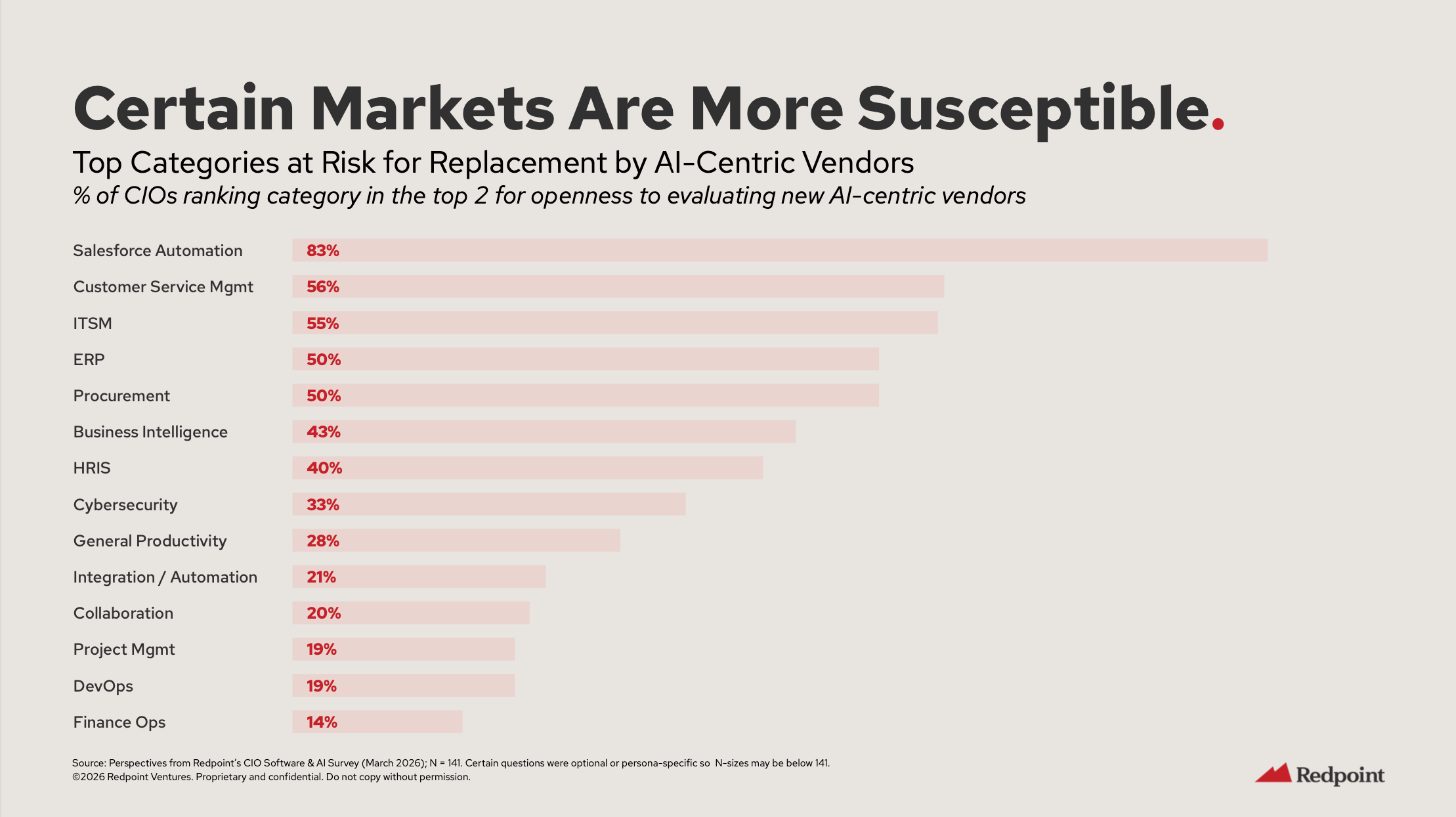
Redpoint surveyed CIOs across the Fortune 500 and mid-market on which software categories they’d be most open to replacing with AI-centric vendors. The results, ranked:
Salesforce Automation: 83%.
Not 83% who are mildly curious. Eighty-three percent who ranked CRM in their top two categories most open to AI-native replacement. Customer service management came in second at 56%. ITSM third at 55%. ERP and procurement tied at 50%.
CRM isn’t just the most vulnerable category. It’s 27 points more vulnerable than the second-place category. That’s not a gap -- it’s a canyon.
The Two Numbers That Tell the Whole Story
Two numbers. The tension between them is the entire strategic picture.
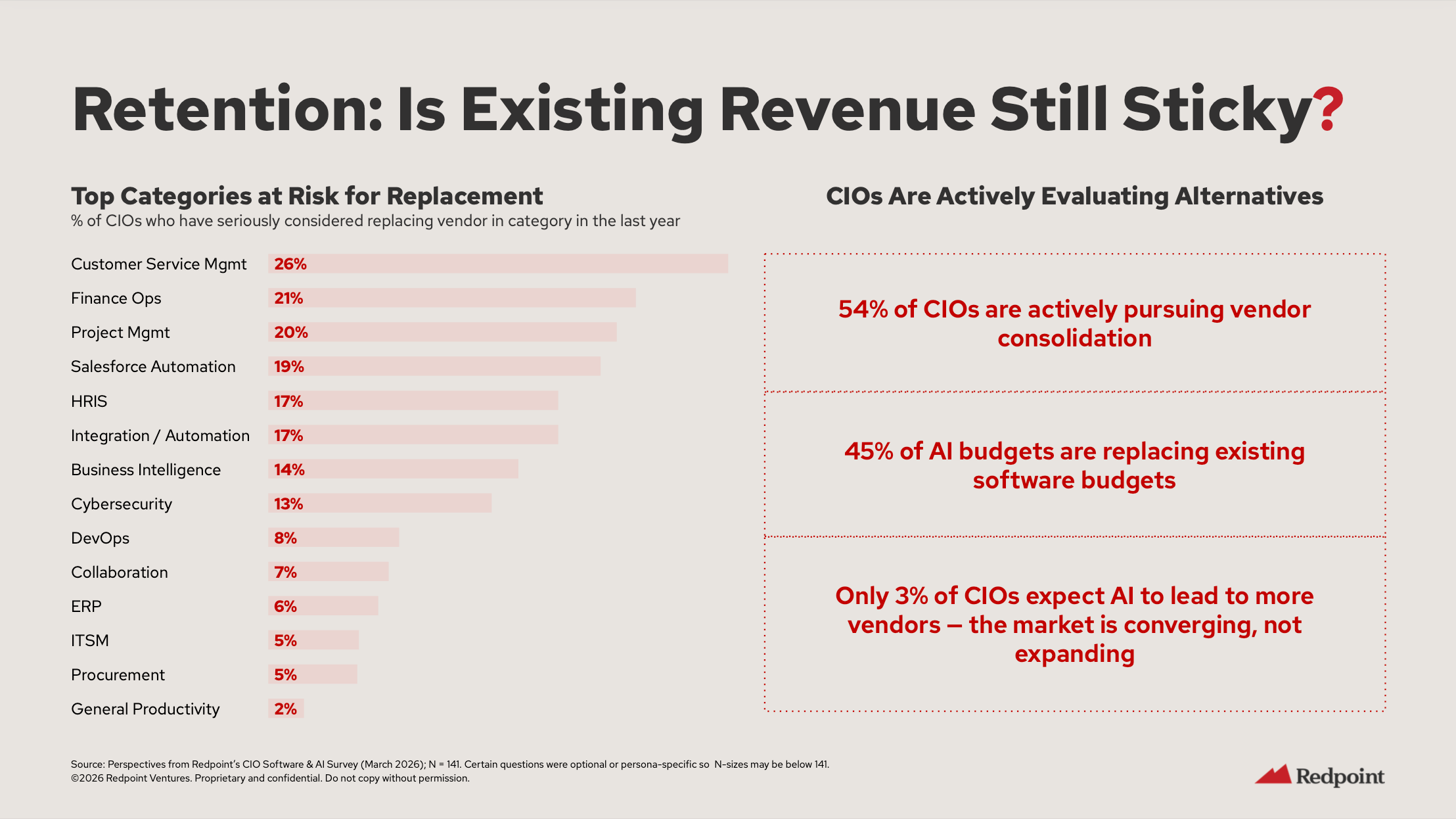
Number one: 19% of CIOs have seriously considered replacing their CRM in the last twelve months. That’s the action metric. One in five enterprise buyers has already done the work -- evaluated alternatives, run cost analyses, maybe even started a POC.
Number two: 83% are open to AI-centric CRM alternatives. That’s the intent metric. Five in six would switch if the right product showed up.
The gap between 19% and 83% is 64 percentage points. That gap is the most important number in enterprise software right now.
Think of it like housing. Nineteen percent of homeowners are actively listing their house. Eighty-three percent would sell at the right price. The market hasn’t moved yet. But here’s the twist the housing metaphor misses: in real estate, sellers wait for the right price. In software, sellers wait for the right replacement. And unlike houses, software replacements get better every quarter.
The 83% aren’t waiting for motivation. They’re waiting for a product good enough to justify the migration pain -- something that makes a rep’s morning pipeline review feel like talking to a colleague instead of clicking through 14 Salesforce tabs. That product is getting built right now.
What’s the catalyst? I think it’s already happened: it’s the public failure of Agentforce.
Agentforce and the Credibility Collapse
Salesforce bet big on Agentforce as the answer to the AI-native threat. Agents inside the CRM. Autonomous workflows. The pitch was: you don’t need to replace Salesforce, because Salesforce is becoming AI-native.
The market’s response has been more damaging than any competitor could have engineered.
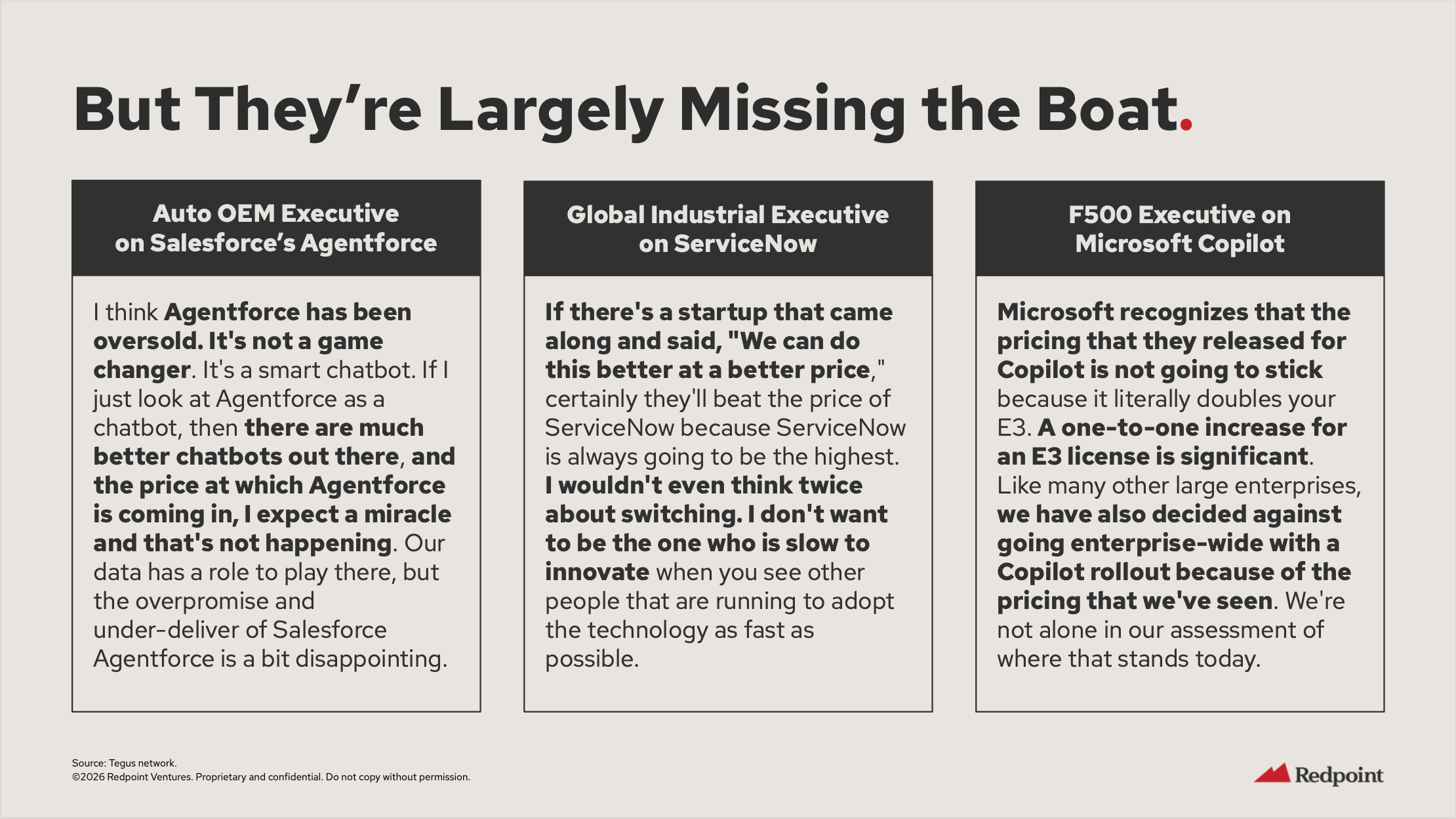
That auto OEM executive again: “Agentforce has been oversold. It’s not a game changer. It’s a smart chatbot. If I just look at Agentforce as a chatbot, then there are much better chatbots out there, and the price at which Agentforce is coming in, I expect a miracle.”
This isn’t a random critic. This is a buyer who wanted it to work. Who probably championed the Salesforce relationship internally. Who went to Dreamforce and got excited about the demo. And then deployed it and found a chatbot.
The pattern across all three mega-vendors is identical. ServiceNow: “I wouldn’t even think twice about switching” if a startup offered better at a better price. Microsoft Copilot: pricing “is not going to stick” because it “literally doubles your E3.”
Every major platform tried the same play -- bolt AI onto the existing product and charge more. Every major platform is hearing the same thing back: not good enough, too expensive, feels like a tax on our existing contract.
This is the credibility collapse. The incumbents had one shot to prove that AI-native meant “we evolved” rather than “we added a feature.” They missed. And now that 83% open-to-replacement number has a tailwind of disappointment behind it.
The Salesforce Moat -- What It Actually Is
The bearish case is easy. The nuance matters more.
Salesforce’s moat was never the product. The CRM itself -- contacts, opportunities, pipeline views -- is a database with a UI. It’s been replicable for a decade. HubSpot proved that. What made Salesforce untouchable wasn’t the software. It was three things:
Data gravity. Twenty years of customer interaction data sitting in Salesforce orgs. Every call logged, every email tracked, every deal stage recorded. Migrating that data isn’t just a technical project -- it’s a political one. Sales leaders built their reporting on Salesforce. CFOs built their forecasting models on Salesforce data. Ripping it out means rebuilding institutional knowledge.
The admin ecosystem. There are over 200,000 certified Salesforce administrators. These people built careers on Salesforce expertise. They influence buying decisions. They resist platform changes because platform changes threaten their livelihoods. It’s not a conspiracy -- it’s rational self-interest at scale.
The AppExchange. Thousands of ISV integrations. CRM isn’t a standalone product -- it’s a platform wired into every other system. Replacing Salesforce means replacing or rebuilding every integration point.
That’s a real moat. It’s held for twenty years. The question is whether AI dissolves it. I think the answer is yes.
