

Everyone welcome back! Well, er, I mean I’m welcoming myself back.
July was a lot. We changed homes, I traveled a ton, enjoyed a couple family reunions, and I’m just now getting the podcast back on track. Huge thank you for the patience and the kindness while I got my feet back under me. Truly means a lot.
And I wanted to come back with a bang.
This week’s guest is Eddie Reynolds, founder of Union Square Consulting and host of the Go-To-Market Science podcast. I’ve genuinely followed this guy for years. I fully fanboyed the first time we talked, and it turns out he’s one of the coolest dudes on the planet who also isn’t afraid to speak his mind. My kind of peeps.
So we got into it. Specifically on his GTM Efficiency Pyramid, which is one of those frameworks that sounds simple and then quietly rearranges how you think about your whole revenue engine. After the podcast review, I tear apart the pyramid and do my best to guide you through the pyramid and examples of how to apply it, but please note, Eddie is the master, so if you need help applying it, go hit him up.
Some of my favorite quotes from Eddie:
1. The whole thesis with the wrong question (~33:52)
“I don’t think the question should be ‘what should we do with AI?’ The question should be ‘what should we do to improve our go-to-market so that we can hit our number and consistently perform?’ If the answer happens to be AI, then that’s great. It’s the difference between trying to figure out how to architect a house and grabbing a hammer and looking for nails.”
2. The pipeline truth test (~13:19)
“How many deals do you have in your pipeline right now that are more than 2X your average sales cycle? So let’s say it takes 60 days to close a deal. How many deals do you have that are 121, 125, 150 days old? Because I can tell you right now, those deals are never going to close. Ever.”
3. AI is not a magic button (~17:25)
“You’re not gonna just get this magical result from a tool like Momentum if you haven’t thought through who your ICP and your buyer personas are, what your sales methodology is, what things you should be looking for in these call transcripts.”
4. Focus is the number one thing missing (~25:12)
“We’re targeting 14 different industries, we’ve got 10 different products, we’ve got 50 different geos. And it’s like, how many sales reps do you have? About that many. I don’t know how you get good at all of those things. You can’t perfect 50 different things at once.”
5. The spicy one on adoption (~28:46)
“There’s a really simple way to get people to use Salesforce. Fire everybody that doesn’t use Salesforce. It’s super effective. Now, if you’ve given them a dumpster fire and then you’re threatening to fire them for not using it, that’s on you. But if you’ve done all the right things and built everything out, this is how we do business.”
Here are the top 5 take aways that are inspired from Eddie:
1. You’re probably asking the wrong question about AI
Eddie said something early that I have been saying as well for years, but it was so nice to hear someone else say it.
Most leaders walk in asking “what should we do with AI?” And he flat out told me that’s the wrong question. It’s like grabbing a hammer and then wandering around looking for nails.
The better question is “what do we need to fix in our go-to-market so we can hit our number and actually hold it?” Sometimes the answer is AI. A lot of the time it’s a tighter process or a better manager.
For example, if you double the time your reps spend selling but your close rate is 5%, you didn’t win anything. You just made the leak bigger. Start with the number you’re trying to move. Then work backward to the tool. Never the other way around.
2. The GTM Efficiency Pyramid
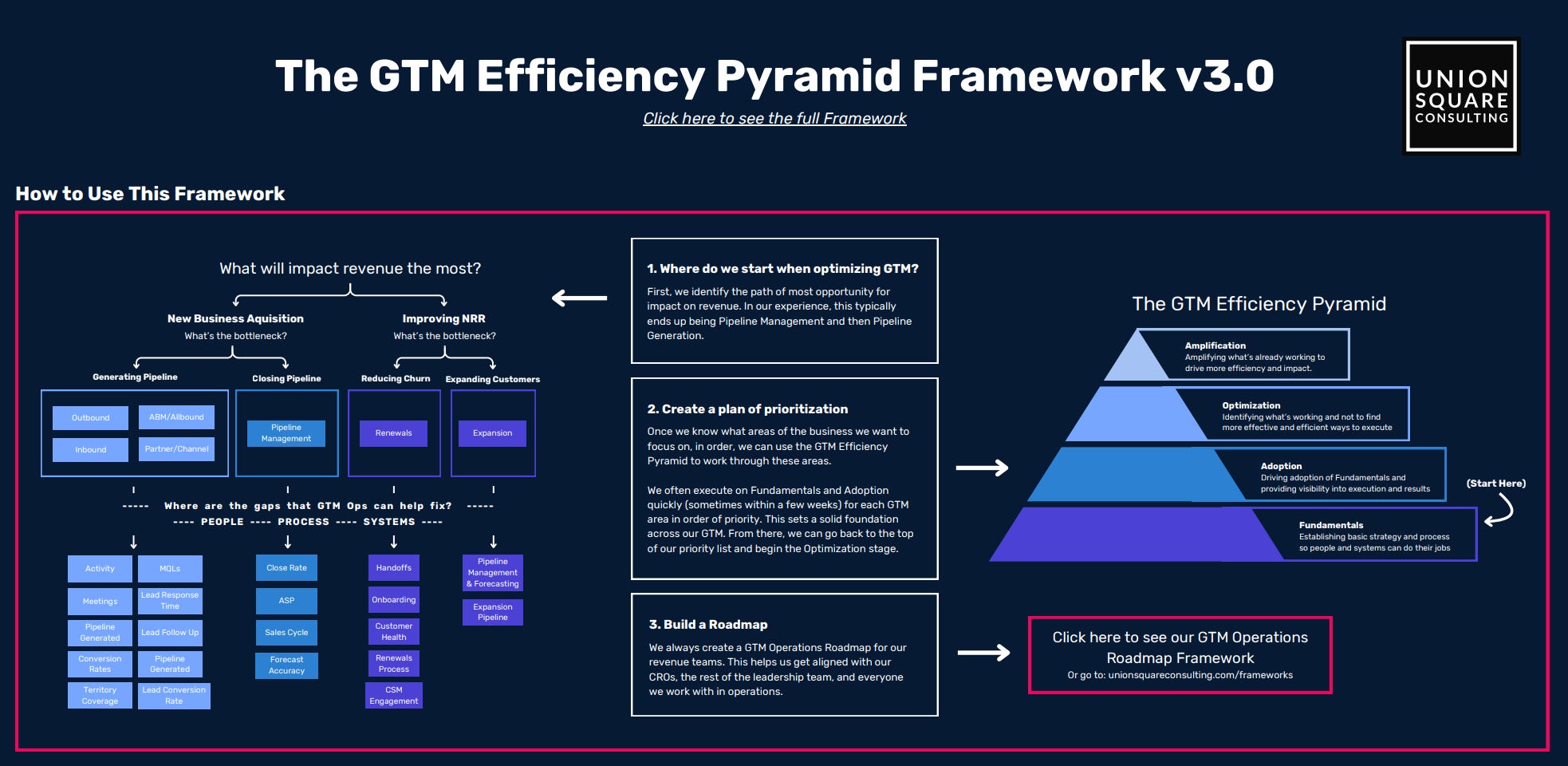
This is the model Eddie has rebuilt for years, and I love that it doubles as an order of operations. Four layers, bottom to top:
Fundamentals: ICP, buyer personas, a documented process for each motion (outbound, inbound, expansion, pipeline), plus the tools and data to run it.
Adoption: getting the whole team to actually do the thing, every time. He says this is the hardest layer, and honestly, he’s right.
Optimization: now your data is clean and you can trust it, so you can finally see what’s working.
Acceleration: where AI amplifies what already works. This is the top of the pyramid, not the bottom.
He said fundamentals plus adoption alone would transform most orgs, and he could’ve ended the podcast right there. AI belongs at the top. You just can’t stand at the top until you’ve built the bottom.
3. The pipeline truth test
Ask yourself: how many deals in my pipeline are older than 2x my average sales cycle? If it takes you 60 days to close and you’ve got deals sitting at 121, 130, 150 days, Eddie’s verdict is brutal and correct. Those deals are never closing. They’re just inflating your number and lying to your forecast.
And here’s the move most teams get backward. Fix the pipeline you have before you go generate more. If you don’t trust a single dollar of your current pipeline, adding $30M more on top of it doesn’t mean anything. Close more of what you’ve already got first.
4. The capacity math nobody actually runs
Do the arithmetic with me. Activities a rep can do per day, times touches per contact, divided across contacts per account. It almost always lands around 200 accounts a year per rep. Eddie calls it the magic number.
Now hand that rep a list of 2,000 accounts and watch what happens. They either call 200 at random and miss 90% of your best ones, or they burn hours in a spreadsheet scoring accounts, which is not what you hired them to do and not what they’re good at.
The fix is focus, and it’s the number one thing he sees missing. Fourteen industries, ten products, fifty geos, a dozen reps. You cannot get good at fifty things at once. Pick the accounts that matter and go deep.
5. Adoption is the real moat, not the tool
Eddie watched about 300 companies during his time at Salesforce, and roughly half of them never actually used the thing they were paying for.
The difference wasn’t budget. It wasn’t the product. It was a leader who said “we are going to make this work” and did the unsexy foundational work to make it easy, versus a leader who delegated it and forgot about it.
AI is no different, friends. A rep who spends 300 hours vibe-coding their own coaching agent, when a tool would’ve done it, is 300 hours not selling. The teams winning with AI aren’t the ones with the most agents. They’re the ones who built the foundation and then focused everything on one outcome until it worked.
So what do you do with all this?
Before Friday, try three things:
Run the pipeline truth test. Pull every deal older than 2x your sales cycle and be honest about which ones are already dead.
Do the capacity math for one rep. Compare their real number to the list you actually handed them.
Pick the one number you’re trying to move this quarter, and ask “what has to change to move it?” before anyone says the word AI.
Grab Eddie’s frameworks at unionsquareconsulting.com/frameworks, and go listen to the full episode. Trust me, it’s a good one.
The tool was never the problem. It’s the humans, the process, the foundation. Build that, then AI-power it. That’s the whole game.
See you next week
GTM EFFICIENCY PYRAMID
A practical, board-by-board guide for GTM leaders
Framework by Eddie Reynolds, Founder & CEO of Union Square Consulting. Full framework and high-res PDF at unionsquareconsulting.com/frameworks.
There are three boards in this framework, and each one has a different job.
The first tells you where to start and how to prioritize. The second and third show you how the exact same four-stage ladder plays out inside every specific GTM motion. Once you see that the ladder never changes, the whole thing gets simple.
For each board below you’ll get: what it’s really for, how to apply it step by step, and an example scenario so you can picture it in your own org.
A quick, honest note on the scenarios: every example below is an illustrative walkthrough, a made-up company with realistic numbers, built to help you conceptualize how the framework gets used. They’re not real client case studies. Think of them as “here’s what this could look like on a Tuesday.”
BOARD 1 — The Master Framework: How to Use It
What it’s for. Every revenue team we meet has 100 things it could improve, from visibility gaps to pipeline struggles, lost deals, churn, missed expansion, and now AI everywhere. That makes anyone’s head spin. This board stops the spin. It helps you find the one gap where improvement moves revenue the most, sequence the work with the four-stage pyramid, and turn it into a roadmap everyone agrees on.
How to apply it, step by step.
Start at the top of the tree: “What will impact revenue the most?” Pick a branch. New Business Acquisition, or Improving NRR.
Find the bottleneck under that branch. New business splits into Generating Pipeline vs. Closing Pipeline. NRR splits into Reducing Churn vs. Expanding Customers.
Quantify the prize. Ask the big question: if we went from where we are today to where we could realistically get, how much would that add to revenue? At 80% NRR on $100M ARR, getting to 100% is +$20M. If you expect $30M in new business, would fixing the process get you to $51M instead? Whichever number is biggest points you to your gap.
Locate the gap across People, Process, and Systems using the metrics under each area (close rate, sales cycle, forecast accuracy, lead response time, customer health, and so on).
Apply the pyramid to that area: Fundamentals → Adoption → Optimization → Amplification. Start at the bottom. Always.
Sequence it with the three steps. Start where impact is highest (in our experience, usually Pipeline Management, then Pipeline Generation). Knock out Fundamentals and Adoption fast, then loop back up the priority list to Optimization.
Build a GTM Operations Roadmap so your CRO, leadership, and everyone in ops align on the order.
The rule of thumb that makes this work: Fundamentals and Adoption can be put in place in weeks. Optimization and Amplification are never truly “done.” So get the base of several motions solid fast, before you chase perfection anywhere.
Here’s an example scenario of how this plays out.
A $50M ARR SaaS CRO says, “We need more pipeline.” That’s the instinct. But run the tree: the branch is New Business, and the reflex answer is “Generating Pipeline.” When we look at the metrics, though, the close rate is 18%, the forecast misses every quarter, and the pipeline is full of deals sitting at 140 days when the sales cycle is only 60. The real bottleneck isn’t generation. It’s Closing Pipeline.
Now quantify the prize. Adding raw top-of-funnel to a pipeline you can’t close is worth almost nothing. Lifting the close rate from 18% to 24% on the pipeline you already have is worth real money. So the decision is made for you: attack Pipeline Management first, apply the pyramid there, and put it on the roadmap as priority #1. Outbound improvements become #2.
One board just turned “100 things to fix” into a sequenced plan the whole leadership team can get behind.
Pipeline Generation (Outbound, Inbound, ABM/Allbound, Partner/Channel)
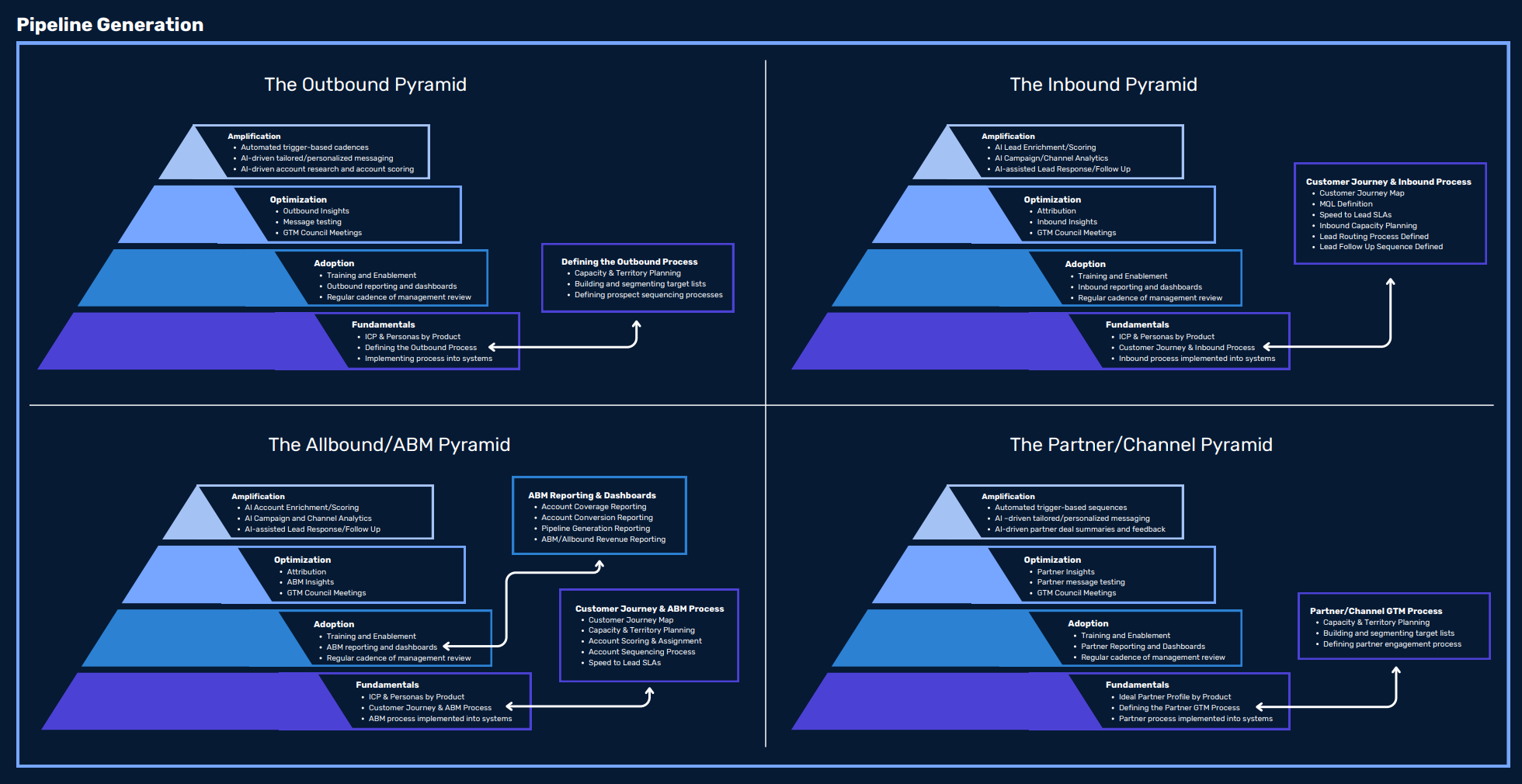
The big idea for this whole board: every motion climbs the exact same ladder. Fundamentals → Adoption → Optimization → Amplification. What changes from motion to motion is only the specific fundamentals at the base. Nail those, and the rest of the climb is the same shape every time.
The Outbound Pyramid
How to apply it.
Fundamentals: Define WHO (ICP and personas by product) and the step-by-step process to convert targets into meetings and pipeline. That means Capacity and Territory Planning (a rep can only truly work so many accounts, and it usually lands around 200 a year), building and segmenting target lists so a rep works one buyer with one message at a time, and defining the sequencing process (how many calls, emails, and LinkedIn touches, and in what order). Then implement it into the system.
Adoption: Train the team, build outbound reporting and dashboards, and run a regular cadence of management review so the sequence actually gets completed, instead of “we reached out twice and gave up.”
Optimization: Analyze outbound insights, test messaging, and bring findings to a GTM Council Meeting.
Amplification: Now, and only now, add automated trigger-based cadences, AI-personalized messaging, and AI-driven account research and scoring.
Here’s an example scenario. A team hands each SDR a list of 2,000 accounts and wonders why results are random. Applying the base first: they do the capacity math and cut the list to the right 200 accounts per rep, segment by persona, and define a clear 5-call, 5-email, 5-LinkedIn sequence. Adoption: a weekly review confirms the sequences are actually being completed. Only after that do they turn on AI to personalize the first-touch email at scale. The AI amplifies a focused motion instead of spraying 2,000 bad-fit accounts faster.
The Inbound Pyramid
How to apply it.
Fundamentals: Define which leads should go to sales (a real MQL definition), the customer journey, Speed-to-Lead SLAs, inbound capacity planning, a defined lead-routing process, and a defined follow-up sequence. Implement it into systems.
Adoption: Train, build dashboards, and inspect that hot leads get worked fully. The classic failure is a hand-raiser getting two touches and then silence.
Optimization: Attribution, inbound insights, GTM Council Meetings.
Amplification: AI lead enrichment and scoring, AI campaign and channel analytics, AI-assisted lead response and follow-up.
Here’s an example scenario. Marketing floods the funnel with MQLs, but sales ignores them because half are junk. Applying the base: they redefine what actually counts as an MQL, set a 5-minute Speed-to-Lead SLA, and define the follow-up sequence. The adoption cadence enforces it. Only then do they add AI to enrich and score inbound leads so reps hit the hottest ones first. Conversion climbs, because the process got fixed before the AI went on top.
The ABM/Allbound Pyramid
How to apply it.
This one requires mastering both inbound and outbound and making them work together seamlessly. Fundamentals: ICP and personas, customer journey, capacity and territory planning, an account-scoring model to decide which accounts to target, an account-sequencing process, and Speed-to-Lead SLAs. Because it’s more complex, it also needs more robust reporting: account coverage, account conversion, pipeline generation, and ABM/allbound revenue.
Adoption, Optimization, Amplification follow the same pattern, with more data to analyze and more surface area to amplify because the motion is richer.
Here’s an example scenario. A team says they “do ABM,” but there’s no account scoring, so reps chase whatever logos look exciting. Applying the base: they build an account-scoring model, lock a focused target-account list, define how marketing and sales tag-team each account, and stand up account-coverage reporting. Adoption ensures every target account is actually being covered. Then AI account enrichment and campaign analytics amplify a coordinated motion instead of a scattered one.
The Partner/Channel Pyramid
How to apply it.
Fundamentals: Define the Ideal Partner Profile by product, the process to turn a prospect partner into an active partner, and the process to build and nurture that relationship into ongoing deal flow. Capacity and territory planning, segmented partner lists, and a defined partner engagement process. Implement into systems.
Adoption, Optimization, Amplification: same ladder. Amplify last with automated sequences, AI partner deal summaries, and feedback.
Here’s an example scenario. A channel team signs plenty of partners, but most never source a single deal. Applying the base: they define the Ideal Partner Profile, a clear recruit-to-activation process, and a nurture cadence. The adoption review tracks deal flow per partner. Then AI summarizes partner deals and surfaces which relationships are worth doubling down on, so the team stops spreading itself thin.
Pipeline Management & Customer Success (Renewals + Expansion)
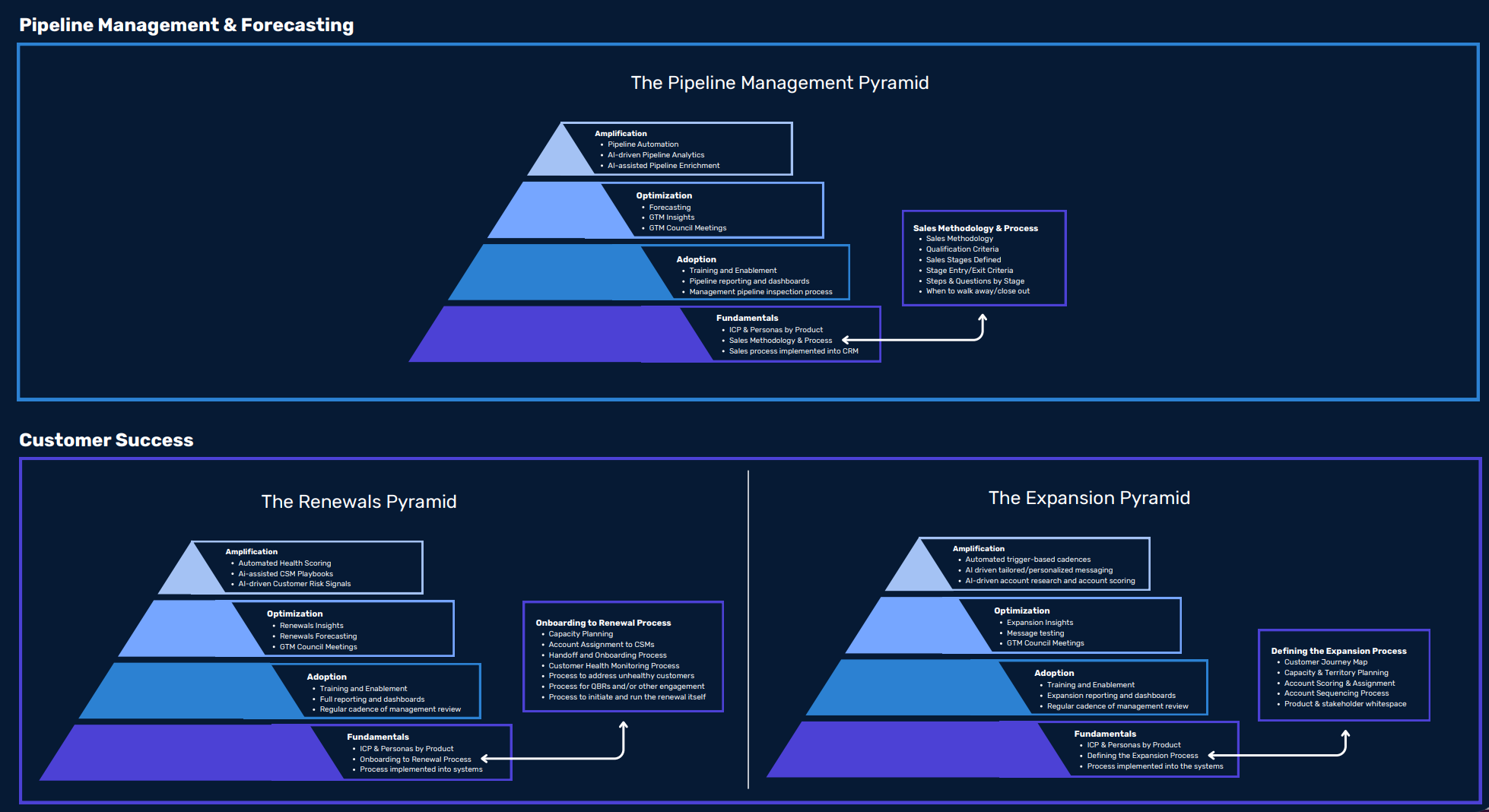
The Pipeline Management Pyramid
What it’s for. Good pipeline management means your reps run the right steps to win the deals they can win, stop wasting precious selling time chasing deals they can’t, and management has the visibility to forecast accurately.
How to apply it.
Fundamentals: ICP and personas, then pick a Sales Methodology you like (for example, MEDDIC) and translate it into a real, stage-by-stage, step-by-step process: qualification criteria, sales stages defined, stage entry and exit criteria, the steps and questions required at each stage, and a clear rule for when to walk away or close a deal out. Implement it into the CRM.
Adoption: Train the team, build pipeline reporting and dashboards, and run a management pipeline inspection cadence. This is where you enforce the exit criteria and clear the dead deals. Anything older than 2x your average sales cycle is almost certainly never closing.
Optimization: Forecasting, GTM insights, GTM Council Meetings.
Amplification: Pipeline automation, AI-driven pipeline analytics, and AI-assisted enrichment, like AI reading call transcripts to update exit criteria in the CRM.
Here’s an example scenario. A $50M team’s forecast misses every single quarter. Applying the base: they translate MEDDIC into defined stages with entry and exit criteria and a walk-away rule, then build it into the CRM. Adoption: a weekly inspection pulls every deal older than 2x the 60-day cycle out of the forecast. The pipeline shrinks from a fantasy $30M to a real $19M, and forecast accuracy jumps within a quarter. Then, and only then, AI updates exit criteria from call transcripts and flags deals going quiet. The AI amplifies a clean pipeline instead of a fantasy one.
The Renewals Pyramid
What it’s for. Maximizing renewal rates. The key truth: most renewals are won or lost long before the renewal process ever begins at the end of the contract.
How to apply it.
Fundamentals: ICP and personas, plus the full onboarding-to-renewal process: capacity planning (enough of the right CSMs to execute), account assignment to CSMs, a handoff and onboarding process, a customer health monitoring process, a process to address unhealthy customers, a QBR/engagement cadence, and the process to initiate and run the renewal itself. Implement into systems.
Adoption: Train, build full reporting and dashboards, run a regular cadence of management review.
Optimization: Renewals insights, renewals forecasting, GTM Council Meetings.
Amplification: Automated health scoring, AI-assisted CSM playbooks, AI-driven customer risk signals.
Here’s an example scenario. A CS team scrambles at contract end and keeps getting blindsided by churn. Applying the base: they capacity-plan the CSM load, define the health-monitoring process, define the exact play to run the moment an account goes yellow, and set a QBR cadence. The adoption review catches at-risk accounts months early instead of days late. Then AI health-scoring and risk signals amplify a proactive motion, catching churn while it’s still fixable.
The Expansion Pyramid
What it’s for. Generating and closing expansion pipeline. You manage and forecast it using the Pipeline Management pyramid above; you generate it much like Outbound or ABM.
How to apply it.
Fundamentals: Define the expansion process. A customer journey map so you understand when and how customers become likely to expand, capacity and territory planning, account scoring and assignment, an account-sequencing process, and product and stakeholder whitespace mapping (which accounts aren’t using certain products, and where you haven’t yet engaged key stakeholders). Implement into systems.
Adoption, Optimization, Amplification: the same ladder as every other motion.
Here’s an example scenario. An org leaves expansion entirely to chance and hopes CSMs stumble into upsells. Applying the base: they map the whitespace (which accounts don’t use product X, where key buyers aren’t engaged), score and assign expansion targets to the right reps, and define the sequence to work them. The adoption review tracks expansion pipeline like any other pipeline. Then AI account research and personalized messaging amplify a deliberate expansion engine instead of a lucky accident.
The One Rule That Ties Every Board Together
AI and automation sit at the very top of every single pyramid, and they are a sharp, double-edged sword.
Layer an AI agent on top of a clean, adopted process and it amplifies what’s working. You could quickly see more pipeline, more deals won, better retention, more expansion. Layer that same agent on top of a broken process and it amplifies the mess just as fast. You could quickly see your domain tarnished, your best prospects blocking your emails, and your best customers churning.
That’s why AI is always last. Build the right foundation first. Then amplify it.
Where to Start (the quick-start)
Ask where the biggest gap is: new business or NRR, generating or closing, churn or expansion. Then quantify the prize.
It’s usually Pipeline Management. There’s no point generating more pipeline just to lose it in the sales process. Get closing in order first.
Get Fundamentals and Adoption in place fast, in weeks, across a couple of motions, before you chase Optimization anywhere.
Build a roadmap so leadership aligns on the order.
Reading about it is great. Doing it is better.
Eddie's pyramid puts adoption exactly where most transformation programs refuse to look. I have written before that AI is not only a technology transformation but a behavior transformation, and the pyramid makes the sequencing consequence clear: the layer that cannot be bought has to come before the layer everyone wants to buy. The 300-company observation matches what I see in luxury and retail as well. Half the value of any system sits in whether the team runs the same process every week, and that is a management product, not a software product. AI at the top of the pyramid works like a tax on honesty below it. Amplification only ever multiplies what is actually there.