

This is sponsored by the AI Business Network and GTM AI Academy
As per usual, so many things have happened this week and we break it down in this weeks newsletter so you can easily consume it all, or you can listen to the AI podcast version here:
Also had the breakdown of this newsletter in a visual deck format you can access he
My goal as always is to cut through the noise and give you some valuable content and read things so you do not have to.
This is a longer one because I deep dive into the battle of the AI Agents with my analysis of ChatGPT Agent, Gemini Agentspace, Manus, and Genspark, so buckle up!
Get into the podcast:
You can go to Youtube, Apple, Spotify as well as a whole other host of locations to hear the podcast or see the video interview.
Liza Adams https://www.linkedin.com/in/lizaadams/
Liza is someone I highly admire, we speak all the time and could not wait to have her on the podcast to bask in her brilliance.
Our Journeys in Marketing and AI
Liza's story from the Philippines to becoming an influential marketing leader is inspiring. Having spent a significant part of her career in Silicon Valley, she learned to balance the fast-paced tech world with a grounded appreciation of nature. Her transition from an engineer to a marketing strategist highlights the importance of storytelling in capturing hearts and minds.
AI as a Thought Partner in Marketing
One of the primary themes of our conversation was how AI can be more than just a tool for creating content. Liza emphasized the potential of AI to flip the script in marketing by using it as a thought partner for ideation, automation, personalization, and gaining market insights. The key is seeing AI as a teammate and assistant rather than just a tool or a threat to jobs. With the right mindset shift, AI can help augment human capabilities, achieving more with the same human resources.
Building a Human-AI Collaborative Model
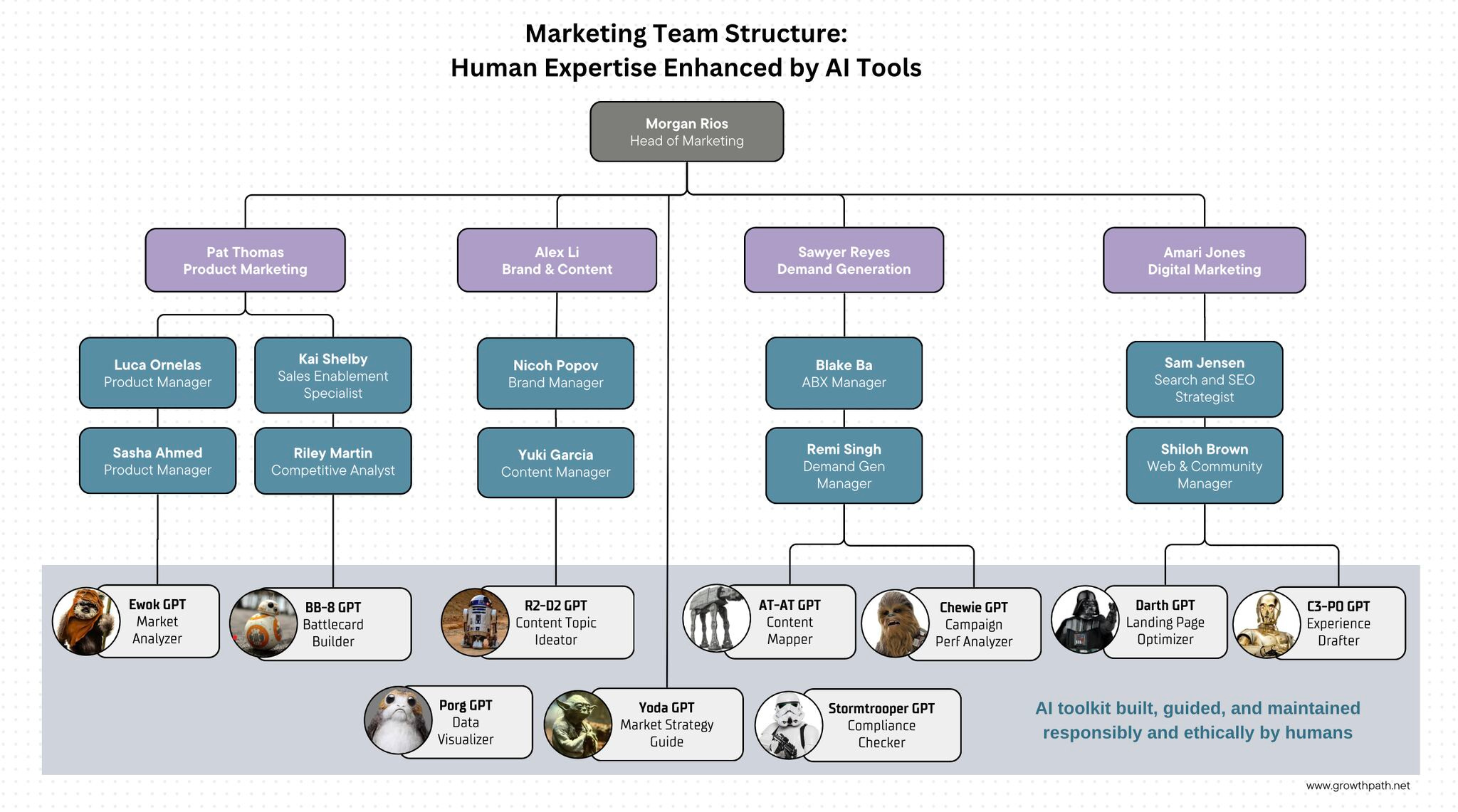
Liza introduced an interesting concept of creating an AI organizational chart, where every human has a set of AI assistants reporting to them. This model shifts the perception of AI from being just a fancy search engine to a collaborative partner in achieving marketing goals. By training AIs on our knowledge and data, we empower them to handle specific tasks, thus enhancing the productivity and creativity of human teams.
Adapting to Changing Customer Behaviors
Understanding evolving customer behaviors is fundamental to leveraging AI effectively. Liza detailed how zero-click searches and the need for relevant, connected experiences require us to adapt our marketing strategies. This is not about gaming algorithms but genuinely understanding customer inquiries and addressing them with highly relevant content.
Using AI Tools to Understand Customer Insights
Liza and I also discussed practical ways to extract customer insights using AI. By tapping into resources like customer reviews on platforms such as Capterra and sales transcripts from tools like Gong, we can gather valuable data about customer needs. AI can then help synthesize this data to provide insights into what customers are actually asking, allowing us to tailor our content to meet their specific needs.
The Role of AI in Content Creation
We concluded our conversation by exploring some of our favorite AI tools beyond the usual suspects like ChatGPT and Claude. Liza shared her love for tools like Napkin and Notebook LM for creating content, emphasizing the importance of accessibility for people with diverse learning styles.
Final Thoughts
Our discussion highlighted the transformative power of AI in marketing. The integration of AI doesn't mean replacing human roles but rather augmenting them to achieve greater efficiency and effectiveness. By embracing AI thoughtfully and strategically, we can unlock new levels of creativity and productivity within our teams.
If you'd like to connect or discuss more about these ideas, feel free to reach out to me on LinkedIn or visit Growth Path Partners for more insights. Thank you for taking the time to explore this conversation, and I hope it sparks some innovative ideas as you consider the role of AI in your marketing strategy.
For inspiration, here is her image on making CustomGPTs and thinking of how to make them team mates from an org chat view:
AI's Maturation: Infrastructure, Agents, and Ethical Frontiers.
Walk through the report today with our AI Guide and talk to it as it shows you the slides
Executive summary
Late July 2025 saw a torrent of announcements, investments and policy moves that reveal how generative‑AI is maturing. Multiple governments and companies unveiled gargantuan investments in data‑centre infrastructure; regulators set voluntary and mandatory standards to rein in systemic risk; vendors introduced new models and “agents” that blur the line between search, software and human workflows; researchers and commentators cautioned that generative models may not yet deliver the productivity gains promised; and forward‑looking leaders highlighted risks such as job displacement and national‑security threats. From these seemingly disparate events, a few statistically significant patterns emerge that matter directly to go‑to‑market leaders:
Infrastructure arms race – Hard assets are becoming the bottleneck. Big Tech and energy firms pledged tens of billions for AI‑ready data centres and power capacity, and governments are poised to fast‑track permitting. OpenAI and Oracle’s Stargate initiative alone aims to build data centres consuming 4.5 GW of power and create 100 000 jobsartificialintelligence-news.com. Such investment underscores that AI deployments now hinge on infrastructure as much as software.
Model proliferation with agentic capabilities – Vendors competed to release models that combine large context windows, vision, coding and agents. xAI’s Grok 4 offers multi‑modal reasoning, 256 k‑token contexts and native tool use; its “Grok 4 Heavy” tier scored higher than competitors on benchmark exams and uses a 200 000‑GPU cluster. Moonshot AI’s Kimi K2 uses a trillion‑parameter mixture‑of‑experts architecture, allowing efficient inference and superior performance on code and math taskshpcwire.com. OpenAI introduced a general‑purpose agent for ChatGPT that can navigate web pages, buy products and integrate Gmail or GitHub. These capabilities foreshadow a shift toward task‑oriented assistants that can execute multi‑step workflows autonomously.
Cost‑per‑intelligence becomes a differentiator – Google’s newly released Gemini 2.5 Flash‑Lite underscores a pivot toward “intelligence per dollar.” It promises high‑volume output at $0.10 per million input words and $0.40 per million output words – prices low enough to democratise AI for solo developers and small teamsartificialintelligence-news.com. This theme repeats across Kimi K2’s mixture‑of‑experts model, which charges roughly $0.15 per million input tokens versus the several‑dollar pricing of GPT‑4hpcwire.com. Such price drops will reduce switching costs and pressure vendors to innovate on efficiency rather than just capability.
Regulation and ethical guardrails – Governments are moving quickly to define rules. The EU’s General‑Purpose AI Code of Practice, published July 10, 2025, is a voluntary framework with chapters on transparency, copyright and safety; it asks model providers to document training data, licensing and energy consumption and was co‑developed by almost 1 000 stakeholders Microsoft plans to sign the code while Meta refuses, arguing that it introduces legal uncertainties and could throttle deployment of frontier modelsartificialintelligence-news.com. The U.S. Department of Education urged grantees to ensure AI systems support educators, prioritise privacy, and remain human‑supervised. Tech platforms such as YouTube tightened monetisation rules for repetitive AI‑generated content, reflecting a crackdown on low‑quality “slop”.
Reality check on productivity – A controlled study by the Model Evaluation and Threat Research team (METR) showed that developers using AI assistants took 19 % longer to complete tasks than when coding without them Time spent debugging and prompting outweighed the benefit from auto‑completion. Similarly, Apple has chosen to delay its Apple Intelligence features until 2026, arguing that the current crop of models is error‑prone and better withheld until polished; Apple notes that Copilot and ChatGPT still hallucinate or produce inconsistent results. Critics argue that waiting allows the company to avoid shipping flawed tools. For go‑to‑market leaders, these warnings suggest that early AI integrations may require more human oversight and quality assurance than vendor demos imply.
Societal risks and public scepticism – OpenAI CEO Sam Altman admitted that some job categories – notably customer support – may disappear altogether and that AI voice cloning could enable widespread fraud. He also revealed that ChatGPT already outperforms most physicians as a diagnostician yet confessed he would not entrust his own healthcare to an agent without a human doctor. Meanwhile, the Pentagon awarded contracts worth up to $800 million each to Anthropic, OpenAI, Google and xAI to develop military AI systems; the government plans to create competition rather than a single vendor and emphasises strict red‑team testing to avoid “Mecha‑Hitler”‑type hallucinations. These discussions highlight that ethical and national‑security concerns are integral to any AI go‑to‑market plan.
The remainder of this newsletter explores these patterns and their implications for marketing, product strategy and customer success.
Infrastructure arms race: securing power and computing capacity
The most striking theme from the week was the scale of infrastructure investment. At the Trump Energy and Innovation Summit on July 15, executives pledged roughly $90 billion for AI‑ready data‑centre projects. Google signed a $3 billion hydropower deal and plans to invest $25 billion in data centres; Blackstone committed $25 billion; FirstEnergy $15 billion to upgrade the grid; Meta aimed to spend “hundreds of billions” on data centres; and CoreWeave announced a $6 billion data‑centre in North Carolina. These pledges, combined with OpenAI’s Stargate partnership with Oracle, underscore that electricity and real estate are becoming strategic differentiators.
For go‑to‑market leaders, the infrastructure arms race has several consequences:
Sourcing and capacity planning – Cloud compute capacity may become scarce. Vendors with dedicated infrastructure (e.g., Google’s hydropower agreements or OpenAI’s 4.5 GW of datacentre powerartificialintelligence-news.com) can guarantee service-level agreements and stable pricing. Buyers may prefer vendors with visible long‑term infrastructure commitments.
Geographic diversification – Investment is spreading beyond Silicon Valley. OpenAI’s Stargate centres will create 100 000 jobs across the U.S., while CoreWeave’s site in North Carolina and projects in Texas aim to leverage cheap energyartificialintelligence-news.com. Go‑to‑market strategies should consider regional incentives and talent pools when locating AI‑dependent operations.
Energy partnerships – Energy utilities are emerging as partners. FirstEnergy and Constellation Energy plan to upgrade transmission infrastructure to support AI workloads. Marketing teams may need to integrate sustainability messaging and highlight carbon‑neutral power sourcing to satisfy increasingly environmentally conscious enterprise buyers.
The infrastructure surge also suggests that the cost of capital and regulatory approval will shape competitive advantage. With the White House preparing executive orders to fast‑track permitting, companies that can navigate local politics and secure permits quickly will gain time‑to‑market advantages.
Models and agents: a new crop of AI capabilities
Grok 4 and Grok For Government
Elon Musk’s xAI released Grok 4 (Base and Heavy) with features that illustrate the next generation of AI models. It offers a 256 k‑token context window, enabling persistent conversations and long document processing. Grok 4 includes native tool use and can orchestrate sub‑agents to perform tasks. The Heavy tier outperforms GPT‑4 and Claude on benchmarks such as MATH‑500, LiveCodeBench and SWE‑Bench; xAI attributes this to a 200 k‑GPU cluster and reinforcement‑learning improvements. Shortly after the Pentagon announced its military contracts, xAI released Grok For Government, bundling Grok 4 with Deep Search and tools designed for classified environments. Go‑to‑market teams should monitor whether government‑grade offerings trickle into enterprise products – such hardened versions can differentiate for customers needing compliance and security.
Kimi K2 and cost‑efficient models
Moonshot AI’s Kimi K2 uses a trillion‑parameter mixture‑of‑experts architecture but activates only a fraction of experts per taskhpcwire.com. The design yields strong performance on programming and math tasks while lowering inference costs to $0.15 per million input tokenshpcwire.com. These economics could shift market share away from expensive closed models. Kimi K2 also demonstrates agentic problem‑solving, hinting that soon multiple specialised LLMs will collaborate like microservices.
Gemini 2.5 Flash‑Lite and “intelligence per dollar”
Google released Gemini 2.5 Flash‑Lite with an explicit aim of maximising “intelligence per dollar.” It is optimised for high‑volume, cost‑efficient tasks; Google claims it is faster than earlier models and prices it at just $0.10 to process a million input words and $0.40 for outputartificialintelligence-news.com. For go‑to‑market leaders, this pricing could enable product tiers that embed AI into features previously considered too expensive, such as summarising all customer interactions or running continuous A/B copy tests. The combination of low latency and low cost means AI can become a background service rather than a premium add‑on.
Agents and autonomy
OpenAI’s general‑purpose ChatGPT agent merges the previously separate Operator and Deep Research modes. It allows users to delegate complex multi‑step tasks – such as ordering a tailored outfit or summarising quarterly results – by simulating a virtual desktop and linking Gmail, Slack or GitHub. Agents represent a radical shift: instead of responding to prompts, models can proactively navigate UI elements, retrieve data and act. Marketers and product teams should prepare for a world where prospects rely on agents to research solutions, schedule demos and even negotiate contracts on their behalf. Designing sales processes that interface seamlessly with agents will be as important as SEO optimisation today.
Mistral’s Le Chat enhancements
Mistral AI upgraded its chatbot Le Chat with a suite of features: Deep Research mode breaks down complex questions and compiles structured reports with citations, Vocal mode uses Mistral’s Voxtral voice model for natural, low‑latency conversations, Think mode taps the reasoning model Magistral and supports multilingual writing – even switching languages mid‑sentence, Projects organises chats into folders, and a partnership with Black Forest Labs adds on‑the‑fly image editing. These features show that vendors are converging on integrated text‑voice‑visual assistants. Le Chat’s research and organisation capabilities may appeal to sales and marketing teams looking for AI assistants that can pull market data, draft proposals in multiple languages and keep track of prospects.
Regulation, governance and cautious adoption
EU and U.S. policy frameworks
The EU General‑Purpose AI Code of Practice is voluntary but serves as a “soft law” prelude to the EU AI Act. It has three chapters—transparency, copyright and safety/security—and asks providers to disclose model properties, training data, energy consumption and licensing. According to DLA Piper, almost a thousand stakeholders co‑authored the code and the aim is to help model providers comply with the upcoming Act. Microsoft signalled its intent to sign the code, emphasising the need for industry collaboration, while Meta’s Chief Global Affairs Officer Jen Kaplan declared that Meta will not sign, arguing that the code introduces legal uncertainty and throttles the deployment of frontier modelsartificialintelligence-news.com. The split illustrates how voluntary governance may sort vendors into “compliant” and “defiant” segments, giving risk‑averse buyers a new criterion for vendor selection.
In the U.S., the Department of Education’s guidance encourages grantees to use AI for personalised learning but insists that human educators remain central, that systems are transparent and accessible, and that data is protected. This suggests that any go‑to‑market strategy targeting the education sector must prioritise explainability and privacy assurances.
Platform policies and content quality
YouTube updated its Partner Program policies to ban monetisation of mass‑produced or repetitive AI‑generated content. This move aims to stem the flood of low‑quality videos and indicates that platforms will penalise content that appears to be “slop.” Marketing teams must ensure that AI‑generated videos or podcasts meet quality thresholds and include human oversight. On social networks, this may mean clearly labelling AI‑created content and focusing on storytelling rather than volume.
Apple’s deliberate pace
Apple’s cautious approach provides a counter‑narrative to the arms race. Its Apple Intelligence features shown at WWDC will not roll out to most users until late 2025 or 2026. The company limits early access to beta users on select devices and emphasises that it refuses to ship half‑baked tools. TechRadar praised Apple’s delay as possibly the smartest move in a hype cycle dominated by buggy releases Apple argues that many current models hallucinate or produce inconsistent results, and it would rather wait until the technology is ready. This illustrates a potential segmentation strategy: some vendors compete on being first, while others target reliability. Go‑to‑market teams should recognise that certain customers – especially in regulated industries – may prioritise stability and trustworthiness over cutting‑edge features.
Developer productivity and the hype gap
The METR study demonstrating that AI assistants can slow developers down by 19 % suggests that generative AI is not yet a magic bullet. Developers spent extra time debugging and writing prompts, offsetting gains from auto‑completion. MIT economist Daron Acemoglu noted that only a small percentage of tasks currently benefit from AI. For go‑to‑market leaders, this means marketing claims about productivity must be tempered; pilot programmes should measure actual time saved and include human review loops.
Safety versus speed
A debate erupted after Harvard professor Boaz Barak, on leave at OpenAI, criticised xAI’s Grok for being launched without a public system card and other transparency artefacts. Ex‑OpenAI engineer Calvin French‑Owen responded that many at OpenAI are working on safety and emphasised the “Safety‑Velocity Paradox”: the industry is trapped between a need to move at breakneck speed to compete and the moral duty to proceed cautiouslyartificialintelligence-news.com. French‑Owen noted that OpenAI has grown to more than 3 000 employees and operates in a state of controlled chaos, with a culture of secrecy and sprint‑like product developmentartificialintelligence-news.com. For go‑to‑market teams, these comments reveal that vendor claims about safety practices may mask internal tensions. Procurement teams should request evidence of red‑teaming, auditing and update cadences.
Societal impacts and economic considerations
Job displacement and national security
At a Federal Reserve conference, Sam Altman warned that AI will erase entire job categories, using customer support as an example; he envisioned AI handling calls without mistakes, transfers or phone trees. However, he simultaneously admitted he would not entrust his own healthcare solely to ChatGPT. This contradiction highlights the tension between AI’s promise and its present limitations. He also voiced fears that adversarial nations could weaponise AI to cripple the U.S. financial system and warned about fraud enabled by voice cloning.
Economic exuberance and potential bubble
A Reuters commentary compared the AI boom to the late‑1990s dot‑com bubble. The top ten S&P 500 stocks are trading at lofty valuations, yet the commentary notes that generative AI adoption will require about $2.9 trillion in data‑centre spending through 2028. Much of the spending will go to hardware (e.g., GPUs) and energy infrastructure If AI growth slows, valuations could correct, though the author argues tech will remain integral to the economy. Go‑to‑market leaders should prepare for scenarios where funding becomes constrained and emphasise ROI in messaging.
Consumer pricing and algorithmic discrimination concerns
Delta Air Lines announced plans to expand AI‑based dynamic pricing to 20 % of domestic routes by the end of 2025, partnering with Fetcherr. U.S. senators criticised the plan as a “privacy-invasive practice” that could charge each passenger the maximum price they are willing to pay. Delta responded that dynamic pricing has long been used and that all customers see the same fares. This case underscores increasing political scrutiny of algorithmic pricing and potential for regulatory intervention. Product managers employing AI‑driven pricing must ensure transparency and fairness.
Recommendations for go‑to‑market professionals
Conduct a supplier readiness assessment – Examine vendors’ infrastructure roadmaps, cost structures, compliance status and agent capabilities. Create a matrix that scores potential partners on these dimensions. Prioritise those with diversified power sources, clear safety practices and low cost per token.
Develop agent‑friendly assets – As customers increasingly rely on AI agents to research and evaluate solutions, ensure your documentation, pricing pages and onboarding flows are machine readable (structured metadata, accessible APIs). Provide sandbox environments where agents can test features.
Highlight compliance and ethics – Incorporate adherence to EU and U.S. guidelines in all messaging. Publish transparency reports that detail training data sources, energy use and privacy safeguards. Consider signing voluntary codes of practice to signal trustworthiness.
Offer tiered AI functionality – Align product tiers with varying risk appetites: a basic tier using cost‑efficient models for low‑stakes tasks; a premium tier using advanced agents with human oversight; and a “trust tier” featuring third‑party audited models for regulated industries.
Plan for human‑in‑the‑loop workflows – Given evidence that AI can slow productivity and still produces hallucinations, design processes that allow users to review and correct AI outputs. Provide clear UI cues and revision histories.
Monitor macroeconomic signals – Keep an eye on valuations and data‑centre spending forecasts. If capital becomes scarce, emphasise ROI and efficiency in messaging and consider shifting to consumption‑based pricing models.
Educate sales and customer success teams – Provide training on how to address concerns about job displacement, data privacy and algorithmic fairness. Equip teams with case studies demonstrating safe, effective AI deployments and emphasise partnership with human expertise.
Concluding thoughts
The week of July 15–23, 2025 highlighted both exuberance and caution in the AI landscape. Unprecedented investment in infrastructure and the release of models with unprecedented context windows and agentic abilities show that the race to build truly capable AI is accelerating. Yet the same period saw regulators drafting codes of practice, companies like Apple delaying releases, researchers flagging productivity declines and executives warning of job losses and security threats. For go‑to‑market leaders, the common thread is balance: harness AI’s power while managing costs, ensuring compliance, maintaining human oversight and communicating trust. Those who master this balance will navigate the hype cycle and deliver sustainable value.
This week instead of 1 AI tech, we are focusing on 4! AI AGENT BATTLE: Manus vs ChatGPT Agent vs Genspark vs Gemini
AI Agent Platforms for GTM Professionals: A Comprehensive Analysis
The AI agent landscape has transformed dramatically in 2024-2025, with four major platforms emerging as leaders for go-to-market applications. This comprehensive analysis examines GenSpark.ai, Manus.lm, ChatGPT's Agent features, and Google Gemini Agentspace through the lens of practical GTM implementation.
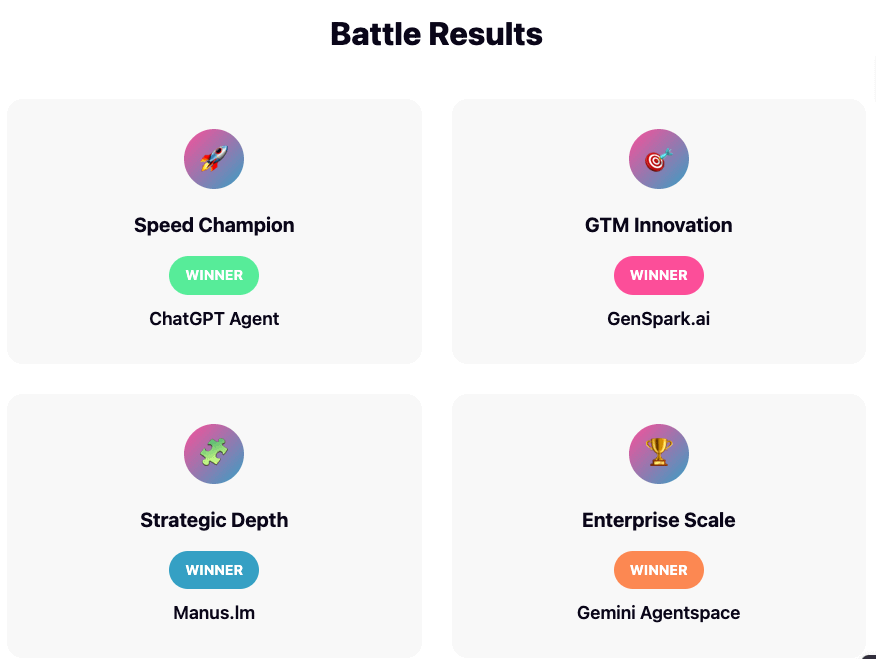
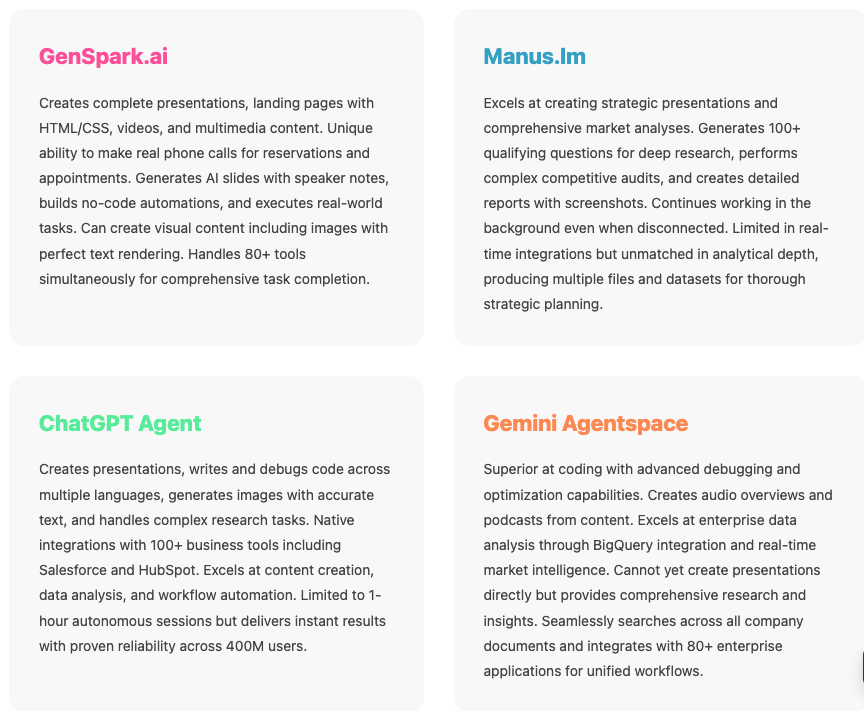
Platform Overview and Market Positioning
GenSpark.ai: The Accessible All-in-One Solution
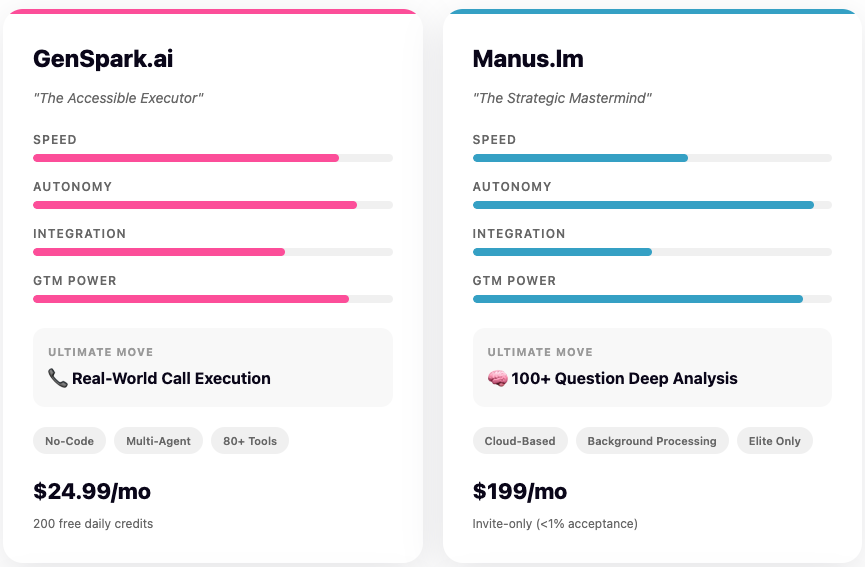
GenSpark has evolved from an AI search engine to a powerful "Super Agent" platform in just two years. Founded by former Baidu executives, the company achieved remarkable $36M ARR in 45 days post-launch with only 20 employees. Their unique "Mixture-of-Agents" architecture orchestrates 9 specialized LLMs with 80+ built-in tools.
Key Differentiator: Real-world task execution including actual phone calls through their "Call For Me" feature - a capability unmatched by competitors.
Manus.lm: The Strategic Depth Champion
Launched March 2025 as "the world's first fully autonomous AI agent," Manus operates in a cloud-based Ubuntu environment, continuing tasks even when users disconnect. However, the platform faces significant challenges including geopolitical tensions (China operations shutdown, Singapore relocation) and limited accessibility (invitation-only with <1% waitlist acceptance).
Key Differentiator: Unparalleled analytical depth with concurrent task execution, producing comprehensive strategic analyses that outperform competitors in quality.
ChatGPT Agent Features: The Market Leader
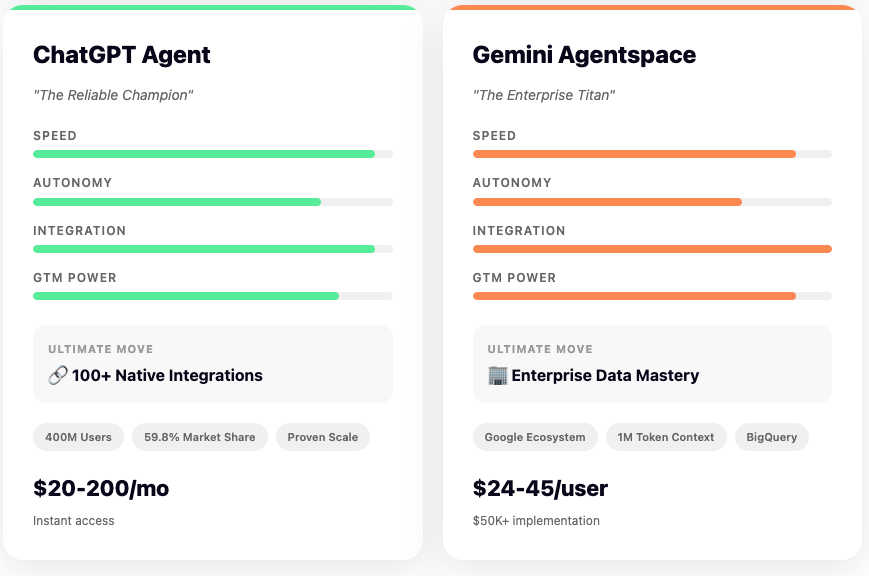
OpenAI's July 2025 launch of unified agent capabilities represents the evolution from conversational AI to autonomous execution. With 400M weekly users and 59.8% market share, ChatGPT offers proven reliability with extensive enterprise adoption.
Key Differentiator: Mature ecosystem with 100+ integrations, proven enterprise security, and the backing of OpenAI's continuous innovation.
Google Gemini Agentspace: The Enterprise Powerhouse
Google's December 2024 entry combines Gemini's reasoning capabilities with enterprise-grade infrastructure. The platform serves as a centralized hub for AI agents across organizations, with deep integration into Google Workspace and 80+ enterprise applications.
Key Differentiator: Seamless Google ecosystem integration with real-time data access and enterprise-grade security architecture.
Technical Capabilities and Architecture
Autonomy Levels
All platforms offer high autonomy, but implementation varies significantly:
GenSpark: Multi-agent orchestration automatically selects optimal models for each task component
Manus: Full autonomy with background processing in cloud environments
ChatGPT: Agent mode with configurable human oversight and intervention points
Gemini: Semi-autonomous collaboration designed for enterprise workflows
Task Complexity Handling
Most Complex: Manus AI handles intricate multi-step analyses with 65% autonomous execution accuracy
Most Versatile: ChatGPT manages coding, research, and content with 1-hour workflow limits
Most Practical: GenSpark executes real-world tasks like phone calls and reservations
Most Scalable: Gemini processes enterprise-wide data with 1M token context windows
GTM-Specific Applications Analysis
Marketing Automation Excellence
Content Creation Leader: GenSpark generates complete landing pages with HTML, videos, and multimedia in 15-20 minutes. Their AI Slides feature creates professional presentations with speaker notes from simple prompts.
Strategic Analysis Leader: Manus provides unmatched depth - one user reported receiving "nearly 20 files AND screenshots" for a Nike content audit, with insights ChatGPT missed.
Speed Leader: ChatGPT cranks out high-volume content almost instantly, with their latest image generator now creating text perfectly within images.
Enterprise Leader: Gemini excels at data-driven content leveraging real-time analytics and market intelligence.
Sales Intelligence and Enablement
Lead Generation Innovation: GenSpark's voice calling capability enables automated appointment setting and qualification calls - a game-changing feature for SDR teams.
Prospect Research Depth: Manus generates 100+ qualifying questions with intent data and SEO insights, providing comprehensive competitive intelligence.
CRM Integration Leader: ChatGPT's native Salesforce and HubSpot connectors enable seamless pipeline management with 47% reported productivity gains.
Data Analysis Leader: Gemini's BigQuery integration provides enterprise-grade analytics for revenue forecasting and pipeline analysis.
Revenue Operations Transformation
Workflow Automation: GenSpark's no-code platform enables RevOps teams to automate complex processes without technical expertise.
Strategic Planning: Manus excels at market analysis and competitive positioning, ideal for quarterly planning cycles.
Operational Efficiency: ChatGPT users report 2-hour daily time savings on administrative tasks with 83% of sales reps seeing tangible success.
Enterprise Scale: Gemini handles massive data volumes with real-time processing for large revenue operations teams.
Pricing and Accessibility Comparison
Cost Structure Analysis
Most Accessible: GenSpark offers 200 free daily credits with paid plans at $24.99/month for 10K credits
Premium Positioning: Manus at $199/month targets strategic users willing to pay for depth
Flexible Options: ChatGPT ranges from $20/month (Plus) to $200/month (Pro) with team options
Enterprise Focus: Gemini at $24-$45/user/month requires $50K-$200K implementation investment
Implementation Complexity
Easiest: GenSpark - browser-based, no setup required, immediate value
Most Challenging: Gemini - requires Google Cloud project, extensive configuration
Moderate: ChatGPT - simple interface but benefits from integration setup
Variable: Manus - easy interface but waitlist and server issues create friction
Real-World Performance and User Feedback
Reliability Metrics
ChatGPT: Highest reliability with 400M users and proven infrastructure
Gemini: Enterprise-grade with Google's infrastructure backing
GenSpark: New but stable with 4.2/5 Glassdoor rating
Manus: Significant issues with server crashes and "busy" status
Speed vs. Quality Trade-offs
Speed Champions: ChatGPT and Gemini deliver near-instant results for most tasks Quality Champion: Manus takes 15-22 minutes but provides exceptional depth Balanced Approach: GenSpark delivers comprehensive results in 15-20 minutes
User Satisfaction Insights
GenSpark users praise real-world execution: "GenSpark will actually call the restaurant and confirm your reservation"
Manus users value depth: "The depth and quality outperformed ChatGPT in almost every test"
ChatGPT users appreciate reliability: "47% productivity increase with 2 hours daily savings"
Gemini users highlight integration: "Seamless research across all company documents"
Strategic Recommendations by Company Profile
Startups and SMBs (1-200 employees)
Recommended: GenSpark.ai
Rationale: Free tier, immediate access, no technical barriers
Expected ROI: 1-3 months
Key Benefits: Real-world automation, comprehensive feature set, minimal investment
Mid-Market Companies (201-1000 employees)
Recommended: ChatGPT Enterprise or Manus AI
Rationale: Proven scale, strategic capabilities, reasonable cost
Expected ROI: 3-6 months
Key Benefits: Extensive integrations, strategic depth, team collaboration
Large Enterprises (1000+ employees)
Recommended: Google Gemini Agentspace
Rationale: Enterprise security, scalability, ecosystem integration
Expected ROI: 6-12 months
Key Benefits: Unified platform, compliance features, real-time data access
Future Outlook and Strategic Considerations
Emerging Capabilities (2025 Roadmap)
Voice Revolution: GenSpark's phone automation represents the next frontier
Multi-Modal Excellence: Gemini 2.0's "agentic era" vision with advanced capabilities
Depth Enhancement: Manus promises open-source components and specialized models
Integration Expansion: ChatGPT's growing ecosystem of 3M+ custom GPTs
Risk Mitigation Strategies
Data Security: Implement strict access controls and avoid sensitive data with newer platforms Vendor Lock-in: Maintain flexibility with platforms offering export capabilities Reliability: Start with pilot programs before full deployment Compliance: Ensure platform capabilities align with industry regulations
Conclusion
The AI agent platform landscape offers distinct choices for GTM professionals. GenSpark leads in accessibility and real-world execution, Manus provides unmatched strategic depth despite challenges, ChatGPT offers proven reliability with extensive integrations, and Gemini delivers enterprise-grade capabilities within the Google ecosystem.
Success depends on matching platform strengths to organizational needs: startups benefit from GenSpark's immediacy, growing companies leverage ChatGPT's reliability, strategic teams value Manus's depth, and enterprises require Gemini's scale. The key is starting with pilot programs, measuring concrete ROI, and scaling based on proven value rather than potential promises.
As these platforms evolve rapidly, GTM leaders should focus on practical implementation today while preparing for the autonomous agent capabilities that will define tomorrow's competitive advantage.