

As per usual, THANK YOU for reading the newsletter and listening in to the podcast. i have received several notes of thanks, feedback of how to improve, and compliments to our amazing guests, all of it is welcome and so appreciated.
We would love for you to subscribe and let us be a part of your orbit in this crazy GTM AI world.
Very Grateful to have dug into some really cool examples of what is making a big difference with GTM teams with AI workflows with the Cofounder of www.workflows.io Dan Rosenthal.
You can go to Youtube, Apple, Spotify as well as a whole other host of locations to hear the podcast or see the video interview.
I’ve talked to a lot of people on this podcast. Revenue leaders, founders, RevOps nerds, AI enthusiasts. Most of the conversations are great. Some are really good.
And then every once in a while someone shows up and I’m sitting there thinking... why hasn’t anyone mapped this out this clearly before?
That was my conversation with Dan.
His background is genuinely wild. Master’s in biology. Almost went to Cambridge for a neurodegenerative disease PhD. Applied to exactly one program, didn’t get it, had zero backup plan. (My kind of guy, honestly.) Ended up in sales at a biotech company, ran $5M in revenue with basically no systems, with no CRM until the very end, no infrastructure, just hustle and spreadsheets.
And that experience? It lit a fire. Because the problem that broke you is usually the one you’re most obsessed with solving.
Now he’s living in Barcelona, running a team that builds the systems he desperately wished he’d had.
Here’s what stuck with me.
The GTM Flywheel And Why Most Teams Are Running Sideboat Experiments
Dan opened with something I’ve been saying for a while, but he put a visual to it that I hadn’t seen.
Most GTM teams aren’t running a strategy. They’re running a collection of disconnected experiments that never talk to each other.
You’ve got marketing running LinkedIn ads... to accounts that sales isn’t prospecting. You’ve got SDRs doing cold outbound... without knowing who just engaged with your content. You’ve got content going out... but no one’s capturing that engagement and routing it back as signal.
That’s not a flywheel. That’s a leaky bucket with a fancy name.
Dan’s GTM Flywheel Playbook maps out every major channel from content, ads, outbound, partnerships and forces you to think about how they all FEED each other. Not just operate next to each other.
The line that hit me hardest: “Your best-performing content should become your ads. You should be running ads to the same list your team is outbounding. And you should be outbounding all the people engaging on your content.”
That’s it. That’s the whole thing. If those three sentences aren’t true in your org right now, you have a structural problem, not a pipeline problem.
What AI Is Actually Good For (And What It’s Not)
We talked a lot about how AI is being used by top GTM teams and I think the reality is very different from the hype.
Here’s what Dan said the best AI use case is, in his words: “A web research agent that looks at a company’s website and decides if they’re qualified and can be enriched further to potentially be lead scored.”
Not AI writing your ad copy. Not an AI SDR blasting thousands of emails. Not replacing your reps.
A filter. A sorter. A noise-reduction engine.
In the pre-AI era, if you handed your sales team a list of 500 people who engaged with your LinkedIn content, 90% of it would be junk. So you just... didn’t do it. The signal existed but wasn’t actionable.
Now AI can sort through that 90% junk and hand your team the 10% that matters. And suddenly all those channels that seemed impractical? They’re producing real signal.
That’s the unlock. Not “AI does the job.” AI makes the human’s job more targeted.
Dan also made a point I completely agree with: “Give an old-school seller new-school systems, and that’s where magic can happen.” The fundamentals don’t go away. The people who have them AND can use these tools? They’re going to be scary good.
The ABM Playbook: When the Flywheel Changes Shape
Here’s where it got really tactical. For companies with fewer than 10,000 target accounts, the mass GTM flywheel doesn’t fully apply. You need account-based thinking.
Dan walked through the full infrastructure, and it’s worth slowing down on because this stuff is actually implementable:
Step 1 — Build a real ICP model. Not a guess. Not a committee argument. Export your closed-won customers, remove outliers, enrich with additional data points, and feed it into an AI model to identify the real patterns. Dan described working with a unicorn GTM company, one everyone would recognize that couldn’t agree on its own ICP. If they can have that problem, so can you.
His tiering philosophy hit me: don’t use complex point systems. Use concentric circles. When your rep sees “Tier 1” they should immediately know exactly what kind of company that is. He said: “A Series B company with a growing GTM team in the AI space, that’s our Tier 1. My team should get excited when they see it.”
Step 2 — Map your TAM wide, then filter down. Most databases, even the AI-first ones, miss huge swaths of companies if you search with narrow tags. Dan’s approach: pull from multiple sources, consolidate in an orchestration tool like Clay, then use AI to filter down. The point isn’t to start with a clean list. The point is to start with a complete one.
Step 3 — Track signals in 3 layers. First-party: what you own like gated content downloads, product usage, website visits. Second-party: LinkedIn ad engagement, content engagement. Third-party: technographics, news, job postings, social activity.
The signals that get ignored most? Gated content. Someone downloads your playbook and your sales team doesn’t know for three days. That’s a missed window. Fix that first.
Step 4 — Score awareness, not just lifecycle. This is the one that genuinely surprised me. Dan said: lifecycle stages (MQL, SQL) don’t capture what happens before someone raises their hand. So he layers an awareness score on top: Identified → Aware → Interested → Considering → Selecting.
The result? One client, first day using the awareness scoring system, had three reps each book two meetings all by just filtering their outreach to “Aware” accounts they’d had no idea were already in the ecosystem. Six-figure ACVs. One day.
That’s not incremental improvement. That’s a completely different game.
The Brutal Honest Part
We talked about what happens to teams that skip the infrastructure and just grab tools.
Dan’s been inside companies you’d assume have this figured out. “I shouldn’t say the name, but a massive company had an infrastructure was an absolute mess because they started as a VC-backed startup, shipped fast, and never went back.”
Every month you wait is another month of messy data, mis-routed leads, and reps prospecting blind. And at some point you have to pay that back, except now you’re paying it back while also trying to compete.
The teams who take 2-6 months to actually build the foundation? They skyrocket after. I’ve watched it happen. The short-term pain is real. The long-term payoff is embarrassingly good.
As Dan put it: “It takes time to save time.”
What Workflows.io Actually Does
Before I let you go, Dan’s team at Workflows.io does 4 things:
LinkedIn content (helping founders post like his co-founder does)
Automated outbound (end-to-end system buildout)
RevOps infrastructure (the systems I just described)
ABM (4-6 month sprint to full implementation)
If you want to connect with Dan directly, his LinkedIn is: https://www.linkedin.com/in/dan-m-rosenthal/ and you can learn more at
https://www.workflows.io/
The full episode is live at

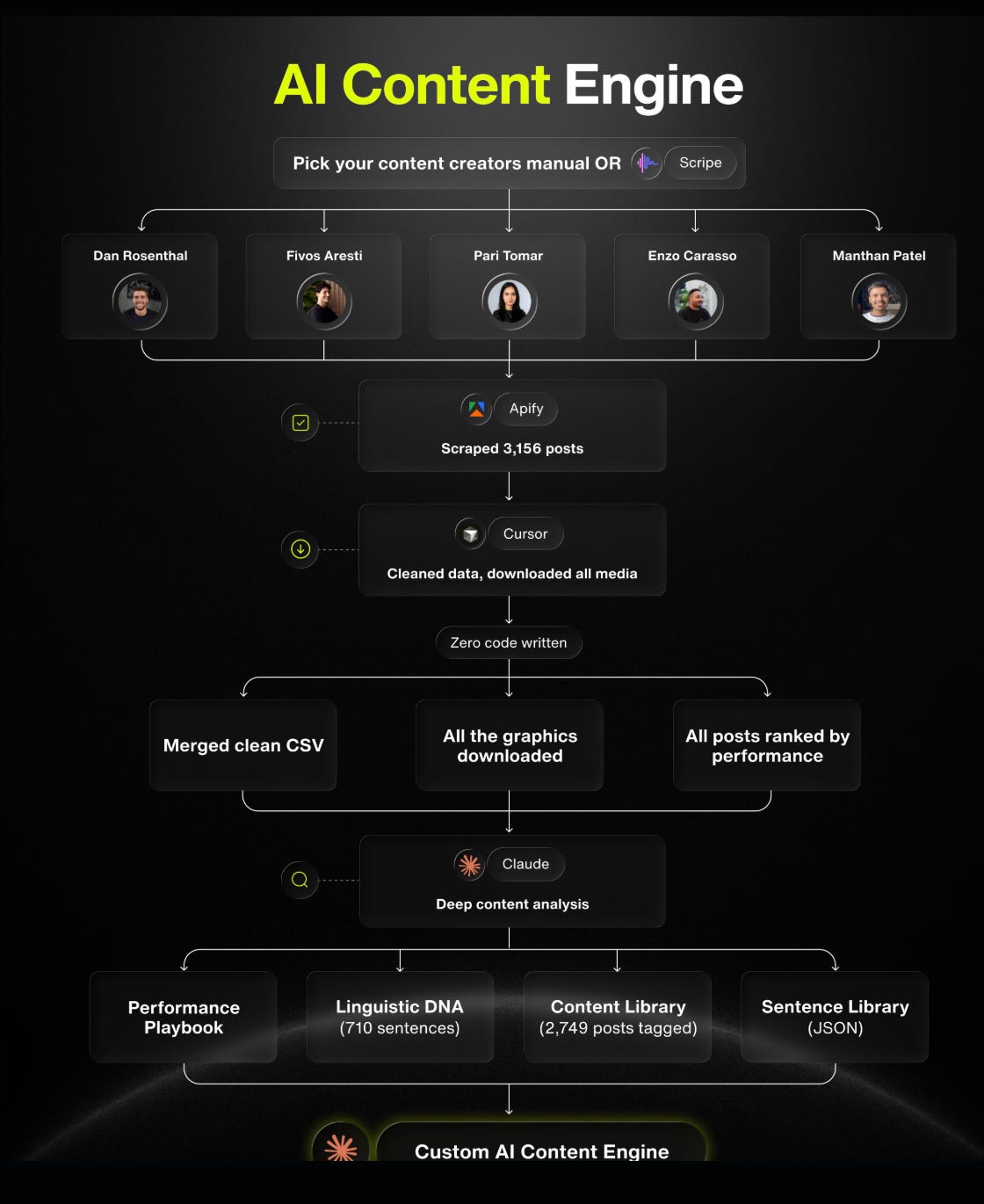
Example workflow you can find on the www.workflows.io website
The GTM Infrastructure Checklist: 12 Things Top Teams Build Before They Scale
A modern guide based on what’s actually working with YC startups, Fortune 500 logos, and everyone in between.
The 12-Point GTM Infrastructure Checklist
Section 1: ICP Clarity
1. You have a tested ICP model, not a debated one. Your ICP should be built from data, not committee opinion. Export your closed-won customers, enrich with firmographic and technographic data, and analyze the patterns with AI. Your Tier 1 accounts should be immediately recognizable to every rep on your team at no point system needed, just clear concentric tiers.
Test: Can every rep describe your Tier 1 account in one sentence without looking anything up?
2. Your ICP tiering is backtested against CRM reality. A good ICP model shows a higher proportion of Tier 1 accounts among your closed-won than among your total TAM. If 10% of your TAM is Tier 1, you should see 25-30% of closed-won fitting Tier 1 criteria. If that differential doesn’t exist, your model isn’t working.
Test: Does your ICP model predict what’s already in your CRM?
3. Your tiering stays stable over 6-12 months. Don’t include time-based signals (open job reqs, recent funding) in your core ICP tier criteria. Those change. Build your tiers on firmographics, technographics, and structural fit signals that hold for at least a year.
Test: Would your Tier 1 accounts from 8 months ago still be Tier 1 today using your current criteria?
Section 2: TAM Mapping
4. You’ve built your TAM from multiple sources, not just one database. No single database captures your full market. Apollo misses companies that keyword searches catch. Clay’s prospecting database gets roughly 80-90% of Apollo’s coverage on companies and less on contacts. Real TAM mapping means pulling wide from multiple tools, consolidating in Clay or a similar orchestration layer, and then filtering for fit.
Test: Have you pulled TAM data from at least 3 distinct sources and deduplicated?
5. Every target account and key stakeholder lives in your CRM before your reps start prospecting. If your reps are logging into ZoomInfo to build lists, you’re wasting selling time and getting inconsistent coverage. Pre-load your CRM with every account and contact in your TAM. Your CRM should be the best prospecting database your team has all with custom fields specific to how you sell.
Test: Can a rep go from “I want to prospect” to “first call logged” without leaving your CRM?
Section 3: Signal Infrastructure
6. You’re capturing and routing first-party signals in real time. Gated content downloads, product usage events, and website visits are first-party gold and most teams let them sit in a spreadsheet for days. Every signal should log to your CRM (HubSpot custom events or Salesforce custom objects work well) and trigger an alert to the right rep within hours, not days.
Test: If someone downloads your best piece of gated content right now, does a rep know within 24 hours?
7. You’re capturing and routing second-party signals (LinkedIn ads, content engagement). LinkedIn ad engagement from target accounts is data that exists and almost nobody acts on fast enough. Tools like Fiddler give you account-level ad engagement data directly in HubSpot or Salesforce. LinkedIn content engagement from connections should also be captured and scored.
Test: Do your reps know which of their target accounts have been engaging with your LinkedIn content in the last 30 days?
8. You have at least one third-party signal source feeding your workflow. Technographic data (what tools they’re using), job change tracking for champions, and relevant news events should be feeding your signal layer. If you integrate with a tool, you should be watching for when prospects adopt or drop that tool.
Test: Do you have at least one automated workflow that fires when a target account crosses a third-party signal threshold?
Section 4: Awareness Architecture
9. You score awareness separately from lifecycle stage. Lifecycle stages (MQL, SQL, SAL) capture intent to buy. Awareness scores capture where someone is in their knowledge of you and they’re not the same thing. Build an awareness layer: Identified → Aware → Interested → Considering → Selecting. Score accounts based on signal accumulation.
Test: Can you pull a list right now of accounts that are “Aware” of you but haven’t yet entered a pipeline stage?
10. Your reps’ daily prospecting starts with the highest-awareness accounts, not cold TAM. The first filter your reps should apply in the morning is awareness score. Outbounding someone who has already engaged with your content, attended a webinar, or downloaded a resource is fundamentally different from cold outreach. It converts at a different rate. Treat it differently.
Test: Is awareness score a visible, filterable field in your CRM that reps use daily?
Section 5: Channel Alignment
11. Your ads, content, and outbound all target the same account list. Your LinkedIn ads should be running to your target account list, not a broad demographic. Your outbound team should be reaching the same accounts your ads are warming. Your best content should be retargeted as ads. These three motions amplify each other. Running them separately wastes budget on noise.
Test: Are the accounts your SDRs are prospecting this week the same accounts in your LinkedIn ad audiences?
12. You have a defined feedback loop from CRM activity back to channel strategy. Every signal, touchpoint, and stage change should log back to the CRM and inform your next move. Which content piece drove the most Aware accounts? Which ad sequence led to the most meetings? That data should be shaping your strategy monthly.
Test: Do you have a monthly review where CRM activity data influences your next 30 days of channel investment?
The Honest Reality Check
Building this infrastructure takes time. Anywhere from 2 to 6 months if you’re doing it right. And during those months, it feels like everyone else on LinkedIn is announcing wins while you’re still in the plumbing.
But here’s what I’ve watched happen over and over: the teams that build this? They hit an inflection point and their output gets scary good. The teams that skip it? They keep adding tools to a broken foundation, building what one smart operator called “time debt” or a bill that comes due right when you can least afford to pay it.
The checklist above is a starting point, not a prescription. Your business has unique channels, audiences, and sales motions. But the architecture such as connected signals, tested ICP, pre-loaded CRM, aligned channels are all part what is universal.
Pick the 3 items on this list where your team scores worst. Fix those first.
Then come back and tell me what changed.