

To Start, we are doing a GTM & AI 2025 Survey and will be publishing a report in January. We partnered with Theysaid.io and will be using their AI tech to do the survey!
Would love to have you participate, you can either go to this link OR if you want to do this on mobile in voice-mode, scan the QR code below

GTM AI PODCAST AND NEWSLETTER
The newsletter and GTM AI Podcast & Newsletter are sponsored by GTM AI Academy with additions article submissions, and my cohost of Jonathan Moss of AI Powered GTM.
Business Impact> Learning Tools
We have the SLACK COMMUNITY around AI , come hang with your fellow GTM professionals, get insights, and content free to help in your teams and roles.
Now with all that being said, lets move forward with todays newsletter which is
We have #44 with Lihong Hicken the CEO of TheySaid | World's 1st AI Survey talking about How AI Surveys Are Revolutionizing Sales Pipeline Generation.
OpenAI going cray cray with releases for December including SORA.
ElevenLabs releases their new customizable audio AI agents
Meta releases the latest Llama model that is outperforming competitors
How GenAI is changing GTM Strategy going into 2025
GTM AI Tool of the week: LearnExperts LEAi tech.
Lets get into the podcast:
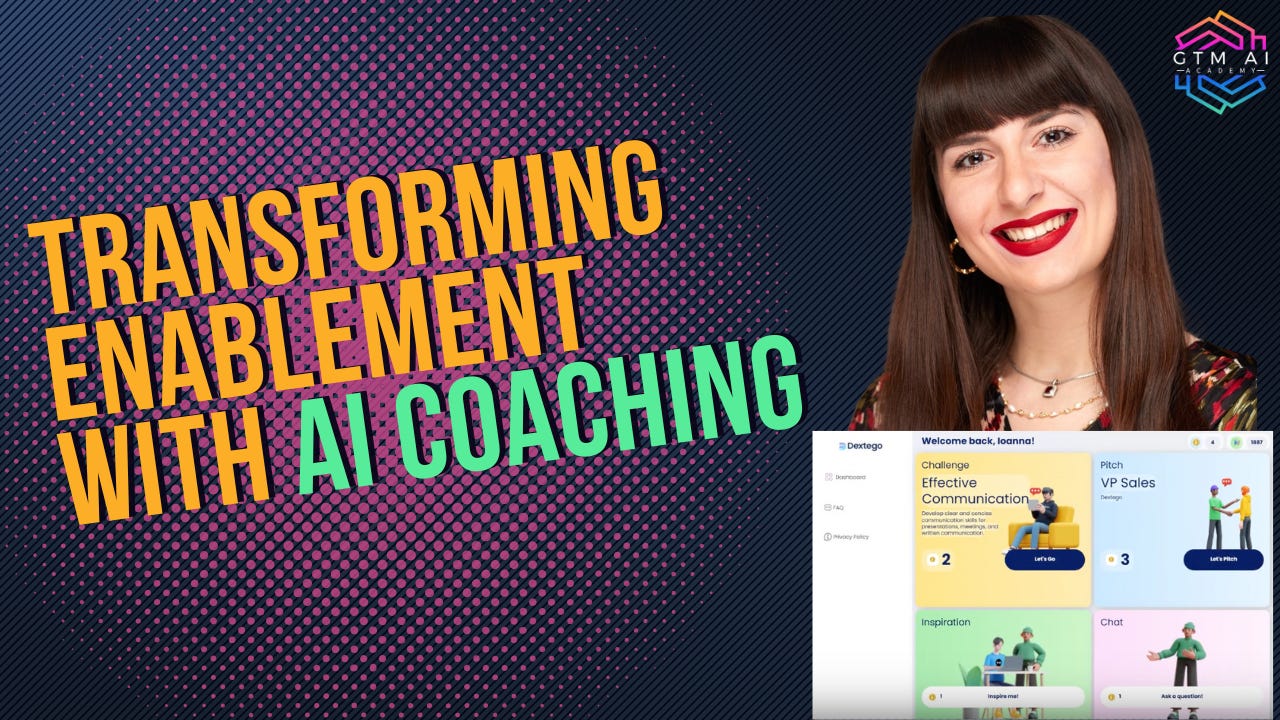
You can go to Youtube, Apple, Spotify as well as a whole other host of locations to hear the podcast or see the video interview.
I sat down with Ioanna Onasi, CEO and co-founder of Dextego, to dive deep into the power of AI coaching for sales enablement. Ioanna’s passion for understanding human motivation, coaching, and technology shines through her story—from her psychology roots to becoming a startup leader.
We explored the gaps in traditional sales training, particularly how ineffective and biased role plays are, and how Dextego leverages AI to deliver timely, personalized coaching that actually works. She shared her take on the human-AI balance, emphasizing that technology should optimize human performance, not replace it. Dextego aims to coach reps throughout the sales cycle, reduce ramp-up times, and help them deliver value-driven messaging to the right persona at the right time.
Ioanna also highlighted how AI can shift enablement from reactive to proactive, shorten sales cycles, and elevate reps with gamified, real-time learning. Lastly, we discussed the broader impact of AI on business workflows, emphasizing change management and the importance of clear strategies.
AI Coaching Gaps in Sales Enablement:
Traditional role plays are outdated and biased. Reps need coaching that aligns with real-world scenarios.
First-time managers often lack proper coaching support.
Dextego’s Core Value:
AI coaching platform that blends company data, sales best practices, and human expertise to deliver targeted, real-time coaching.
Use cases span onboarding, consistent messaging, and deal support.
Results and Impact:
Shortens sales cycles by 30% on average.
Drives reps to deliver persona-specific value props, not scripts.
AI as an Optimizer, Not a Replacer:
Ioanna believes in improving human performance while automating low-value tasks.
Sales remains a human-centric art of communication.
Future of Enablement:
AI agents will focus on specialized coaching areas like negotiation, discovery, and methodologies.
Continuous feedback and tailored coaching styles are key.
Upcoming Trends for Leaders:
Companies need to rethink their tech stacks and decide what tools are foundational vs. integrative.
AI tools can transform workflows, but change management is critical.
Key Quotes from Ioanna
On Coaching Gaps:
“We found that the first-time managers—BDR managers, for example—just don’t get the training they deserve.”On the Power of AI:
“The goal is to deliver the right coaching at the right time. Reps don’t have time to wait for feedback—AI makes it immediate.”On Sales Enablement Problems:
“You tell a rep, ‘If the customer says A, say B,’ but the customer always says C or D.”On Human vs. AI Balance:
“Sales is the art of communication. If we lose that, what are we as a civilization?”On Dextego’s Results:
“On average, companies shorten their sales cycles by 30% when they use our platform.”On Using AI Responsibly:
“Founders have a responsibility to create solutions that improve well-being, not just replace jobs because they can.”On the Bigger Picture:
“It’s not about trying 10 pilots. It’s about being strategic and supporting yearly goals with real ROI.”
Wrap Up
This conversation was all about transforming sales enablement into something modern, effective, and human-first. Ioanna’s vision for Dextego and AI coaching is practical and forward-thinking. If you’re serious about accelerating your team’s performance and staying ahead in a changing market, Dextego is one to watch.
Learn more: Dextego.com
And if you’re in NYC, mark your calendars for Dextego’s invite-only event in January 2025. It’s AI enablement done right.
In-Depth Overview of OpenAI’s December 2024 Releases and Their GTM Impact
OpenAI’s "12 Days of OpenAI" event is shaping up to be a landmark moment, showcasing their ambition to redefine the AI landscape. I’ve been closely following these updates, and it’s clear they offer a wealth of tools that can transform how we operate, strategize, and engage in this rapidly evolving market. Here’s a breakdown of the key announcements and why they matter.
1. Sora: AI Video Generation
What it is:
Sora allows users to create high-definition videos from text prompts, extend existing videos, and even blend scenes seamlessly. It’s included in ChatGPT Plus and Pro plans at no extra cost.
Why it matters for GTM:
Sora is a game-changer for content creation. Imagine being able to generate a promotional video or product demo in minutes, tailored to a specific audience. It reduces production costs, shortens timelines, and empowers teams to deliver engaging, professional-quality visuals without needing a full video production team. For campaign launches or product education, this tool is invaluable.
Personal opinion:
I have used RunwayML for a while and the video generation is not as good as I thought it would be to be quite frank. Its ability to take pictures and make videos is amazing, but creating from scratch is ehhh ok.
2. Advanced Model o1 & ChatGPT Pro
What it is:
The o1 model enhances AI reasoning, allowing for deeper, more contextual interactions, while ChatGPT Pro provides access to advanced capabilities for professionals.
Why it matters for GTM:
This is a powerhouse for customer engagement. The o1 model can handle complex customer queries, making AI interactions feel more natural and helpful. For internal use, it enhances sales enablement by creating better pitches or training materials. ChatGPT Pro also automates repetitive tasks like drafting outreach emails or generating meeting summaries, freeing up time to focus on strategic initiatives.
o1 Pro is an amazing feature, very good with logic and coding, and solves or at least gives advanced angles to some of my advanced questions around GTM strategy.
3. ChatGPT Search Integration
What it is:
A new search feature in ChatGPT provides real-time answers sourced from the web, competing directly with search engines like Google.
Why it matters for GTM:
Having real-time market insights at your fingertips is a game-changer. Whether you’re researching competitors, identifying industry trends, or refining a pitch, this feature ensures you’re always armed with the latest information. It’s also a valuable tool for quickly addressing customer inquiries with relevant data.
I tried this for a day and did not like it being my default, I sometimes like the old school Google and I like to have more control over when this is used or not and I still prefer Perplexity.
4. Canvas: Collaborative Writing and Coding Interface
What it is:
Canvas is an interface within ChatGPT designed for real-time collaboration on writing and coding projects.
Why it matters for GTM:
Collaboration is at the heart of GTM strategy. With Canvas, teams can co-create sales playbooks, marketing content, and even customer-facing materials more efficiently. It eliminates version control issues and ensures everyone is aligned on messaging and objectives.
5. Projects Feature
What it is:
This feature allows users to organize their work into structured folders within ChatGPT.
Why it matters for GTM:
Managing campaigns, outreach plans, and content creation workflows just became simpler. With Projects, GTM teams can keep everything in one place, ensuring no task or deliverable falls through the cracks. It’s like having a personal project manager built into your AI workspace.
6. Advanced Voice and Video Features
What it is:
Enhanced voice capabilities now integrate with video, enabling more dynamic interactions. Additionally, OpenAI introduced "Santa Mode" for creative seasonal engagements.
Why it matters for GTM:
The ability to pair advanced voice features with video elevates customer interactions. Picture personalized video messages for clients or AI-driven voiceovers for training content—these features add a layer of professionalism and engagement that’s hard to ignore. And let’s not overlook the potential for seasonal campaigns with the fun addition of Santa Mode.
7. Reinforcement Fine-Tuning Program
What it is:
OpenAI expanded its reinforcement learning capabilities, allowing businesses to fine-tune AI models for specific tasks.
Why it matters for GTM:
Customization is king. This program lets GTM teams tailor AI to their unique market needs, whether it’s fine-tuning a chatbot to handle industry-specific jargon or optimizing models for targeted lead generation. The ability to make AI work smarter for your specific challenges can set you apart in a crowded market.
8. Holiday Developer Tools
What it is:
A suite of new tools aimed at developers to foster innovation within the OpenAI ecosystem.
Why it matters for GTM:
These tools aren’t just for developers—they’re opportunities for GTM teams to create custom solutions that align with their goals. Whether it’s building a better lead-scoring model or automating aspects of account-based marketing, the potential for innovation is huge.
What Stands Out Most for GTM Teams
If I had to pick the most impactful updates, Sora and the o1 model top the list. Sora’s ability to revolutionize video content creation is a direct win for marketing and customer engagement, while o1 enhances both internal and external communications. Together, they simplify complex tasks, reduce resource dependencies, and empower teams to operate faster and smarter.
Newsletter: OpenAI's 12 Days of AI – What’s Next?
Continuing from the groundbreaking announcements during OpenAI’s “12 Days of OpenAI,” the buzz around what’s next is louder than ever. While we’ve already seen transformative releases like Sora, o1, and ChatGPT Pro, rumors of what’s coming suggest that OpenAI is just getting started. Here’s a breakdown of the rumored innovations and how they could redefine the game for GTM professionals.
What’s on the Horizon?
1. Orion: A New Frontier for AI Models
Rumor has it that OpenAI is preparing to launch a next-gen model, code-named Orion, before the year ends. Reports suggest that Orion could be up to 100x more powerful than GPT-4, setting a new benchmark for AI capabilities.
Why GTM Professionals Should Care:
Smarter Insights: With enhanced computational power, Orion could provide deeper insights into customer behavior, market trends, and campaign performance.
Enhanced Creativity: Expect smarter, faster content creation, from tailored outreach emails to campaign ideas generated with nuanced understanding.
2. Operator: Your Virtual Sales Assistant
OpenAI might release Operator, an autonomous AI agent, early in 2025. This tool is expected to perform complex tasks independently, from scheduling to managing customer queries.
Why GTM Professionals Should Care:
Time Savings: Operator could take over routine tasks, freeing teams to focus on strategy and relationship building.
Scalability: With AI agents handling the workload, GTM teams can scale efforts without proportional increases in headcount or resources.
3. Advanced Reasoning Models
Building on the success of o1, OpenAI is rumored to be working on even more sophisticated reasoning models designed to tackle complex problem-solving.
Why GTM Professionals Should Care:
Strategic Edge: These models could deliver actionable, data-backed recommendations for market positioning, pricing strategies, and customer engagement.
Tailored Customer Journeys: Improved reasoning capabilities mean more precise customer segmentation and personalized experiences.
4. Proprietary AI Chips
To address computational bottlenecks, OpenAI is reportedly collaborating with Broadcom on a proprietary AI chip, with a tentative launch set for 2026.
Why GTM Professionals Should Care:
Faster Processing: Improved hardware could enhance the responsiveness and efficiency of AI tools, accelerating workflows for GTM teams.
Cost Efficiency: Proprietary chips may reduce operational costs over time, making advanced AI tools more accessible.
How GTM Professionals Can Prepare
Stay Agile: As new tools like Operator and Orion emerge, GTM teams should prepare to integrate AI more deeply into workflows. Ensure your teams are ready to adapt quickly to these innovations.
Focus on Data Quality: With advanced reasoning models and search capabilities, the quality of your input data will directly influence the effectiveness of these tools. Start cleaning and organizing your CRM and campaign data now.
Explore AI Experimentation: Tools like Sora and ChatGPT Pro already allow for experimentation with AI in marketing, sales, and customer success. Use these tools to identify opportunities and potential gaps.
Embrace Collaboration: Features like Canvas signal a future where collaboration between human teams and AI will define success. Begin integrating AI into team workflows to stay ahead.
Final Thoughts
OpenAI’s rumored developments could reshape the GTM landscape, providing professionals with tools that are faster, smarter, and more capable than ever. Whether it’s autonomous agents or AI models capable of unparalleled reasoning, the possibilities are endless—but so are the challenges of adoption.
Newsletter: Google Gemini 2.0 – Transforming GTM Strategies
Google’s recent Gemini 2.0 release is setting a new standard for AI capabilities, unveiling tools that seamlessly integrate into the workflows of businesses across industries. The advancements brought by Gemini 2.0 are poised to have a transformative impact on how we operate. Let’s dive into the details and explore what these updates mean for your GTM strategies.
Key Gemini 2.0 Innovations and GTM Impact
1. Project Astra: The Universal AI Assistant
What It Is:
Astra is Google’s flagship AI assistant, built to streamline tasks like scheduling, email management, and information retrieval across platforms.
Why It Matters for GTM:
Astra can handle routine admin tasks, freeing up your team to focus on high-impact activities like customer engagement and strategy. Its seamless integration with Google tools ensures minimal disruption to workflows while boosting productivity.
2. Project Mariner: Autonomous Web Navigator
What It Is:
Mariner enables autonomous web navigation, executing complex tasks like gathering market insights, competitor analysis, or managing web-based customer interactions.
Why It Matters for GTM:
With Mariner, you can automate competitive analysis or customer research, saving hours of manual effort. It’s particularly useful for managing large-scale web-based campaigns or interactions at scale, allowing your team to focus on crafting compelling strategies.
3. Jules: AI-Powered Code Assistance
What It Is:
Jules is an AI agent designed to support developers by providing real-time coding assistance, debugging, and optimization.
Why It Matters for GTM:
For teams building custom GTM tools, Jules accelerates development timelines and ensures high-quality outputs. Whether it’s creating CRM integrations, marketing dashboards, or analytics platforms, Jules helps get you there faster.
4. Gemini 2.0 Flash: Speed Meets Intelligence
What It Is:
The “Flash” version of Gemini 2.0 is optimized for speed and responsiveness, making it ideal for real-time applications.
Why It Matters for GTM:
From live customer interactions to on-the-fly analytics, Flash enables instant responsiveness. Imagine handling customer queries during a webinar or updating campaign strategies in real-time with actionable insights.
5. NotebookLM Plus: Smarter Information Management
What It Is:
NotebookLM Plus expands on Google’s AI-driven note-taking app by adding features like content generation and audio interactions with AI hosts.
Why It Matters for GTM:
NotebookLM Plus is your GTM team’s ultimate productivity tool. Organize campaign plans, generate content outlines, and facilitate team collaboration with ease. AI-generated notes and insights ensure nothing gets lost in the shuffle, keeping everyone aligned.
What This Means for GTM Teams
1. Efficiency at Scale
Tools like Astra and Mariner automate labor-intensive processes, allowing GTM teams to scale operations without sacrificing quality. By taking over administrative tasks and market research, these AI tools free your team to focus on strategy and creativity.
2. Data-Driven Decisions
With deep integrations into Google’s ecosystem, Gemini 2.0 provides rich, actionable insights. Use these to refine your targeting, optimize campaigns, and outmaneuver competitors in real-time.
3. Personalization Like Never Before
The multimodal capabilities of Gemini 2.0—processing text, images, and audio—let you create highly personalized marketing content tailored to each customer’s unique needs, increasing engagement and conversion rates.
4. Real-Time Customer Engagement
Gemini 2.0’s speed and responsiveness mean you can engage customers instantly. Whether answering questions during a live event or adjusting messaging based on immediate feedback, your GTM team will stay agile and effective.
Final Thoughts
Google Gemini 2.0 is more than just an AI update—it’s a toolkit for GTM professionals to enhance efficiency, engage customers, and drive revenue. Whether you’re automating workflows with Astra, diving into competitive research with Mariner, or optimizing tools with Jules, the opportunities are immense.

Anthropic’s Game-Changing Updates to Claude AI
Anthropic has made waves with its latest updates to Claude AI, showcasing advancements that are poised to redefine how businesses leverage artificial intelligence. These updates focus on enhancing model performance, introducing groundbreaking computer interaction capabilities, and expanding integration options. For GTM professionals, the new features offer an incredible opportunity to improve workflows, engage customers, and create value in ways that were previously unimaginable.
Updates to Claude AI and Their GTM Impact
1. Upgraded Models: Claude 3.5 Sonnet and Haiku
What They Are:
Anthropic introduced Claude 3.5 Sonnet, which excels in coding tasks, and Claude 3.5 Haiku, a model designed to provide faster performance while matching the capabilities of larger models like Claude 3 Opus.
Why It Matters for GTM:
Enhanced Coding Efficiency: Claude 3.5 Sonnet’s improved coding capabilities streamline the development of GTM tools and dashboards, enabling faster customization for specific market needs.
Optimized Performance: Haiku ensures rapid responses, making AI integrations seamless for customer-facing applications like chatbots or virtual assistants.
2. Groundbreaking Computer Use Capability
What It Is:
Claude 3.5 Sonnet can now simulate human interactions with a computer, including navigating GUIs, interpreting screen images, moving the mouse pointer, and entering text.
Why It Matters for GTM:
Universal Compatibility: This feature allows Claude to interact with virtually any software, eliminating the need for custom API integrations. Imagine automating CRM updates, lead scoring, or campaign execution across platforms with minimal setup.
Automated Workflows: Claude can handle repetitive tasks like scheduling, data entry, and system navigation, freeing GTM teams to focus on strategy and customer engagement.
3. Performance Improvements
What They Are:
Claude 3.5 Sonnet now outperforms models like GPT-4 on coding benchmarks (SWE-bench Verified) and leads in computer interaction benchmarks (OSWorld), with groundbreaking results in the screenshot-only category.
Why It Matters for GTM:
Faster Development: Higher accuracy in coding tasks accelerates the creation of GTM tools, enabling quicker deployment of strategies.
Scalable Interactions: Superior computer interaction capabilities mean Claude can manage complex, multi-system tasks, improving operational efficiency across sales, marketing, and customer success teams.
4. Expanded Availability and Integration
What They Are:
Claude 3.5 Sonnet is now available on platforms like Anthropic API, Amazon Bedrock, and Google Cloud's Vertex AI. Claude 3.5 Haiku is accessible on the Claude AI chatbot platform across web and mobile.
Why It Matters for GTM:
Versatile Deployment: Seamless integration with existing platforms allows GTM teams to incorporate Claude into their workflows with minimal friction.
Improved Accessibility: With mobile and web availability, GTM teams can leverage AI capabilities on the go, enhancing productivity in real-time scenarios.
5. New Features and Privacy Innovations
What They Are:
Anthropic introduced Clio, a system that tracks AI usage trends while maintaining user privacy. They’ve also added support for MCP server connections to the Claude Desktop app.
Why It Matters for GTM:
Data Privacy Assurance: Clio ensures compliance with data protection regulations, building trust with customers and stakeholders.
Cross-System Compatibility: The ability to connect servers enhances Claude’s usability across enterprise environments, supporting scalable GTM operations.
What This Means for GTM Teams
1. Streamlined Operations
Claude’s computer use capability enables end-to-end workflow automation. Whether it’s updating CRM records, managing marketing automation platforms, or pulling analytics reports, the time savings and accuracy improvements are immense.
2. Enhanced Customer Engagement
With faster response times and better performance, Claude 3.5 models allow GTM teams to deliver exceptional customer experiences through chatbots, personalized outreach, and real-time support.
3. Accelerated Tool Development
Claude’s improved coding abilities make it easier to build and deploy GTM-specific applications, from lead management tools to custom dashboards, ensuring faster go-to-market execution.
4. Real-Time Market Adaptability
The integration of AI across cloud platforms means teams can analyze and respond to market trends in real-time, keeping strategies agile and data-driven.
5. Scalable Growth
With universal software compatibility and expanded platform integrations, Claude can scale alongside your GTM initiatives, supporting growth without requiring proportional resource investments.
Final Thoughts
Anthropic’s updates to Claude AI are a game-changer for GTM professionals. From automating complex workflows to improving customer engagement, the new capabilities open doors to unprecedented efficiency and innovation. Tools like Claude 3.5 Sonnet and Haiku, combined with groundbreaking features like computer use, position Anthropic as a leader in AI-driven business transformation.
As GTM professionals, adopting these advancements now can ensure you stay ahead of the curve, leveraging AI to drive revenue, enhance customer experiences, and scale operations efficiently. The future of GTM is here—and it’s powered by Claude AI.
7 Mistakes Business Leaders Are Guaranteed to Make in 2025
In Forbes, Bernard Marr writes an interesting article about mistakes Leaders make and it’s clear the business landscape is shifting faster than ever. These changes aren’t just about artificial intelligence—they’re about how leaders navigate transformation in culture, technology, customer behavior, and global risks. Bernard Marr’s analysis of the seven critical mistakes leaders are poised to make highlights the intersection of human decision-making and technological disruption, particularly where AI plays a pivotal role.
While not all of these mistakes are tied directly to AI, several are either enabled by or exacerbated by its rapid adoption. Leaders who misunderstand AI’s role, fail to prepare their workforce, or overlook data strategy are setting their organizations up for failure. Others, like underestimating sustainability imperatives or ignoring geopolitical risks, reflect broader challenges that demand a strategic and adaptable approach.
Let’s break down these mistakes and focus on how GTM professionals can not only avoid them but turn them into opportunities for growth—especially in areas influenced by AI.
The Seven Mistakes and GTM Takeaways
1. Misunderstanding AI's Role
The Mistake:
Many leaders are treating AI as a magical solution or just another IT project, without recognizing its transformative potential. They rush implementation without clear use cases or underinvest, failing to adapt processes and strategies for true AI integration.
GTM Takeaway:
AI should be a strategic enabler, not just a tool. For GTM teams, this means using AI to enhance—not replace—human expertise. Whether it’s analyzing customer data or refining messaging, AI should augment decision-making. The key is aligning AI tools with clearly defined goals and ensuring teams are trained to use them effectively.
2. Mishandling Workforce Transformation
The Mistake:
Organizations are rolling out AI and automation without preparing their teams, leading to resistance, widening skill gaps, and outdated structures that stifle innovation.
GTM Takeaway:
For GTM professionals, workforce transformation is about upskilling and empowering. Invest in training programs to help sales and marketing teams adapt to AI-powered tools. Create collaborative environments where AI complements human creativity, ensuring the workforce thrives alongside technological change.
3. Neglecting Data Leadership
The Mistake:
Leaders continue to undervalue data as a strategic asset, operating with fragmented strategies, unclear ownership, and poor governance—major risks in an AI-driven world.
GTM Takeaway:
Data is the lifeblood of modern GTM strategies. GTM professionals must prioritize data quality, accessibility, and governance. Build a unified data strategy that drives targeted campaigns, informed decision-making, and seamless customer experiences. Treat data as a cornerstone of GTM operations, not a byproduct.
4. Underestimating Sustainability Imperatives
The Mistake:
Leaders treat sustainability as a checkbox exercise or PR effort, overlooking its potential as a core business driver amidst regulatory shifts and changing consumer preferences.
GTM Takeaway:
Sustainability resonates with today’s customers. GTM teams should align campaigns with sustainability goals, showcasing genuine efforts toward carbon reduction or ethical sourcing. Highlight these initiatives in messaging to build trust and differentiate your brand in an increasingly eco-conscious market.
5. Maintaining Rigid Cultural Structures
The Mistake:
Clinging to traditional hierarchies and rigid working models hinders organizational agility. Leaders resist hybrid work, maintain bureaucracy, and fail to adapt to the expectations of a multigenerational workforce.
GTM Takeaway:
Flexibility is non-negotiable for GTM teams. Embrace distributed decision-making and fluid collaboration. Implement tools that enable hybrid work and empower your teams to respond quickly to changing market conditions. A flexible culture will foster innovation and attract top talent.
6. Misreading Customer Evolution
The Mistake:
Leaders over-automate customer interactions, ignore privacy concerns, and fail to balance digital efficiency with human connection, leading to customer dissatisfaction.
GTM Takeaway:
Striking the right balance is key. Use AI to enhance, not replace, human touchpoints. Prioritize personalization while respecting privacy, and maintain diverse engagement channels (digital and human). In 2025, customer experience will be a hybrid of digital convenience and empathetic interaction.
7. Ignoring Geopolitical Risk Management
The Mistake:
Businesses treat geopolitical tensions as temporary disruptions rather than permanent challenges, leaving themselves vulnerable to single-region dependencies and regulatory divergence.
GTM Takeaway:
Diversify strategies and partnerships to minimize geopolitical risk. For GTM teams, this means tailoring campaigns to regional contexts and building resilient supply chains that adapt to political shifts. A globally aware GTM approach will safeguard growth in uncertain times.
What This Means for GTM Teams
These mistakes offer a roadmap for what not to do in 2025. For GTM professionals, the lessons are clear:
Adopt a Long-Term AI Strategy: Use AI to enhance team capabilities and focus on sustainable, well-defined use cases.
Empower Your Workforce: Invest in skills and create roles that merge human expertise with AI tools.
Leverage Data as a Strategic Asset: Build data-driven campaigns and customer strategies that provide measurable ROI.
Align with Sustainability Goals: Position your brand as a leader in sustainability to attract customers and partners.
Embrace Agility: Be ready to adapt your messaging, workflows, and operations to market and customer demands.
Balance Automation and Humanity: Personalize customer interactions while maintaining the human connection that builds loyalty.
Stay Geopolitically Aware: Diversify operations and tailor GTM strategies to regional nuances.
Final Thoughts
2025 will be a defining year for leaders who recognize these challenges as opportunities for transformation. For GTM professionals, the message is clear: agility, innovation, and balance will set the winners apart. By avoiding these common pitfalls, GTM teams can position themselves as drivers of change, delivering exceptional customer value and business growth.
Let’s embrace 2025 not as a challenge but as a chance to lead. Will you drive the transformation, or will the transformation drive you?
Deep Dive Review: Twelve Labs – Redefining Video Understanding with AI
https://www.twelvelabs.io/ is pushing the boundaries of what’s possible with video comprehension. This AI-powered platform enables developers to create applications that analyze video content with near-human understanding. By leveraging multimodal AI, Twelve Labs processes visual, audio, and textual data, making it a powerful tool for industries reliant on video content. While its potential is vast, there are a few areas where refinement is needed. Let’s dig into the details.
The Goods
1. Advanced Video Search
Twelve Labs revolutionizes video search by allowing users to locate specific moments within videos using natural language. Imagine searching for “the scene where the speaker discusses revenue growth” and being taken directly to that moment—no more scrubbing through hours of footage. For industries like media, education, and enterprise training, this is a massive time saver.
2. Multimodal Processing
The platform doesn’t just analyze visuals; it incorporates audio, spoken language, and text on screen. This multimodal approach provides a richer understanding of video content, enabling applications to capture the full context of what’s happening. It’s not just “smart search”—it’s intelligent video comprehension.
3. Customizable Models
Developers can fine-tune Twelve Labs’ AI models for specific use cases. Whether you’re in healthcare, legal, or media production, the ability to adapt the platform’s AI ensures it delivers value tailored to your industry’s unique needs.
4. Scalability
Twelve Labs handles large-scale video libraries with ease, making it suitable for enterprises managing extensive archives. The infrastructure supports growing data demands without compromising performance, a must for companies with high-volume video operations.
5. Strong Backing and Leadership
With $107.1 million in funding and leadership from Yoon Kim, a former architect of Apple’s Siri, Twelve Labs has the financial and strategic foundation to innovate at scale. Their partnerships with heavyweights like Databricks and SK Telecom signal confidence in the platform’s potential.
The Bads
1. High Resource Requirements
Video analysis at scale is compute-intensive. While Twelve Labs is built for enterprise use, smaller organizations may struggle with the infrastructure demands required to fully utilize its capabilities.
2. Data Privacy Challenges
Processing video content often involves sensitive information. Without robust privacy measures and clear compliance frameworks, organizations may hesitate to adopt such powerful AI tools, particularly in regulated industries.
3. Integration Complexity
Although the platform offers APIs for integration, embedding Twelve Labs into existing workflows and systems may require significant upfront effort, particularly for enterprises with complex tech stacks.
4. Cost Accessibility
With its enterprise focus, Twelve Labs might not be financially accessible to smaller organizations or startups. While its benefits justify the investment for large companies, wider adoption could be limited without more flexible pricing models.
Revenue Impact for GTM Teams
1. Enhanced Customer Engagement
Twelve Labs enables GTM teams to leverage video content more effectively by making it searchable and context-aware. Imagine a sales rep searching for a specific moment in a webinar to share with a prospect, rather than sending the entire recording. This precision improves engagement and increases the likelihood of converting leads into customers.
2. Personalized Marketing Campaigns
With Twelve Labs' multimodal capabilities, marketing teams can create highly targeted campaigns. By analyzing audience interactions with video content, GTM teams can tailor messaging to specific pain points or interests, driving higher click-through and conversion rates.
3. Accelerated Sales Enablement
Twelve Labs allows GTM teams to extract key insights from training sessions, product demos, or case studies. Sales enablement teams can build libraries of actionable clips that reps can quickly access to address specific objections or highlight value propositions, shortening sales cycles.
4. Scalable Account-Based Marketing (ABM)
For ABM strategies, Twelve Labs empowers teams to deliver personalized video content to target accounts. For example, sales teams can create highlight reels from webinars or conferences, ensuring the content resonates with the unique challenges of each account, thereby driving upsell and cross-sell opportunities.
5. Smarter Content Utilization
GTM teams often produce a vast amount of video content that goes underutilized. Twelve Labs makes this content accessible and actionable. Teams can repurpose training videos, customer interviews, and product showcases into bite-sized clips for social media, email campaigns, or direct customer outreach.
6. Competitive Analysis
Twelve Labs can help GTM teams analyze competitor videos for positioning, messaging, and strategy insights. This data can inform market positioning and give teams a clear advantage in developing differentiated strategies.
7. Customer Success Insights
Customer success teams can use Twelve Labs to analyze feedback or support call recordings to identify patterns, helping teams proactively address issues and improve retention rates.
For GTM teams, Twelve Labs isn’t just a video analysis tool—it’s a revenue accelerator. By improving how teams utilize and repurpose video content, the platform enhances customer engagement, streamlines enablement, and drives personalized marketing efforts. With the ability to unlock the full potential of video libraries, GTM teams can execute smarter strategies that impact pipeline velocity, win rates, and customer satisfaction.