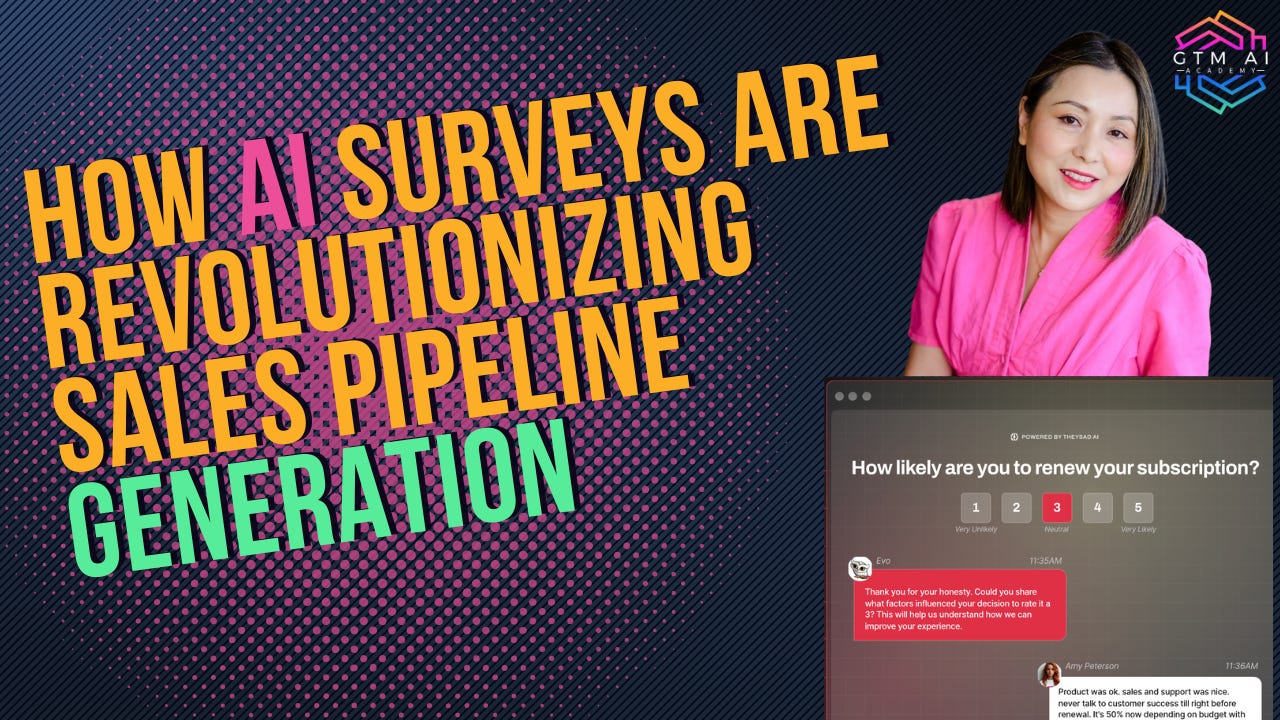
To Start, we are doing a GTM & AI 2024 Survey and will be publishing a report in January. We partnered with Theysaid.io and will be using their AI tech to do the survey! Would love to have you participate, you can either go to this link OR if you want to do this on mobile in voicemode, scan the QR code below
You can go to Youtube, Apple, Spotify as well as a whole other host of locations to hear the podcast or see the video interview.
Again to see this in action and try it yourself, use this link or scan the QR code.
I interviewed Lihong Hicken ,CEO and co-founder of TheySaid | World's 1st AI Survey who shared how her company is transforming traditional survey methods in many ways from customer research, closed loss analysis and how to create pipeline using her AI-powered sales tool.
In Fact, if you want to participate in research around AI for GTM using her tech, go to this link:
The conversation was first a lot of fun and show how she evolved from her experience at User Testing and engineering productivity firms. Her journey from being an intern who built desks to becoming a CEO provides context for her innovative approach to sales and revenue generation.
The core innovation lies in using AI surveys not just for feedback, but as sophisticated sales tools. Lihong demonstrated how their platform engages prospects through casual, conversational surveys that simultaneously qualify leads and gather market intelligence. This approach has proven particularly effective for understanding customer needs, predicting churn, and identifying upsell opportunities before they become apparent through traditional product usage metrics.
She detailed how companies use her tool for win/loss analysis, customer sentiment tracking, and sales pipeline building. She emphasized that traditional survey methods, while good at counting numbers, fail to capture the depth of customer sentiment that AI-driven conversations can achieve.
"The best salesperson asks good questions. Why not let AI ask these questions at scale?"
"Most companies wait until customers leave to ask why. You should be asking before they leave."
"You don't want a general AI chatting with your customer. You want it to be YOUR employee, trained with your company information."
"Sales is about understanding people... you need to understand first."
"If you can handle things at the speed of yearly reviews, great. But CRO is the most fired job ever. You need to act fast."
"You're thinking like, if you go to the market, you understand what they think, what language they use, what their concern is... you build a product to fit their use case and their pricing expectation - how can you not win?"
For sure worth a listen with her out of the box method.
OpenAI is dropping bombs during it’s December announcements so far we have:
1. Sora: Text-to-Video Generation Model (more in depth below)
On December 9, OpenAI launched Sora, a text-to-video AI model that enables users to generate high-definition video clips from textual descriptions. Sora can also animate still images and extend existing videos by filling in missing frames. Initially previewed in February 2024, Sora is now accessible to ChatGPT Plus and Pro subscribers at no additional cost. However, its availability is currently limited, with plans to expand to the European Union, Switzerland, and the United Kingdom in the future.
2. o1: Advanced Reasoning AI Model
Earlier in December, OpenAI released o1, an AI model designed to enhance complex reasoning capabilities. Unlike previous models, o1 employs a “chain of thought” reasoning technique, allowing it to evaluate and revise its outputs for improved accuracy. This approach makes o1 particularly effective in tasks requiring verifiable solutions, such as debugging computer code. OpenAI offers o1 through a subscription plan, ChatGPT Pro, priced at $200 per month, which includes unlimited access to this advanced model.
3. “12 Days of OpenAI”: A Series of Product Announcements
Starting December 5, 2024, OpenAI initiated the “12 Days of OpenAI,” a series of daily livestreams featuring new product reveals and demonstrations. This event showcases OpenAI’s latest developments and provides insights into upcoming AI technologies. The series is scheduled to continue through December 23, offering a platform for OpenAI to engage with users and highlight its innovations.
News Highlights:
Deep Dive Review: OpenAI’s Sora – The Future of AI Video Generation?
OpenAI is officially stepping into the generative video space with Sora, its AI video-generation model. This tool lets users create high-definition video clips by simply typing a description, much like its sibling tool, DALL-E, does for images. The ability to extend videos, blend scenes, and even fill in missing frames adds depth to its capabilities. While the launch of Sora in the U.S. and many other countries signals a new frontier in generative AI, it’s not without controversy or challenges.
The Goods
1. Multimodal Creativity at Scale
Sora continues OpenAI’s push toward multimodality by combining text, image, and video generation. This opens up endless possibilities for creators to experiment with dynamic storytelling, visual narratives, and even functional use cases like video presentations or product demos.
2. Advanced Features
The “Blend” feature and the ability to fill in missing frames are standout capabilities. For content creators, marketers, or businesses, these features reduce the need for complex video editing software, allowing seamless transitions and smoother workflows.
3. Cost Inclusion
Sora is included in existing ChatGPT Plus and Pro plans, making it accessible to users without additional costs. This lowers the barrier to entry for experimenting with high-quality AI-generated video.
4. International Rollout
While Sora is debuting in the U.S. and other countries, its international reach positions OpenAI as a major player in the video AI space. This broad launch strategy could accelerate adoption and feedback loops.
5. Creative Applications
From enhancing video marketing campaigns to creating training materials and immersive storytelling, Sora offers businesses and creators new ways to engage audiences.
The Bads
1. Safety and Ethical Concerns
Sora’s potential for misuse—such as creating deepfakes or misleading videos—is significant. With the proliferation of AI-generated misinformation, especially during political elections, OpenAI faces immense pressure to enforce robust safeguards.
2. Limited Transparency
The backlash from early testers and artists highlights concerns about OpenAI’s approach to community engagement. The accusations of “art washing” and unpaid labor may hurt OpenAI’s reputation within the creative community, potentially deterring future collaboration.
3. Compute-Heavy Model
Generating high-definition videos is computationally expensive, raising questions about scalability. Users with limited hardware resources may find performance uneven, and OpenAI itself may face challenges in managing infrastructure costs as adoption scales.
4. Limited Geographic Availability
The delayed rollout to Europe and the U.K. leaves a significant market segment untapped, potentially allowing competitors like Google’s Lumiere or Stability AI’s Stable Video Diffusion to gain ground.
5. Dependency on Feedback
While OpenAI relies on red-teamers and early testers to refine the model, the lack of structured incentives for contributors risks undermining the model’s evolution.
Revenue Impact
1. Market Differentiation
Sora positions OpenAI as a frontrunner in generative video, competing with offerings from Meta, Google, and Amazon. By expanding its portfolio, OpenAI strengthens its market share in the rapidly growing generative AI sector, predicted to top $1 trillion in revenue within the next decade.
2. Monetization Potential
By including Sora in ChatGPT Plus and Pro plans, OpenAI incentivizes subscriptions, driving steady revenue growth. Offering advanced features in future paid tiers could further monetize this technology.
3. Corporate Adoption
Businesses looking for innovative marketing tools or cost-effective video production solutions could adopt Sora to streamline campaigns. This could drive adoption in industries like advertising, e-commerce, and education, contributing to OpenAI’s bottom line.
4. Partnerships and Licensing
The ability to integrate Sora with existing platforms (e.g., Adobe Creative Suite, YouTube) creates potential licensing opportunities, further diversifying revenue streams.
5. Competitive Edge
Sora’s advanced features, like blending and frame filling, give OpenAI a competitive edge over existing players. If executed well, this could attract high-profile corporate clients, accelerating growth in enterprise adoption.
Potential Use Cases for GTM Professionals
1. Content Marketing: Use Sora to generate engaging video campaigns tailored to different audience segments, reducing production costs and time.
2. Training and Onboarding: Create high-quality training videos or e-learning content to onboard employees or educate customers on new products.
3. Customer Engagement: Enhance product demos or presentations with AI-generated visuals, making pitches more compelling.
4. Social Media Campaigns: Generate short-form videos for platforms like Instagram, TikTok, and LinkedIn, leveraging Sora’s creativity to capture audience attention.
5. Event Coverage: Repurpose still images and text into dynamic event highlight reels or promotional materials.
Conclusion
Sora represents an exciting evolution in generative AI, offering users the ability to create sophisticated video content with minimal effort. Its multimodal capabilities, advanced features, and accessibility make it a valuable tool for creators, businesses, and GTM professionals. However, ethical concerns, transparency issues, and the potential for misuse highlight areas that OpenAI must address to build trust and foster broader adoption.
The revenue potential is immense, especially if OpenAI can position Sora as an indispensable tool across industries. For GTM professionals, Sora is a tool to watch closely—it could redefine how businesses create and share visual narratives, offering opportunities for efficiency, innovation, and deeper audience engagement.
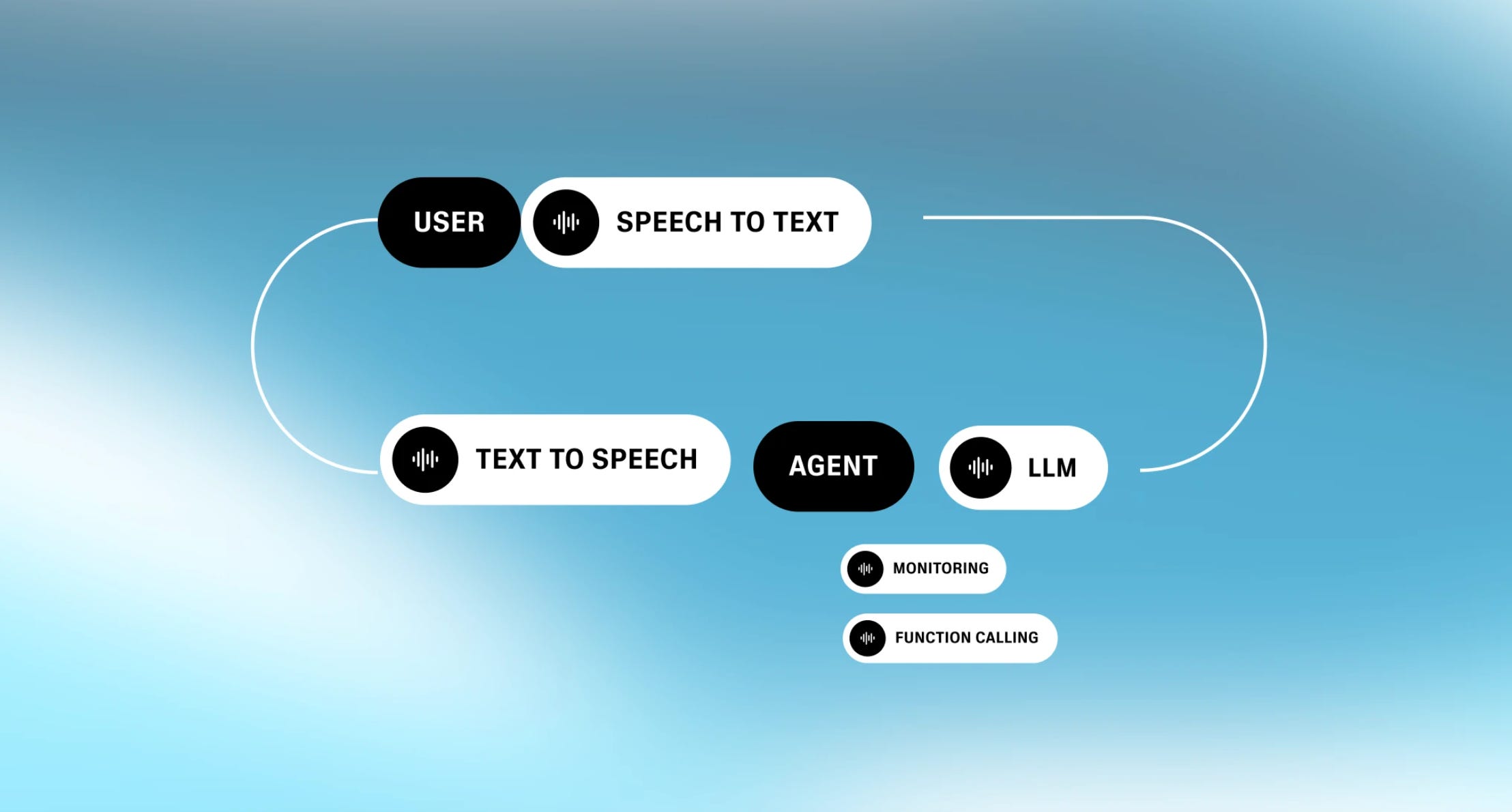
ElevenLabs has unveiled its Conversational AI platform, designed to facilitate the creation of customizable, interactive voice agents. This platform integrates advanced Text-to-Speech (TTS) and Speech-to-Text (STT) technologies with large language models (LLMs), enabling applications such as outbound sales dialers, scheduling assistants, interactive game characters, tutors, and customer support agents.
Key Features:
• Low Latency: The platform minimizes server calls, ensuring prompt responses and a seamless user experience.
• Natural Conversation Flow: Employing real-time models, it adeptly manages turn-taking and interruptions, predicting when a speaker has concluded to maintain fluid dialogues.
• Simplified Customization: Users can focus on building knowledge bases, crafting system prompts, connecting applications via function calling, and selecting or cloning voices from ElevenLabs’ extensive library.
• Advanced Integration: Features include native Twilio integration for call handling, both server-side and client-side tool calling for flexibility, and dynamic prompting to facilitate personalized conversations.
Strengths:
• Versatility: The platform’s adaptability across various applications makes it a valuable asset for businesses aiming to enhance customer engagement through interactive voice agents.
• User-Friendly Setup: By streamlining technical configurations, it allows users to concentrate on customizing their agents without extensive technical expertise.
• Realistic Voice Output: Leveraging ElevenLabs’ TTS technology, the platform delivers natural-sounding, emotionally rich speech, enhancing user interaction quality.
Potential Limitations:
• Dependence on Data Quality: The effectiveness of conversational AI agents is contingent upon the quality of data used in training and deployment. Inadequate or biased data can lead to suboptimal performance.
• Integration Complexity: While the platform offers various integration options, aligning it seamlessly with existing systems may require significant effort and technical proficiency.
Revenue Impact:
Implementing ElevenLabs’ Conversational AI can lead to substantial revenue growth by:
• Enhancing Customer Engagement: Interactive voice agents can provide personalized experiences, increasing customer satisfaction and loyalty, which can drive repeat business and higher lifetime value. • Reducing Operational Costs: Automating routine tasks with voice agents can decrease the need for human intervention, leading to cost savings in customer service and support operations.
• Expanding Market Reach: The platform’s multilingual capabilities enable businesses to cater to a broader audience, potentially opening new revenue streams in diverse markets.
In summary, ElevenLabs’ Conversational AI platform offers a comprehensive solution for developing interactive voice agents, with the potential to enhance customer engagement and operational efficiency, thereby positively impacting revenue.
Deep Dive Review: Meta’s Llama 3.3 70B – A Game-Changer for Open AI Models
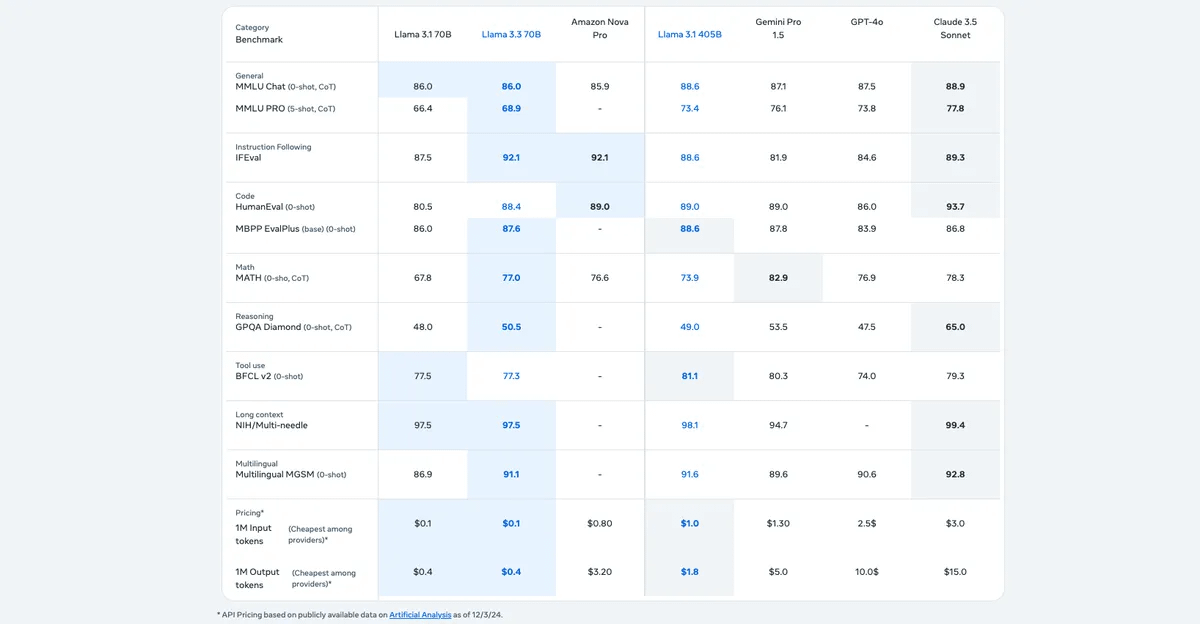
Meta’s release of the Llama 3.3 70B model signals a significant step forward for open AI models. With benchmarks rivaling—and in some cases outperforming—proprietary giants like OpenAI’s GPT-4o and Google’s Gemini Pro 1.5, Llama 3.3 underscores the growing capabilities of open-source frameworks. This release is particularly exciting for developers and enterprises seeking customizable AI solutions that balance cost, performance, and control.
The Goods
1. Competitive Performance
Llama 3.3’s benchmarks place it near the older 405B parameter Llama 3.1 model, with specific metrics exceeding those of major closed systems. This level of performance demonstrates that open models are not just catching up—they’re leading in certain areas.
2. Accessibility and Cost-Effectiveness
Unlike proprietary models, Llama 3.3 is designed for local use, meaning users can deploy it on consumer-grade hardware with minimal VRAM requirements. This dramatically reduces the entry barrier for developers and businesses, allowing high-quality AI deployment without cloud reliance or expensive infrastructure.
3. Fine-Tuning and Customization
The model’s open nature means it’s highly adaptable. Developers can fine-tune it, add language support, and extend capabilities to meet specific needs. This flexibility is evident in the 60,000+ derivative models already available on Hugging Face.
4. Broad Adoption Across Industries
Llama’s user base includes both large enterprises like Goldman Sachs, Accenture, and Shopify, and smaller-scale developers. Use cases span customer support, software engineering, data analysis, and beyond, proving the versatility of the model.
5. Strong Ecosystem
With over 20 million downloads in August alone, the Llama ecosystem is thriving. The growing library of derivatives and widespread adoption by both cloud and on-premise users reinforce Meta’s leadership in the open model space.
The Bads
1. Limited Language Support
While Llama 3.3 supports eight languages, this falls short compared to other models with broader linguistic capabilities. Users with diverse language needs may face challenges unless they invest in further fine-tuning.
2. Hardware Limitations for Advanced Users
Though the model is optimized for consumer-grade hardware, larger or more complex implementations may still require powerful GPUs, which can be a hurdle for smaller developers or hobbyists.
3. Cloud vs. Local Tension
While Meta promotes the benefits of local deployment, a significant portion of enterprise users still rely on cloud implementations. This split could limit the realization of the full potential of Llama 3.3’s local-first philosophy.
4. Ecosystem Fragmentation
The sheer number of derivative models—over 60,000—can make it overwhelming for users to identify the best fit for their needs. A more curated or categorized repository might enhance accessibility.
Revenue Impact
1. Cost Savings for Enterprises
Enterprises using Llama 3.3 can reduce costs by deploying models locally, avoiding recurring cloud fees. For smaller teams, this means accessing top-tier AI without breaking the budget.
2. Accelerated Development Cycles
The ease of fine-tuning and customizing Llama 3.3 enables businesses to deploy AI solutions faster, reducing time-to-market for products and services.
3. Increased Efficiency Across Use Cases
From customer support to data analysis, Llama 3.3 drives automation and operational efficiency. Enterprises like Zoom and DoorDash are already leveraging it to improve workflows, creating tangible cost and time savings.
4. Democratization of AI
By making cutting-edge AI accessible to developers with modest hardware, Meta expands the AI user base. This increased adoption could spur innovation across industries and unlock new revenue streams for businesses of all sizes.
5. Marketing Value for Meta
The widespread adoption of Llama strengthens Meta’s position as a leader in general-purpose AI, indirectly driving interest in its other products, including Meta AI, which now boasts over 600 million monthly users.
Use Cases for GTM Professionals
1. Customer Support Optimization: Deploy Llama-powered AI agents to handle high volumes of customer inquiries with speed and accuracy.
2. Sales Enablement: Use Llama 3.3 to analyze CRM data and provide sales teams with actionable insights for account management and prospecting.
3. Localized Marketing Campaigns: Fine-tune the model to generate personalized content in supported languages for region-specific campaigns.
4. Data Analysis and Forecasting: Automate the analysis of large datasets to identify trends and make strategic business decisions.
5. Content Creation: Leverage Llama 3.3 for generating high-quality written or multimedia content, reducing production time for marketing teams.
Final Thoughts
Meta’s Llama 3.3 70B represents a bold step forward in open AI models, closing the gap with—and in some cases surpassing—proprietary counterparts. Its performance, flexibility, and accessibility make it an invaluable tool for developers and enterprises seeking to integrate AI into their workflows. While challenges like language support and hardware requirements remain, the benefits far outweigh the drawbacks.
For GTM professionals, Llama 3.3 offers opportunities to streamline operations, enhance customer engagement, and unlock new revenue channels. By embracing open models like Llama, businesses can achieve greater control and efficiency while staying at the forefront of AI innovation. This release cements Meta’s status as a key player in the AI landscape and sets the stage for what’s next in open AI.
LEAi, developed by LearnExperts, is an AI-powered tool designed to streamline the creation of structured training content by transforming existing materials—such as documents, presentations, and videos—into comprehensive learning programs. This facilitates the rapid development of eLearning modules, instructor-led training, and various educational resources.
Advantages:
• Accelerated Content Development: LEAi enables users to produce training materials up to three times faster than traditional methods by automating the generation of learning objectives, content, and assessment questions. (Learn Experts)
• Ease of Use: Users have reported that LEAi is intuitive, allowing for quick adaptation and efficient content creation. (Capterra)
• Versatility in Content Formats: The platform supports various media types, enabling the repurposing of content across multiple platforms and mediums. (Capterra)
• AI-Generated Assessments: LEAi can automatically generate test questions, significantly reducing the time required to develop assessments. (Capterra)
Disadvantages:
• Learning Curve for Advanced Features: While basic functionalities are user-friendly, mastering advanced features may require additional time and effort. (Capterra)
• Dependence on Input Quality: The effectiveness of LEAi’s output is contingent upon the quality of the input materials; substandard source content may lead to less effective training materials.
Potential Revenue Impact:
By expediting the content development process, LEAi enables organizations to deploy training programs more swiftly, leading to faster onboarding of employees, customers, and partners. This acceleration can result in increased productivity and quicker revenue generation. Additionally, the ability to rapidly update and repurpose content ensures that training materials remain current, potentially enhancing customer satisfaction and retention rates.
User Testimonials:
Users have expressed satisfaction with LEAi’s capabilities:
• “LEAi was easy to use right from the first time! Having developed courses for years in other tools that were prevalent in the industry, I was blown away when I used LEAi to pull together a course—it was so easy to create content in a meaningful structure from disparate sources of content.” (Capterra)
• “Before LEAi, we would take hours or days to review and extract information from videos to get the content we needed to create a piece of content. That’s usually stuff buried deep in documentation or someone’s brain. LEAi helps to surface this information quickly and easily.” (Capterra)
Pretty cool tech and another way to see impact fast as a result of AI properly used. I hope to have a demo for the library approved soon ;)
Here are some key features and benefits of LEAi:
1. Content Transformation: LEAi takes existing content like documents, presentations, web content, and videos, and converts them into learning objectives and structured course content.
2. Automated Content Generation: The tool automatically generates learning objectives, course content, and assessment questions, significantly reducing the time needed to create courses.
3. Multiple Output Formats: Content created with LEAi can be used for various purposes, including eLearning, instructor-led training, microlearning, and video scripts.
4. LearnAdvisor Feature: This patented feature continuously checks for learning best practices and suggests improvements to the content.
5. Time-Saving: Users report being able to create courses up to 3 times faster with LEAi compared to traditional methods.
6. Content Protection: Unlike open-source AI tools, LEAi doesn't allow your company's information to become part of the public domain, protecting your intellectual property.
While there isn't a demo video available, the LearnExperts website offers detailed information about how LEAi works and its benefits. If you're interested in seeing the tool in action, you might want to contact the company directly to request a personalized demo or trial of the software.
For more in depth look, go to the www.gtmaipodcast.com for in depth look at some key articles for free ;)