

Welcome everyone! This week we will have 2 podcasts coming out because of how relevant they are and to make sure they are the latest and greatest for you to have in this ever changing AI world.
As a reminder, we will always offer this GTM AI Podcast and Newsletter with its assets or giveaways for free. We have a library of strategic and tactical video walk throughs of anything from tech guides, to connecting multiple systems together, to how to set up advanced multi agent frameworks that you can do in the paid level.
You are welcome to join us anytime!
For now, lets get into this weeks podcast with the CEO of Spara, David Walker.
For 20 years, your revenue was capped by how many humans you could put on a phone.
That constraint is gone.
I just recorded a podcast with David Walker, co-founder and CEO of Spara, and he did not mince words: “If you don’t have an agentic front door, you basically don’t have a front door at all.” Every buyer now starts discovery inside an LLM. They leave ChatGPT, click through to your site, and hit a form from 2008. That is not a front door. That is a dead end.
Here is what pays for your read today.
1. Stop only automating Salesforce fields. Start rebuilding the motion.
The single biggest mistake David sees in GTM leaders: “I have my old human-led motion, I just want to automate one small piece.”
His counter is a thought exercise I’m stealing immediately. He sits executives down and asks: “Your sales team just 10X’d for free, starting tomorrow. What do those 90 new people do?”
Nobody answers “update a Salesforce field.”
They answer: “Talk to every person on our website. Run every ICP research play. Follow up on every raised hand in real time. Run the 90-day upsell motion with the right signals, not blasts.”
That list IS your new GTM motion. AI agents are how you build it without hiring 90 people. The strategy unlock is not “make the old thing faster.” It is “design the motion that would have been impossible and now isn’t.”
Run the 10X exercise on your own team this week.
Audit each item on the list and ask “is a human the highest and best use, or is an agent?”
Sequence the build order by revenue impact, not by what’s easiest to automate.
2. Lean INTO “this is AI.” Conversion goes up.
When Spara launched, customers were split 50/50 on whether their agent should disclose it was AI.
Today it’s 99% AI-disclosed.
The reason is counterintuitive: buyers get MORE direct when they know it’s an agent, not less. They stop performing. They drop the dance. They say: “Here are the 3 things I care about in this procurement process. Can you do them?”
Now your AE walks into the first call already holding the map of the deal. The pre-call discovery work that used to take three touches happened in 30 seconds on a call the prospect wanted.
Default your inbound agents to disclose.
Lead the conversation with value prop + reason: “I want to get you to the right person fast. Can I ask three questions?”
Capture the buyer’s stated priorities verbatim and route them to the AE notes before the first meeting.
3. The Kayak vs Wedding Planner filter.
GTM leaders keep asking the wrong question: “Will buyers want to talk to AI?”
Reframe it. Every moment in your funnel is either a Kayak moment or a Wedding Planner moment.
Kayak moments are high-frequency, low-consequence, I-want-an-answer-right-now moments. Form fills. “Do you have voice AI?” replies. Pricing questions. Usage-based upsell triggers. Buyers 100% want an agent here, because the alternative is waiting 8 hours for a human to email back and the buyer has already context-switched.
Wedding Planner moments are low-frequency, high-consequence, I-want-a-human-physically-present moments. Executive business reviews. Enterprise procurement. The close call on a seven-figure deal. Keep humans on these.
The fatal error is mushing the whole funnel into one answer. Deploy humans in high-leverage, high-consequence moments. Deploy agents everywhere else. The customers David shared results from are not running “AI-only” or “human-only” motions, they’re running hybrid motions with every moment mapped.
Map your inbound funnel moment by moment.
Tag each as Kayak or Wedding Planner.
Deploy the right instrument to each.
4. The results are not incremental.
David shared two case studies on the show. Both are instructive because they attack different sides of the funnel.
The first: a company with a flood of low-tier free users clogging the “Contact Us” form and starving the sales team of real enterprise MQLs. Spara was deployed on inbound. Qualified MQL rate went up 3X. Unqualified junk dropped 80%. The low-tier users actually left happier because they got their answer immediately instead of being disqualified by an SDR. The sales team got more of the right conversations. Win-win-win.
The second: a company that deployed a chat agent and started booking 50% more qualified meetings on the same traffic. The result was not that they fired reps. They hired more reps because the pipeline outgrew the team. The AI expanded the business; it didn’t shrink the headcount.
Two different failure modes solved by the same move: put a conversational agent where there used to be a dead end.
The tactical shift:
This week: Walk your own inbound journey as a buyer. Every moment you hit a dead end, flag it.
This month: Run the 10X Horsepower exercise with your leadership team. Write down the motion the new people would build.
This quarter: Stand up ONE conversational agent at the highest-intent dead end on your site. Measure qualified meeting lift + AE notes richness.
Don’t try to boil the ocean. Pick the single moment where a buyer today raises their hand and nobody’s there. Put an agent there. Watch the KPIs move.
My challenge to you this week: stop optimizing the old motion. Redesign the one you’d have built if capacity was never the constraint. Because starting now, it isn’t.
To help you run this yourself, I built a free 10X Horsepower Workshop kit down below which is a complete 90-minute facilitated session for your leadership team. Pre-work, agenda, prompts, worksheets, facilitator notes, 30-day commitment template. Works whether you use Spara, a competitor, or nothing at all. Download in the link below.
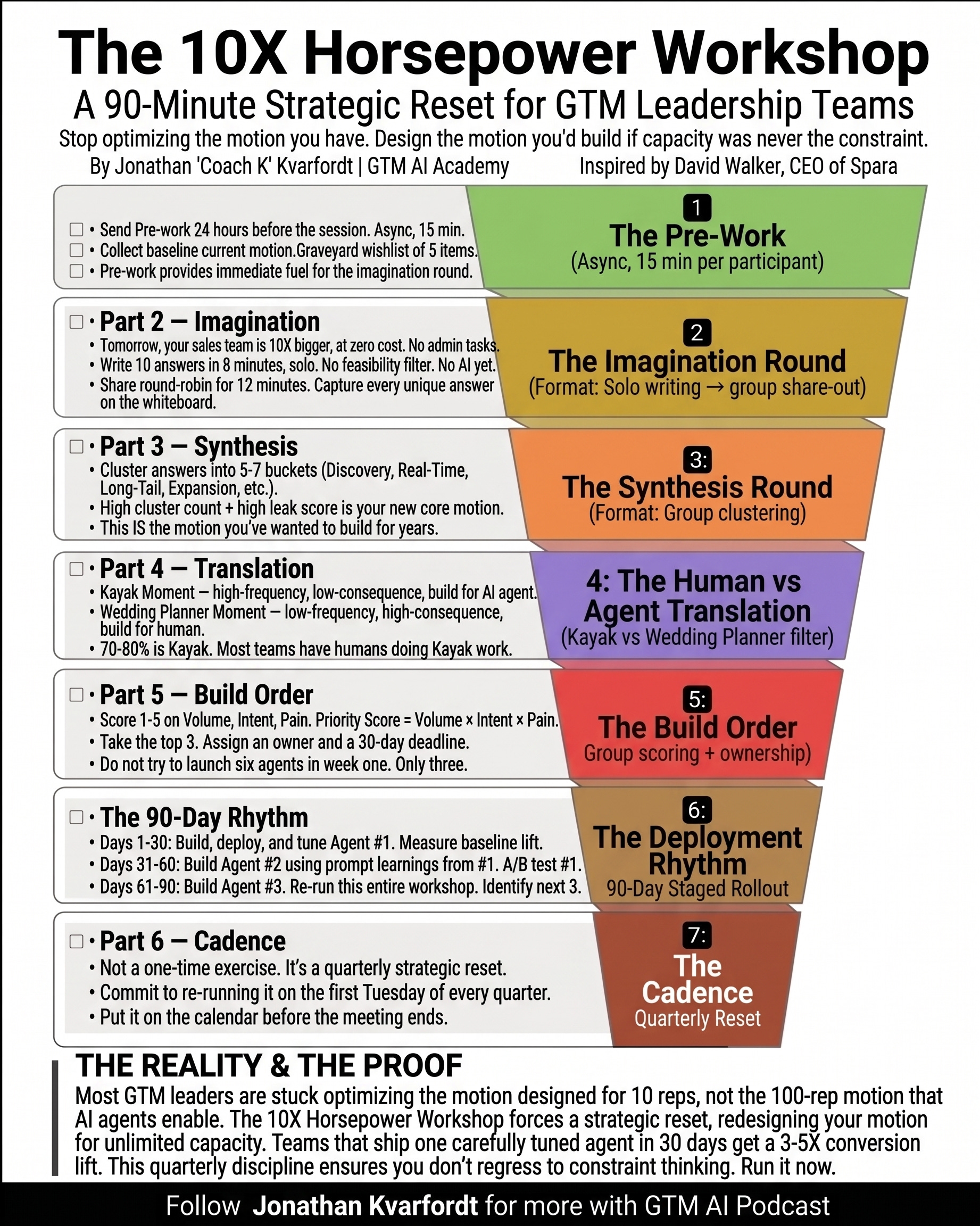
The 10X Horsepower Workshop
A 90-Minute Strategic Reset for GTM Leadership Teams
Stop optimizing the motion you have. Design the motion you’d build if capacity was never the constraint.
By Jonathan “Coach K” Kvarfordt | GTM AI Academy Inspired by David Walker, CEO of Spara
Why This Workshop Exists
Most GTM leaders are stuck in constraint thinking.
You inherited a sales motion that was designed for 10 reps. You hire faster. You add tools. You optimize calls per day. You ask AI to “automate one small piece” of the existing motion. The math gets slightly better. The motion stays the same.
Meanwhile, the company that out-executes you next year is not running your motion 10% faster. They’re running a different motion. They redesigned what good looks like the moment they realized capacity was no longer the constraint.
This workshop is the forcing function.
It comes from a conversation with David Walker, CEO of Spara, who runs this exercise with executive teams every week. The prompt is simple. The shift it creates is not.
“Your sales team just 10X’d in size, starting tomorrow, at zero additional cost. You went from 10 reps to 100 reps. Headcount, comp, ramp — all free. What do those 90 new people do?”
Nobody answers “update Salesforce fields.” That’s the point. The answers reveal the motion you would build if you weren’t trapped by today’s headcount math.
This kit gives you everything to run that exercise with your leadership team in 90 minutes and includes an agenda, prompts, worksheets, facilitator notes, and a 30-day commitment template.
Who This Is For
CROs and VPs of Sales rethinking GTM strategy
CMOs aligning marketing motion to a redesigned sales motion
RevOps leaders building the operating system that supports the motion
Founders preparing for the next stage of GTM scale
Heads of CS thinking about expansion as a discipline, not an afterthought
You’ll get the most value running this with 4-8 cross-functional GTM leaders in one room (or one Zoom), with a sharp facilitator and the agreement that nothing is feasibility-gated until Round 4.
The Setup (Read Before You Run It)
Why this exercise works.
Constraint thinking is invisible. You don’t know you’re inside it. When asked to “improve the sales motion,” your brain auto-generates ideas that fit within today’s capacity envelope. The prompt is pre-filtered. The answers are incremental.
When you remove the capacity constraint explicitly and dramatically, the brain has to reach for ideas that were previously impossible. Those ideas are not random. They are the highest-value moves you’ve been quietly suppressing because there was no one to do them.
Your job in this workshop is to surface those moves and then translate them into a real motion using AI agents and humans in the right roles.
The four most common executive responses (and what to do).
“That’s not realistic.” Cut them off politely. Round 2 is not for feasibility. They get to push back in Round 4. Until then, force imagination.
“We’d just have them do more of what we do today.” Probe twice. “More what? Calls to whom? Saying what?” Specificity surfaces the real wishlist.
“AI can’t actually do that.” Park it. Round 4 handles the human-vs-agent split. Round 2 is purely about identifying the work.
“This is just a thought exercise.” Yes. And the output is a real 90-day motion. Stay disciplined and they’ll see it by Round 5.
What you need.
90 minutes (60-minute express version included below)
A whiteboard or shared doc
One participant per cross-functional GTM lead (4-8 people total)
A facilitator who will keep rounds tight and protect the no-feasibility rule
Pre-work sent 24 hours in advance (Part 1 below)
Part 1 — Pre-Work
Format: Async, 15 min per participant Send: 24 hours before session
Drop this into a Slack DM or email to each participant:
Subject: Pre-work for our GTM strategy reset (15 min)
Before we meet, please complete the worksheet attached. Two parts:
(a) Baseline. In 3 sentences, describe your team’s current motion. What do reps actually spend their time on? Be honest, not aspirational.
(b) The graveyard. List 5 things you wish your team did but they don’t have time for. Examples: “follow up on every doc-page view,” “run discovery on every dormant account quarterly,” “respond to every inbound at 9pm.” No filter. No judgment.
Bring both to the session. We’ll start there.
The pre-work matters because it gets everyone past the warming-up phase. They arrive with a baseline AND a wishlist, which means Round 2 has fuel from the first minute.
Pre-Work Worksheet
Question Answer (a) In 3 sentences, what does your team’s current motion actually look like day-to-day? (b1) Wish-list item #1 — what would you have your team do if they had time? (b2) Wish-list item #2 (b3) Wish-list item #3 (b4) Wish-list item #4 (b5) Wish-list item #5
Part 2 — The Imagination Round
Format: Solo writing → group share-out Duration: 20 min (8 min solo + 12 min share)
This is the David Walker prompt. Read it out loud, exactly:
“Tomorrow, your sales team is 10X bigger. You went from your current headcount to 10 times that, at zero additional cost. No ramp time. No comp impact. They show up tomorrow ready to work.
The only rule: don’t tell me about Salesforce field updates or admin tasks. I want to know what those new people actually DO with customers and prospects.
You have 8 minutes. Solo. Write 10 answers. No filter, no feasibility, no thinking about AI yet.”
Run it solo first. Group brainstorm corrupts the output. You want individual lists.
The Imagination Worksheet
# If I had unlimited rep capacity, my 90 new people would… 1 2 3 4 5 6 7 8 9 10
After 8 minutes, share round-robin for 12 minutes. Each person reads their list. Capture every unique answer on the whiteboard. Don’t debate. Just capture.
Facilitator watch-fors:
Anyone says “automate” immediately flag it. That’s constraint thinking. Push them.
Multiple people say the same thing, then note the cluster. That’s signal.
Someone is stuck, feed them a category prompt: “What about your dormant pipeline? Your free users? Your inbound at midnight?”
You should end Round 2 with 30-60 unique items on the board.
Part 3 — The Synthesis Round
Format: Group clustering Duration: 20 min
Now you cluster the answers into a small number of categories. Walk the board with the team and group items into 5-7 buckets. The categories almost always emerge as some version of:
Discovery & Research (account, persona, intent, competitor signals)
Real-Time Engagement (inbound response, in-product chat, after-hours)
Long-Tail Coverage (dormant accounts, free tier, second-tier ICP)
Expansion & Retention (usage signals, upsell triggers, renewal prep)
Content & Enablement (custom proposals, follow-ups, demo prep)
Signal & Intelligence (competitive moves, buyer behavior, deal risk)
Synthesis Worksheet
Category # items in cluster Highest-value example Estimated leak today (gut, 1-5) Discovery & Research Real-Time Engagement Long-Tail Coverage Expansion & Retention Content & Enablement Signal & Intelligence (Other)
This output IS your new GTM motion. The categories with the highest cluster count + highest leak score are the parts of your motion you’ve been silently writing off because nobody had time to do them.
Reframe — read out loud:
“Look at the board. None of you said ‘automate one Salesforce field.’ You said ‘talk to every buyer,’ ‘follow every signal,’ ‘engage every dormant account.’ This is the motion you’ve been wanting to build for years and have been blocked from building by capacity. Today we’re going to build it.”
Part 4 — The Human vs Agent Translation Round
Format: Pair work or full group Duration: 20 min
Now you re-introduce a constraint, but it’s a new one. Not “how many humans can we afford” but “which moments demand a human vs which can be done better, faster, and 24/7 by an agent?”
Use the Kayak vs Wedding Planner filter (David’s framing):
Kayak Moment — high-frequency, low-consequence, “answer me right now.” Buyer’s willingness to wait is near zero. Build for AI agent.
Wedding Planner Moment — low-frequency, high-consequence, buyer wants a human present. Build for human.
Hybrid Moment — AI first touch + human handoff at qualification.
Translation Worksheet
One row per high-value item from Part 3.
Item from synthesis K / W / H If AI: what tool category does this require? If Human: what lower-value work do they STOP doing to make room?
The reveal. When the team finishes this worksheet, two patterns will jump out:
70-80% of your wishlist is Kayak or Hybrid. Those are the items where AI agents make the previously impossible motion possible.
The 20-30% that’s pure Wedding Planner is what your humans should be exclusively doing. Most teams currently have humans doing 80% Kayak work and 20% Wedding Planner work. That’s the inversion.
This is the moment the room shifts. Executives stop debating “if” and start debating “in what order.”
Part 5 — The Build Order
Format: Group scoring + ownership assignment Duration: 15 min
You have a list. Now make a plan.
For each AI-tagged item in Part 4, score 1-5 on three dimensions:
Volume: How many buyers/accounts does this affect per month?
Intent: How qualified is the buyer at this moment? (5 = ready to buy, 1 = casual reader)
Pain: How obvious is the leak today? (5 = AEs visibly losing deals here, 1 = nobody notices)
Priority Score = Volume × Intent × Pain
Build Order Worksheet
Item Volume (1-5) Intent (1-5) Pain (1-5) Score Owner Build by
Take the top 3. Assign an owner. Assign a 30-day deadline.
The discipline: only three. Teams that try to launch six AI agents in week one do not get 3-5X conversion lift. Teams that ship one carefully tuned agent in 30 days, then learn from it before shipping the second, do.
The 90-Day Rhythm
Days 1-30: Build, deploy, and tune Agent #1. Measure baseline lift.
Days 31-60: Build Agent #2 using prompting + tone learnings from #1. Begin A/B testing #1.
Days 61-90: Build Agent #3. Re-run this entire workshop with the team. Identify next 3.
Part 6 — The Cadence
Duration: 5 min
This is not a one-time exercise. It’s a quarterly reset.
Every quarter, capacity unlocks somewhere — a new agent ships, a manual process gets eliminated, a team member moves up. The motion you can build keeps expanding. If you only run the 10X Horsepower exercise once, you’ll re-anchor to your new constraint within a quarter.
The commitment to make in the room (read it out loud, get verbal yes):
“We will re-run this exercise on the first Tuesday of every quarter. Same prompt. Same imagination round. We will re-build the motion every 90 days because our capacity envelope keeps changing and our motion should change with it.”
Put it on the calendar before the meeting ends. Without the cadence, you’ll regress to constraint thinking by next quarter.
The Express Version (60 Minutes)
If you can only get 60 minutes:
Round Time Notes
Part 1 — Pre-work Async Mandatory. Skip and the session collapses.
Part 2 — Imagination 15 min Cut to 5 min solo + 10 min share
Part 3 — Synthesis 15 min
Part 4 — Translation 15 min
Part 5 — Build Order 12 min
Part 6 — Cadence 3 min
Same outputs. Less debate room. Use only if executive calendars don’t allow 90.
What to Do With the Output
Within 24 hours of the session, the facilitator should:
Send the build order table to all participants with owners + deadlines locked in
Schedule the 30 / 60 / 90-day check-ins on calendars
Schedule the next quarterly reset (90 days out)
Identify a single executive sponsor for each of the top 3 agents — usually the leader whose function is most affected
Capture the synthesis board as a photo or doc — this becomes the artifact you reference for the rest of the year
Common Failure Modes
The room debates feasibility in Round 2. Facilitator’s job: “We’ll get there in Round 4. Right now, write what you’d do.”
Everyone defaults to “more outbound.” Probe: “More outbound to whom? Saying what? Triggered by what?” Specificity wins.
No one writes 10 answers. Time pressure helps. Hard 8-minute timer.
The team picks 6 priorities instead of 3. Cut. Ruthlessly. Three or fewer in the first 90 days, every time.
No quarterly cadence is scheduled. This is the single most common failure mode. Without a calendared re-run, the motion ossifies.
My Challenge to You
Run this in the next two weeks. Not next quarter. Not after planning season. The teams that out-execute you in 2026 are running this exercise right now, and they will have shipped their first three agents before your next QBR.
Block the 90 minutes. Send the pre-work tonight. The first time you watch a CRO write “talk to every person who lands on our site” and realize that’s now a 30-day deliverable, the room changes.
That’s when you stop optimizing the old motion and start building the new one.
— Coach K
© 2026 GTM AI Academy. Free to use and share. Attribution appreciated.