

Welcome one and all to this weeks GTM AI newsletter, podcast and updates.
In our free tier, you’ll still get:
1. Podcast In-Depth Notes: Key takeaways and actionable insights from each episode.
2. GTM AI Tool of the Week: In-depth reviews and practical applications.
3. Weekly Research Update: Expert analysis of the latest trends in GTM and AI.
Introducing the Paid Tier
For those looking to dive even deeper, we’re launching a premium tier packed with exclusive resources like:
• Advanced AI Prompts and Templates
• In-depth Case Studies and Success Stories
• Video Breakdowns and Exclusive Events
This new structure allows you to choose the level of insights you need to elevate your GTM strategy.
Thank you for being a part of this journey! Let’s continue pushing the boundaries of what AI can do for GTM.
In case you want an audio rundown from my AI Friends Philbert and Sally, here you go:
GTM AI PODCAST AND NEWSLETTER
The newsletter and GTM AI Podcast & Newsletter are sponsored by GTM AI Academy with additions article submissions, and my cohost of Jonathan Moss of AI Powered GTM.
Business Impact> Learning Tools
We have the SLACK COMMUNITY around AI , come hang with your fellow GTM professionals, get insights, and content free to help in your teams and roles.
Now with all that being said, lets move forward with todays newsletter which is:
We have #42 with the the CEO of ProofAnalytics.ai Mark Stouse talking about how casual analytics creates major 8x impact with AI.
To access the rest of the articles and reviews, subscribe for free to the newsletter
TIME on Digital Workers and what is coming
CFO's cannot wait on AI adoption
Digital Reasoning
GTM AI Tool of the week: Rox
Some AI posts from this last week in case you missed it:
Prompt for ICP research or refinement
AI, AI+ Automation, AI Agents, whats the difference?
Impact of Agents coming on GTM teams
AI will kill SAAS as we know it
Now to the podcast!
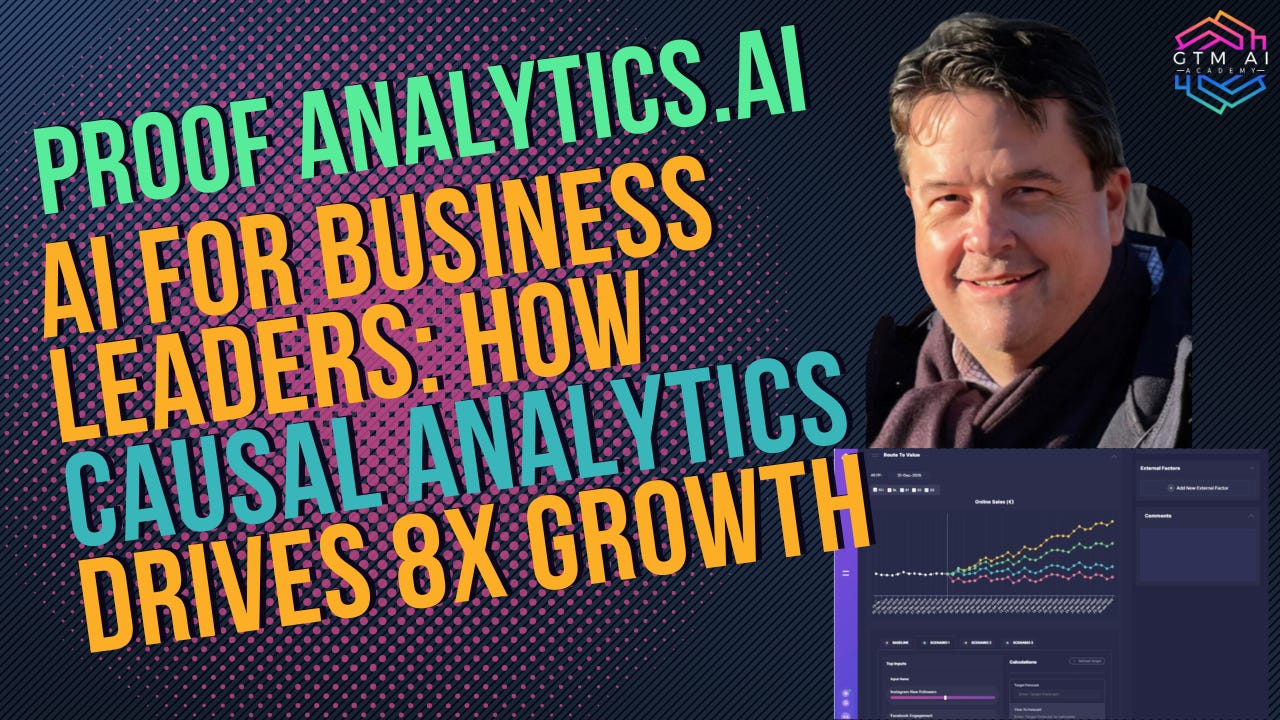
Diving deep into casual analytics and the impact of AI with Mark Stouse of proofanalytics.ai
Here's what struck me most about my conversation with Mark: we've been thinking about AI and analytics all wrong in GTM. We obsess over pipeline metrics, conversion rates, and efficiency gains - but we're missing the bigger picture entirely.
The most jarring insight came when Mark explained the multiplier effect of marketing on sales performance. Think about this: in mid-market companies, effective marketing makes sales eight times more effective and five times more efficient. Let that sink in. As a GTM leader, if you're not measuring and maximizing this multiplier effect, you're leaving massive value on the table.
I've seen this play out countless times in my career. Sales leaders make decisions based on gut feel or limited data points. Mark shared a perspective that hit home:
> "The definition of a good model is how close it gets to real life... They have to confront a whole bunch of assumptions, usually, that they've always made that turned out to not be true."
This resonates deeply with my experience in enablement and revenue operations. We often make assumptions about what drives performance without truly understanding the causal relationships.
Key Insights for GTM Professionals:
1. Your Data Language Matters
When Mark said he's "a corporate UN translator," it clicked for me. Every day, I see RevOps, Sales, and Marketing teams talking past each other because they're using the same words to mean different things. Take this quote:
> "CDOs and CFOs were both using the word 'predictive' and yet it became very clear to me sitting there that they were using it very differently."
As GTM professionals, we need to ensure we're speaking the same language across departments. Your definition of "qualified lead" might be completely different from marketing's definition.
2. The Time Lag Effect
This is crucial for GTM teams. Mark explained how many companies cut marketing because they don't see immediate impact. But here's what really happens:
> "Data becomes a proto-asset that as soon as you use analytics to turn it into something of utility, an insight that helps you make a better decision, that helps you make more money. Then and only then does it become an asset."
In GTM, we need to understand and account for these time lags. That marketing campaign you're running? Its full impact might not show up in your numbers for months.
For GTM Leaders:
1. Rethink Your Analytics Approach
The way we've been measuring GTM effectiveness is outdated. We need to move beyond simple correlation to true causal analytics. This means:
- Understanding external market factors
- Measuring time lag effects
- Identifying true multiplier activities
2. Maximize Your AI Investment
When Mark explained the multiplication effect of AI, it changed how I think about tool adoption:
- High performers + AI = Exponential results
- Average performers + AI = Steady improvement
- Low performers + AI = Minimal impact
This has massive implications for how we deploy technology across our GTM teams.
3. Bridge the Communication Gap
Mark's role as a "corporate UN translator" highlights a critical leadership responsibility. We need to:
- Ensure consistent definitions across teams
- Translate data insights for different stakeholders
- Bridge the gap between technical and business language
A Personal Observation:
What fascinated me most was Mark's description of the market shift:
> "If you're in high school and no one wants to date you and then something happens and everybody wants to date you... that's what it's like."
This perfectly captures the current state of GTM analytics. In the era of easy growth, we could get away with imprecise measurements and gut-based decisions. Those days are over.
Practical Steps for GTM Leaders:
1. Audit Your Current Metrics
- Are you measuring true cause and effect?
- Do you understand the time lag in your key metrics?
- Can you quantify the multiplier effect of your marketing?
2. Evaluate Your Team's AI Readiness
- Identify your high performers who could benefit most from AI tools
- Assess current tool usage and effectiveness
- Plan for capability multiplication, not just efficiency gains
3. Review Your Marketing-Sales Alignment
- Are you measuring marketing's multiplier effect on sales?
- Do your teams speak the same language?
- Have you accounted for time lag in your performance metrics?
The Bottom Line:
As someone deeply involved in GTM strategy, what strikes me most about this conversation is the enormous gap between how we currently operate and what's possible with modern causal analytics. We're entering an era where gut feel and simple metrics won't cut it anymore. The tools exist to truly understand and optimize our GTM operations. The question is: are we ready to embrace them?
Think about it this way: every major decision you make in your GTM strategy has ripple effects that extend months into the future. Without causal analytics, you're essentially flying blind. Mark's insights show us there's a better way - we just need the courage to abandon our outdated assumptions and embrace a more sophisticated approach to GTM decision-making.
This isn't just about having better data - it's about fundamentally transforming how we make decisions in GTM. The future belongs to leaders who can harness these tools to multiply their team's capabilities, not just make incremental improvements in efficiency.

The article, penned by Marc Benioff in TIME, explores a pivotal moment in technology: the dawn of the Agentic Era. This era is defined by the rise of autonomous AI agents capable of performing tasks, making decisions, and driving productivity independently. Unlike predictive or generative AI, which assist humans with insights and content creation, these agents act autonomously, adapting and learning as they execute tasks.
He highlights their transformative potential across industries. Imagine a retail AI agent handling customer inquiries, inventory restocking, and logistics without human oversight. Healthcare agents could ease administrative burdens for overworked providers and support patients post-procedure. Education could see personalized AI tutors for every student. The implications are massive: scaling operations, lowering costs, and redefining how businesses and individuals operate.
Still, this revolution comes with challenges. The need for trust, ethical guidelines, sustainability, and human upskilling is critical. Historical precedents show that while technology disrupts, it also creates unprecedented opportunities. In short, Benioff sees the Agentic Era as a transformative force, unlocking abundance and innovation if approached responsibly.
2. Why This Matters to GTM Teams and Professionals
GTM professionals are standing at the edge of a seismic shift. Autonomous AI agents aren’t just a tech buzzword—they’re operational game-changers. Here’s why this is critical:
• Scale Without People: Agents eliminate bottlenecks. Whether automating lead follow-ups or managing data, they bring scalability without the need for additional human resources.
• Productivity Redefined: With digital agents amplifying your team’s efforts, efficiency skyrockets. Imagine an SDR working alongside an agent that pre-qualifies leads, books meetings, and nurtures prospects automatically.
• Competitive Differentiation: Early adopters who integrate agents into their workflows will deliver faster, better customer experiences, leaving competitors scrambling to catch up.
• Personalization at Scale: Agents enable highly tailored customer journeys, from real-time responses to predictive outreach, creating deeper engagement.
• Budget Efficiency: Fewer human hours spent on repetitive tasks means more resources for strategic priorities.
Agents will force GTM leaders to rethink roles, processes, and outcomes. You either harness this momentum or risk irrelevance.
3. What Takeaways Should People Take
Here’s what this means for you and your team:
• Adopt Early, Learn Fast: The companies thriving in the Agentic Era are those experimenting today. Identify redundant workflows that could be agent-powered and start testing.
• Upskill Continuously: The best teams will combine human creativity and strategic thinking with agent efficiency. Ensure your team understands how to leverage these tools effectively.
• Focus on Trust: AI without guardrails is a liability. Build processes that ensure fairness, transparency, and accountability in how agents operate, especially in customer-facing roles.
• Keep an Eye on Sustainability: Agents reduce resource demands but require computing power. Balance their use with sustainability goals to align with global expectations.
• Challenge Old Assumptions: Agents aren’t just “assistants”—they’re partners capable of owning entire processes. Shift your mindset and redesign your team’s operations accordingly.
4. Coach K’s Thoughts
I’m going to be blunt: if you’re not already thinking about agents, you’re behind. This isn’t a distant future—it’s happening now. GTM teams need to evolve, fast.
Agents won’t just make your processes more efficient; they’ll fundamentally change what your team is for. No more manual lead qualification or endless back-and-forth scheduling. That’s old-school. The future is an SDR partnered with an agent handling repetitive tasks while they focus on strategic conversations.
Yes, there’s risk. Mismanaged AI can erode trust, and sloppy implementation will backfire. But the rewards are massive. Think about the edge your competitors will have if they can deliver seamless, 24/7 customer engagement while your team struggles with outdated tools.
Start small but dream big. Pick one workflow—lead routing, customer success follow-ups, or even internal project management—and test an agent solution. Measure the impact. Scale what works.
Remember, this isn’t just about tech. It’s about leadership. Your team will look to you to guide them through these changes. Be the leader who embraces the possibilities while addressing the challenges head-on.
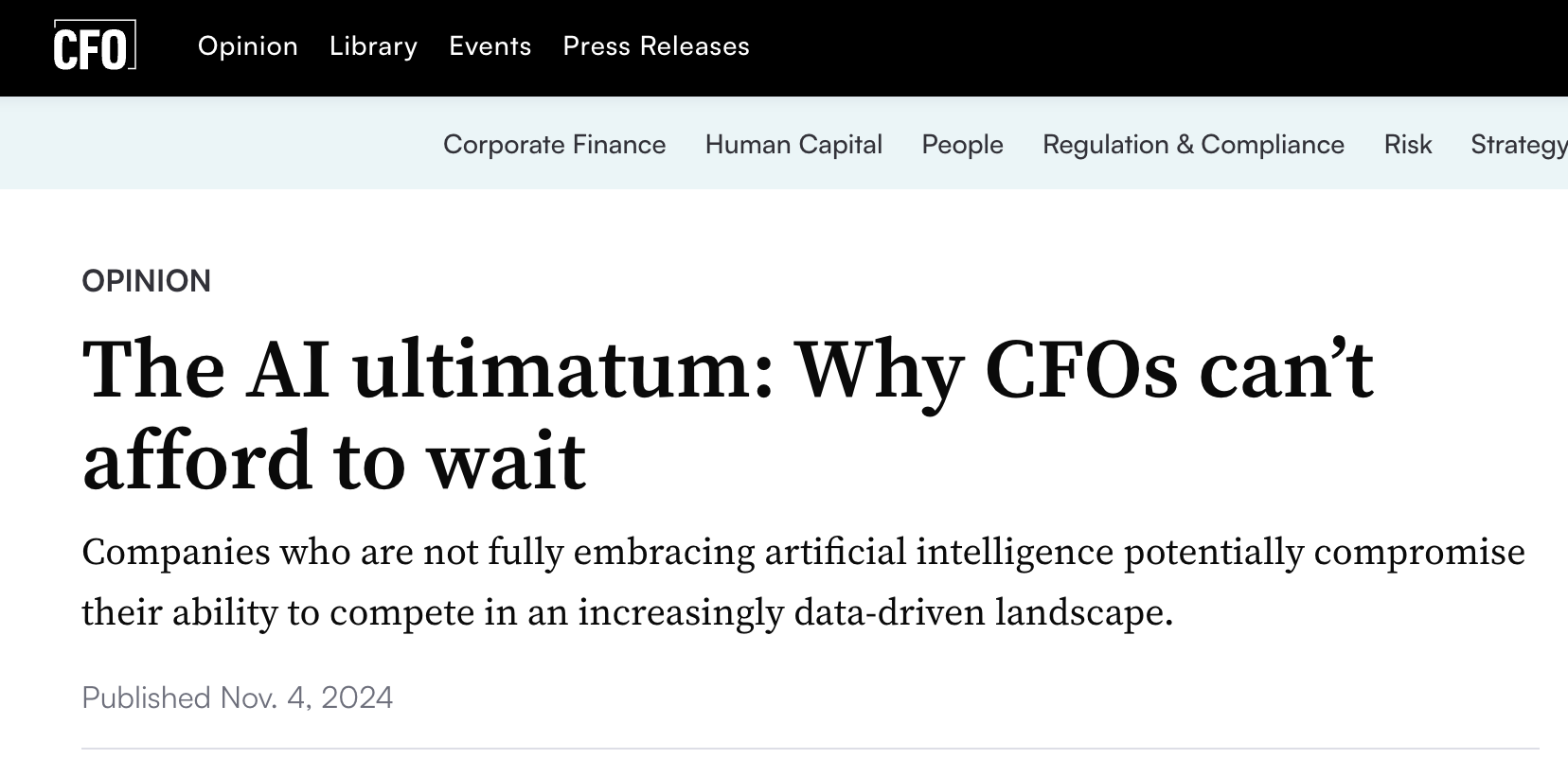
Bob Purcell, CFO of Billtrust, lays out a compelling case for why finance leaders must embrace AI now—or risk being left behind. In his guest post for CFO.com, he highlights the evolving role of the CFO, shifting from back-office precision to strategic leadership. With economic uncertainty increasing, CFOs are now expected to drive growth and innovation, and AI is positioned as the ultimate enabler of this transformation.
He points out that finance has traditionally lagged in adopting new technologies, but this caution is no longer sustainable. Generative AI is already revolutionizing financial processes, enabling CFOs to make data-driven decisions instantly. AI’s true power lies in freeing finance teams from repetitive tasks, allowing them to focus on predictive analytics, strategic planning, and deepening business relationships. However, challenges like data security and poor implementation loom large.
To overcome these barriers, Purcell outlines a clear action plan: auditing current processes, educating teams, starting small with AI pilots, prioritizing data quality, and fostering a culture of continuous learning. His message is simple yet urgent—AI isn’t just a tool; it’s a competitive necessity for CFOs who want to lead their organizations into the future.
2. Why This Matters to GTM Teams and Professionals
This article might be written for CFOs, but the implications resonate far beyond the finance department. Here’s why GTM teams should care:
• Strategic Alignment: AI adoption by CFOs signals a broader shift toward data-driven decision-making across organizations. GTM teams must align their strategies with this shift, leveraging AI to present actionable insights that support company goals.
• Operational Efficiency: Just as AI transforms finance, it can revolutionize sales, marketing, and customer success. From automating repetitive tasks to providing real-time customer insights, AI offers GTM teams a pathway to scale efficiently.
• Cross-Department Collaboration: CFOs embracing AI will look to other teams for alignment. GTM leaders who understand AI’s role in driving revenue growth will strengthen their influence in strategic planning.
• Talent Attraction: As finance teams evolve, the demand for tech-savvy professionals rises. GTM teams must similarly embrace AI to attract top-tier talent and foster innovation.
This isn’t just about finance—it’s about an organizational transformation that GTM teams need to be part of.
3. What Takeaways Should People Take
Here’s what to remember from Purcell’s call to action:
• AI Isn’t Optional Anymore: Whether you’re in finance or GTM, ignoring AI is a competitive risk. Start identifying processes ripe for automation and optimization today.
• Data is King: AI’s effectiveness depends on clean, structured data. If your CRM, forecasting, or customer databases are messy, now’s the time to fix them.
• Focus on Practical Applications: Don’t adopt AI for its buzz—use it to solve real pain points like lead qualification, pipeline forecasting, or churn prediction.
• Educate Your Team: Just like finance teams need AI literacy, GTM teams must upskill to understand how AI can amplify their efforts.
• Experiment Boldly: Start small with AI tools in specific workflows, measure results, and scale what works. Waiting for “perfect” AI solutions will leave you behind.
AI is no longer just a futuristic concept; it’s a tool for immediate, measurable impact.
4. Coach K’s Thoughts
Let me get straight to it: Bob Purcell is right. If you’re not actively implementing AI in your GTM operations—or at least preparing for it—you’re falling behind.
AI isn’t just automating tasks; it’s redefining how we think about efficiency and strategy. Picture this: a GTM leader with AI handling lead scoring, customer segmentation, and even real-time deal insights. Instead of wasting hours crunching numbers, your team spends that time closing deals and building relationships.
But here’s the catch: like Purcell said, it’s all about doing it right. Sloppy data or unclear goals will sabotage any AI initiative. Clean up your data pipelines, involve your team in the strategy, and don’t be afraid to test and fail.
And don’t just think about the tools—think about the mindset. AI adoption requires a shift in how we approach problems. Stop thinking in terms of “how we’ve always done it” and start asking, “how can this be better?” AI will be your partner in answering that.

A recent randomized clinical trial published in JAMA Network Open explored whether large language models (LLMs), like ChatGPT Plus (GPT-4), improve diagnostic reasoning among physicians. The study, conducted across multiple academic medical centers, compared two groups: physicians using LLMs alongside traditional diagnostic tools versus those using only conventional resources like UpToDate or Google.
Surprisingly, the results showed no significant improvement in physicians’ diagnostic performance when they used LLMs. While the LLM group achieved a median diagnostic score of 76% compared to 74% for the conventional group, the difference wasn’t statistically meaningful. However, when used independently, the LLM significantly outperformed both groups, scoring 92% on diagnostic tasks.
The findings highlight a gap in integrating LLMs into clinical workflows effectively. While LLMs have immense standalone potential, the study underscores the need for better training, interface design, and workflows to enhance human-AI collaboration in medicine.
2. Why This Matters to GTM Teams and Professionals
This study holds key lessons for GTM leaders, especially in industries adopting AI-driven tools:
• Technology Alone Isn’t Enough: LLMs can outperform humans in specific tasks, but their integration into workflows requires careful design. For GTM teams, this means focusing on how AI tools complement—not disrupt—existing processes.
• Human-AI Collaboration is Key: Much like in clinical diagnostics, AI can’t operate in isolation within GTM. Teams must be trained to leverage AI effectively, ensuring alignment between human expertise and AI capabilities.
• Adoption Without Training is Risky: The lack of meaningful improvement in the study highlights a common pitfall: deploying AI tools without investing in user training. GTM teams adopting AI must prioritize onboarding and education to maximize impact.
• Metrics Matter: The study demonstrates the importance of robust evaluation frameworks to measure AI’s success. GTM teams should establish clear KPIs for AI adoption, whether it’s lead quality, deal velocity, or customer satisfaction.
3. What Takeaways Should People Take
Here’s what this trial teaches us about AI integration:
1. Evaluate Use Cases Carefully: The study reminds us that AI shines brightest in narrowly defined, specific tasks. For GTM, this could mean focusing AI efforts on data enrichment, lead scoring, or customer segmentation.
2. Don’t Skip Training: LLMs didn’t deliver better outcomes for physicians because of poor integration and lack of training. Ensure your team knows how to work with AI effectively.
3. AI Alone Can Excel: While LLMs outperformed humans on their own, they faltered in collaboration. This suggests that workflows and interfaces need redesigning to facilitate seamless teamwork.
4. Measure Success Differently: The study introduced nuanced metrics for assessing AI’s impact beyond accuracy. GTM teams should adopt similar metrics, like efficiency gains or decision-making quality.
5. Iterate and Improve: AI adoption is a process. Start small, measure results, refine, and scale—don’t expect overnight success.
4. Coach K’s Thoughts
This study might be about doctors, but it applies directly to GTM teams. The lesson is clear: AI’s potential is massive, but unlocking it takes work. Tools like LLMs can’t just be dropped into workflows and expected to deliver miracles. If your team isn’t trained to use AI properly or if your processes aren’t designed to accommodate it, the results will disappoint.
Here’s the kicker: when LLMs operated alone, they crushed it—scoring 92% on diagnostics. That tells me the problem isn’t the tool—it’s the way humans and AI are working together. This is a call to action for GTM leaders: build workflows and training programs that leverage AI’s strengths without sidelining your team’s expertise.
Think about your current operations. Where are the bottlenecks? How can AI take on those repetitive, time-consuming tasks so your team can focus on strategy and creativity? And are you measuring success in the right way? The diagnostic framework in this study is a brilliant reminder to assess not just outcomes but the process itself.
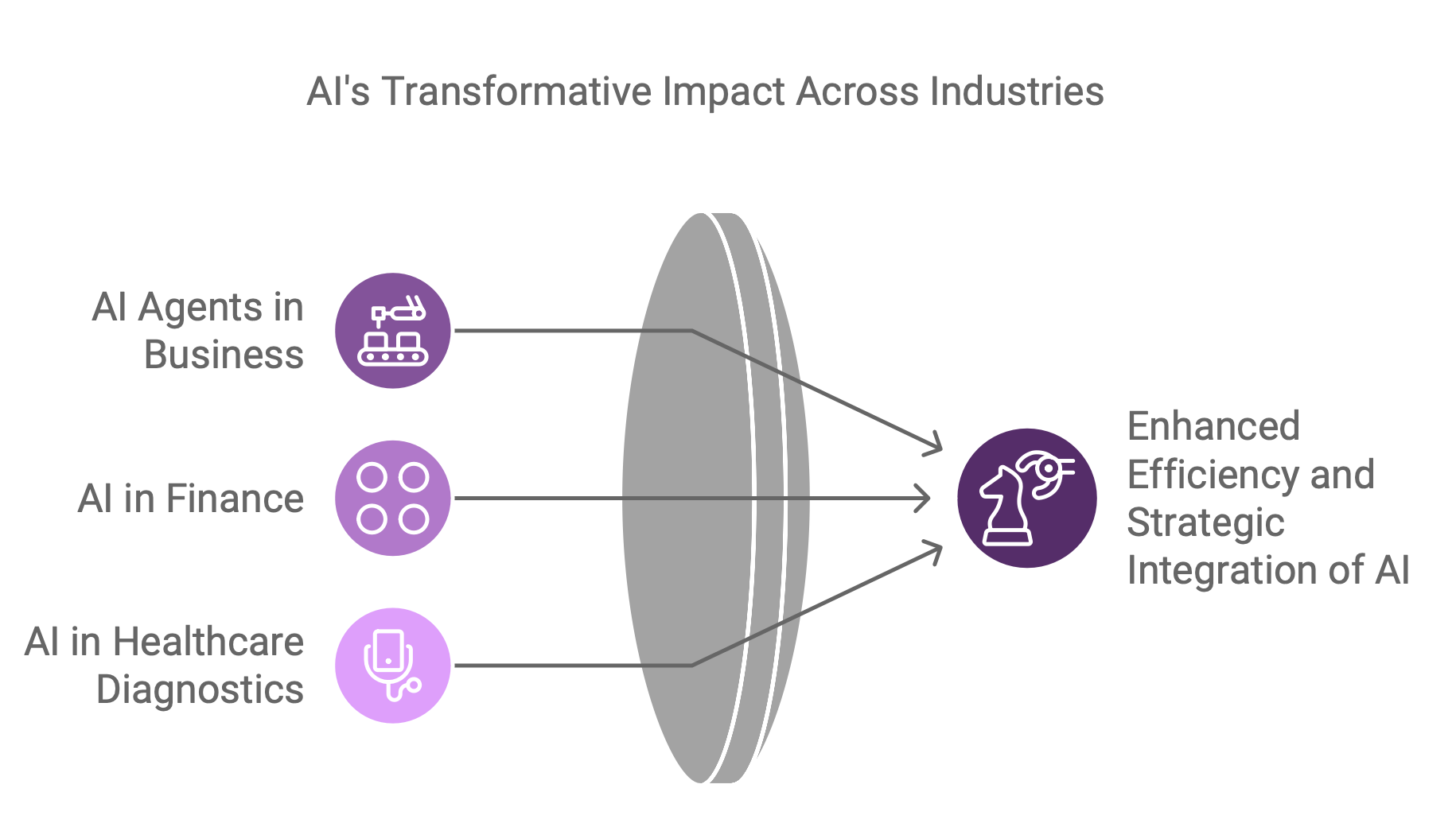
Summary of All Three Articles
Across these three pieces, we see a unifying narrative: the transformative potential of AI and the urgency to adopt and integrate it effectively. Each article offers unique insights into specific applications of AI but highlights overlapping themes:
1. AI Agents in Business (Marc Benioff, TIME): The rise of autonomous AI agents marks a revolutionary shift in how businesses operate. These agents are scaling operations, automating decision-making, and reducing reliance on human labor for repetitive tasks. While promising, challenges like ethics, trust, and sustainability require deliberate action.
2. AI in Finance (Bob Purcell, CFO.com): AI is reframing the CFO’s role, turning finance into a more strategic function. Generative AI’s ability to handle repetitive processes and provide real-time insights drives efficiency and better decision-making. However, adoption must be strategic, focusing on training teams and integrating AI responsibly.
3. AI in Healthcare Diagnostics (JAMA Network Open): While large language models (LLMs) excel independently, their collaborative integration with physicians in clinical workflows has yet to show significant benefits. The study highlights the importance of training and workflow design to realize AI’s full potential in augmenting human expertise.
Patterns and Trends Suggested by the Articles
1. AI is Transformational Across Industries:
• From automating retail operations to redefining finance and healthcare, AI is no longer a supplementary tool—it’s driving fundamental changes in how work is done.
• The shift from traditional labor to AI-driven workflows suggests that automation will soon become a cornerstone of operational efficiency and scalability.
2. Adoption Requires More Than Technology:
• All three articles emphasize that successful AI implementation depends on effective training, strategic integration, and redesigning workflows to complement human capabilities.
• Poorly integrated AI results in missed opportunities, as shown in the healthcare study where LLMs excelled independently but not in collaboration with humans.
3. Data and Training Are Foundational:
• AI thrives on clean, structured data and teams trained to use it effectively. Whether in diagnostics or finance, quality input and user understanding are prerequisites for meaningful AI impact.
4. The Workforce is Being Redefined:
• AI is freeing professionals from mundane tasks, enabling them to focus on strategic, value-adding activities. However, this shift demands reskilling to ensure employees stay relevant in AI-augmented environments.
5. Trust and Accountability are Critical:
• Ethical concerns like bias, security, and transparency must be addressed to build trust in AI-driven decisions. This responsibility spans organizational leaders, technology providers, and regulators.
Why GTM Professionals Should Care About These Trends
1. Operational Efficiency is Table Stakes:
GTM teams need to embrace AI for scalability and efficiency. Whether it’s autonomous agents handling repetitive tasks or LLMs supporting decision-making, leveraging AI allows teams to focus on strategic initiatives like closing deals or optimizing customer experiences.
2. AI Adoption Will Define Competitiveness:
Much like CFOs and physicians, GTM leaders who effectively integrate AI will outpace competitors. From lead scoring to personalized outreach, AI-driven insights will determine which teams win in increasingly saturated markets.
3. Collaboration is Key to Success:
These articles stress that AI isn’t replacing humans—it’s augmenting them. GTM professionals must invest in training, redesign workflows, and align tools with team goals to achieve meaningful impact. Success lies in synergy, not separation.
4. Adapt or Be Left Behind:
As with other industries, the risk of inaction is clear. Competitors leveraging AI to automate mundane tasks or deliver hyper-personalized customer experiences will leave laggards scrambling to catch up.
5. Focus on Trust and Ethics:
GTM leaders must ensure their AI systems are transparent, fair, and trustworthy. Ethical implementation not only avoids risks but builds stronger customer and stakeholder relationships.
The Big Picture
AI is here, and it’s reshaping industries at an unprecedented pace. The trends highlighted in these articles are clear: success in the AI era demands strategic adoption, robust training, and ethical implementation. GTM professionals who lean into this transformation will drive greater efficiency, unlock new opportunities, and future-proof their teams. Those who wait risk irrelevance in a world that’s quickly evolving beyond manual processes.

Rox is an AI-driven sales productivity platform designed to enhance the efficiency and effectiveness of sales teams. By integrating seamlessly with existing systems, Rox offers a suite of tools that streamline account planning, research, and engagement processes. Its AI agents provide personalized insights and automate routine tasks, allowing sales professionals to focus on building relationships and closing deals.
Why GTM Professionals Should Care
For Go-To-Market (GTM) professionals, Rox presents a significant opportunity to optimize sales operations. The platform’s AI capabilities enable teams to gain deeper insights into customer behavior, predict sales trends, and tailor strategies accordingly. By automating repetitive tasks, Rox frees up valuable time, allowing GTM teams to concentrate on strategic initiatives and customer engagement. This leads to improved efficiency, higher conversion rates, and ultimately, increased revenue.
Leveraging Rox for GTM Success
1. Enhanced Account Planning: Rox consolidates data from various sources, providing a comprehensive view of each account. This enables GTM teams to develop targeted strategies based on real-time insights.
2. Automated Research: The platform’s AI agents continuously monitor market trends and customer activities, delivering timely information that informs decision-making and keeps teams ahead of the competition.
3. Personalized Engagement: Rox assists in crafting customized communication tailored to individual client needs, fostering stronger relationships and increasing the likelihood of successful outcomes.
4. Performance Monitoring: With robust analytics, Rox allows GTM professionals to track the effectiveness of their strategies, identify areas for improvement, and adjust tactics to maximize impact.
Industry Reception and Its Significance in AI Evolution
Rox has garnered attention from industry leaders and investors, reflecting its potential impact on sales technology. Sequoia Capital, in their partnership announcement, highlighted Rox’s innovative approach, stating that “Rox represents the future of enterprise sales.” (Sequoia Capital) Similarly, General Catalyst emphasized Rox’s role in building a new revenue operating system for the applied AI era. (General Catalyst)
This positive reception underscores a broader trend in AI development: the shift towards specialized, user-centric applications that address specific industry challenges. Rox’s success illustrates how AI can be effectively integrated into complex workflows, providing tangible benefits without overwhelming users with unnecessary complexity. As AI technology continues to evolve, platforms like Rox set a precedent for creating tools that are both powerful and accessible, paving the way for more widespread adoption across various sectors.
Sample Workflow: Sales Prospecting and Outreach
Before Rox
1. Researching Accounts
The sales rep manually researches prospective companies, sifting through LinkedIn, company websites, and news articles to gather relevant details. This process takes hours per account.
• Time Spent: 3–4 hours per account.
• Challenges: Information overload, outdated or irrelevant data, inconsistent insights.
2. Prioritizing Prospects
The rep uses gut instinct, limited CRM insights, or a basic lead scoring system to decide which accounts to prioritize.
• Time Spent: 1–2 hours sorting and ranking.
• Challenges: Lack of accurate predictions, potential high-value accounts overlooked.
3. Crafting Outreach Messages
The rep drafts personalized emails and LinkedIn messages by hand, attempting to tailor each one based on their limited research.
• Time Spent: 15–30 minutes per email.
• Challenges: Generic messaging, missed opportunities for deeper personalization.
4. Follow-Up Management
The rep manually tracks follow-ups using spreadsheets or basic CRM tools, often missing optimal follow-up windows.
• Time Spent: 1–2 hours daily.
• Challenges: Missed leads, inefficiencies in scheduling follow-ups.
After Rox
1. Researching Accounts
Rox’s AI agents automatically gather, filter, and analyze relevant account information, delivering a concise summary directly to the rep’s dashboard. The AI highlights recent news, key decision-makers, and competitive insights.
• Time Spent: 15–20 minutes per account.
• Benefits: Comprehensive, up-to-date information presented without manual effort.
2. Prioritizing Prospects
Rox leverages AI to rank prospects based on factors such as engagement history, likelihood to close, and company fit. It provides actionable recommendations for the highest-priority accounts.
• Time Spent: Almost instant.
• Benefits: Data-driven prioritization, focus on the most promising leads.
3. Crafting Outreach Messages
Rox generates hyper-personalized outreach templates using AI, based on account insights and past successful communications. Reps only need to tweak minor details, saving significant time.
• Time Spent: 2–5 minutes per email.
• Benefits: Highly personalized messaging, greater response rates.
4. Follow-Up Management
Rox automates follow-up scheduling and reminders, optimizing timing based on previous engagement data. The platform sends nudges for ideal follow-up opportunities or even drafts automated messages for approval.
• Time Spent: Minimal—managed by Rox.
• Benefits: Fewer missed opportunities, streamlined follow-up process.
Key Outcomes
• Before Rox: Reps spend 6–8 hours on research, prioritization, messaging, and follow-ups daily, with inconsistent results.
• After Rox: Reps reduce workflow time to 2–3 hours, with more strategic and effective outputs, leading to increased productivity and deal success rates.
This streamlined process enables sales reps to focus on high-value activities like building relationships and closing deals rather than being bogged down by administrative tasks. Rox enhances not just efficiency but also the quality of engagement with prospects.
Coach's review:
Overall cool tech, I have experimented with it on several accounts and the concept is awesome, but I did find a lot of hallucinations when it came to account research. For well known companies, it did awesome, but for up and coming or not as well known companies it hallucinated like crazy even when given the correct URL and background info. SO something to be aware of and double check the results.
Free to test and no I am not paid for this, try it out and tell me what you think!