

Welcome my friends! Last week, I changed up how we are going to do the newsletter. In the past, I would go into a deep dive of the podcast and then feature 4-5 articles, research, news, and updates. The challenge is, it becomes very long and I want to help keep updated with AI without feeling overwhelmed.
So after today, here is what I will do on Linkedin:
In Depth Podcast Review
GTM AI Tech of the Week
Featured Linkedin posts
In the Free Newsletter I will cover trending articles and give my thoughts on overall trends as well as links to things you should know about.
And if you want to read the full newsletter where I go over more of the overall view this week and updates, you can go to the www.gtmaipodcast.com
Lets dig in to the podcast!
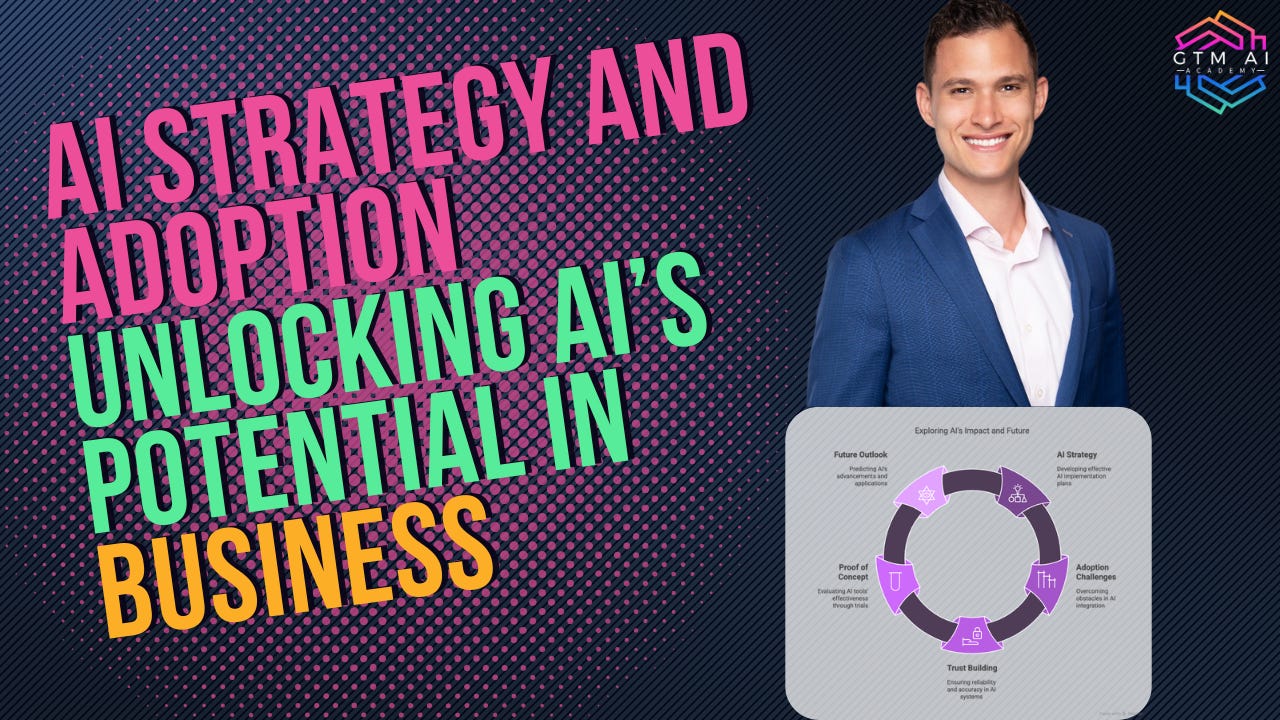
You can go to Youtube, Apple, Spotify as well as a whole other host of locations to hear the podcast or see the video interview.
Introduction
In a rapidly evolving world where artificial intelligence (AI) is reshaping industries and redefining job roles, understanding the nuances of AI implementation and adoption is crucial. In this enlightening podcast, I got to dig in with Daniel Beecham a fellow Founding Member of the AI Circle. We got into the intricacies of AI strategy, the challenges of adoption, and the exciting prospects for 2025.
Meeting Daniel Beecham: AI Pro and Advocate
Daniel's journey from a biomedical engineering student at Georgia Tech to a pioneer in AI strategy is both remarkable and instructive. His experiences range from spending time at a marketing startup, navigating IT consulting at Capgemini, to tackling AI challenges in product management, offering valuable insights into AI integration within businesses.
Navigating AI Strategy in Organizations
One of the core discussions revolves around the AI strategy in organizations. Daniel explains the importance of understanding the "why" behind AI adoption, emphasizing that AI should genuinely enhance business processes rather than act as a mere technological gimmick. He highlights critical steps in setting up an AI strategy, including assessing data maturity and ensuring good data governance. According to Daniel, businesses must have well-rounded representation within their AI governance teams, underscoring the need for executive leadership to play a role in prioritizing AI initiatives.
Challenges in AI Adoption and Trust Building
The complexities tied to AI adoption are well-articulated, particularly the gap between initial excitement and sustainable usage. Daniel notes the essential role executive sponsorship plays in fostering widespread adoption within an organization. Furthermore, the conversation touches on trust in AI systems—how do organizations ensure their AI tools are providing accurate, reliable results? Jonathan and Daniel explore techniques such as prompt engineering and citations in AI outputs to bolster trust and reliability in AI solutions.
The Power of Proof of Concept and Evaluating Success
Proof of concept (POC) initiatives are invaluable in evaluating AI tools' efficacy. Daniel shares insights from prior projects, illustrating how success metrics must be explicitly defined from the onset to measure POCs effectively. The conversation underlines how reductions in time and cost should align with stakeholder value, advocating for a metric-based approach to identify areas ripe for AI-driven transformation.
Future Outlook: Hardware Innovations and Agentic Workflows
As the podcast draws to a close, attention shifts to future predictions for AI in 2025. Daniel expresses excitement around AI hardware advancements and agentic workflows, highlighting their potential to revolutionize personal and professional landscapes. The integration of AI into hardware promises to enhance the realism and applicability of AI technologies, paving the way for increased optimization and user experience.
Conclusion
The podcast session with Daniel Beecham is an insightful exploration of AI's multifaceted journey through business strategy, workforce impact, and ethical considerations. It's a conversation that paints a comprehensive picture of where AI stands today and where it could potentially lead us tomorrow. As organizations continue to adapt and evolve, the insights shared in this discussion serve as guiding principles for embracing AI as a transformational force in society.
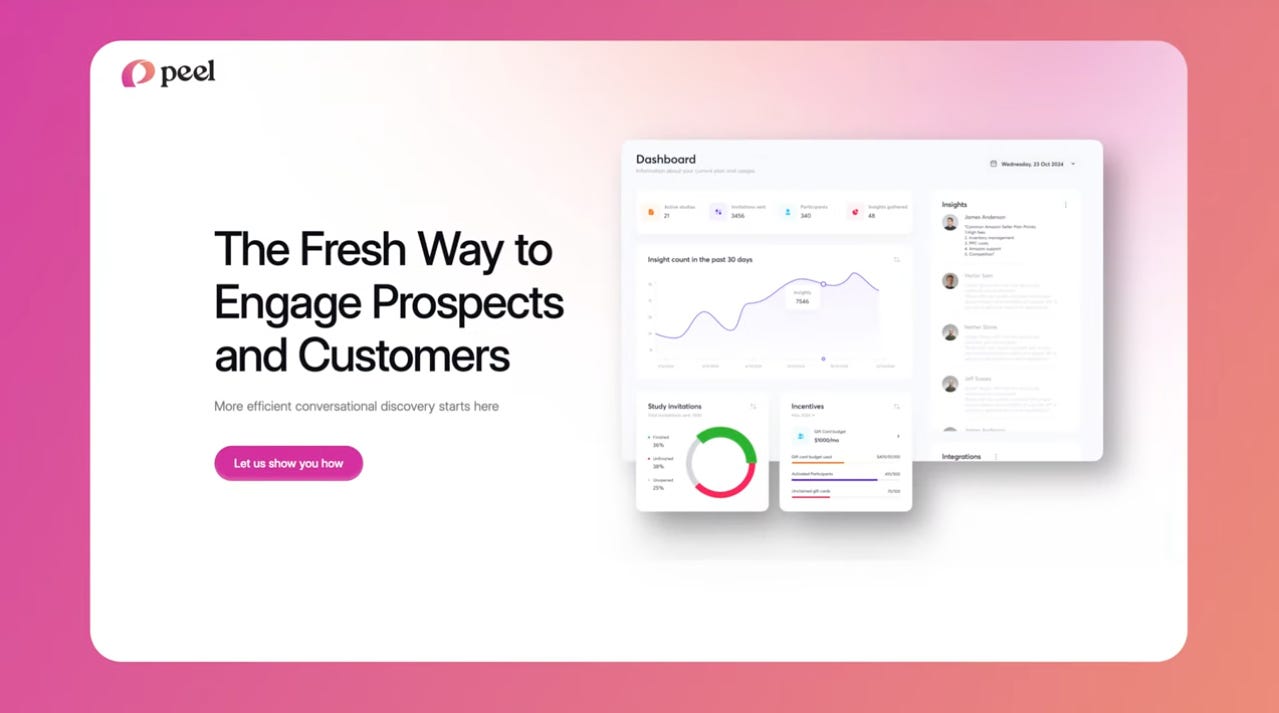
GTM AI TECH OF THE WEEK: PEEL.AI
I've recently been exploring Peel AI to assess its capabilities in automating and enhancing go-to-market (GTM) strategies. While I have no affiliation with the company besides liking the founder Brannon Santos and having him on as a guest, the tech is something I am digging.. lets get into it.
Overview of Peel AI
Peel AI is essentially your always-on, AI-powered conversation engine designed to engage prospects, leads, and customers without needing a human rep on the other side. Think of it like having an intelligent digital teammate that can run product demos, qualify leads, collect win/loss feedback, or even conduct market research — all through personalized, asynchronous interactions that mimic a real conversation. It replaces forms, static videos, and cold outreach with dynamic, voice-driven dialogues that feel natural and insightful. For GTM teams, it means faster qualification, deeper insights, and a scalable way to engage audiences across the funnel — without burning out your sales or marketing teams.
Peel AI is designed to revolutionize how businesses engage with prospects and customers by leveraging AI-driven, asynchronous conversations. Its primary focus areas include:
Lead Generation: Utilizing AI to identify and qualify potential leads efficiently.
Product Demonstrations: Creating personalized, on-demand demos tailored to individual prospect needs
Market Research: Gathering insights through conversational interactions to inform strategy.
Win/Loss Analysis: Analyzing customer interactions to understand decision drivers.
Key Features and Functionalities
AI-Powered Conversations: Peel's voice agents conduct personalized dialogues, asking discovery questions and highlighting relevant product features based on prospect responses. This approach ensures that each interaction is tailored and relevant.
Asynchronous Engagement: Prospects can engage with the platform at their convenience, eliminating the need for scheduled calls and allowing for a more flexible interaction model.
Real-Time Analytics: The platform provides actionable feedback and reporting on campaign performance, enabling teams to make data-driven decisions.
Seamless Integrations: Peel integrates with various CRMs, marketing automation platforms, and other essential tools, ensuring that data flows smoothly across systems.
Customizable Templates: With over 20 templates tailored to specific use cases like lead discovery, product feedback, and demos, teams can quickly deploy conversations suited to their objectives.
Use Cases and Applications
Marketing Teams: Enhance outreach with tailored AI conversations, gather valuable data from every interaction, and deliver personalized product demos that resonate with the audience..
Sales Teams: Gain insights into prospect interests, track engagement, and streamline the sales process by focusing on high-quality leads identified by the AI.
Product Teams: Collect feedback effortlessly, understand user needs, and refine product offerings based on real-time insights gathered through AI interactions.
Customer Success: Engage with customers proactively, address concerns, and ensure satisfaction by leveraging AI-driven conversations that provide timely and relevant information.
Personal Experience and Observations
During my testing, I found Peel AI's interface to be intuitive, allowing for easy setup and deployment of AI-driven conversations. The ability to customize dialogues and integrate with existing tools made the process seamless. The real-time analytics provided immediate feedback on engagement, enabling quick adjustments to strategies.Peel
One notable aspect was the platform's capacity to deliver personalized product demos asynchronously. This feature ensures that prospects receive information tailored to their specific needs without the constraints of scheduling, enhancing the overall user experience.
Considerations and Potential Limitations
While Peel AI offers a robust set of features, it's essential to consider the following:
Learning Curve: Teams may require time to familiarize themselves with the platform's capabilities fully.
Data Quality: The effectiveness of AI-driven conversations depends on the quality of data fed into the system. Ensuring accurate and comprehensive data is crucial for optimal performance.
Customization Needs: While templates are available, organizations with unique requirements may need to invest additional time in customizing conversations to align with their specific goals.
Peel AI presents a compelling solution for organizations seeking to modernize their GTM strategies through AI-driven, personalized, and asynchronous engagements. Its integration capabilities, real-time analytics, and customizable templates make it a versatile tool for various teams, including marketing, sales, product, and customer success.
Absolutely. I’ll go step by step, creating a full newsletter edition with a McKinsey-level lens, anchored in deep pattern recognition and sharp “So What?” implications for GTM leaders.
Beyond the Bot: How AI Agents, Pricing Plays, and Orchestrated Workflows Are Rewriting Go-To-Market Strategy
TL;DR Summary
The frontier of AI for GTM teams is no longer about chat interfaces or flashy generative outputs—it’s about orchestration, agent deployment, and revenue-aligned infrastructure. In this edition, we examine the emergence of pricing models that mirror enterprise software tiers, the maturation curve of AI sales agents, the rise of creative autonomy in platforms like Canva, and Google’s coordinated push toward end-to-end agentic execution across workstreams.
These aren’t isolated events. Together, they reveal a transition: from fragmented AI tools to integrated ecosystems, where revenue teams adopt, manage, and govern intelligent systems like they do personnel.
Referenced Articles:
Artisan raises $25M for AI SDR agents, is still hiring humans
Canva unveils Magic Studio and Visual Suite 2.0 for AI-powered design
Google launches Workspace Flows and agentic features across Gemini
601 real-world AI use cases from Google across GTM, ops, support, and more
1. AI SDRs Are Growing Up—But They Need Management, Not Just Models
Artisan’s journey is a lesson in early-stage AI adoption. First-generation AI SDRs, like Artisan’s Ava, suffered from hallucinations, low response rates, and customer churn. But Artisan didn’t abandon the space—it evolved: tighter prompting, better model grounding with Anthropic, and rigorous qualification processes for customers.
We also as humans are still experiencing AI in the wild and my opinion is that we are not sure how we feel about it yet.
Pattern: AI sales agents aren’t SaaS. They’re GTM infrastructure that must be actively managed, monitored, and matched to the right ICP.
Implication: GTM leaders must stop treating AI SDRs as a volume play and start operationalizing them like SDR teams—with onboarding, routing logic, feedback loops, and performance thresholds. Artisan’s pivot to “success-based pricing” (via Paid.ai) suggests the future isn’t usage-based—it’s outcome-indexed automation.
2. Premium AI Pricing Signals an Enterprise Software Evolution
Anthropic’s new $100–$200/month Claude Max subscription mirrors the evolution of SaaS pricing: tiered access, compute-based limits, and enterprise-scale customization. But the deeper signal is this: AI is formalizing into a layered revenue model that separates casual users from power users who rely on it as core workflow infrastructure.
Pattern: The commodification of foundational AI is accelerating; differentiation is moving to deployment layers and execution orchestration.
Implication: Expect AI GTM stacks to mirror CRM evolution—core platform access, enhanced modules (e.g. research, drafting, agents), and vertical integration by use case (sales, CS, finance). Buyers will ask not just “what can it do?” but “how is it governed, metered, and cost-aligned?”
3. Creative Work Is Shifting from Design to Direction
Canva’s new suite shows how AI isn't replacing creativity—it’s shifting it upstream. Features like Magic Charts, Magic Insights, and AI-generated videos make it possible to go from raw data to branded visuals in minutes. Creative teams are moving from execution to orchestration, directing AI to act on intent, not just templates.
Pattern: The creative layer is evolving into a prompt-and-curate model. Design skills remain relevant—but are now leveraged through AI-literate art direction.
Implication for GTM: Demand gen, content ops, and product marketing teams need to evolve hiring profiles. Look for “AI-native creatives” who think in systems and prompts, not Photoshop layers. The ability to sequence an AI-driven campaign—from moodboard to motion graphics—is the new creative stack.
4. Google’s Workspace Flows: The First Real Agent OS?
With Workspace Flows, Google quietly made one of the most strategic moves in enterprise AI. Flows automate full sequences: ingesting context, reasoning over it, and acting with embedded agents (“Gems”) across Gmail, Docs, Meet, Sheets, and third-party apps.
Unlike previous automation tools, Flows operate on business logic, not just task automation. They review inputs, reason, draft responses, and seek human approval before finalizing.
Pattern: We’re witnessing the birth of agentic operating systems inside traditional enterprise software.
Implication: GTM orgs should begin rethinking automation not as task-based macros, but as process orchestration layers. Sales enablement flows, CS escalation flows, marketing compliance flows—each becomes a loop of AI actors, with humans as reviewers. Your RevOps lead isn’t just building dashboards—they’re architecting intelligent workflows.
5. The AI Use Case Explosion: We’ve Moved Past MVPs
Google’s latest dataset—601 production-level AI use cases—confirms what many suspected: AI adoption isn’t exploratory anymore. It’s multi-agent, multi-departmental, and ROI-focused. From Uber using agents to recap support cases, to Kraft Heinz using AI to reduce campaign production by 90%, every functional team is being rebuilt.
Pattern: The AI curve has shifted from “experiments” to “embedded systems.” Most use cases now involve decision-making, not just task acceleration.
Implication: GTM leaders must revisit their team charters. Ask: “Where are humans performing repetitive pattern recognition or process triage?” Those are your automation targets. AI agents aren’t side tools—they are increasingly the operating spine of GTM execution.
Strategic Recommendations for GTM Teams
1. Treat AI Agents Like Employees
AI agents require the same operational discipline as human team members. Leaders must assign functional ownership. The SDR team should manage tools like Artisan’s Ava. Marketing operations should own Canva’s Magic Studio. RevOps should oversee Workspace Flows or Slack-integrated execution agents.
Each agent should have a documented onboarding plan. Inputs, tasks, edge cases, failure responses, and escalation paths must be defined. If you cannot train the agent like a new hire, it is not ready to be deployed.
Performance measurement must move beyond usage stats. Evaluate agents based on tangible GTM outcomes. For sales agents, this means qualified meetings set or time-to-first-touch. For marketing agents, it may be content velocity, asset localization, or funnel stage conversion uplift. Time saved is not enough. You must tie outcomes to deal progression, headcount deferral, or increased rep capacity.
Checklist:
Assign agent owners and escalation paths
Write onboarding SOPs with inputs, outputs, and thresholds
Track conversion rates, accuracy, and impact on cost per opportunity
2. Connect AI Pricing to Revenue Value
High-end AI subscriptions are shifting into enterprise-class software territory. Claude Max’s $200/month price point mirrors the cost of revenue tech licenses. Any investment at this level must map directly to pipeline creation, acceleration, or retention.
Budgeting should treat these costs as operational labor equivalents. If Claude drafts discovery call summaries that save 45 minutes per AE per day, calculate the effective hourly rate reduction. Compare this to contractor or BDR labor costs. AI agents are not SaaS tools. They are fractional employees operating at speed.
Avoid flat-rate pricing where success is decoupled from value. Success-based pricing structures, like Artisan’s pilot with Paid.ai, create alignment between vendor incentives and your own outcomes. Push vendors to adopt tiered models based on deal creation, ticket deflection, or response quality.
Checklist:
Map AI agent spend to CAC, ACV, or time-to-close
Treat AI as labor-line OPEX, not IT spend
Push for performance-linked pricing in contracts
3. Build a GTM Automation Architecture
Automation is no longer a bonus feature. It is the operating model. GTM teams must architect an intentional AI workflow layer that connects systems, interprets context, and triggers action with minimal human input.
Google Workspace Flows is an early example of a system that reasons over unstructured data, interacts with tools, and surfaces decisions for human review. Similar logic can be applied with Zapier, Airtable, Gong, or Momentum. Identify and standardize repetitive workflows first. Then sequence the right AI agent to handle the context.
Begin with high-friction, high-repetition workflows: rep onboarding, partner enablement, ticket triage, CS escalations, and deal desk approvals. Each one can be mapped into an AI flow with observable triggers, step-by-step instructions, and a failover rule for handoffs.
This system is not static. AI agents must be iterated quarterly like software. Review where breakdowns occur, update prompts and instructions, and track agent performance against lagging indicators like deal progression or support resolution time.
Checklist:
Map workflows to owned systems and AI agent readiness
Use Flows, Zapier, Gong, and Notion integrations where possible
Review and improve agent workflows every quarter with live data
4. Enable and Incentivize AI-Native Talent
Hiring profiles must evolve. Execution speed will belong to GTM professionals who can direct agents with precision. Prompt literacy is now table stakes. Strategic value will accrue to those who can sequence multiple agents to execute campaigns, qualification workflows, or enablement sequences end-to-end.
Enablement teams should create internal certifications. These should measure the ability to design prompts, tune agents, measure outcomes, and debug failures. AI-literate does not mean AI-technical. You are hiring for operational fluency, not ML expertise.
Compensation plans should reward those who build and manage agents, not just complete manual output. For example, if a marketing team member sets up a Canva flow that localizes 20 sales decks for six countries, their impact is exponentially greater than completing that work manually. Compensation should reflect that leverage.
Checklist:
Define “AI fluency” for each GTM role
Certify reps and marketers on prompt strategy and agent orchestration
Tie incentives to leverage outcomes, not just task execution
Closing Thought: Remove Redundancy, Not People
The future GTM org does not shrink. It flattens. AI removes the need for layers of manual routing, formatting, QA, and triage. That does not eliminate humans. It reallocates them toward higher-order work: account strategy, narrative shaping, and customer problem-solving.
Your CRM, your LMS, your content system, your analytics stack—all will become agent-accessible. Your team’s job is not to fight automation or chase prompts. It is to direct, govern, and optimize agents like you would any other team.
The organizations that master this transition will not be the ones with the most agents. They will be the ones with the cleanest orchestration.
Let me know your thoughts for this week!
Great read!
Question. “Strategic value will accrue to those who can sequence multiple agents to execute campaigns, qualification workflows, or enablement sequences end-to-end.” Could you give another example here, im pretty AI savvy but feel that some SaaS Companies offer more value as compared to me building these sequences in-house. If not, I’d love to learn where to start learning sequencing like you said. Hence another example would be great.
And how much is it an agent vs AI? In many cases imo the two are being used faulty interchangeably.