You can go to Youtube, Apple, Spotify as well as a whole other host of locations to hear the podcast or see the video interview.
KrooloThe Only Productivity Tool You Will Ever Need:
I have gotten to know the Kroolo team fairly well over this last month or so and been impressed by how they have thought through and executed on their tech.
FYI, I am not an advisor, nor am paid for this post, I just think the tech is amazing.
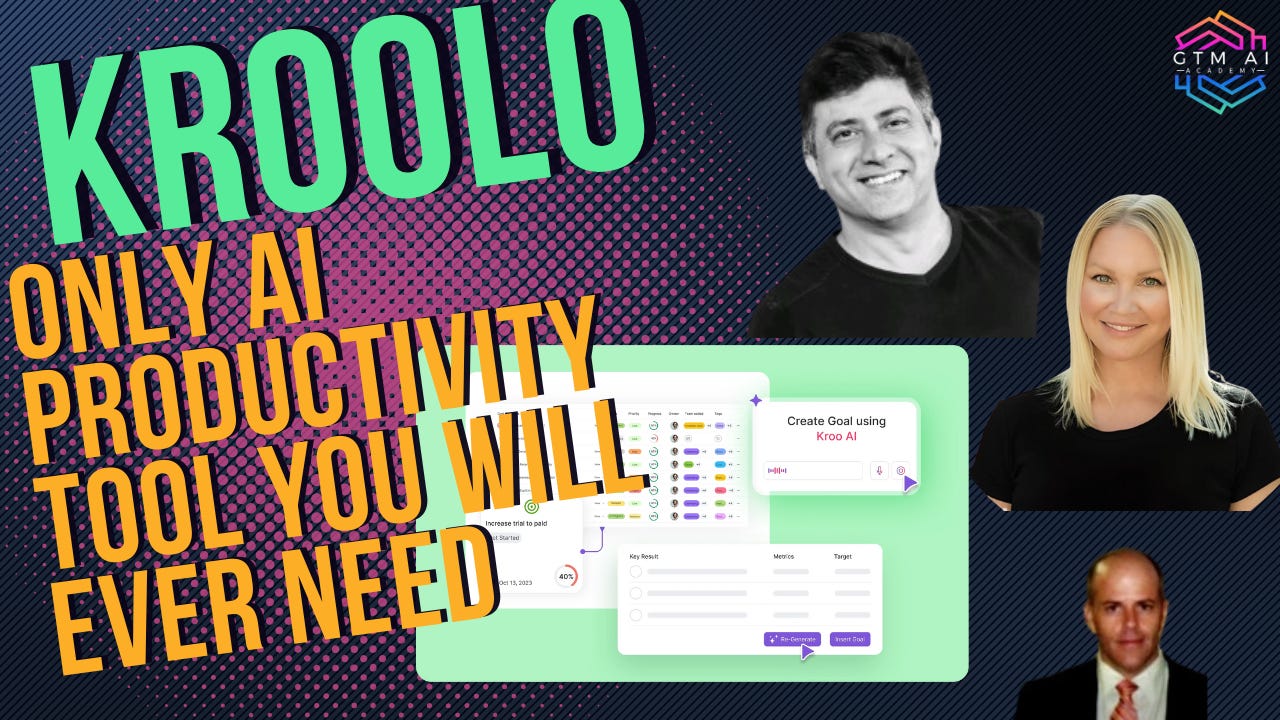
As someone who's constantly testing new tech (and I want to be clear - this isn't a paid promotion!), I was genuinely impressed by what Shashank Singh (Founder/CEO), Katie Wade (Head of Product), and my "bald brother" Steven MacNeil (Founding AE) have built over the last year.
What sets them apart? They've created an AI-native platform that's actually language model agnostic - meaning if OpenAI goes down, they can switch to Google's LLMs or others seamlessly OR they leverage the best LLM for the task required. It's like having multiple AI engines under one hood, all working together to supercharge your productivity.
Key Highlight Moments:
• Discovery that Kroolo reduces team meetings by 60% through intelligent AI agents
• Discussion of how true AI-native architecture differs from "bolt-on" AI solutions
• Revelation about their platform-agnostic approach to LLMs (OpenAI, Google, etc.)
• Insight into how they're tackling AI bias in productivity tools
• Preview of their upcoming agent-focused framework and rebranding
• Real-world impact on reducing implementation time from days to hours
Notable Quotes:
Katie Wade:
"Almost think we're at a space now where if it's not as easy as pulling your iPhone out of an iPhone box, turning it on and just intuitively understanding how to work it, people just don't want to do it anymore."
"It's the collaboration because you probably would have agonized over three sentences. And if you run it as AI, here's the three different ways you could say it."
Shashank Singh:
"We will reduce the number of meetings by 60 percent... the platform is intelligent enough where agents could be trained and deployed. And whatever you normally ask these questions in traditional stand ups and meetings, those could be answered by pre-trained, co-piloted agents."
"If somebody is not betting on agentic, I think making it some serious problem for looking through. The future is agentic."
Steve McNeil:
"You're only going to establish the right ROI model if you can actually utilize the technology effectively and quickly... that's the one thing that really resonates with me."
I thoroughly enjoyed talking to the team and think you will enjoy it.
I wanted to share some critical insights about where AI is heading and why it matters for your go-to-market strategy taking insights from this Sequoia article and research. I just read an interesting analysis of the AI market, and here's what you need to know:
The Big Picture
The AI market is entering its second phase, and it's a game-changer for how we'll sell and deliver products. Instead of just having AI that gives quick answers based on training (think ChatGPT), we're moving toward AI that can actually reason and think through problems - more like how humans do. This is huge for us in GTM because it's changing what we can sell and how we sell it.
Market Structure
The foundation layer (the companies making the core AI models) has pretty much settled into a few major players:
- Microsoft/OpenAI
- AWS/Anthropic
- Meta
- Google/DeepMind
Here's what matters: These big players are making AI capabilities cheaper and more accessible every day. For example, GPT-4's price has dropped 98% since its last developer day. This means we can build more sophisticated solutions at lower costs.
The New Business Model: Service-as-a-Software
This is where it gets interesting for us. While the cloud era was about Software-as-a-Service (SaaS), the AI era is about turning services into software. Instead of selling software licenses, we're essentially selling work output. Here's a real example:
- Sierra (an AI company) puts their AI on B2C websites to handle customer service. They don't charge per seat or license - they charge per resolved customer issue. It's pure output-based pricing.
Why This Matters for GTM:
1. Our addressable market just got WAY bigger. We're not just looking at the software market anymore - we're looking at the entire services market, which is in the trillions.
2. The sales motion is changing:
- Moving from bottom-up to top-down sales
- Requiring more high-touch, high-trust delivery models
- Focusing on outcomes rather than features
3. Pricing models are evolving:
- Shifting from per-seat licensing to outcome-based pricing
- Creating new opportunities for value-based selling
- Opening up markets that were previously too expensive to serve
Key GTM Implications:
- We need to rethink how we position our products. Instead of selling features, we're selling outcomes and completed work
- Our sales teams need to be comfortable selling to both technical and business buyers
- We should be looking at services companies as competitors, not just other software vendors
- Customer success becomes even more critical as we tie our revenue directly to customer outcomes
The Application Opportunity
The sweet spot right now is in applications, not infrastructure or core AI models. Why? Because:
1. The core tech is getting commoditized by the big players
2. The real value is in solving specific business problems
3. Companies need help dealing with the messiness of AI in real-world applications
A Heads Up About Competition
Here's something interesting - while we initially thought existing SaaS companies would easily adapt to AI, that might not be true. Building effective AI solutions requires completely new "cognitive architectures" - essentially, new ways of thinking about how to structure and deliver solutions. This could be similar to when cloud computing emerged and most on-premise software companies couldn't make the transition.
Where to Focus
For our GTM strategy, we should be focusing on:
1. Identifying service-heavy workflows we can automate
2. Building trust-based relationships with senior decision makers
3. Creating clear ROI models based on work output, not software usage
4. Developing pricing models that align with value delivery
5. Building customer success teams that can handle high-touch, outcome-based relationships
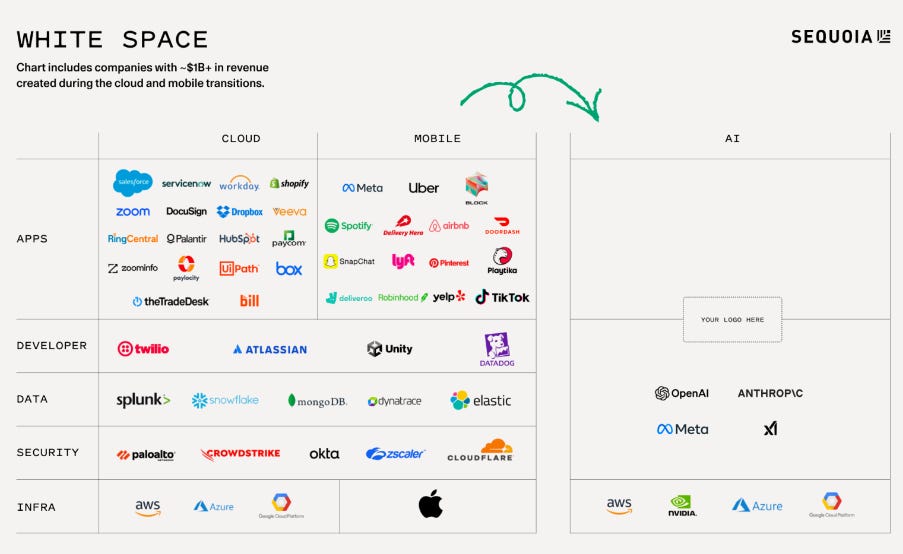
Looking at this visualization, I'm seeing something really interesting about where the next big opportunities are in AI. The image maps out how Cloud and Mobile each created waves of billion-dollar companies, but what's striking is the empty space in the AI column.
Here's why this matters: Each previous wave (Cloud and Mobile) created about 15-20 billion-dollar companies in apps and another 15 in infrastructure/dev tools. But in AI, while the infrastructure layer is getting crowded with the usual suspects (AWS, NVIDIA, Azure, Google Cloud, Meta, Anthropic, OpenAI), the application layer is basically empty. It's just sitting there waiting to be filled.
What's wild is the scale of this opportunity. When we went through the cloud transition, we were fighting for pieces of a $350B software market. But this AI transition? We're looking at the entire services market - we're talking trillions. The white space isn't just about adding AI features to existing software - it's about completely transforming how work gets done, especially in service-heavy industries.
To wrap up everything we've covered:
We're at a pivotal moment in AI where the foundation is set (those big players I mentioned), but the real opportunity is in building what comes next. The next wave of billion-dollar companies won't just be making existing software smarter - they'll be turning entire service industries into software products.
For those of us in GTM, this means three big things:
1. Our playbook needs to change - we're not selling seats anymore, we're selling outcomes
2. The market is way bigger than we thought - we're not just looking at software budgets, but entire service industry budgets
3. The window is now - the infrastructure is there, the costs are down (remember that 98% drop in GPT-4 pricing), and the technology is reaching a level of sophistication where it can actually reason through complex problems
Looking back at previous transitions, the companies that won weren't always the obvious choices. They were the ones who saw the white space and moved fast to capture it. Right now, that white space in AI is still wide open. The question isn't whether it will be filled - it's who will fill it.
The next 12-24 months will be critical. We're moving from the foundation-building phase into the application phase, and just like with Cloud and Mobile, this is where the biggest opportunities will emerge. The winners won't just be building AI features - they'll be fundamentally reimagining entire industries as software products.
This isn't just another tech transition - it's potentially the biggest market opportunity we've seen in tech. And unlike previous transitions, it's not just about making software better - it's about turning human expertise and services into scalable software products. That's the white space we're looking at, and that's where the next wave of major tech companies will emerge from.
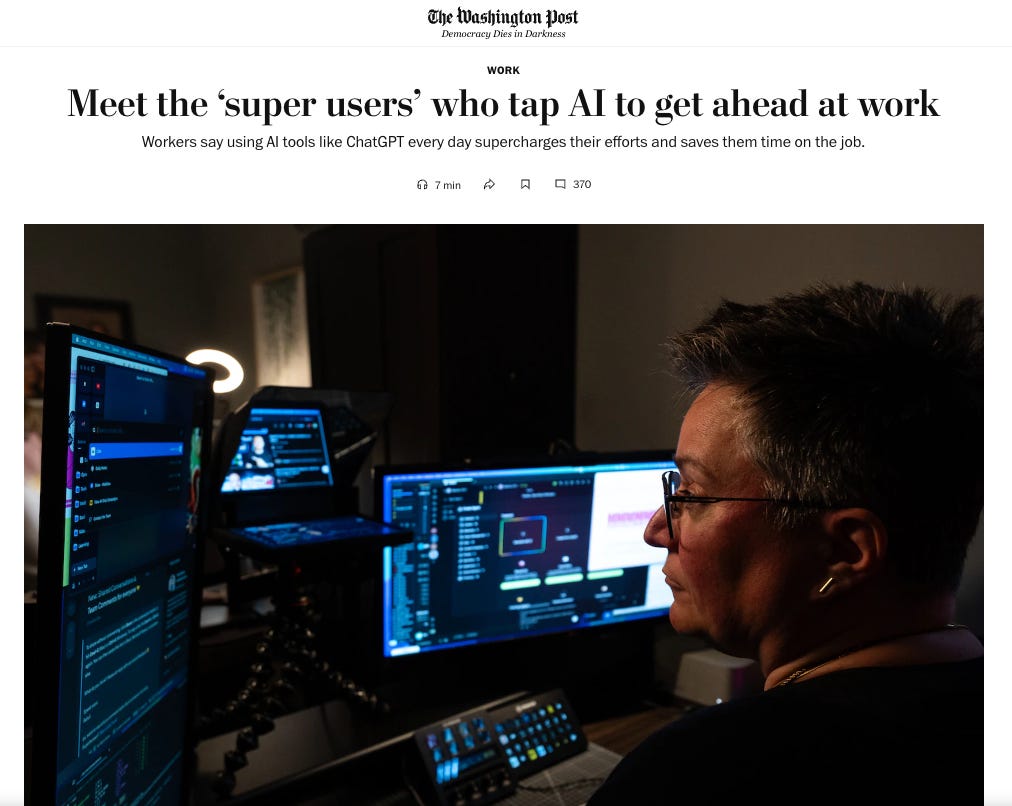
Fascinating article from the Washington Post and gives you a good idea of where the mass market believes people are by highlighting workflows and use cases that they feature.
Hey - let me break down this fascinating article about AI "super users" and what it means for the future of work:
Looking at how people are actually using AI day-to-day in their jobs, I'm seeing some really interesting patterns emerge. What's striking is that while only 4% of workers are using AI daily (according to Gallup), those who do are completely transforming how they work.
Here's what's particularly interesting about these super users:
The Productivity Gains:
- Some folks are doubling their productivity
- Others are saving 10-15 hours per week
- Most importantly, they're not just doing the same work faster - they're taking on new responsibilities and higher-value work
Real Examples That Matter:
1. Lisa Ross (VP at Avenue)
- Built 40 custom AI bots for different tasks
- Uses AI for strategic planning and tough conversations
- Became their company's go-to "AI person"
2. Ilker Erkut (UMD Admin Assistant)
- Turned a 5-hour book summary into 2.5 hours
- Learned complex Excel skills through AI
- Freed up 15 hours weekly for new projects
3. Kanika Khurana (Design Head)
- Created custom bots for junior staff
- Streamlined HR processes
- Uses AI for meeting minutes and candidate evaluations
What's Really Important Here:
1. AI is becoming a workplace "accommodation"
- Particularly helpful for neurodivergent workers (multiple examples of ADHD workers using it to mask challenges)
- Helps non-native English speakers work more efficiently
- Levels the playing field in many ways
2. The Limitations Are Clear:
- Can't be trusted with sensitive data
- Needs fact-checking
- Sometimes tries too hard to please and makes mistakes
- Not great with complex numerical analysis
3. The Skills Evolution:
- People aren't just automating tasks
- They're learning new skills through AI
- Creating custom tools for their specific needs
- Building "digital twins" of themselves for work
The Big Picture:
What I'm seeing here is that we're not just talking about productivity tools anymore. These super users are essentially creating personalized AI assistants that understand their work style, voice, and needs. They're not replacing their jobs - they're augmenting their capabilities and taking on more strategic work.
The Future Implications:
- Companies like Salesforce and Nvidia are betting on autonomous AI
- We're moving toward AI that works alongside us, not just for us
- The idea of "digital twins" doing work before we even think of it is becoming real
Key Takeaway:
The most successful AI users aren't just using it as a tool - they're using it as a partner to elevate their work. They're not worried about replacement because they're actively shaping how AI fits into their workflow.
Here's what matters most: These aren't just tech workers or programmers - these are regular professionals who've figured out how to make AI work for them. They're creating custom solutions, learning new skills, and fundamentally changing how work gets done.
The gap between the 4% who use AI daily and the 67% who never use it is going to be one of the most important workplace dynamics to watch. Those who figure out how to effectively partner with AI are going to have a massive advantage in the coming years.
Looking ahead, it's clear that the future isn't about AI replacing workers - it's about workers who use AI replacing workers who don't. That's the real shift we need to be prepared for.
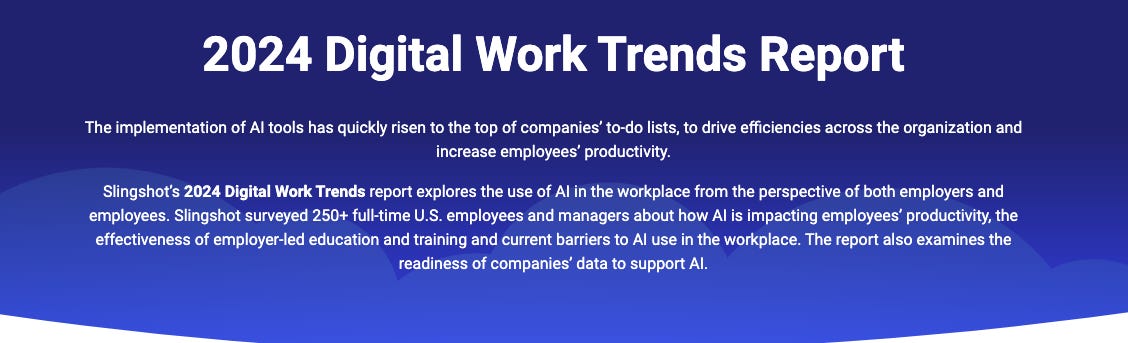
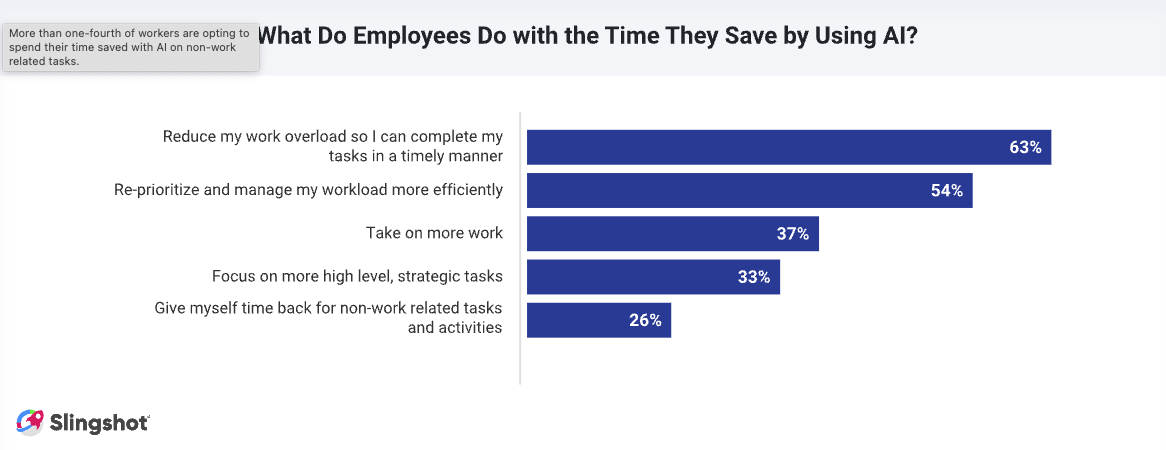
Now we get to dig into Slingshots 2024 Digital Work trends report.. some fascinating items that shows larger trends:
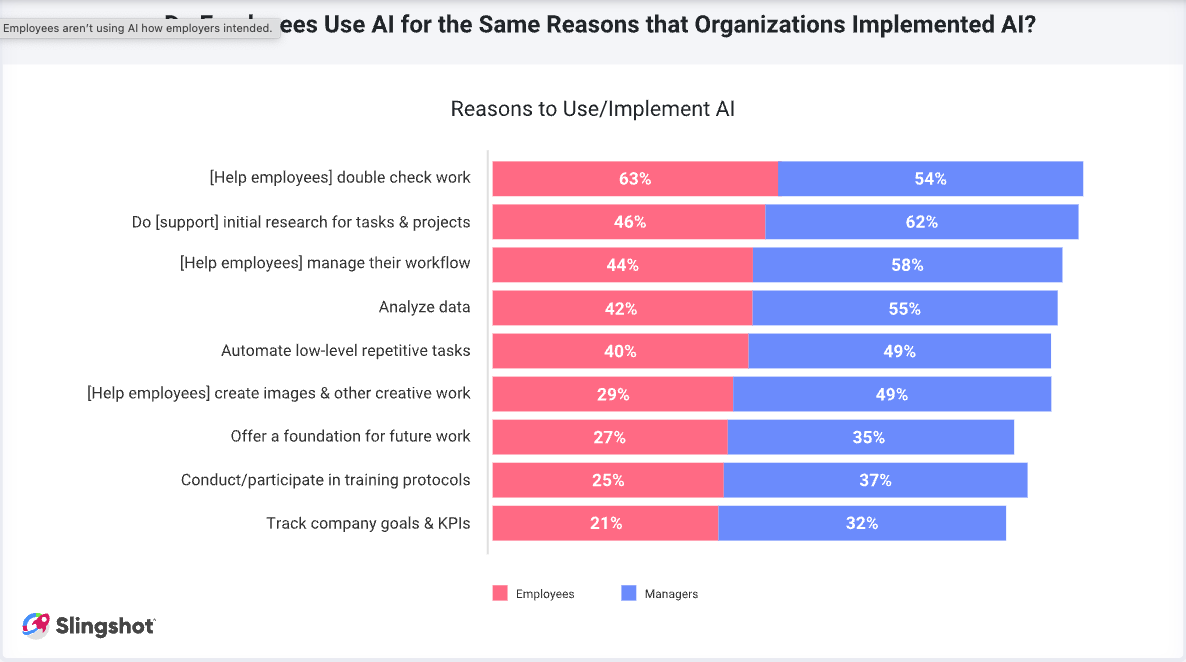
1. AI Usage in Practice vs. Employer Intentions
Most employers aim for AI to streamline tasks, boost data analysis, and manage workflows. However, 63% of employees are primarily using AI to double-check their work rather than for these intended purposes. This discrepancy suggests a need for more transparent AI education and usage guidance within companies.
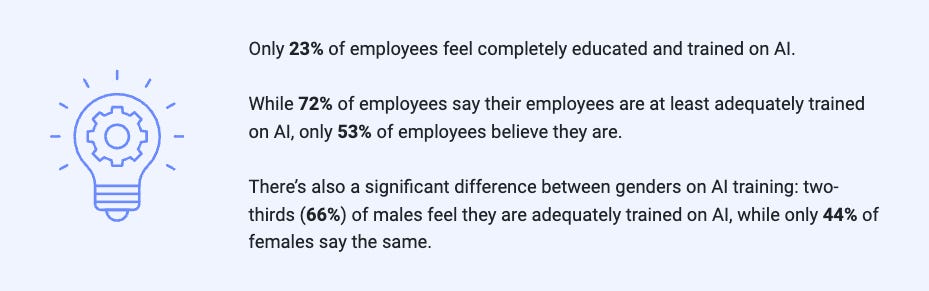
2. Education and Training Gaps
Only 23% of employees feel fully trained on AI, despite 72% of employers believing their teams have adequate AI knowledge. There’s also a gender gap—66% of male employees feel well-trained versus 44% of female employees, indicating potential biases in training accessibility.
3. Perceived Productivity Gains
While 60% of employers see AI as boosting productivity, only 44% of employees agree. Interestingly, 10% of employees report no productivity boost at all, suggesting that many may not be leveraging AI optimally.
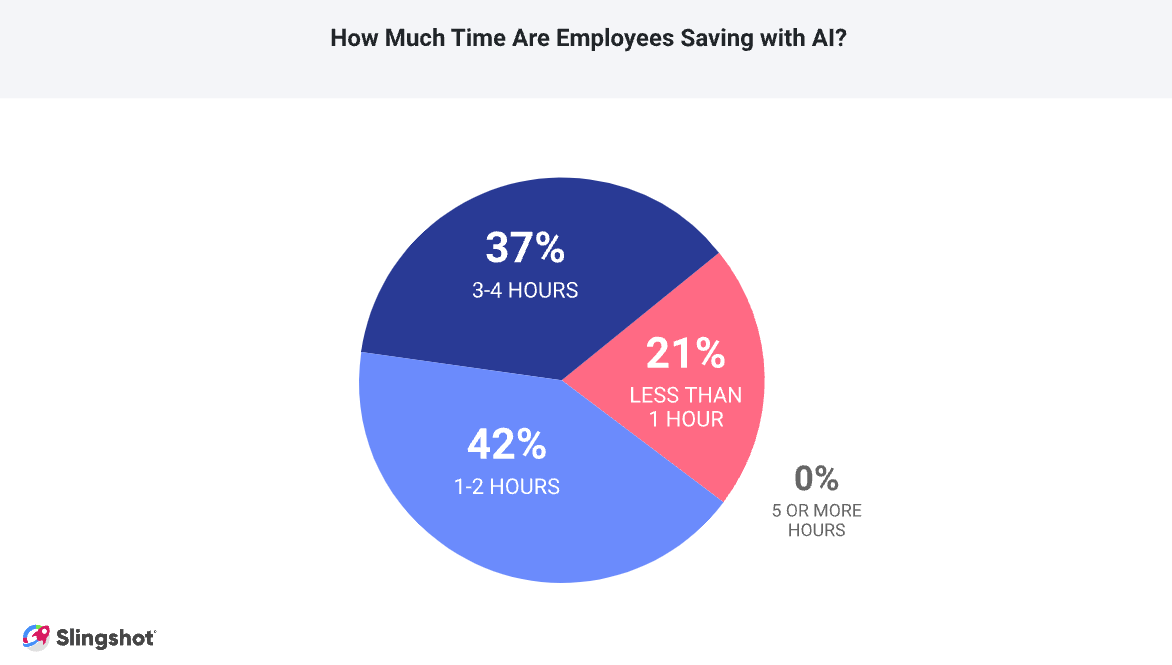
4. Time Savings and Its Usage
AI helps most employees save 1-2 hours daily, with 37% saving 3-4 hours. Employees use this extra time to manage workloads better, yet over a quarter spend it on non-work activities, hinting at potential efficiency gains if AI usage were maximized.
5. Data Readiness as a Barrier
Data readiness remains a critical hurdle for AI adoption, with 45% of employers pointing to siloed, unprepared data as a reason for stalled AI initiatives. Employees also recognize this limitation, with many seeing a need for more training and data accuracy.
Overall, the report underscores a mismatch between AI’s potential and actual utilization in workplaces, largely due to training gaps, differing expectations, and challenges in data readiness.
Cove AI is a sophisticated AI-enhanced workspace designed to transform the way professionals conduct research, organize information, and collaborate. By combining top AI models and offering seamless integration with existing workflows, Cove AI empowers users to dive deep into research, manage content across websites, and create an interactive space for brainstorming and project development. With Cove, professionals can streamline their tasks and bring structure to complex research projects, all within an adaptable, infinite canvas.
Why GTM Professionals Should Care
For GTM professionals, Cove AI offers a powerful solution to tackle in-depth market research, competitive analysis, and customer insights. The platform allows users to collect, organize, and compare information in real-time, providing a centralized, interactive hub for managing all aspects of GTM strategies. With Cove’s ability to integrate with web-based tools, GTM teams can work efficiently, blending AI-driven insights directly into their workflows.
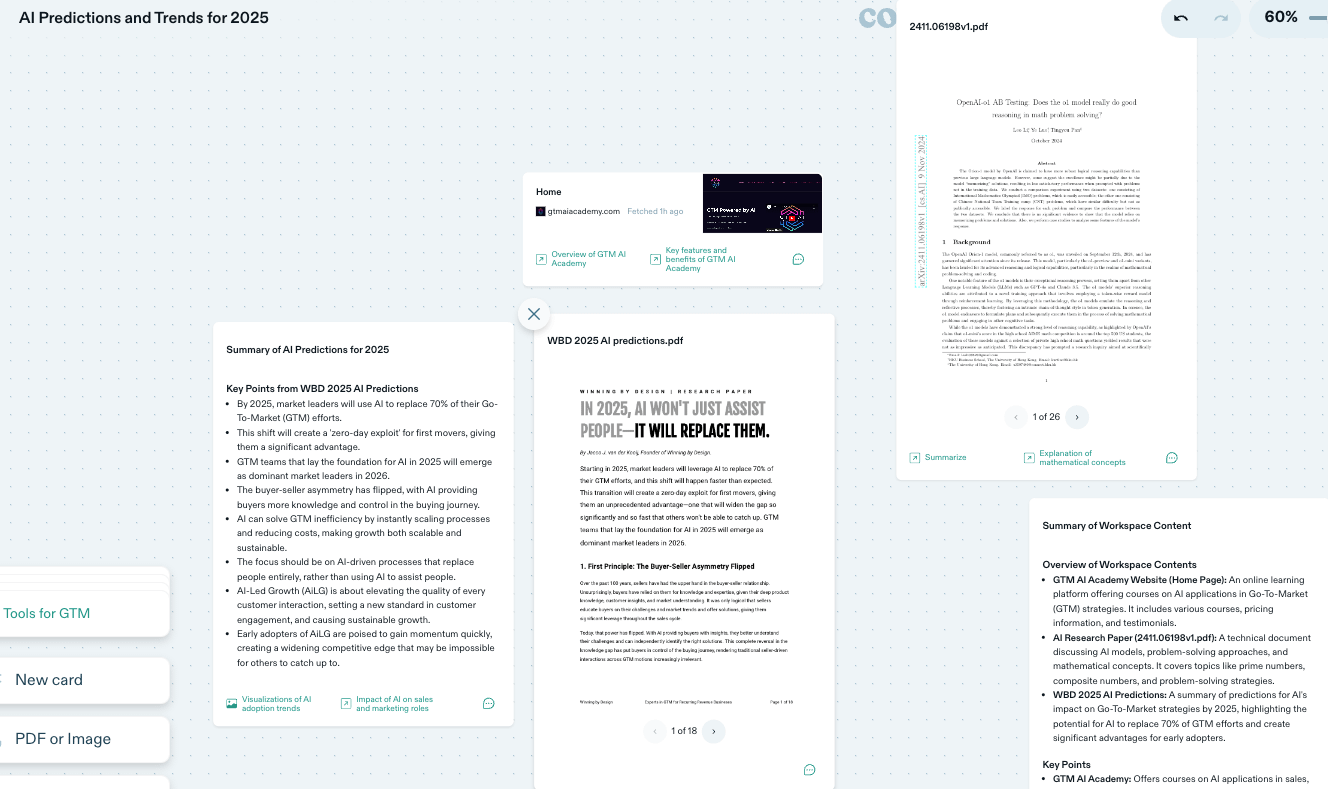
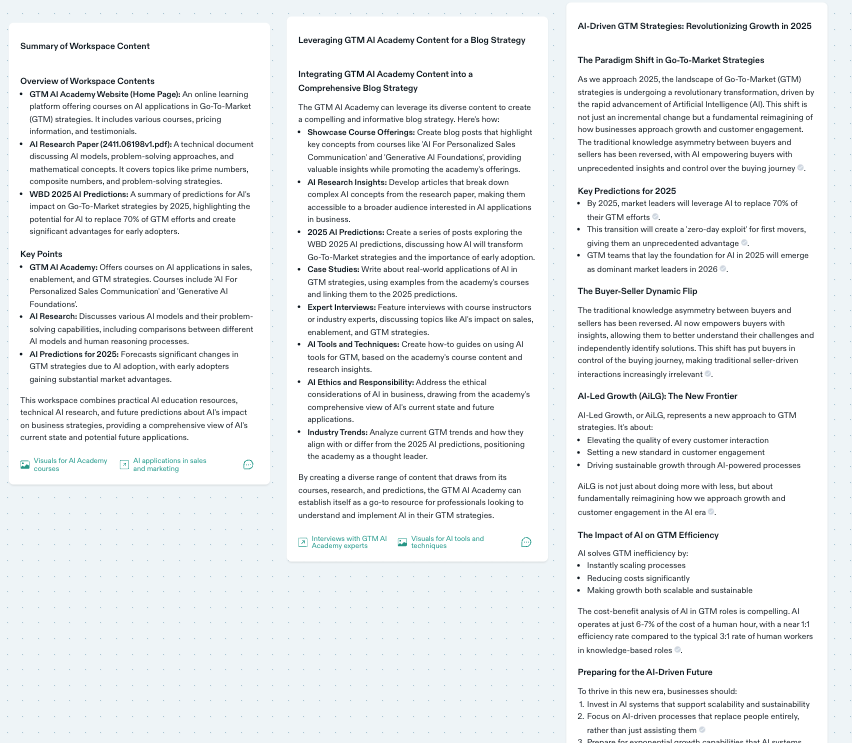
Here is a screenshot of my current workspace, what is cool is you can load in several types of content and get outputs of various kinds, really cool visually.
Conceptual Overview of the Workspace
1. Centralized Knowledge Hub:
• The workspace consolidates key documents, resources, and summaries on complex topics—such as AI predictions and trends, research papers, and organizational overviews. This centralization allows users to keep all relevant information in one place, facilitating easy access to critical insights without the need to switch between multiple applications or sources.
2. Enhanced Research and Summarization Capabilities:
• Advanced AI-powered tools are likely in use here, enabling users to ask complex questions, summarize extensive documents, and get clear, concise answers from research materials. The workspace leverages AI to extract the most relevant insights from long-form content, distilling information into key points or actionable summaries. This capability would be especially useful for quick knowledge assimilation, helping users understand core themes and insights without needing to dive into every detail manually.
3. Visual Organization and Interactive Layout:
• Each document or research item is presented as a visual “card” within an infinite canvas, allowing users to structure their thoughts visually. The layout is modular and expandable, suggesting a flexible space where users can group related content, annotate sections, and create thematic clusters. This type of organization fosters a more intuitive approach to information management, supporting users who think visually and helping teams to arrange their knowledge in ways that mirror their mental models or workflow processes.
4. Real-Time Collaboration and Editable Content:
• The platform likely includes collaborative editing features, allowing team members to add, refine, or update content in real-time. This functionality would support brainstorming, knowledge-sharing, and iterative strategy development. Editable summaries or notes mean that as new information becomes available, teams can continuously refine and evolve their understanding without losing historical context or insights.
5. Cross-Site Data Collection and Comparison:
• There’s an apparent ability to collect, clip, and compare information from multiple sources across the web, creating a seamless flow between external research and internal knowledge management. Users can gather insights from articles, LinkedIn profiles, or PDFs and organize them into structured tables or sections within the workspace. This feature would help teams build a comprehensive view of markets, competitors, or specific topics, with AI helping to standardize and categorize this information efficiently.
6. Proactive AI-Driven Suggestions:
• The workspace is designed to be more than a passive tool; it likely uses AI to suggest next steps, generate new ideas, or prompt deeper exploration based on the context of the current research. This type of proactive assistance encourages users to expand their thinking, explore related topics, and potentially discover insights they hadn’t initially considered. By anticipating user needs, the AI-driven suggestions turn the workspace into a dynamic research partner, guiding users along productive research paths.
7. Integration with Existing Workflows and Tools:
• With seamless compatibility across tools and platforms (e.g., CRM, email, project management), the workspace integrates with existing workflows without requiring additional setup. This integration allows users to directly apply research insights and summaries into operational tools, making it easier to transfer knowledge and action items from research to practical application within business processes.
Conceptual Impacts on Team Dynamics and Workflow
1. Streamlined Knowledge Sharing:
• By bringing all research, insights, and summaries into one shared workspace, teams can easily access and distribute knowledge across departments. This not only speeds up the research phase of any project but also helps align various team members around common insights and objectives.
2. Enhanced Decision-Making and Strategic Planning:
• With instant access to summarized research and AI-generated insights, teams can make data-driven decisions more quickly and confidently. The consolidated view of relevant topics enables leaders to assess risks, identify trends, and strategize based on real-time information, which is particularly valuable in fast-moving industries like tech and AI.
3. Improved Collaboration and Cross-Departmental Alignment:
• The interactive and editable nature of the workspace supports real-time collaboration, enabling different teams (e.g., sales, marketing, enablement) to contribute to and benefit from a shared knowledge base. This alignment helps break down silos, fostering a unified approach to market strategy, customer insights, and overall business goals.
4. Productivity Boost Through Task Automation and AI Suggestions:
• The AI’s ability to summarize, organize, and suggest next steps reduces the manual burden of data processing and interpretation, allowing team members to focus on higher-level tasks and strategy. Automated suggestions and organized summaries mean teams can move through the research phase faster, spend more time on critical analysis, and ensure that nothing important is overlooked.
5. Long-Term Knowledge Retention and Institutional Memory:
• The workspace acts as a living repository for organizational knowledge, capturing past research, insights, and strategies in a format that’s easy to revisit and build upon. This structure supports continuity, even when teams or projects change, creating an invaluable asset for long-term knowledge retention.
Conclusion
Conceptually, the workspace represents a powerful fusion of AI-driven research, collaborative knowledge management, and real-time task optimization. It transforms a traditional research process into an agile, dynamic, and collaborative experience, allowing teams to adapt quickly to new insights, organize their information visually, and drive strategic decision-making with confidence. By integrating advanced AI capabilities with flexible organization and collaboration tools, this workspace empowers GTM professionals and other business units to work smarter, make faster decisions, and innovate with precision.
Practical Applications of Cove AI for GTM Professionals
1. Instant Web Summarization and Analysis: Cove AI allows GTM teams to summarize and analyze web pages, articles, and PDFs in seconds. This can be especially valuable for tracking industry trends, understanding competitors, and gathering data for strategic decision-making. The AI can handle complex queries and provide concise answers to help users keep up with critical information.
2. Cross-Site Content Collection and Comparison: Cove AI enables professionals to collect and compare information across various sites seamlessly. GTM teams can compile LinkedIn profiles, competitor data, or customer insights into organized tables or notes, making it easy to identify patterns and opportunities without jumping between browser tabs.
3. Flexible Editing and Interactive Collaboration: Cove allows users to collaboratively edit content, making it ideal for brainstorming sessions, strategy planning, and content development. This functionality encourages teams to build on each other’s ideas in real-time, all while Cove’s AI assists with precise, context-sensitive edits.
4. Integrated Research Tool: Cove is designed to work alongside existing tools like CRM, email, and docs, with no special integration setup. This versatility means that GTM teams can conduct research and apply insights directly within their preferred platforms, saving time and maintaining consistency across tasks.
5. AI-Powered Suggestions and Idea Generation: Cove AI doesn’t just help organize information; it also anticipates next steps, offering suggestions and insights that can lead users to new research directions or ideas they might not have considered otherwise. This proactive assistance helps GTM professionals stay agile and informed.
6. Visual Organization and Collaboration Spaces: Cove’s canvas functionality allows users to expand into a visual workspace, arranging thoughts and notes in a more structured way. This feature is especially helpful for teams working on complex projects, providing a shared space to build, refine, and review GTM strategies collaboratively.
How Different Teams Can Use Cove AI
1. Sales
• Use Case: Sales teams can use Cove to research prospects, collecting LinkedIn profiles and market insights in one place. The AI’s summarization capabilities allow them to capture key details without spending hours on manual research.
• In Depth: Cove’s ability to aggregate prospect data and provide next-step suggestions helps sales teams develop personalized outreach strategies, making sales interactions more informed and effective.
2. Customer Success
• Use Case: Customer success teams can leverage Cove to manage customer information and feedback, creating a single repository for client insights and follow-up strategies.
• In Depth: Cove allows these teams to store and organize key customer details, track recent engagements, and anticipate potential issues or upsell opportunities, ensuring proactive and consistent customer support.
3. Marketing
• Use Case: Marketing teams can use Cove to research competitors, gather insights from across the web, and create campaign plans collaboratively.
• In Depth: Cove’s cross-site comparison tool and AI-powered content suggestions enable marketing teams to analyze competitor strategies and develop data-driven campaigns, aligning content with customer needs and trends.
4. Enablement
• Use Case: Enablement teams can build structured training materials, organize market insights, and consolidate best practices within Cove’s infinite workspace.
• In Depth: Cove’s visual organization capabilities allow enablement professionals to create comprehensive training resources, pulling together knowledge from across different teams and centralizing it for easy access and dissemination.
5. Business Development
• Use Case: Business Development teams can research partnerships, assess market trends, and create strategic plans using Cove’s AI capabilities.
• In Depth: Cove’s research and organization tools enable BD teams to compile insights on potential partners and market opportunities, helping them make data-backed decisions that drive growth.
6. HR
• Use Case: HR teams can use Cove to organize candidate profiles, gather insights on hiring trends, and create collaborative onboarding materials.
• In Depth: Cove provides HR teams with a structured space to manage hiring and onboarding processes, helping them efficiently organize candidate information and develop tailored onboarding plans for new hires.
Pros and Cons of Cove AI
Pros
• Advanced Research Capabilities: Cove’s combination of powerful AI models (ChatGPT, Claude, Meta, and Perplexity) provides a rich, versatile research tool that can answer questions, summarize information, and offer insights.
• Interactive, Collaborative Editing: Cove’s content is editable by both users and the AI, creating an interactive workspace where ideas can evolve dynamically.
• Seamless Integration with Existing Tools: Cove functions smoothly alongside other web tools and platforms, making it adaptable to existing workflows without requiring special integration.
Cons
• Initial Setup for Customization: Getting the most out of Cove may require some initial customization and setup, which can be a time investment for larger teams.
• Learning Curve for Advanced Features: Users may need to familiarize themselves with Cove’s more complex features to fully utilize its capabilities, especially in cross-team workflows.
Conclusion
Cove AI is a dynamic, AI-powered workspace designed to transform the way GTM professionals conduct research, collaborate, and strategize. Its ability to interact with web content, suggest ideas, and organize information visually makes it a valuable tool for professionals who need a comprehensive, flexible platform to drive their goals. By blending powerful AI models, seamless web integration, and collaborative editing capabilities, Cove AI empowers teams across sales, marketing, customer success, and more to work smarter, faster, and more creatively.
That is all for this newsletter, let me know what you think!