

We dig in again this week for a really fun GTM AI Podcast with my man who is the Founder and CEO of Thrivestack.ai:
Gururaj Pandurangi
Today we will deep dive into his inbound engine and you will get:
1-Newsletter Led playbook for SaaS
2-Growth Playbook inspired by this podcast
Lets dig in!
You can go to Youtube, Apple, Spotify as well as a whole other host of locations to hear the podcast or see the video interview.
The $800K Analytics Tax (And the Bootstrapped Founder Who Deleted It)
Most B2B SaaS founders are paying $300K to $800K per year on analytics tools that don’t talk to each other. Marketing analytics. Product analytics. Sales analytics. Billing analytics. Customer success analytics. Five tools. Zero correlation. And then they hire RevOps to duct-tape it all together.
Guru has done this dance twice before. Two venture-backed startups, both acquired (the last one by Zscaler), and both times he watched 60-65% of all spend get torched on GTM with no way to connect the dots between a newsletter click and a closed deal. His third company, ThriveStack.AI, is fully bootstrapped. And the way he’s running GTM should make every funded startup uncomfortable.
Here’s what he showed us on this week’s GTM AI Podcast:
1) AI SDRs are a money pit. Education-first content is the play.
Guru’s team tried the usual suspects. Artisan. 11X. Instantly with OpenAI. Pure outbound. The result: open rates tanked, clicks tanked, and they hemorrhaged cash on email deliverability. So they killed it.
Instead, they built a newsletter engine that sends AI-generated content to 200K-350K contacts weekly through Brevo. The entire content operation runs on AI. But the strategy is human.
The workflow:
Cold newsletter goes out weekly (educational, not pitch)
Anyone who opens gets auto-added to a warm sequence
Warm sequence delivers problem-specific education (marketing correlation, product analytics)
CTAs point directly into the product in demo mode, personalized with the reader’s email
After 7-8 weeks of engagement, a hyper-personalized outbound message hits
The numbers are staggering. 40-50% of recipients still open emails after 5 weeks. The personalized outbound to these warm readers? 90% open rate. 15-20% click rate. And 80% of those sign up to the product without ever needing a demo. Total email channel spend: $3.5K. ROI: 551%. Seven closed deals.
2) The real leverage is signal unification, not more tools.
Here’s the insight most GTM leaders miss. The problem is not that you need better tools. The problem is your tools are blind to each other.
ThriveStack correlates the marketing visitor ID to the product user ID to the billing account to the CS signals. In real time. When someone clicks a newsletter CTA, the product already knows who they are. When they sign up, the system already has their full marketing journey. When they start paying through Stripe or ChargeBee, that revenue connects back to the original campaign.
Guru showed a live example: one campaign generated visitors from Cisco (38,000 sessions over a few months), and ThriveStack could trace the exact path from first newsletter open to product activation to payment. No RevOps team required. No $800K analytics stack.
3) Churn is predictable if you track account movement, not just usage metrics.
This was the most tactical part of the episode. ThriveStack tracks accounts through five stages: non-activated, activated, active, dormant, churned. The team found a tipping point. After 3 months of active use, accounts start going dormant. If you intervene before dormancy, you recover them. After dormancy, you lose them.
The data across 50+ customers:
15-20% acceleration in conversions from right-timed interventions
23-26% reduction in churn by intervening before the active-to-dormant shift
The product pays for itself on churn reduction alone
4) A lean team with AI builds faster than a funded team without it.
Guru’s team achieved a 30-40% reduction in headcount over 4-5 months using AI for product development. They use Claude Code and Cursor for backend, database, and API work. For frontend mocks and UI, they switched to Google AI Studio, which they found produces higher fidelity output with simpler prompts. One live product page was built in 2.5 hours with Google AI Studio.
The takeaway: they are a fully bootstrapped company shipping at the speed of a well-funded team, because AI replaced the roles, not just the tasks.
The tactical shift:
Stop treating GTM as a funnel of disconnected tools. Start treating it as a single signal stream from first touch to renewal.
What to do this week:
Audit how many analytics tools your company pays for that don’t share data with each other (the answer will hurt)
Test a newsletter-to-product pipeline: send educational content, point CTAs into your product, track who engages for 4+ weeks before doing outbound
Map your customer lifecycle stages and identify the tipping point between active and dormant (it’s probably around month 3)
The founders spending $800K on disconnected analytics are funding their competitor’s advantage. The ones unifying signals on a $3.5K email budget are closing deals.
For Guru’s own playbook on creating newsletters that drive conversions go enjoy
The Content-to-Pipeline Playbook
How a Bootstrapped Founder Replaced AI SDRs with a $3.5K Newsletter Engine (551% ROI)
Guru burned through two VC-backed startups watching 60-65% of all spend evaporate on GTM. Both got acquired. Both left him with the same problem: five analytics tools, zero correlation between a marketing click and a closed deal.
His third company, ThriveStack.AI, is fully bootstrapped. No VC pressure. No “grow at all costs.” And the GTM engine he built on a $3.5K email budget is outperforming what his funded competitors spend $800K to replicate.
He broke the entire system down on this week’s GTM AI Academy. This playbook gives you the exact architecture, metrics, and implementation sequence.
The Problem: The $800K Analytics Tax
Here’s the pattern every growing B2B SaaS company repeats:
$0-$500K ARR: Buy marketing analytics (Google Analytics, HockeyStack). Focus on acquisition.
$500K-$1M ARR: Add product analytics + sales CRM. Three tools. None connected.
$1M-$3M ARR: Churn kicks in. Add billing + CS tools. Now you’re at $300K-$400K/year on 4-5 analytics tools that still don’t talk to each other.
$3M+ ARR: Hire RevOps. Buy ETLs. Build dashboards. Total analytics spend: $800K+. Investors ask about growth efficiency. Nobody can answer because marketing tells one story, product tells another, sales tells a third, and customer success is always surprised by churn.
The core failure: nobody can connect a newsletter click to a closed deal.
The Fix: The 5-Stage Warm Pipeline Engine
This is the exact system that generates 551% ROI on a $3.5K email spend and gets buyers 80% of the way to purchase before a single demo call.
Stage 1: Cold Newsletter (Weekly)
AI-generated educational content sent to 200K-350K contacts. Not a pitch. Not outbound. Pure education on specific problems your product solves.
The content answers questions like: “How do I correlate marketing spend to revenue?” or “How do I detect churn before it happens?” Every piece is built with AI. The strategy behind it is human.
Tool: Brevo (or SendGrid). Cadence: Weekly. Cost: ~$3.5K/month for 200K+ sends.
Stage 2: Auto-Warm Sequence (48hr trigger)
Anyone who opens the cold newsletter gets auto-added to a warm contact list. 48 hours later, they receive the first warm email. Then another 7 days later. Then another.
Each email delivers progressively deeper educational content. CTAs point into two places: your marketing site and your product (in demo mode).
Key metric: 40-50% of recipients still open emails after 5 weeks.
Stage 3: Product Demo Mode (CTA destination)
This is where most companies blow it. They send people to a landing page or a “book a demo” form.
Instead, CTAs point directly into the product, pre-loaded in demo mode with the reader’s email already populated. When they click, they land in a personalized product experience. No signup form. No friction. No gate.
Behind the scenes, the system auto-enriches them: company, title, pain points, which content they consumed. By the time they explore the product, you already know everything about them.
Stage 4: Signal Tracking (Continuous)
Every interaction is tracked and correlated:
Which emails opened (and when)
Which CTAs clicked
Which product pages visited
How long spent in each section
Which features explored
Whether they hit the pricing page
By week 4-5, you have a complete behavioral profile that connects marketing engagement to product interest.
Stage 5: Hyper-Personalized Outbound (Week 7-8)
After 7-8 weeks of engagement, send one message. Not a template. A personalized note:
“You’re [name] at [company]. You’ve read our content on [specific topics]. You explored [specific features]. Would you want to talk? Here’s my Calendly.”
The numbers on this final-stage outbound:
90% open rate
15-20% click rate
80% sign up to the product without ever needing a demo
Only 20% request a conversation, and when they do, they say: “I just need to show this to my champion”
You’re entering the deal at the bottom of the funnel. The buyer is pre-sold.
Why AI SDRs Failed (The Expensive Lesson)
Guru’s team tried the obvious plays first:
Artisan (AI SDR platform)
11X (AI SDR platform)
Instantly + OpenAI (DIY outbound)
The result: open rates tanked, click rates tanked, and they wasted significant budget on email deliverability infrastructure. Pure AI-powered outbound to cold audiences does not work the way the vendors promise.
The lesson: AI is not the strategy. AI is the content engine that fuels the strategy. The strategy is building trust through repeated, genuine value delivery until the buyer self-selects into your product.
The Signal Unification Model
The real competitive advantage is not better marketing or better sales. It is connecting signals that every other company keeps in separate tools.
The 5 signal layers you need to connect:
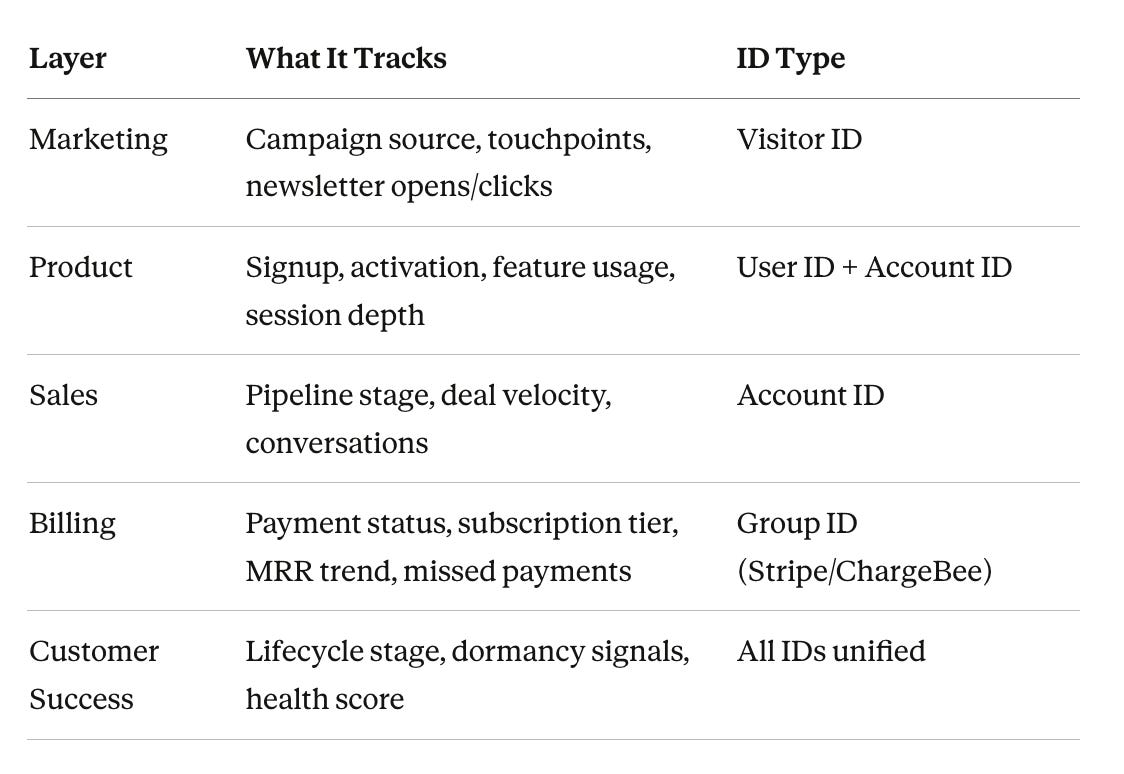
The correlation chain:
Newsletter Click (Visitor ID) → Product Signup (User ID) → Account Created (Account ID) → Payment Made (Group ID) → Revenue Attributed (Campaign ROI)
When these IDs are mapped together, you trace a single newsletter open all the way to closed revenue. Guru showed this live: one campaign generated visitors from Cisco (38,000 sessions), and ThriveStack traced the exact path from first newsletter open to product activation to payment. No RevOps team required.
The Churn Intervention Playbook
Across 50+ B2B SaaS customer data points, a consistent pattern emerged. There are five account stages, and the intervention window between “active” and “dormant” is where you save or lose the customer.
The 5 account lifecycle stages:
Non-Activated — Signed up, hasn’t completed setup
Activated — Completed setup, starting to use the product (the “aha moment” zone)
Active (first 3 months) — Regular weekly engagement. Healthy state.
Dormant (THE DANGER ZONE) — Usage drops below weekly. Not logging in monthly. Still paying, but heading toward churn.
Churned — Gone. If you’re intervening here, you’re too late.
The tipping point rule: There is a measurable tipping point between Active and Dormant. For most B2B SaaS products, it hits around month 3 post-conversion when weekly usage starts declining. Intervene before this point and you recover the customer. Intervene after and recovery rates collapse.
The results:
15-20% acceleration in conversions from right-timed interventions during onboarding
23-26% reduction in churn from proactive intervention before the active-to-dormant shift
The product pays for itself on churn reduction alone
The Lean AI Tech Stack
Guru’s entire product is built by a small team that achieved a 30-40% reduction in headcount over 5 months using AI.
Their stack for building:
Backend/APIs/Database: Claude Code + Cursor (connected to GitHub)
Frontend mocks/UI: Google AI Studio (they found it produces higher fidelity output with simpler prompts than other tools for frontend work)
One live product page: Built in 2.5 hours with Google AI Studio
Their stack for GTM:
Email campaigns: Brevo (~$3.5K/month)
Content generation: AI (various models)
Signal unification: ThriveStack (their own product, but you can build with analytics + ETL)
Billing correlation: Stripe/ChargeBee API
Total estimated cost for the content-to-pipeline engine: under $500/month. Compare that to the $800K analytics tax.
Your Implementation Sequence
Week 1: Audit your signal gaps. List every analytics tool you pay for. Map which ones share data. Calculate total annual spend. Document where the ID chain breaks between marketing and revenue.
Week 2: Build the content engine. Choose an email platform. Build your ABM contact list. Use AI to generate educational newsletter content (not pitches). Set up weekly sends. Create a warm sequence triggered by opens (48hr delay, then weekly).
Week 3: Connect content to product. Build a demo mode for your product. Point newsletter CTAs into the product (not a landing page). Pass the reader’s email through the CTA URL for personalization. Set up tracking to connect marketing visitor ID to product user ID.
Week 4: Instrument your lifecycle. Define your 5 account stages. Set telemetry triggers for each stage transition. Identify your “aha moment.” Track weekly active usage. Flag accounts dropping below threshold. Build an intervention workflow for the active-to-dormant transition.
Weeks 5-8: Activate warm outbound. Wait for 4+ weeks of engagement data. Identify contacts who opened 3+ emails and clicked into the product. Send hyper-personalized outbound referencing their specific content engagement. Measure ROI: channel spend vs. attributed revenue.
The Bottom Line
The founders spending $800K on disconnected analytics are funding their competitor’s advantage. The ones unifying signals on a $3.5K email budget are closing deals before the demo even happens.
Stop selling to cold audiences. Educate them for 8 weeks. Let them self-select into your product. By the time they talk to sales, they’re already sold.
Based on the GTM AI Podcast episode with Guru, Founder & CEO of ThriveStack.AI